
[2026 Outlook] Plan Ahead! Share the Investment Opportunities You Are Optimistic About

2026 Outlook | Moving Away from Hype, Embracing Reality: Quantum Computing Enters the 'Validation Year' – Who Will Breakthrough First?
Fellow investors, as we face a brand-new 2026, instead of anxiously chasing trends, it's better to calmly understand the direction. Stay tuned.@Niuniu Classroomto unlock your investment roadmap in real time. In the new year, let’s stay calm and patient, proceed steadily for long-term success, and slowly grow our wealth together.
By 2025, quantum computing-related stocks will officially leave the 'niche track' and enter the spotlight of mainstream investors with a strong presence. As technological bottlenecks are overcome, the capital market is starting to reevaluate the disruptive potential of this technology.
Entering 2026, competition among global quantum giants will shift from performance testing of individual chips to a comprehensive 'system-level' confrontation. According to industry analysts’ forecasts for 2026,Global quantum computing revenue is expected to reach approximately $2 billion by 2026,The defense and aerospace sectors are becoming key drivers of adoption and growth.
At the CES conference earlier this year, IBM also indicated that the quantum computing industry would see the emergence of 'strong quantum advantage claims' this year, marking a potential turning point in the race to prove that quantum computers can outperform classical systems on practical problems.
Has the 'Golden Age' of quantum computing arrived? This article will delve into the core tracks of the industry and review a list of promising stocks most worthy of attention by fellow investors, ensuring you don't miss the next big tech trend.
What does the future hold for the quantum computing sector?
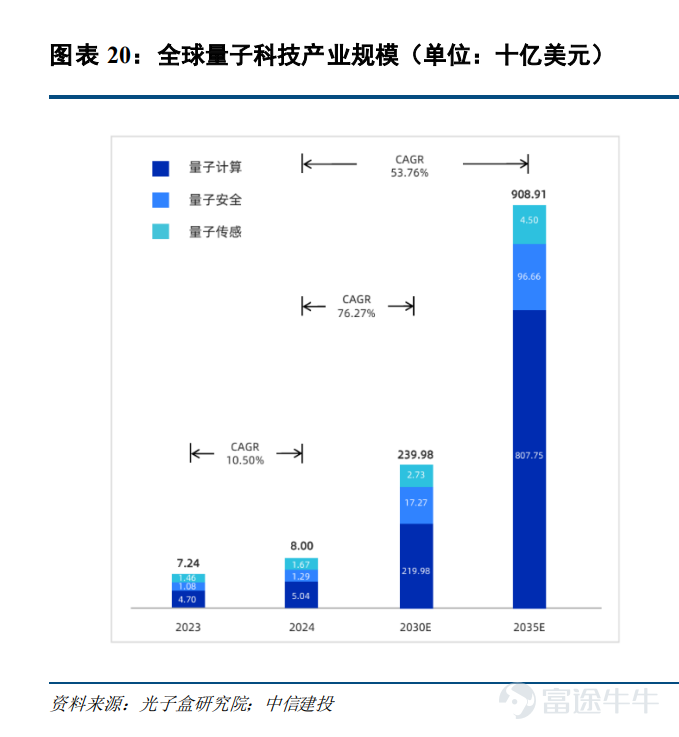
According to data provided by ICV, an international cutting-edge technology consulting firm, and the Photonics Box Research Institute, in 2024, the overall scale of the global quantum technology industry reached $8 billion. By region, North America accounts for 31.45%, Europe 26.91%, China 24.03%, the Asia-Pacific region (excluding China) 12.74%, and other regions 4.87%.
ICV forecasts that the global quantum technology industry’s compound annual growth rate (CAGR) from 2024 to 2030 will reach 76.27%. By 2035, the total scale of the quantum industry is expected to reach $908.91 billion, of which quantum computing will account for $807.75 billion.
![Fellow investors, as we face a brand-new 2026, instead of anxiously chasing trends, it's better to calmly understand the direction. Stay tuned.[Share Link: @Niuniu Classroom]to unlock your investment roadmap in real time. In the new year, let’s stay calm and patient, proceed steadily for long-term success, and slowly grow our wealth together. By 2025, quantum computing-related stocks will officially leave the 'niche track' and enter the spotlight of mainstream investors with a strong presence. As technological bottlenecks are overcome, the capital market is starting to reevaluate the disruptive potential of this technology. Entering 2026, competition among global quantum giants will shift from performance testing of individual chips to a comprehensive 'system-level' confrontation. According to industry analysts’ forecasts for 2026,Global quantum computing revenue is expected to reach approximately $2 billion by 2026,The defense and aerospace sectors are becoming key drivers of adoption and growth. At the CES conference earlier this year, IBM also indicated that the quantum computing industry would see the emergence of 'strong quantum advantage claims' this year, marking a potential turning point in the race to prove that quantum computers can outperform classical systems on practical problems. Has the 'Golden Age' of quantum computing arrived? This article will delve into the core tracks of the industry and review a list of promising stocks most worthy of attention by fellow investors, ensuring you don't miss the next big tech trend. What does the future hold for the quantum computing sector? According to data provided by ICV, an international cutting-edge technology consulting firm, and the Photon Box Research Institute, in 2024, globally...](https://nnqimage.futunn.com/sns_client_feed/900080/20260113/web-1768310758173-WECM38vU56.png/big?area=1&is_public=true&imageMogr2/ignore-error/1/format/webp)
Notably, major countries around the world are increasing their strategic focus on quantum technologies, accelerating efforts to seize development opportunities; quantum technology has become a new arena for global competition.
China's '15th Five-Year Plan' has listed quantum technology as the top future industry,with the Ministry of Industry and Information Technology taking the lead in establishing a quantum information standardization technical committee, which has preliminarily clarified the blueprint for the development of the quantum technology industry.
Meanwhile, across the ocean,the Trump administration’s industrial policy is also undergoing a significant shift.In October last year, reports emerged that the U.S. was actively expanding its intervention in key technological fields, planning to emulate the model of investing in Intel,by injecting federal funds in exchange for equity stakes in several quantum computing companies.
According to CITIC Securities, countries are accelerating the R&D and application of quantum technologies through policy guidance, funding support, research collaboration, and other means. The global competition in quantum technology is showing a multipolar and high-intensity trend. Each technological breakthrough and policy implementation is reshaping the global competitive landscape in the quantum field, driving quantum technology toward deeper levels and wider applications, and injecting new momentum into global technological competition and industrial transformation.
Which companies are worth watching?
By 2026, the main players on the grand stage of quantum technology can be summarized as:the steadily advancing 'three giants,' the bold 'quantum four heroes,' and the strategically minded NVIDIA.Our fellow investor has compiled a list of quantum computing concept stocks in the U.S. market for investors’ reference:
![Fellow investors, as we face a brand-new 2026, instead of anxiously chasing trends, it's better to calmly understand the direction. Stay tuned.[Share Link: @Niuniu Classroom]to unlock your investment roadmap in real time. In the new year, let’s stay calm and patient, proceed steadily for long-term success, and slowly grow our wealth together. By 2025, quantum computing-related stocks will officially leave the 'niche track' and enter the spotlight of mainstream investors with a strong presence. As technological bottlenecks are overcome, the capital market is starting to reevaluate the disruptive potential of this technology. Entering 2026, competition among global quantum giants will shift from performance testing of individual chips to a comprehensive 'system-level' confrontation. According to industry analysts’ forecasts for 2026,Global quantum computing revenue is expected to reach approximately $2 billion by 2026,The defense and aerospace sectors are becoming key drivers of adoption and growth. At the CES conference earlier this year, IBM also indicated that the quantum computing industry would see the emergence of 'strong quantum advantage claims' this year, marking a potential turning point in the race to prove that quantum computers can outperform classical systems on practical problems. Has the 'Golden Age' of quantum computing arrived? This article will delve into the core tracks of the industry and review a list of promising stocks most worthy of attention by fellow investors, ensuring you don't miss the next big tech trend. What does the future hold for the quantum computing sector? According to data provided by ICV, an international cutting-edge technology consulting firm, and the Photon Box Research Institute, in 2024, globally...](https://nnqimage.futunn.com/sns_client_feed/900080/20260113/web-1768310841401-K364Y7TKnq.png/big?area=1&is_public=true&imageMogr2/ignore-error/1/format/webp)
 The three giants — Google, IBM, Microsoft
$Alphabet-A (GOOGL.US)$ : Following the release of the Willow processor with 105 physical qubits by the end of 2024, Google officially announced the achievement of 'verifiable quantum advantage' in October 2025.
In building its ecosystem, Google has adopted a strategy of 'strong alliances': on one hand, deeply integrating NVIDIA’s CUDA-Q platform to precisely address noise issues in next-generation processors through large-scale simulations; on the other hand, actively expanding its global influence by entering into a strategic partnership with the UK National Quantum Computing Centre (NQCC), providing cloud access to the Willow chip to secure algorithm pricing power in cutting-edge fields like materials science.
According to data from the Photonics Box Research Institute, Google gained an early lead in 2025 with the Willow processor, and 2026 will be the engineering year dedicated to solving energy consumption bottlenecks in quantum cooling systems and addressing system integration complexity.
![Fellow investors, as we face a brand-new 2026, instead of anxiously chasing trends, it's better to calmly understand the direction. Stay tuned.[Share Link: @Niuniu Classroom]to unlock your investment roadmap in real time. In the new year, let’s stay calm and patient, proceed steadily for long-term success, and slowly grow our wealth together. By 2025, quantum computing-related stocks will officially leave the 'niche track' and enter the spotlight of mainstream investors with a strong presence. As technological bottlenecks are overcome, the capital market is starting to reevaluate the disruptive potential of this technology. Entering 2026, competition among global quantum giants will shift from performance testing of individual chips to a comprehensive 'system-level' confrontation. According to industry analysts’ forecasts for 2026,Global quantum computing revenue is expected to reach approximately $2 billion by 2026,The defense and aerospace sectors are becoming key drivers of adoption and growth. At the CES conference earlier this year, IBM also indicated that the quantum computing industry would see the emergence of 'strong quantum advantage claims' this year, marking a potential turning point in the race to prove that quantum computers can outperform classical systems on practical problems. Has the 'Golden Age' of quantum computing arrived? This article will delve into the core tracks of the industry and review a list of promising stocks most worthy of attention by fellow investors, ensuring you don't miss the next big tech trend. What does the future hold for the quantum computing sector? According to data provided by ICV, an international cutting-edge technology consulting firm, and the Photon Box Research Institute, in 2024, globally...](https://nnqimage.futunn.com/sns_client_feed/900080/20260113/web-1768310758478-u4lMnkUNAc.png/big?area=1&is_public=true&imageMogr2/ignore-error/1/format/webp)
In 2026, Google is expected to refine its surface code error-correction solution, transitioning from single experimental breakthroughs to stable systemic gains. The goal is to build a prototype capable of running millions of gate operations continuously without logical collapse. Meanwhile, Google is exploring ways to reduce wiring load for quantum processors operating in extremely low-temperature environments. The real-time error correction capabilities of the Willow chip will be integrated into Google's broader quantum cloud ecosystem in 2026, aiming to provide hardware acceleration for specific AI research.
$IBM Corp (IBM.US)$:Last year, IBM claimed to have found a 'feasible path' to construct the world’s first large-scale 'fault-tolerant' quantum computer by 2030, which is projected to operate at 20,000 times the capacity of current quantum computers. They also released and delivered the 120-qubit processor codenamed 'Nighthawk,' which uses next-generation tunable couplers, improving computational performance by approximately 20% over the previous generation 'Heron.' Additionally, IBM introduced the experimental chip 'Loon' to test the stability of large-scale fault-tolerant components.
According to data from the Photonics Box Research Institute,IBM has positioned 2026 as a key milestone for 'scalable systems.'IBM believes that future quantum computers will not consist of a single chip but rather a distributed processing center connected through quantum interconnect technologies (L-couplers).
![Fellow investors, as we face a brand-new 2026, instead of anxiously chasing trends, it's better to calmly understand the direction. Stay tuned.[Share Link: @Niuniu Classroom]to unlock your investment roadmap in real time. In the new year, let’s stay calm and patient, proceed steadily for long-term success, and slowly grow our wealth together. By 2025, quantum computing-related stocks will officially leave the 'niche track' and enter the spotlight of mainstream investors with a strong presence. As technological bottlenecks are overcome, the capital market is starting to reevaluate the disruptive potential of this technology. Entering 2026, competition among global quantum giants will shift from performance testing of individual chips to a comprehensive 'system-level' confrontation. According to industry analysts’ forecasts for 2026,Global quantum computing revenue is expected to reach approximately $2 billion by 2026,The defense and aerospace sectors are becoming key drivers of adoption and growth. At the CES conference earlier this year, IBM also indicated that the quantum computing industry would see the emergence of 'strong quantum advantage claims' this year, marking a potential turning point in the race to prove that quantum computers can outperform classical systems on practical problems. Has the 'Golden Age' of quantum computing arrived? This article will delve into the core tracks of the industry and review a list of promising stocks most worthy of attention by fellow investors, ensuring you don't miss the next big tech trend. What does the future hold for the quantum computing sector? According to data provided by ICV, an international cutting-edge technology consulting firm, and the Photon Box Research Institute, in 2024, globally...](https://nnqimage.futunn.com/sns_client_feed/900080/20260113/web-1768310758792-09HDYqWhc6.png/big?area=1&is_public=true&imageMogr2/ignore-error/1/format/webp)
In 2026, IBM will deploy a modular system based on the 'Kookaburra' processor. This processor will introduce the first complete modular architecture, combining quantum memory units with computing logic. It aims to achieve computational quality with 7,500 gate operation depth across 360 qubits. The focus is on verifying the efficiency of microwave cable connections between chips, marking a crucial step toward the 'Starling' system with 200 logical qubits by 2029.
IBM plans to demonstrate the first scientifically significant instance of quantum advantage by 2026, with a focus on high-fidelity molecular modeling and materials science.
$Microsoft (MSFT.US)$:Microsoft released its first quantum chip, 'Majorana 1,' based on topological superconductor materials in February 2025. This product marks the transition of Microsoft's long-term investment in topological quantum computing from theoretical research to hardware prototyping.
Microsoft previously proposed a fault-tolerant quantum computing roadmap based on Majorana topological qubits (tetrons), spanning four generations of devices: single-qubit measurement benchmarks, two-qubit Clifford gate operations, eight-qubit quantum error correction demonstrations, and multi-qubit arrays supporting lattice surgery. This architecture, centered around measurement, has the potential to achieve scalable quantum computing with low error rates and represents a key blueprint for practical quantum computing.
![Fellow investors, as we face a brand-new 2026, instead of anxiously chasing trends, it's better to calmly understand the direction. Stay tuned.[Share Link: @Niuniu Classroom]to unlock your investment roadmap in real time. In the new year, let’s stay calm and patient, proceed steadily for long-term success, and slowly grow our wealth together. By 2025, quantum computing-related stocks will officially leave the 'niche track' and enter the spotlight of mainstream investors with a strong presence. As technological bottlenecks are overcome, the capital market is starting to reevaluate the disruptive potential of this technology. Entering 2026, competition among global quantum giants will shift from performance testing of individual chips to a comprehensive 'system-level' confrontation. According to industry analysts’ forecasts for 2026,Global quantum computing revenue is expected to reach approximately $2 billion by 2026,The defense and aerospace sectors are becoming key drivers of adoption and growth. At the CES conference earlier this year, IBM also indicated that the quantum computing industry would see the emergence of 'strong quantum advantage claims' this year, marking a potential turning point in the race to prove that quantum computers can outperform classical systems on practical problems. Has the 'Golden Age' of quantum computing arrived? This article will delve into the core tracks of the industry and review a list of promising stocks most worthy of attention by fellow investors, ensuring you don't miss the next big tech trend. What does the future hold for the quantum computing sector? According to data provided by ICV, an international cutting-edge technology consulting firm, and the Photon Box Research Institute, in 2024, globally...](https://nnqimage.futunn.com/sns_client_feed/900080/20260113/web-1768310758479-yFZJ2vkoKA.png/big?area=1&is_public=true&imageMogr2/ignore-error/1/format/webp) The Quantum Four — IonQ, Rigetti, D-Wave, QUBT
The Quantum Four — IonQ, Rigetti, D-Wave, QUBTIn 2025, Rigetti, IonQ, D-Wave, and Quantum Computing are racing to turn quantum theory into real machines, aiming to solve problems that today's computers cannot address, with artificial intelligence potentially playing a supporting role.
Art Hogan, Chief Market Strategist at B. Riley Wealth, stated that while major tech companies like IBM and Google are also involved in quantum computing, the four companies primarily targeted by traders have been collectively dubbed the 'Quantum Four' by the market.
$Rigetti Computing (RGTI.US)$This company is a vertically integrated superconducting quantum enterprise, covering chip design, Fab-1 factory manufacturing, QPU sales, and cloud services.According to CITIC Securities, in Q2 2025, the company launched Aspen-M136, the industry's first 3-chip modular interconnected quantum computer (136 physical qubits), achieving single-qubit gate fidelity of 99.8% and two-qubit gate fidelity of 99.4%. During the same period, it completed a $350 million equity financing round, bringing its cash reserves to over $570 million. It was also selected for DARPA’s quantum network benchmarking program, receiving $5.48 million in funding to develop multi-chip quantum interconnects and fault-tolerance benchmarking technologies, advancing the small-chip scalability pathway.
$IonQ Inc (IONQ.US)$Specializing in the trapped-ion quantum route, this company distributes high-fidelity systems via cloud platforms like AWS and Azure.According to CITIC Securities, in 2024, the company launched the Aria1 processor (25 physical qubits) and upgraded to the Aria2 processor (29 physical qubits, single-qubit gate fidelity of 99.92%, and two-qubit gate fidelity of 99.7%) in Q1 2025. Throughout the year, it continued expanding applications in defense and finance sectors, securing federal funding through procurement agreements and R&D grants from the U.S. Department of Defense and Department of Energy. Its technology, centered on high fidelity as a core advantage, reduces enterprise adoption barriers via cloud services. In Q1 2025, total bookings grew 120% year-over-year, and revenue increased 95% year-over-year, maintaining rapid growth momentum.
According to data from the Photon Box Research Institute, IonQ will launch the Tempo system in 2026, targeting 64 algorithmic qubits (AQ 64) and beginning deployment of a 256 physical qubit system. The core advantage lies in leveraging its ultra-high fidelity of 99.99% to run deeper circuits without relying on heavy error correction.
![Fellow investors, as we face a brand-new 2026, instead of anxiously chasing trends, it's better to calmly understand the direction. Stay tuned.[Share Link: @Niuniu Classroom]to unlock your investment roadmap in real time. In the new year, let’s stay calm and patient, proceed steadily for long-term success, and slowly grow our wealth together. By 2025, quantum computing-related stocks will officially leave the 'niche track' and enter the spotlight of mainstream investors with a strong presence. As technological bottlenecks are overcome, the capital market is starting to reevaluate the disruptive potential of this technology. Entering 2026, competition among global quantum giants will shift from performance testing of individual chips to a comprehensive 'system-level' confrontation. According to industry analysts’ forecasts for 2026,Global quantum computing revenue is expected to reach approximately $2 billion by 2026,The defense and aerospace sectors are becoming key drivers of adoption and growth. At the CES conference earlier this year, IBM also indicated that the quantum computing industry would see the emergence of 'strong quantum advantage claims' this year, marking a potential turning point in the race to prove that quantum computers can outperform classical systems on practical problems. Has the 'Golden Age' of quantum computing arrived? This article will delve into the core tracks of the industry and review a list of promising stocks most worthy of attention by fellow investors, ensuring you don't miss the next big tech trend. What does the future hold for the quantum computing sector? According to data provided by ICV, an international cutting-edge technology consulting firm, and the Photon Box Research Institute, in 2024, globally...](https://nnqimage.futunn.com/sns_client_feed/900080/20260113/web-1768310758635-23pmFUZr49.png/big?area=1&is_public=true&imageMogr2/ignore-error/1/format/webp)
$D-Wave Quantum (QBTS.US)$It is the world’s first commercial quantum computer-semiconductor supplier and a pioneer in the field of quantum annealing.D-Wave’s systems are primarily applied in areas such as finance, logistics, and machine learning. The company has also received procurement certification from the U.S. Department of Defense, demonstrating significant influence in government and corporate collaborations.
$Quantum Computing (QUBT.US)$:An integrated photonics company established in 2021, focusing on developing quantum processors and qubit technology. Its Dirac quantum computing device has been widely used in artificial intelligence, cybersecurity, and remote sensing, showcasing its advantages in quantum hardware technology. Additionally, QUBT has developed innovative products such as a quantum random number generator (uQRNG) and quantum certification equipment, reflecting deep technical expertise and broad application potential.
NVIDIAThe year 2025 marks a 'watershed' moment for NVIDIA's quantum strategy. Huang Renxun transitioned from cautious skepticism at the start of the year to publicly apologizing and establishing quantum computing as a core strategic focus during the March GTC Summit. Following this, NVIDIA executed aggressive capital operations.
A 'casting a wide net' heavy bet:In September, NVentures, under NVIDIA, conducted a 'carpet bombing' investment spree across three technological pathways within a week: leading a nearly $600 million funding round for Quantinuum (ion trap), backing QuEra (neutral atom), and participating in PsiQuantum's (photonic quantum) $1 billion Series E financing round.This series of 'combinations' clearly conveys NVIDIA's ambition: not to manufacture QPUs themselves, but to become the 'brain' and foundational architecture behind all QPUs.
Ecosystem Dominance:At the end-of-year GTC conference in Washington, the introduction of NVQLink officially broke down communication barriers between QPUs and GPUs. As Huang Renxun stated, NVIDIA has become the 'operating system' of the quantum world—17 top-tier global quantum enterprises and eight U.S. Department of Energy national laboratories have all been integrated into its quantum ecosystem.
With the promotion of middleware platforms like NVIDIA CUDA-Q,By 2026, 'Quantum-Classical Hybrid Computing' is expected to become the standard deployment model for data centers.
In addition to the companies mentioned above, participants in the quantum computing industry also include $Infleqtion (INFQ.US)$ 、 $Honeywell (HON.US)$ 、 $SEALSQ Corp (LAES.US)$ 、 $Arqit Quantum (ARQQ.US)$ 、 $Quantum (QMCO.US)$ 、 $WiMi Hologram Cloud (WIMI.US)$ 、 $MicroCloud Hologram (HOLO.US)$ 、 $Oracle (ORCL.US)$ , among others.
Summary
Based on the technology roadmaps of major vendors and forecasts from industry analysis firms, 2026 is considered a critical milestone for quantum computing as it transitions from engineering validation to utility validation.
However, how long the industry consolidation will take remains uncertain. BNP Paribas analyst David O'Connor noted in a recent report that quantum computing is now more of an engineering challenge than a scientific experiment, involving how to build larger-scale computers. He estimates this could take three to four years.
If these challenges are addressed, quantum computing appears poised for rapid growth and could deliver substantial returns for investors. Scientists have already used quantum computers to identify materials that can improve solar cell efficiency, simulate the performance of Airbus aircraft, and optimize power grids. Powerful quantum computers can quickly test complex molecular combinations, potentially accelerating the discovery of new drugs.
The question now is not whether quantum computing will become a worthwhile investment technology, but when it will become one—and that may still take some time.
Fellow investors may also refer to previous articles in the 2026 outlook series.
Risk Disclaimer: The above content only represents the author's view. It does not represent any position or investment advice of Futu. Futu makes no representation or warranty.Read more


Comments (6)
to post a comment
121
281