[2026 Outlook] Plan Ahead! Share the Investment Opportunities You Are Optimistic About
Fellow investors, 2025 is coming to an end, and as we face a brand-new 2026, instead of anxiously chasing trends, it’s better to calm down and understand the direction of the market. Stay tuned.@Niuniu Classroomto unlock your investment roadmap in real time. In the new year, let’s stay calm and patient, proceed steadily for long-term success, and slowly grow our wealth together.
JPMorgan recently released its highly anticipated 2026 US stock annual strategy report. The analyst team predicts that the S&P 500 Index will reach 7,500 points by the end of 2026 and could break through 8,000 points in an optimistic scenario (such as further interest rate cuts by the Fed).
However, this is not a broad-based bull market but rather unfolds in a 'K-shaped' economy, meaning there will naturally be winners and losers.The bank pointed out that investors should focus on companies with strong pricing power, long-term growth drivers, robust balance sheets, and the ability to benefit from transformative trends such as data center expansion and infrastructure investment.These companies are typically leaders in innovation, benefit from industry consolidation, and have management teams with strong execution capabilities in operational efficiency and capital allocation. They are also expected to leverage regulatory or policy tailwinds.
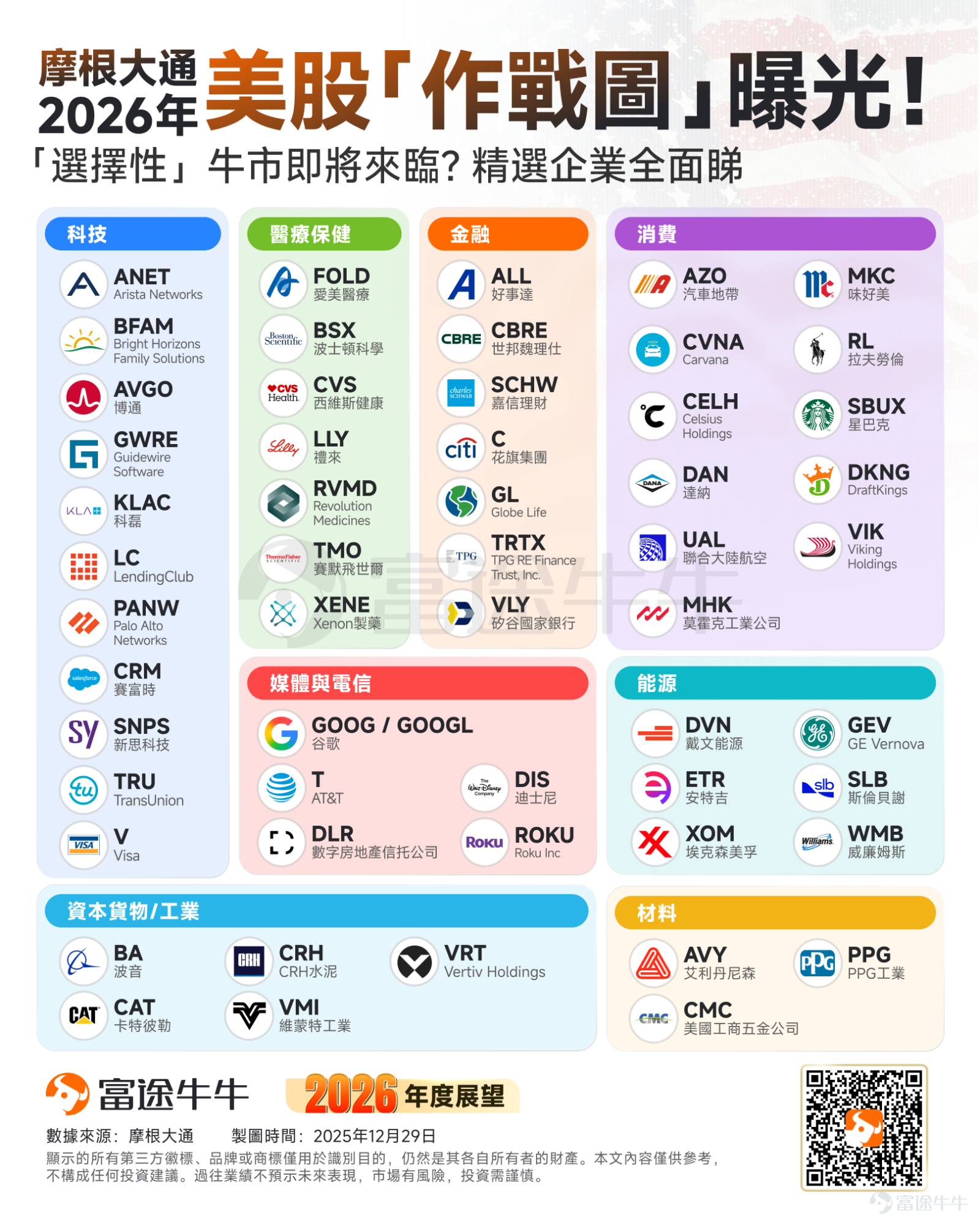
Against the backdrop of an AI supercycle, record capital expenditures, and potential deregulation, JPMorgan has compiled a cross-sector "Top Stock Picks for 2026". This list sends a clear signal:Capital is shifting from pure tech stocks to sectors like 'powering AI,' 'industrial reinvention,' and 'high-quality consumption.' The list covers eight major industries and includes 55 companies.for investors' reference:
![Fellow investors, 2025 is coming to an end, and as we face a brand-new 2026, instead of anxiously chasing trends, it’s better to calm down and understand the direction of the market. Stay tuned.[Share Link: @Niuniu Classroom]to unlock your investment roadmap in real time. In the new year, let’s stay calm and patient, proceed steadily for long-term success, and slowly grow our wealth together. JPMorgan recently released its highly anticipated 2026 US stock annual strategy report. The analyst team predicts that the S&P 500 Index will reach 7,500 points by the end of 2026 and may break through 8,000 points in an optimistic scenario (such as further interest rate cuts by the Fed). However, this is not a broad-based bull market but unfolds in a "K-shaped" economy, meaning there will naturally be winners and losers.The bank pointed out that investors should focus on companies with strong pricing power, long-term growth drivers, robust balance sheets, and the ability to benefit from transformative trends such as data center expansion and infrastructure investment.These companies are typically leaders in innovation, benefit from industry consolidation, and have management teams with strong execution capabilities in operational efficiency and capital allocation. They are also expected to leverage tailwinds from regulatory or policy changes. Against the backdrop of an AI supercycle, record capital expenditures, and potential deregulation, JPMorgan has compiled a cross-sector "Top Picks for 2026 List". This list sends a clear signal:Capital is shifting from pure tech stocks towards companies that "power AI," "industrial..."](https://nnqimage.futunn.com/sns_client_feed/900080/20251230/web-1767059258691-6jfFHkijdi.png/big?area=1&is_public=true&imageMogr2/ignore-error/1/format/webp)
It is also evident from JPMorgan's curated list that the entire cryptocurrency industry is absent.This suggests that JPMorgan may still view the crowding in high-beta/speculative growth sectors as a tactical risk.Sector rotation will ultimately benefit high-quality growth and low-volatility stocks.。
Overall, this list reveals JPMorgan's core judgment on market style for 2026:This will be a year where a 'barbell strategy' prevails— one hand capturing AI-driven high growth, the other hand seizing cyclical recovery and asset revaluation deep value. Below are the logics of the three main themes:
1. Global technology and computing power: Value revaluation from hardware infrastructure to software ecosystem
Core logic: The growth brought by AI is spreading from chips to network architecture, software applications, and fintech.
Core hardware for AI data centers:
$Arista Networks (ANET.US)$ : As the top choice for hyperscale cloud service providers, it has an extremely high penetration rate in high-speed network architecture.
$Broadcom (AVGO.US)$ : Dominates the customized AI chip (ASIC) field with an overwhelming position, expected to maintain strong growth until 2026. These two companies form the dual pillars of the AI era's hardware.
Semiconductor cornerstone:
$KLA Corp (KLAC.US)$ : A leading manufacturer of process control equipment.
$Synopsys (SNPS.US)$ : A leader in the electronic design automation (EDA) field. Both fundamentally support breakthroughs in the physical limits of computing power.
Software and Cybersecurity:
$Salesforce (CRM.US)$ : Utilizing AI to reshape business processes, redefining pricing power in the SaaS model.
$Palo Alto Networks (PANW.US)$ : Benefiting from increased corporate cybersecurity budgets and industry consolidation trends.
Fintech and Digital Life:
$Guidewire Software (GWRE.US)$ : A specialized leader in the insurtech field, demonstrating strong customer stickiness.
Payment and Credit Infrastructure: Covering $Visa (V.US)$ the global payment network, $TransUnion (TRU.US)$ the value of data credit, and $LendingClub (LC.US)$ The flexibility in the credit market, together with other factors, has formed the revenue foundation of digital finance.
II. Global Industrial and Energy Restart: Electrification Wave and Infrastructure Dividends
Core Logic: 2026 will be the year when the return of U.S. manufacturing, infrastructure development, and AI-driven 'power hunger' come together to deliver significant benefits.
AI Infrastructure and Power Management:
$Vertiv Holdings (VRT.US)$ Its liquid cooling and power management technologies are essential components for high-density AI data centers.
$GE Vernova (GEV.US)$ It plays a central role in the global grid upgrade and addressing unprecedented surges in electricity demand.
Traditional Manufacturing and Infrastructure Giants:
$Caterpillar (CAT.US)$ Continues to benefit from global infrastructure capital expenditure.
$CRH PLC (CRH.US)$ A building materials giant that has demonstrated excellent pricing power in an inflationary environment.
$Valmont Industries (VMI.US)$ Demonstrates operational resilience at the intersection of agriculture and infrastructure.
$Boeing (BA.US)$ : Included in the key observation list due to its duopoly position in the aviation cycle and long-term demand resilience.
Energy Transition and Security:
Upstream Resources: The logic shifts from mere extraction to 'energy security' and 'efficiency'. $Exxon Mobil (XOM.US)$ and $Devon Energy (DVN.US)$ Prevailed with strong financial backing.
Oil Services and Technology: $SLB Ltd (SLB.US)$ Utilizing digital technology to help energy companies improve efficiency and capture market share.
Energy Transportation and Utilities: $Williams (WMB.US)$ 's natural gas pipeline network and $Entergy (ETR.US)$ 's power supply provide stable cash flow assurance during the energy transition period.
III. Global Consumption, Healthcare, and Finance: 'Alpha' Choices Amid K-Shaped Divergence
Core logic: In the 'K-shaped' recovery of 2026, only companies with strong brand power, extreme efficiency, or scarce assets will be able to navigate through the cycle.
Telecom and Media:Re-pricing of scarce assets
$Alphabet-C (GOOG.US)$ : Even in the AI era, its search engine moat remains solid.
$Disney (DIS.US)$ : Top-tier content IPs are undergoing value reassessment.
$AT&T (T.US)$ : Improved cash flow attracts value investors.
$Digital Realty Trust Inc (DLR.US)$ : As the 'landlord' of data centers, asset value has significantly increased due to the AI wave.
$Roku Inc (ROKU.US)$ : A key platform entrance for streaming media ad distribution.
Healthcare: A safe haven for high-quality growth
Industry leader: $Eli Lilly and Co (LLY.US)$ With its dual dominance in weight-loss drugs (GLP-1) and Alzheimer's disease, high growth expectations have been established.
Devices and services: $Boston Scientific (BSX.US)$ Continuous innovation in the minimally invasive field; $Thermo Fisher Scientific (TMO.US)$ Benefiting from the recovery of biopharmaceutical R&D investment.
Biotechnology and services: $Amicus Therapeutics (Delisted) (FOLD.US)$ 、 $Revolution Medicines (RVMD.US)$ and $Xenon Pharmaceuticals (XENE.US)$ Represents a highly resilient innovative force; $CVS Health (CVS.US)$ Aiming to rebuild the 'pharmacy + insurance' business closed loop.
Finance and materials: Valuation regression and cyclical opportunities
Banks and insurance: As the interest rate environment stabilizes, $Citigroup (C.US)$ and $Charles Schwab (SCHW.US)$ Profitability is expected to recover beyond expectations; $Allstate (ALL.US)$ and $Globe Life (GL.US)$ demonstrated resilience on the underwriting side.
Real estate and credit: $CBRE Group (CBRE.US)$ 、 $TPG RE Finance Trust Inc (TRTX.US)$ and $Valley National Bancorp (VLY.US)$ is closely capturing cyclical turning points in the real estate and credit markets.
Basic materials: $Avery Dennison (AVY.US)$ (labeling technology), $Commercial Metals (CMC.US)$ (green steel), and $PPG Industries (PPG.US)$ (high-performance coatings) lay the material foundation for the manufacturing recovery by 2026.
Summary
JPMorgan's 2026 list conveys a core strategy:Don't just focus on NVIDIA.
While AI remains a mega-theme, the opportunities in 2026 lie more inThe 'spillover effects of AI' (such as electricity, heat dissipation, power grids) and the 'recovery of the traditional economy' (such as Boeing, Citi).
Against the backdrop of a K-shaped divergence in the macroeconomy, the difficulty of simply buying index funds for guaranteed wins has increased. Holding companies that possessstrong balance sheets,pricing power,andand strategic positions in key supply chainswill be the best strategy to navigate through market volatility up to 2026.
This also implies that sharp swings in sentiment and market turbulence, like what we've seen this year, will become the norm in the coming years.
Risk Disclaimer: The above content only represents the author's view. It does not represent any position or investment advice of Futu. Futu makes no representation or warranty.Read more
Comments (2)
to post a comment
67
124