[2026 Outlook] Plan Ahead! Share the Investment Opportunities You Are Optimistic About
Fellow investors, 2025 is coming to an end, and as we face a brand-new 2026, instead of anxiously chasing trends, it’s better to calm down and understand the direction of the market. Stay tuned.@Niuniu Classroomto unlock your investment roadmap in real time. In the new year, let’s stay calm and patient, proceed steadily for long-term success, and slowly grow our wealth together.
The year 2025 marks the beginning of mass production for humanoid robots, transitioning from "showcases" to "factories."With leading domestic and international players such as Unitree Robotics, $Tesla (TSLA.US)$ , and FigureAI achieving commercial delivery, the industry's fundamentals have undergone a qualitative transformation: humanoid robots are no longer just technological totems at exhibitions but have become real productive forces. This leap heralds the comprehensive arrival of the era of scaled applications.
Notably, the robotics industry has become the next major battleground for competition between the United States and other large economies globally. Previously, U.S. Secretary of Commerce Gina Raimondo frequently met with CEOs in the robotics sector, expressing "full support" (all in) for accelerating the industry's development. It was also reported that the Trump administration is considering issuing an executive order on robotics next year.
In addition,As the pace-setter of global industrial progress, the mass production pathway for Tesla's third-generation humanoid robot (Gen3) has become increasingly clear.In early December 2025, the Optimus team released a new video showcasing the robot's ability to run steadily on complex terrains, marking a generational contrast to its previously unsteady gait. This demonstrates a substantial leap in its "cerebellum" function (responsible for motion control).
At the same time,In China, leading humanoid robot manufacturers such as Unitree Technology, Leju Intelligence, and Zhiyuan Robotics have initiated intensive capitalization moves, including IPOs and mergers for public listings.The industry is entering the eve of explosive growth driven by dual engines of "industrialization + capitalization."
Looking ahead to 2026, the industry widely regards it as the "major test year" for the commercialization of robotics companies.Capital markets are no longer satisfied with impressive technical demonstrations and grand narratives but instead demand clear paths to profitability and sustainable business models. Companies with insufficient self-sustaining capabilities may face certain risks.
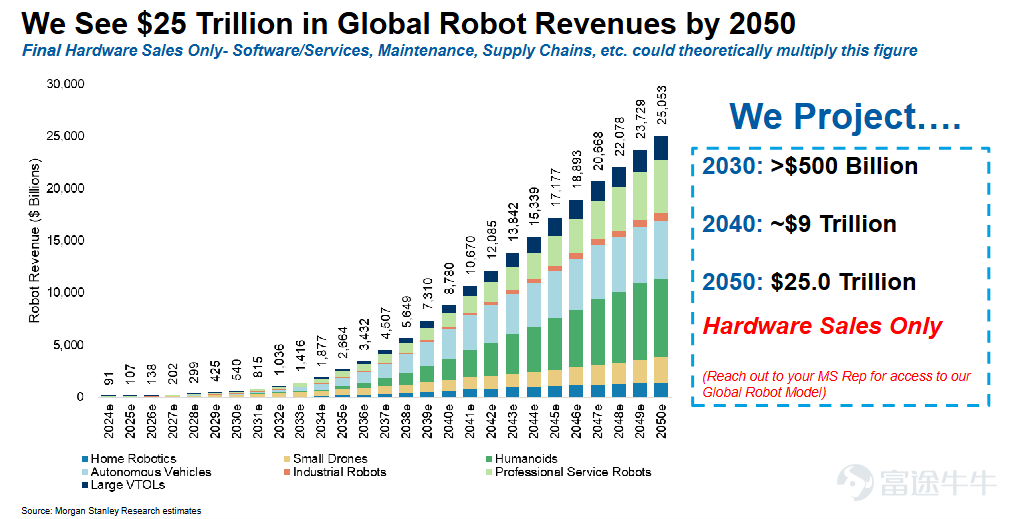
Morgan Stanley's global embodied AI team, in the latest release of the 'Robotics Yearbook,' forecasts that under a baseline scenario,global robot hardware sales will surge from approximately USD 100 billion in 2025 to USD 500 billion by 2030, reaching USD 9 trillion by 2040 and climbing to USD 25 trillion by 2050.This forecast only covers hardware sales; if software services, maintenance, and supply chain-related revenues are included, the market size could potentially double.

Source: Morgan Stanley
Through its Global Robotics Model, Morgan Stanley predicts thatby 2050, 1.4 billion robots will be sold globally, with the total number of operational robots reaching 6.5 billion.Robots will exhibit significant diversity in form, including industrial robots, service robots, drones, autonomous vehicles, humanoid robots, and home robots, covering a wide range of applications from manufacturing to healthcare, agriculture, transportation, defense, and space exploration.
According to Morgan Stanley’s estimates, around 90 million robots will be sold globally by 2030, increasing to 600 million by 2040. Among these, small drones and home robots show the most market potential in the near term, while humanoid robots are expected to begin large-scale deployment between 2029 and 2030.
What are the key highlights to watch in the robotics industry in 2026?
As the industry approaches mass production, the value and investment timing of each segment are being reassessed. Currently,Value creation is highly concentrated in upstream core components,particularly the rotating joints and linear joints (assemblies) that constitute the execution system, which can account for nearly 70% of the total value.
Specifically,the precision manufacturing and integration of motors, reducers, and ball screws are key to cost reduction and efficiency improvement,with related companies currently undergoing a critical validation period, transitioning from prototype sampling (A/B samples) to securing small batch orders (RFQ).This represents the most certain investment theme at present.
Meanwhile, components such as dexterous hands, six-axis force sensors, and 3D vision sensors—crucial for robotic precision operations and environmental perception—are also receiving continued market attention as technological high grounds and next-generation hardware innovation directions.
Morgan Stanley's report particularly highlights that in the race for embodied intelligence, data collection and manufacturing capabilities are inseparable. To build excellent robots, it is necessary to first produce large quantities of 'imperfect' robots for data collection and model training. Prototypes are relatively easy to develop, but scaling production remains the true challenge. Morgan Stanley has identified 100 companies worth watching in the robotics era; relevant Hong Kong and US stock concept stocks have been screened out for fellow investors' reference:
![Fellow investors, 2025 is coming to an end, and as we face a brand-new 2026, instead of anxiously chasing trends, it’s better to calm down and understand the direction of the market. Stay tuned.[Share Link: @Niuniu Classroom]to unlock your investment roadmap in real time. In the new year, let’s stay calm and patient, proceed steadily for long-term success, and slowly grow our wealth together. In 2025, humanoid robots will officially enter the first year of mass production, transitioning from "showcases" to "factories."With leading domestic and international players such as Unitree, $Tesla (TSLA.US)$ , and FigureAI achieving commercial delivery, the industry's fundamentals have undergone a qualitative transformation: humanoid robots are no longer just technological showcases at exhibitions but have become real productive forces. This leap marks the full arrival of the era of scaled applications. Notably, the robotics industry has become the next major battleground for competition between the United States and other large global economies. Previously, U.S. Commerce Secretary Lutnick frequently met with CEOs in the robotics industry, showing "full support" (all in) for accelerating the development of the sector. It was also reported that the Trump administration is considering issuing an executive order on robotics next year. In addition,As the global pace-setter in industrial progress, Tesla's third-generation humanoid robot (Gen3) mass production pathway has become increasingly clear.In early December 2025, the Optimus team released the latest video showcasing the robot's ability to run steadily on complex terrain, forming a generational contrast to its earlier unsteady gait, proving...](https://nnqimage.futunn.com/sns_client_feed/900080/20251231/web-1767174084457-rBKRJYKzOY.png/big?area=1&is_public=true&imageMogr2/ignore-error/1/format/webp)
Brain - Software and Core Computing:
Foundation models include $Baidu (BIDU.US)$ 、 $Meta Platforms (META.US)$ 、 $Alphabet-A (GOOGL.US)$ 、 $NVIDIA (NVDA.US)$ 、 $Microsoft (MSFT.US)$ ;
Data science and analytics include $Palantir (PLTR.US)$ 、 $Oracle (ORCL.US)$ 、 $Microsoft (MSFT.US)$ ;
Simulation and visualization software $Meta Platforms (META.US)$ 、 $Alphabet-A (GOOGL.US)$ 、 $NVIDIA (NVDA.US)$ 、 $Take-Two Interactive Software (TTWO.US)$ 、 $Roblox (RBLX.US)$ 、 $Unity Software (U.US)$ 、 $SIEMENS AG (SIEGY.US)$ ;
Visualization and computing chips $Intel (INTC.US)$ 、 $NVIDIA (NVDA.US)$ 、 $Mobileye Global (MBLY.US)$ 、 $Qualcomm (QCOM.US)$ 、 $Ambarella (AMBA.US)$ 、 $HORIZONROBOT-W (09660.HK)$
Chip design and manufacturing include $Arm Holdings (ARM.US)$ 、 $Synopsys (SNPS.US)$ 、 $Cadence Design Systems (CDNS.US)$ 、 $Taiwan Semiconductor (TSM.US)$ 、 $Intel (INTC.US)$ 。
Body - Hardware and drive components:
Actuators and parts include: bearings $RBC Bearings (RBC.US)$ 、 $The Timken (TKR.US)$ 、 $Regal Rexnord (RRX.US)$ , reducers/gears $The Timken (TKR.US)$ 、 $Regal Rexnord (RRX.US)$ , integrated actuators $Moog-A (MOG.A.US)$ 、 $Regal Rexnord (RRX.US)$ 、 $SANHUA (02050.HK)$ , motors $Sensata Technologies (ST.US)$ 、 $Regal Rexnord (RRX.US)$ 、 $Renesas Electronics (ADR) (RNECY.US)$ , Encoder $Novanta (NOVT.US)$ 、 $Sensata Technologies (ST.US)$ , Rare Earth/Magnetic Materials $MP Materials (MP.US)$ 、 $JLMAG (06680.HK)$ ;
Sensors include: Radar and LiDAR $Magna International (MGA.US)$ 、 $Intel (INTC.US)$ 、 $Aptiv PLC (APTV.US)$、 $Teledyne Technologies (TDY.US)$; Magnetic Induction Sensors $Allegro Microsystems (ALGM.US)$; Torque Sensors $Novanta (NOVT.US)$ 、 $Sensata Technologies (ST.US)$ 、 $TE Connectivity (TEL.US)$ ; Vision Sensors $Teledyne Technologies (TDY.US)$ 、 $Intel (INTC.US)$ 、 $ON Semiconductor (ON.US)$ 、 $TE Connectivity (TEL.US)$ 、 $Sony (SONY.US)$ 、 $ROBOSENSE (02498.HK)$ ;
Frame/Wired Control/Thermal Management includes $Magna International (MGA.US)$ 、 $Amphenol (APH.US)$ 、 $TE Connectivity (TEL.US)$ 、 $Aptiv PLC (APTV.US)$ 、 $SANHUA (02050.HK)$ ;
Integrator - End Manufacturer:
$Tesla (TSLA.US)$ 、 $Alibaba (BABA.US)$ 、 $Amazon (AMZN.US)$ 、 $Sony (SONY.US)$ 、 $Apple (AAPL.US)$ 、 $Toyota Motor (TM.US)$ 、 $Teledyne Technologies (TDY.US)$ 、 $XPeng (XPEV.US)$ 、 $UBTECH ROBOTICS (09880.HK)$ 、 $GAC GROUP (02238.HK)$ 、 $TENCENT (00700.HK)$ 、 $MIDEA GROUP (00300.HK)$ 、 $BYD COMPANY (01211.HK)$ 、 $XIAOMI-W (01810.HK)$ 。
More notably,Morgan Stanley's significant release of the 'Humanoid Tech 25' list,In the report, the bank advises investors to focus on the inner workings of machines, targeting suppliers that provide the 'brain' (AI), 'eyes' (sensors), and 'body' (actuators), rather than the robot brands themselves.This shift itself signals an important trend: the industry focus is transitioning from showcasing complete systems to emphasizing foundational capabilities.
![Fellow investors, 2025 is coming to an end, and as we face a brand-new 2026, instead of anxiously chasing trends, it’s better to calm down and understand the direction of the market. Stay tuned.[Share Link: @Niuniu Classroom]to unlock your investment roadmap in real time. In the new year, let’s stay calm and patient, proceed steadily for long-term success, and slowly grow our wealth together. In 2025, humanoid robots will officially enter the first year of mass production, transitioning from "showcases" to "factories."With leading domestic and international players such as Unitree, $Tesla (TSLA.US)$ , and FigureAI achieving commercial delivery, the industry's fundamentals have undergone a qualitative transformation: humanoid robots are no longer just technological showcases at exhibitions but have become real productive forces. This leap marks the full arrival of the era of scaled applications. Notably, the robotics industry has become the next major battleground for competition between the United States and other large global economies. Previously, U.S. Commerce Secretary Lutnick frequently met with CEOs in the robotics industry, showing "full support" (all in) for accelerating the development of the sector. It was also reported that the Trump administration is considering issuing an executive order on robotics next year. In addition,As the global pace-setter in industrial progress, Tesla's third-generation humanoid robot (Gen3) mass production pathway has become increasingly clear.In early December 2025, the Optimus team released the latest video showcasing the robot's ability to run steadily on complex terrain, forming a generational contrast to its earlier unsteady gait, proving...](https://nnqimage.futunn.com/sns_client_feed/900080/20251231/web-1767173690980-n2v44cmrIj.png/big?area=1&is_public=true&imageMogr2/ignore-error/1/format/webp)
Companies identified by Morgan Stanley as pillars of the humanoid robotics era:
'Brain': $Baidu (BIDU.US)$ 、 $Iflytek Co.,ltd. (002230.SZ)$ 、 $Alibaba (BABA.US)$ 、 $CSOP Samsung Electronics Daily (2x) Leveraged Product (07747.HK)$ 、 $NVIDIA (NVDA.US)$ 、 $Cadence Design Systems (CDNS.US)$ 、 $Texas Instruments (TXN.US)$ 、 $Synopsys (SNPS.US)$ 、 $Arm Holdings (ARM.US)$ 、 $Advanced Micro Devices (AMD.US)$ 、 $Huizhou Desay SV Automotive (002920.SZ)$ 、 $HORIZONROBOT-W (09660.HK)$ ;
Looking ahead, what can we expect?
By 2026, robots will enter a growth phase from 1 to 10. Nomura Securities points out that the global humanoid and quadruped robot markets are still in their infancy, with a clear landscape of leading players:In the humanoid robot sector, Tesla and Figure AI are the main players, while Boston Dynamics leads in the quadruped robot field.
Based on information obtained by Nomura from supply chain companies,Tesla Optimus is expected to ramp up production after March 2026, with an estimated delivery of 60,000 to 80,000 Optimus units in 2026. By the second half of 2026, weekly production capacity is expected to reach 1,000 to 2,000 units.
By 2026, China’s humanoid and quadruped robot industries are expected to catch up with Tesla in terms of mass production progress.Nomura believes this is mainly due to the product design strategies adopted by most Chinese companies—actively sacrificing high anthropomorphic performance for faster mass production and lower costs, such as using wheeled chassis and non-dexterous hand solutions.
According to Nomura's estimates, six companies—Ubtech Robotics, Unitree Robotics,灵动科技 (Lingdong Technology),智元机器人 (Zhiyuan Robotics),傅立叶智能 (Fourier Intelligence), and深之蓝 (DeepBlue Technology)—will lead the industry in capacity release by 2026.Under the baseline scenario, their combined shipments are expected to reach 110,000 to 200,000 units (including quadruped robots).

Source: Nomura
However, Nomura believes that the structural growth of the humanoid robot market will remain constrained by 2026. Key uncertainties persist, including the timeline for mass production, the final product design from leading companies (such as Tesla's third-generation Optimus), and the allocation of supply chain shares. In the short term, these factors are unlikely to make a substantial contribution to the financial performance of companies in the industrial chain.
Therefore, regarding Tesla's industrial chain targets,Nomura favors companies with robust and clear growth momentum in core non-robotics businesses.Their humanoid robotics operations should be viewed as highly flexible long-term options, with potential earnings materializing only in 2027-2028, rather than serving as profit drivers by 2026.
For China’s robotics industrial chain, Nomura is optimistic about two types of enterprises:those with genuine technological moats and those occupying dominant positions in key subsystems.Such companies will secure excess returns when the domestic robotics market sees shipments surpassing 200,000 units in 2026, driven by mainstream models (humanoid robots, wheeled chassis, non-dexterous solutions).
Overall, Nomura maintains a selectively optimistic stance toward companies with solid growth in core businesses and competitive advantages in niche areas.
Fellow investors may also refer to previous articles in the 2026 outlook series.
Risk Disclaimer: The above content only represents the author's view. It does not represent any position or investment advice of Futu. Futu makes no representation or warranty.Read more
Comments (5)
to post a comment
204
385