[2026 Outlook] Plan Ahead! Share the Investment Opportunities You Are Optimistic About

2026 Outlook | Don't Just Focus on NVIDIA! The Optical Communications Industry Could Become the Strongest Growth Sector by 2026—What Opportunities Should Investors Watch?
Fellow investors, 2025 is coming to an end, and as we face a brand-new 2026, instead of anxiously chasing trends, it’s better to calm down and understand the direction of the market. Stay tuned.@Niuniu Classroomto unlock your investment roadmap in real time. In the new year, let’s stay calm and patient, proceed steadily for long-term success, and slowly grow our wealth together.
As 2025 draws to a close, capital markets have begun searching for the core investment themes of 2026.
Looking ahead to 2026, who will lead the next wave of AI advancements? The answer may be hidden within the optical communications sector. As GPUs and ASICs undergo rapid upgrades and iterations, the marginal gains in computing power are increasingly constrained by the physical limits of network bandwidth. The 'scissors gap' between computing power and transport capacity is shifting the industry's focus toward interconnect technologies.
The underlying logic of the 2026 market may shift from simply 'buying computing power' to 'buying transport capacity.'In this process, the strategic importance of optical communications is likely to undergo a revaluation, emerging as a critical factor that cannot be overlooked in the second half of the AI era.
By now, dear fellow investors, you likely have a question in mind:Why is optical communications poised to become a focal point in 2026? And where are the true 'gold mining opportunities' hidden within this complex industrial chain?With these questions in mind, we will conduct an in-depth analysis of the current state of the industry, identifying key investment opportunities worthy of attention.
Why is optical communications poised to become a focal point in 2026?
The answer lies in a structural transformation currently underway. In its landmark report, 'Optics Super Cycle,' SemiAnalysis highlights that as the boundaries of AI training and inference clusters continue to expand, the optical communications industry is entering a multi-year 'optical super cycle.'
Coincidentally, both Goldman Sachs and SemiAnalysis have reached the same conclusion:By 2026, market focus will expand from traditional 'scale-out networks' to include 'scale-up networks' and 'cross-domain interconnected networks.'
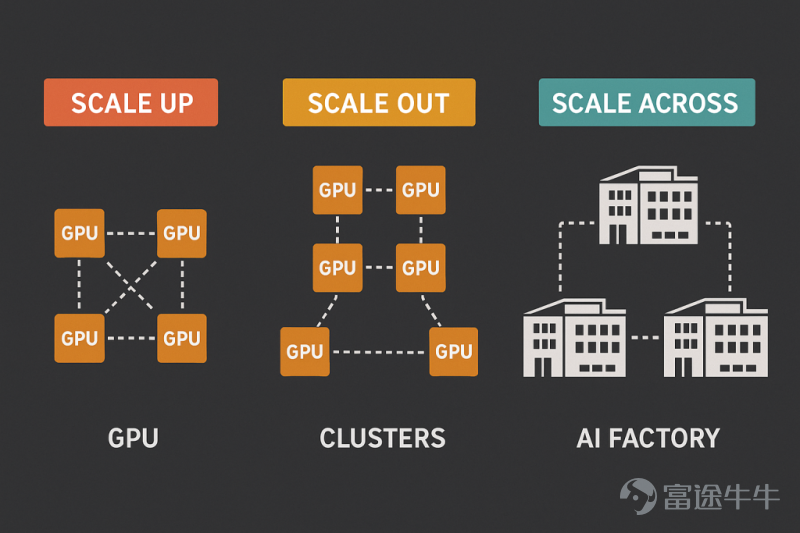
To facilitate understanding, let us first explain the three concepts in simple terms:
Scale-out:This primarily refers to the interconnection networks between server racks, representing the core battleground of traditional Ethernet switching.
Scale-up:This mainly pertains to the interconnection within a rack, such as between GPUs, emphasizing lower latency, higher bandwidth, and greater consistency.
Cross-domain interconnection (Scale-Across, DCI):When AI clusters grow large enough to require deployment across multiple buildings or data centers, high-speed interconnection between different structures or campuses becomes necessary, also known as data center interconnect (DCI).
![Fellow investors, 2025 is coming to an end, and as we face a brand-new 2026, instead of anxiously chasing trends, it’s better to calm down and understand the direction of the market. Stay tuned.[Share Link: @Niuniu Classroom]to unlock your investment roadmap in real time. In the new year, let’s stay calm and patient, proceed steadily for long-term success, and slowly grow our wealth together. As 2025 draws to a close, the capital markets have begun searching for the core investment themes of 2026. Looking ahead to 2026, who will lead the next wave of AI innovation? The answer may lie within the optical communications sector. As GPUs and ASICs continue to evolve rapidly, the marginal benefits of computational power are increasingly constrained by the physical limits of network bandwidth. The 'scissors gap' between computational power and transport capacity is shifting the industry’s focus toward interconnect technologies. The underlying market logic in 2026 may shift from simply 'buying compute power' to 'buying transport capacity.'In this process, the strategic importance of optical communications may undergo a value reassessment, emerging as a critical factor that cannot be ignored in the second half of the AI era. By now, fellow investors likely have a pressing question:Why will optical communications take center stage in 2026? And where are the true 'gold mining opportunities' hidden within this complex supply chain?With these questions in mind, we will conduct an in-depth analysis of the current state of the industry and identify key investment opportunities worthy of attention. Why will optical communications take center stage in 2026? The answer lies in a structural transformation currently underway. SemiAnalysis, in its...](https://nnqimage.futunn.com/sns_client_feed/900080/20251229/web-1767004556131-yV0IrvjiRi.png/big?area=1&is_public=true&imageMogr2/ignore-error/1/format/webp)
In fact, the application scenarios for optical communication are expanding from traditional intra-data center connections to three dimensions: 'scale-out, cross-domain interconnection, and scale-up,' significantly broadening the market's boundaries. Specifically:
 Basic Framework: Scale-Out
This is the fundamental framework of the optical communication industry. As hyperscale cloud providers and emerging cloud vendors increase the number of GPU servers, racks, and cabinets, the number of links between servers and switches, as well as between switches, will automatically expand. Concurrently, port bandwidth doubles, driving synchronized growth in demand for optical modules.
For example, NVIDIA's Hopper series corresponds to 400G optical modules, the GB200 series upgrades to 800G, and the upcoming Vera Rubin series will further advance to 1.6T. The product iteration cycle has been compressed from the traditional 3-4 years to just 2 years, with both volume and price increases becoming the dominant trend.
Core Growth Driver: Scale-Across (Inter-domain Connectivity/DCI)When AI clusters grow too large to fit within a single data center, necessitating inter-building or inter-campus connections, this generates demand for DCI (Data Center Interconnect). This represents the largest marginal shift expected by 2026. When conventional optical modules fail to meet these demands, coherent optical modules become essential. This transition not only signifies technological substitution but also creates an entirely new market segment with a TAM (Total Addressable Market) far surpassing that of the traditional telecom market, serving as a key driver of industry growth.
Future Direction: Scale-UpCurrently, copper cables still dominate short-distance interconnections within servers and racks. However, as single XPU bandwidth advances toward 1.6T or even higher, copper cables face severephysical limitations (power consumption and signal attenuation).To overcome this bottleneck,Co-Packaged Optics (CPO) Technology is gradually moving from the lab to the mainstream.
The Total Addressable Market (TAM) scale of CPO is expected to be 10 times that of the 'scale expansion' scenario. Although it will replace some pluggable optical modules, core components such as lasers and Photonic Integrated Circuits (PIC) will still be required, offering component manufacturers greater growth potential.
Overall,At the heart of this 'optical super cycle' period lies a structural transformation:On one hand, AI applications are compressing the network bandwidth upgrade cycle from the traditional 3-4 years to just 2 years,with the iteration pace from 400G to 800G to 1.6T significantly accelerating.;On the other hand,As GPU clusters are deployed across buildings and campuses, the demand for long-distance transmission is surging, giving rise to new growth areas such as coherent pluggable modules.
Most notably for investors, the relationship between optical communications and computing power is undergoing a qualitative change. The report predicts that over the next 2-3 years, the growth rate of the optical module market will significantly outpace the shipment growth rate of GPUs/XPUs. This marks a major turning point in industry logic — optical modules are no longer optional 'accessories' but rather a core capacity determinant for AI cluster performance. From 'following' to 'leading,' the valuation framework for the optical communications sector is facing a complete overhaul.
Which companies in the supply chain are worth watching?
Overall, the global AI wave is driving robust demand for computing power, accelerating changes in the competitive landscape of the optical communications market and the development trend of high-speed optical interconnects.
Against the backdrop of high demand for high-speed optical modules in data centers, 2026 is expected to become a key inflection point for the rapid growth of silicon photonics solutions and the initial adoption of CPO networks. Silicon photonics technology will significantly drive market penetration of 800G and 1.6T optical modules.
Industry observers note that CPO technology is evolving into two major camps, led respectively by Broadcom and NVIDIA. Broadcom has entered the market with its Tomahawk series of switches, which integrate CPO technology. Meanwhile, NVIDIA is leveraging its Spectrum-X ecosystem and next-generation Quantum Photonics silicon photonics network switches, including the official update of the Quantum-X silicon photonics switch solutions in December 2025, signaling that CPO products are entering a phase of volume production, thereby accelerating the deployment of AI data centers.
In other words, the momentum in optical communications is expected to extend from optical modules to upstream and downstream segments. AI networks are shifting from Scale-out to Scale-up, leading to a clearer competitive landscape within the industry. Relevant companies have been compiled for reference by fellow investors:
![Fellow investors, 2025 is coming to an end, and as we face a brand-new 2026, instead of anxiously chasing trends, it’s better to calm down and understand the direction of the market. Stay tuned.[Share Link: @Niuniu Classroom]to unlock your investment roadmap in real time. In the new year, let’s stay calm and patient, proceed steadily for long-term success, and slowly grow our wealth together. As 2025 draws to a close, the capital markets have begun searching for the core investment themes of 2026. Looking ahead to 2026, who will lead the next wave of AI innovation? The answer may lie within the optical communications sector. As GPUs and ASICs continue to evolve rapidly, the marginal benefits of computational power are increasingly constrained by the physical limits of network bandwidth. The 'scissors gap' between computational power and transport capacity is shifting the industry’s focus toward interconnect technologies. The underlying market logic in 2026 may shift from simply 'buying compute power' to 'buying transport capacity.'In this process, the strategic importance of optical communications may undergo a value reassessment, emerging as a critical factor that cannot be ignored in the second half of the AI era. By now, fellow investors likely have a pressing question:Why will optical communications take center stage in 2026? And where are the true 'gold mining opportunities' hidden within this complex supply chain?With these questions in mind, we will conduct an in-depth analysis of the current state of the industry and identify key investment opportunities worthy of attention. Why will optical communications take center stage in 2026? The answer lies in a structural transformation currently underway. SemiAnalysis, in its...](https://nnqimage.futunn.com/sns_client_feed/900080/20251229/web-1767004745265-Z7EkEZxDYv.png/big?area=1&is_public=true&imageMogr2/ignore-error/1/format/webp)
Photonic integrated circuit design (including DSP/electronic chips):Including $Intel (INTC.US)$ 、 $Broadcom (AVGO.US)$ 、 $Coherent (COHR.US)$ 、 $Cisco (CSCO.US)$ 、 $NVIDIA (NVDA.US)$ 、 $Lumentum (LITE.US)$ 、 $Marvell Technology (MRVL.US)$ 、 $POET Technologies (POET.US)$ 、 $Nokia Oyj (NOK.US)$ 、 $MACOM Technology Solutions (MTSI.US)$ 、 $Credo Technology (CRDO.US)$ 、 $Astera Labs (ALAB.US)$ 、 $Semtech (SMTC.US)$ 、 $ZTE (00763.HK)$ 。
Silicon photonics and CMOS wafer fabs:Including $Taiwan Semiconductor (TSM.US)$ 、 $United Microelectronics (UMC.US)$ 、 $Intel (INTC.US)$ 、 $GlobalFoundries (GFS.US)$、 $Tower Semiconductor (TSEM.US)$ 、 $STMicroelectronics (STM.US)$ 、 $SkyWater Technology (SKYT.US)$ 。
Intel has invested over two decades in silicon photonics technology and has collaborated with Taiwan-based silicon photonics epitaxy supplier Lianya for more than 10 years. In 2023, Intel sold its pluggable optical module business to Jabil and stated that it would focus on high-value optical I/O solutions tailored for artificial intelligence.
GlobalFoundries offers the GF Fotonix silicon photonics platform, which integrates optical components onto a single chip. The platform has already engaged in collaborations with key partners such as NVIDIA, Broadcom, and Marvell Technology.
Tower Semiconductor provides a 300mm silicon photonics platform tailored for silicon photonics products. It collaborates with companies like Coherent and Innolight to manufacture transceivers based on 1.6T and 3.0T silicon photonics technologies and is currently developing a single-channel 3.2T transceiver.
Optical module suppliersIncluding $Coherent (COHR.US)$ 、 $Lumentum (LITE.US)$ 、 $Applied Optoelectronics (AAOI.US)$ 、 $CIG (06166.HK)$ , among which, Coherent and LumentumA long-established powerhouse offering full vertical integration capabilities from chips to modules.
EMS (Electronic Manufacturing Services) / ConnectorsIncluding $Amphenol (APH.US)$ 、 $Celestica (CLS.US)$ 、 $Fabrinet (FN.US)$ 、 $Jabil (JBL.US)$ 、 $FIT HON TENG (06088.HK)$ 、 $TIME INTERCON (01729.HK)$Wait for the company;
System Equipment OpticalIncluding $Arista Networks (ANET.US)$ 、 $Cisco (CSCO.US)$ 、 $Nokia Oyj (NOK.US)$ 、 $Ciena (CIEN.US)$ 、 $Hewlett Packard Enterprise (HPE.US)$ 、 $Dell Technologies (DELL.US)$ ;
Packaging and TestingIncluding $ASE Technology (ASX.US)$ 、 $Amkor Technology (AMKR.US)$ ;Fiber Optic CablesIncluding $Corning (GLW.US)$ 、 $YOFC (06869.HK)$ ;Epitaxial Wafer SupplierIncluding $AXT Inc (AXTI.US)$ ;InP (Indium Phosphide) Wafer FabIncluding $Coherent (COHR.US)$ 、 $Lumentum (LITE.US)$ ;
Equipment - Data Communication DevicesIncluding $Arista Networks (ANET.US)$ 、 $Cisco (CSCO.US)$ 、 $NVIDIA (NVDA.US)$ 、 $Hewlett Packard Enterprise (HPE.US)$ 、 $Dell Technologies (DELL.US)$ ;Equipment - Telecommunication DevicesIncluding $Ciena (CIEN.US)$ 、 $Nokia Oyj (NOK.US)$ 、 $LM Ericsson Telephone (ERIC.US)$ 、 $ZTE (00763.HK)$ 。
Summary
Standing at the tail end of 2025 and looking ahead, we are at a critical crossroads in the development of AI computing power. If the past two years have been a 'one-man show' dominated by GPUs, then 2026 will officially usher in an era driven by the dual engines of 'computing power' and 'data transmission capacity'.
From SemiAnalysis's assertion of an "optical supercycle" to the industry chain’s three-dimensional expansion through Scale-Out, Scale-Across, and Scale-Up, all are validating a fundamental logic:Optical communication is no longer just an accessory to data centers but has become the "weakest link in the barrel" determining the performance ceiling of AI clusters.
However, at the same time, investors should also be mindful of associated risks. If technological advancements fall short of expectations, future demand for the optical communication industry could be negatively impacted.
Risk Disclaimer: The above content only represents the author's view. It does not represent any position or investment advice of Futu. Futu makes no representation or warranty.Read more


Comments (9)
to post a comment
190
485