
[2026 Outlook] Plan Ahead! Share the Investment Opportunities You Are Optimistic About

2026 Outlook | Musk's 'Mass Production Preview' Sparks Brain-Computer Interface Frenzy! How to Seize Investment Opportunities? Keep This List of Concept Stocks Handy!
Fellow investors, as we face a brand-new 2026, instead of anxiously chasing trends, it's better to calmly understand the direction. Stay tuned.@Niuniu Classroomto unlock your investment roadmap in real time. In the new year, let’s stay calm and patient, proceed steadily for long-term success, and slowly grow our wealth together.
On January 1st,Musk suddenly announced on X: Neuralink’s brain-computer interface device will enter mass production this year.To date, Neuralink has implanted brain-computer interface devices in 13 patients. They can type, browse the web, and play games using their 'thoughts.' Musk has previously stated clearly that as Neuralink’s technology advances, it may enable remote control of Optimus robots through thought.This aims to build the ultimate ecosystem of 'Human Brain + Robots.'
Meanwhile, Merge Labs, backed by OpenAI CEO Sam Altman, is spinning off independently to focus on a new technological approach utilizing ultrasound to read brain activity.The moves by these two tech giants indicate that brain-computer interfaces are transitioning from single scientific experiments to diversified commercial races.
These developments not only validate the feasibility of the technology but also prompt the market to reassess the broad application prospects of brain-computer interfaces in areas such as medical rehabilitation, AI interconnectivity, and humanoid robot collaboration.
The buzz around brain-computer interfaces (BCI) continues to grow—is this still a sci-fi concept or the next big investment opportunity? On the eve of a potential technological explosion, how should investors position themselves? Which companies could emerge as future industry leaders? This article will provide an in-depth breakdown of the track opportunities and highlight promising stocks to watch.
What does the future hold for the brain-computer interface sector?
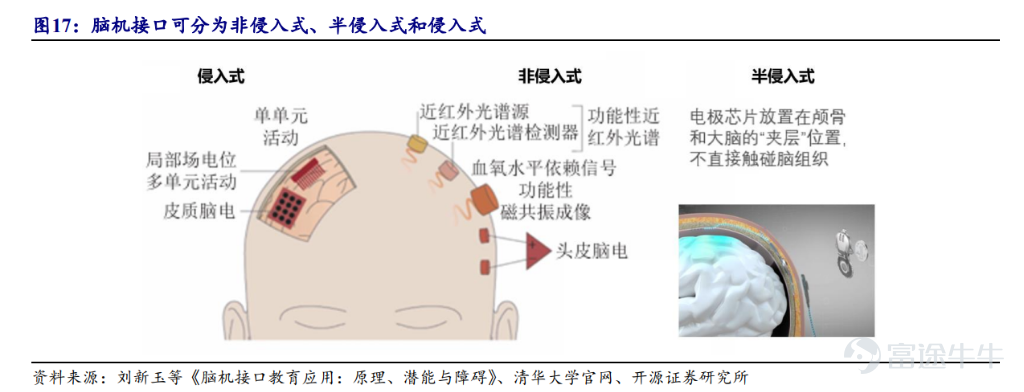
A brain-computer interface (Brain-Computer Interface, abbreviated BCI) essentially establishes a 'direct hotline' between the brain and external devices. It bypasses language, limbs, and neuromuscular systems entirely, enabling humans to control machines directly with 'thoughts,' achieving a leap from 'manual' to 'brain-controlled' operations. Currently, brain-computer interfaces are divided into three types: non-invasive, semi-invasive, and invasive.
![Fellow investors, as we face a brand-new 2026, instead of anxiously chasing trends, it's better to calmly understand the direction. Stay tuned.[Share Link: @Niuniu Classroom]to unlock your investment roadmap in real time. In the new year, let’s stay calm and patient, proceed steadily for long-term success, and slowly grow our wealth together. On January 1st,Musk suddenly announced on X: Neuralink’s brain-computer interface device will enter mass production this year.To date, Neuralink has implanted brain-computer interface devices in 13 patients. They can type, browse the web, and play games using their 'thoughts.' Musk has previously stated clearly that as Neuralink’s technology advances, it may enable remote control of Optimus robots through thought.This aims to build the ultimate ecosystem of 'Human Brain + Robots.' Meanwhile, Merge Labs, backed by OpenAI CEO Sam Altman, is spinning off independently to focus on a new technological approach utilizing ultrasound to read brain activity.The moves by these two tech giants indicate that brain-computer interfaces are transitioning from single scientific experiments to diversified commercial races. These developments not only validate the feasibility of the technology but also prompt the market to reassess the broad application prospects of brain-computer interfaces in areas such as medical rehabilitation, AI interconnectivity, and humanoid robot collaboration. The growing popularity of Brain-Computer Interfaces (BCI) raises the question: Is this still a sci-fi concept or the next big investment opportunity? On the eve of this technological explosion...](https://nnqimage.futunn.com/sns_client_feed/900080/20260109/web-1767955811252-FWEz3cTYyX.png/big?area=1&is_public=true&imageMogr2/ignore-error/1/format/webp)
According to Guoxin Securities, the three major technological approaches—invasive, semi-invasive, and non-invasive—show significant differences in signal quality, safety, and commercialization cycles.
Invasive (Neuralink route):Electrodes are surgically implanted through brain tissue, providing the highest spatiotemporal resolution and bandwidth, suitable for complex scenarios such as brain-controlled prosthetics and vision reconstruction.
Cost: Requires craniotomy implantation, with a development cycle of 5 to 8 years and clinical costs per case reaching hundreds of thousands of dollars.
Technical barriers: Extremely high. The core lies in the long-term stability, biocompatibility, and high-throughput chips of flexible electrodes.
Current status: The US is 2-5 years ahead. Domestic companies like Tier Medical and BrainTiger Technology are catching up, having completed their first clinical trials.
Non-invasive (consumer-grade route):Signals are collected via scalp or body surface sensors.
Characteristics: No surgery required, safe and low-cost, but with significant signal attenuation.
Technical barriers: Algorithms and data. Massive amounts of data are needed to train algorithms to solve signal noise issues.
Current situation: China and the US are progressing side by side. Domestic companies like Strong Brain Technology and BrainLink have already launched products in rehabilitation and sleep monitoring fields.
Semi-invasive/Interventional:Electrodes are placed inside the skull but do not penetrate brain tissue.
Characteristics: Signal quality is better than non-invasive methods, and trauma is less than invasive methods; however, it still falls under Class III medical devices, requiring craniotomy. The interventional technology developed by Shineway Medical avoids craniotomy by using vascular implantation.
Morgan Stanley's healthcare technology team estimates that, just in the US market,The total addressable market (TAM) for BCI implantable devices could reach $80 billion by 2035 and soar to $320 billion by 2045.Mainly covering treatments for various neurological diseases such as ALS, stroke, spinal cord injuries, epilepsy, and depression.
![Fellow investors, as we face a brand-new 2026, instead of anxiously chasing trends, it's better to calmly understand the direction. Stay tuned.[Share Link: @Niuniu Classroom]to unlock your investment roadmap in real time. In the new year, let’s stay calm and patient, proceed steadily for long-term success, and slowly grow our wealth together. On January 1st,Musk suddenly announced on X: Neuralink’s brain-computer interface device will enter mass production this year.To date, Neuralink has implanted brain-computer interface devices in 13 patients. They can type, browse the web, and play games using their 'thoughts.' Musk has previously stated clearly that as Neuralink’s technology advances, it may enable remote control of Optimus robots through thought.This aims to build the ultimate ecosystem of 'Human Brain + Robots.' Meanwhile, Merge Labs, backed by OpenAI CEO Sam Altman, is spinning off independently to focus on a new technological approach utilizing ultrasound to read brain activity.The moves by these two tech giants indicate that brain-computer interfaces are transitioning from single scientific experiments to diversified commercial races. These developments not only validate the feasibility of the technology but also prompt the market to reassess the broad application prospects of brain-computer interfaces in areas such as medical rehabilitation, AI interconnectivity, and humanoid robot collaboration. The growing popularity of Brain-Computer Interfaces (BCI) raises the question: Is this still a sci-fi concept or the next big investment opportunity? On the eve of this technological explosion...](https://nnqimage.futunn.com/sns_client_feed/900080/20260109/web-1767955811727-cVoDrzL7fC.png/big?area=1&is_public=true&imageMogr2/ignore-error/1/format/webp)
Overall, according to CICC (China International Capital Corporation),Brain-computer interface represents both a healthcare investment and a technology investment.In the short term, motion decoding products for rehabilitation purposes, such as for paralysis and ALS, are expected to be commercialized first. In the long term, if human enhancement capabilities can be achieved through integration with AI and robotics, this would unlock a trillion-dollar market.
Which companies are worth watching?
Although Musk's Neuralink occupies a central position in the brain-computer interface (BCI) industry, it has yet to go public, prompting investors to shift their focus to the public market. So the question arises:Faced with a wide variety of companies in the market, how can investors develop a discerning eye to identify the true beneficiaries?We have compiled a list of relevant concept stocks for fellow investors to reference:
![Fellow investors, as we face a brand-new 2026, instead of anxiously chasing trends, it's better to calmly understand the direction. Stay tuned.[Share Link: @Niuniu Classroom]to unlock your investment roadmap in real time. In the new year, let’s stay calm and patient, proceed steadily for long-term success, and slowly grow our wealth together. On January 1st,Musk suddenly announced on X: Neuralink’s brain-computer interface device will enter mass production this year.To date, Neuralink has implanted brain-computer interface devices in 13 patients. They can type, browse the web, and play games using their 'thoughts.' Musk has previously stated clearly that as Neuralink’s technology advances, it may enable remote control of Optimus robots through thought.This aims to build the ultimate ecosystem of 'Human Brain + Robots.' Meanwhile, Merge Labs, backed by OpenAI CEO Sam Altman, is spinning off independently to focus on a new technological approach utilizing ultrasound to read brain activity.The moves by these two tech giants indicate that brain-computer interfaces are transitioning from single scientific experiments to diversified commercial races. These developments not only validate the feasibility of the technology but also prompt the market to reassess the broad application prospects of brain-computer interfaces in areas such as medical rehabilitation, AI interconnectivity, and humanoid robot collaboration. The growing popularity of Brain-Computer Interfaces (BCI) raises the question: Is this still a sci-fi concept or the next big investment opportunity? On the eve of this technological explosion...](https://nnqimage.futunn.com/sns_client_feed/900080/20260110/web-1768030842873-gpTJ7U5Aqn.png/big?area=1&is_public=true&imageMogr2/ignore-error/1/format/webp)
Specifically:
Upstream component and infrastructure suppliers: Integer Holdings, Integra LifeSciences, ClearPoint Neuro, Ceribell, Lens Technology, and MicroPort Surgical Robotics-B.
$Integer Holdings (ITGR.US)$ These companies play a key 'picks-and-shovels' role in the brain-computer interface (BCI) field,As a global leader in medical device outsourcing manufacturing, it does not directly develop finished BCI products but provides essential core underlying components to BCI and neuromodulation companies like Neuralink.This includes critical hardware such as implantable batteries, precision leads, and pulse generator housings.
$Integra Lifesciences (IART.US)$They are indispensable 'infrastructure' suppliers in neurosurgical procedures.Any invasive brain-computer interface requires opening the skull and dura mater during implantation. The subsequent 'closing of the skull' and 'repair' stages are Integra’s absolute domain of expertise. Its flagship product, DuraGen (artificial dura mater), is the gold standard in global neurosurgery, used to repair damaged dura after chip implantation, preventing cerebrospinal fluid leakage and protecting the brain from infection — a key factor in ensuring the long-term survival of BCI implant recipients.
$ClearPoint Neuro (CLPT.US)$ This company provides crucial support to the brain-computer interface industryHigh-precision surgical navigation and implant platformIf we compare brain-computer interfaces to 'satellites' in the brain, ClearPoint is the 'rocket navigation system' that ensures satellites enter the intended orbit accurately. The core lies in utilizing an MRI-guided platform to develop robotic navigation and delivery systems for treating brain diseases, enabling doctors to perform surgeries like deep brain stimulation with greater precision. It’s a technology provider in the brain-computer interface field, directly integrating its technology with surgical procedures to achieve more precise interventions in the brain.
$Ceribell (CBLL.US)$ Its role in the brain-computer interface space can be summarized asThe vanguard of commercializing brain signal reading technologies.It has developed an AI-integrated rapid electroencephalogram (EEG) system focused on epilepsy monitoring in emergency rooms and intensive care units; its core technology involves precise acquisition and automated decoding of neural signals, falling under the diagnostic applications segment of 'non-invasive sensing and signal processing' within the brain-computer interface industry chain.
$LENS (06613.HK)$ is a strategic investor in Strong Brain Technology, a leading domestic company in China’s brain-computer interface field,exclusively undertaking mass production of Strong Brain Technology's core hardware modules.
$MEDBOT-B (02252.HK)$ It focuses on the hardware foundation (e.g., stent electrode carriers) and clinical channels for neural repair in 'interventional brain-computer interfaces.'
Core BCI developers include NeuroPace, NeuroOne Medical, Brainsway, Wearable Devices, Nexalin Technology, Brain Dynamics-B, and HeartCare Medical-B.
$NeuroPace (NPCE.US)$It is one of the very few companies that has successfully commercialized 'implantable brain-computer interfaces' and achieved widespread clinical application.Its core product, the RNS system, functions like a "brain pacemaker." Once implanted in the skull, it can monitor (read) brain waves in real time. Upon detecting precursor signals of an epileptic seizure, it automatically sends electrical impulses to intervene (write), thereby stopping the seizure. This is a typical example of a 'closed-loop brain-computer interface,' mainly used for treating drug-resistant epilepsy.
$NeuroOne Medical (NMTC.US)$Focuses on producing neural electrodes — the 'contact points' of brain-computer interfaces.It developed.Evo Thin-Film ElectrodesThey are thinner and clearer than traditional electrodes, enabling extremely high-precision brain signal recording and stimulation. They are essential 'consumable hardware' for various types of invasive brain-computer interface systems, whether used for diagnosis or treatment.
$Brainsway (BWAY.US)$This falls under the category of 'neuromodulation' within the broader definition of brain-computer interfaces, meaning 'computers sending signals to the brain.'It utilizes patented Deep TMS (Deep Transcranial Magnetic Stimulation) technology, which does not require craniotomy. Instead, it delivers magnetic waves externally via a special helmet to precisely stimulate deep brain regions. It does not read your thoughts but physically alters the activity of brain neural networks by 'writing' energy. It is primarily used for treating severe depression and obsessive-compulsive disorder.
$Wearable Devices (WLDS.US)$It aims to bring brain-computer interface technology into daily life, with its core product beingMudra Band(an Apple Watch strap). It does not come into contact with the head but instead utilizesSNC (Surface Nerve Conduction) A technology that reads the neural electrical signals sent from the brain to the fingers at the wrist. This allows users to control watches or AR glasses through subtle finger movements (an extension of thought), falling under 'neural gesture interaction'It is currently the form of non-invasive neural interface closest to ordinary consumers.
$Nexalin Technology (NXL.US)$ Similar to Brainsway, it belongs tonon-invasive neural treatmentcompanies. It has developed a specialfrequency stimulation technologythat sends specific frequency waveforms to the brain via electrodes placed behind the ear, attempting to resonate with the natural frequencies of the human brain to regulate neurotransmitter levels (such as dopamine and serotonin). It primarily focuses on treating anxiety, insomnia, and Alzheimer's disease, essentially using external devices to 'reset' brain states rather than controlling external machines.
$BRAINAURORA-B (06681.HK)$It is the first company in China to develop a medical-grade digital therapeutic product targeting cognitive impairment.Although it does not involve implanted hardware, it focuses on digital therapies and cognitive impairment assessment software, falling under 'software BCI' or digital applications in brain science, analyzing brain cognitive functions through algorithms.
$HEARTCARE-B (06609.HK)$ Previously collaborated with Nankai University on an invasive brain-computer interface, implanting electrode stents through minimally invasive vascular procedures, with plans to complete the first human implant by the end of 2026, targeting ALS and high-risk paraplegic patients. Additionally, the company has wholly established Wei Brain Intelligence, marking its strategic layout in the brain-computer interface (BCI) field entering a new phase of substantive implementation and independent operation, innovatively pursuing a technical route of implanting electrode stents into cerebral blood vessels via minimally invasive procedures.
Core devices are supplied by medical giants including Medtronic, Abbott Laboratories, Boston Scientific, LivaNova, Inspire Medical Systems, CVRx Inc, and MicroPort NeuroTech.
$Medtronic (MDT.US)$ GloballyA leader in deep brain stimulation (DBS) technology, considered a pioneering application of invasive brain-computer interfaces. Its latest Percept™️PC system features BrainSense™️technology, which not only performs electrical stimulation of the brain (writing) but also simultaneously captures and records the brain’s bioelectrical signals (reading).This achieves preliminary 'closed-loop' brain-computer interaction, laying the hardware foundation for more complex BCI therapies in the future.
$Abbott Laboratories (ABT.US)$ The company's connection to the brain-computer interface field is primarily reflected in its advancedneuromodulation technology,especially itsInfinity™️DBS SystemThis system uses directional lead technology to precisely stimulate specific brain regions to treat movement disorders such as Parkinson’s disease. While currently focused on therapeutic stimulation (unidirectional), its implantable pulse generator and wireless control technologies are key components for building future clinical-grade brain-computer interface systems.
$Boston Scientific (BSX.US)$ Through its Vercise™️Genus DBS Systemholds a significant position in the field of neural interfaces. The company focuses on high-precision current control and directional stimulation technology (MICC), aiming to more precisely 'communicate' with brain neural circuits and reduce side effects; its technological accumulation provides a mature engineering platform for precise intervention of brain signals, representing a direct clinical application of brain-computer interface technology.
$LivaNova (LIVN.US)$IsThe global leader in the Vagus Nerve Stimulation (VNS) field, a type of peripheral nerve interface technology. Although it does not directly implant into the cerebral cortex, by stimulating the vagus nerve connected to the brain, it modulates brain activity (treating epilepsy and treatment-resistant depression). This 'accessing the brain via peripheral nerves' pathway demonstrates the possibility of non-craniotomy neuromodulation and is an important component of a broader definition of neural interfaces.
$Inspire Medical Systems (INSP.US)$ Specializing inhypoglossal nerve stimulationtechnology to treat sleep apnea, which is an application ofperipheral nerve interfaces. While it does not involve signal reading or writing in the cerebral cortex, its core technology involves real-time interaction between implantable sensors (monitoring breathing patterns) and stimulators (controlling neuromuscular activity). This closed-loop 'sensing-stimulating' control logic aligns closely with the engineering principles of brain-computer interfaces.
$CVRx Inc (CVRX.US)$ developed Barostim™️ System, which focuses on stimulating the baroreceptors (nerve endings) in the carotid sinus to modulate the autonomic nervous system for treating heart failure. This falls under the category of bioelectronic medicine, using electrical signals rather than drugs to interact with the nervous system; it demonstrates the commercial potential of intervening in core physiological functions of the human body through neural interface technology and serves as a representative example of neuro-modulation technology extending into visceral organ control.
$MICROPORT NEURO (02172.HK)$ The current core business isneurointerventional medical devices(such as stents and coils for treating strokes), primarily providingvascular access technology supportfor brain-computer interfaces. As 'intravascular brain-computer interfaces' become a popular direction, the company’s extensive expertise in neurovascular anatomy and catheter technology positions it uniquely as a potential 'delivery channel' for intravascular brain-computer interface devices or a future co-development partner.
Indirect beneficiaries include Tesla, Meta Platforms, Microsoft, Snap Inc., and Lenovo Group.
$Tesla (TSLA.US)$ While not directly involved in brain-computer interface research, it is Neuralink's (Elon Musk’s brain-computer interface company) most powerful 'engineering sibling.' Both share Elon Musk as a core founder. Tesla’s expertise in high-precision robotics manufacturing, battery technology, and the Dojo supercomputer provides critical engineering and manufacturing support for Neuralink’s surgical robots and implantable chips. In the future, Musk has envisioned controlling Tesla vehicles or robots directly via Neuralink’s brain-control technology, achieving an integrated 'human-machine' ecosystem.
$Meta Platforms (META.US)$ is actively developing non-invasive brain-computer interface (BCI) technology, leveraging deep learning AI models like Brain2Qwerty to interpret EEG/MEG signals for 'thought-to-text' functionality and interaction with AR/VR devices. The goal is to enable users to control devices through thought, eventually integrating into social and metaverse environments, distinct from invasive methods like Neuralink. Despite technological breakthroughs, the technology remains in the lab stage, facing commercialization challenges such as high costs and signal interference.
$Microsoft (MSFT.US)$ has conducted in-depth research in the brain-computer interface field, particularly exploring technologies to measure and convert central nervous system activity through Microsoft Research. Recently, they partnered with Spanish company InBrain, utilizing their graphene technology alongside Microsoft’s Azure AI platform to develop a closed-loop AI system for real-time neural modulation, advancing BCI's medical applications.
$Snap Inc (SNAP.US)$ Through the acquisition of the French neurotech startup NextMind, directly entered thevisual cortex brain-computer interfacesector. NextMind's technology primarily uses headband devices to read signals from the brain's visual cortex, determining the user's focus of attention. Snap aims to integrate this 'visual thought control' technology into its Spectacles AR glassesecosystem, enabling users to trigger filters or operate interfaces merely by 'looking,' thereby freeing their hands and creating a more intuitive augmented reality social experience.
$LENOVO GROUP (00992.HK)$ Launched the world's first consumer-grade brain-computer interface headset, the 'Lenovo MindX1,' paired with its proprietary 'Lingxi' AI algorithm, achieving a thought-input speed of 12-15 words per minute with over 85% accuracy. This marks a major leap from laboratory-based BCI interactions to everyday life applications.
It is worth noting that amid the surge of brain-computer interface concept stocks, $Regencell Bioscience (RGC.US)$although stock prices are performing actively, their investment logic is entirely different from the main industry narrative.This companyis not engaged in neural signal engineering, but rather focuses on utilizingtraditional Chinese medicine therapyto address neurocognitive disorders such as ADHD and ASD. Despite its previous announcement that a new generation of neuromodulation chips received FDA approval and that it is collaborating with the Mayo Clinic for Parkinson’s disease treatment research,
investors seeking exposure to brain-computer interface hardware or algorithm technologies need to carefully differentiate such stocks to avoid the risk of 'conceptual mismatch' in their investments.
Fellow investors may also refer to previous articles in the 2026 outlook series.
Risk Disclaimer: The above content only represents the author's view. It does not represent any position or investment advice of Futu. Futu makes no representation or warranty.Read more


Comments (14)
to post a comment
395
273