[2026 Outlook] Plan Ahead! Share the Investment Opportunities You Are Optimistic About

2026 Outlook | Has autonomous driving reached the eve of an explosion? NVIDIA's model ignites market enthusiasm, five core opportunities worth watching!
Fellow investors, as we face a brand-new 2026, instead of anxiously chasing trends, it's better to calmly understand the direction. Stay tuned.@Niuniu Classroomto unlock your investment roadmap in real time. In the new year, let’s stay calm and patient, proceed steadily for long-term success, and slowly grow our wealth together.
At CES 2026, NVIDIA unveiled an open-source autonomous driving AI model named Alpamayo, which Jensen Huang described as 'the world’s first AI for autonomous vehicles capable of thinking and reasoning,' directly challenging Tesla’s FSD system. Huang stated that the first car equipped with NVIDIA technology will hit US roads in the first quarter.
Notably, Jensen Huang remarked:The ChatGPT moment for Physical AI has arrived—machines are now beginning to understand, reason, and act in the real world.Robotaxis are among the first beneficiaries.Alpamayo brings reasoning capabilities to autonomous vehicles, enabling them to think through rare scenarios, drive safely in complex environments, and explain their driving decisions—a cornerstone for safe and scalable autonomous driving.
Additionally, Morgan Stanley previously noted,Tesla's FSD 14.3 could become the 'steam engine moment' for autonomous driving.Overall,Autonomous driving is considered one of the main investment themes on Wall Street for 2026.This article will provide fellow investors with an in-depth analysis of the growth logic in this sector and identify high-potential core investment targets.
Is autonomous driving on the verge of a breakout?
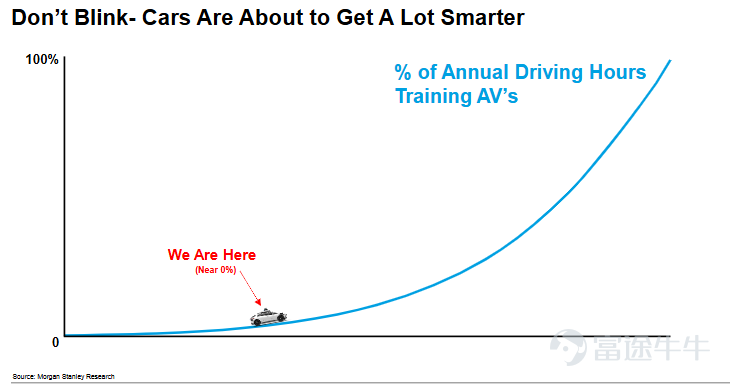
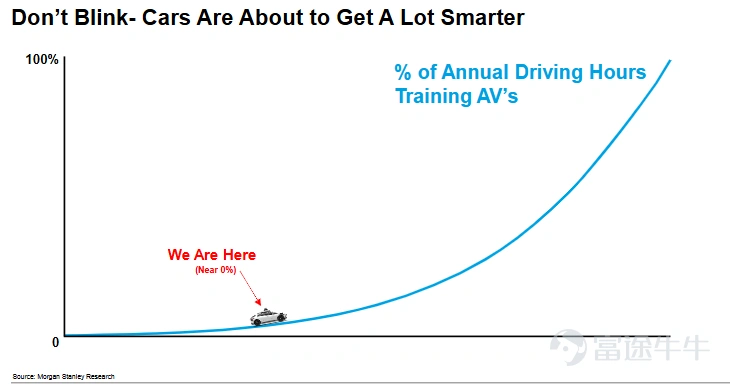
Morgan Stanley believes that despite humans collectively spending the equivalent of 82 million years annually inside cars, this traditional driving model is about to be disrupted. Autonomous driving technology is at the cusp of an explosive '0 to 1' breakthrough.
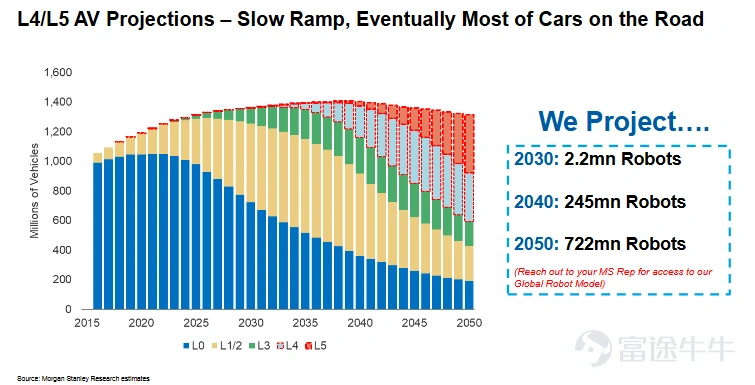
Morgan Stanley is extremely optimistic about the long-term adoption rate of autonomous driving. The report predicts that while the initial phase may progress slowly, this trend is irreversible. By 2030, it is estimated that 2.2 million robotaxis will be in use globally, increasing dramatically to 245 million by 2040 and ultimately reaching 722 million by 2050. Morgan Stanley emphasized that autonomous driving will be the 'ultimate accelerator' for the electric vehicle industry, fundamentally transforming human mobility and economic models.
Source: Morgan Stanley
Notably, on January 13 EST,A committee of the U.S. House of Representatives will hold a hearing to discuss legislation aimed at streamlining the deployment process for driverless vehicles.The draft proposal includes increasing the annual cap on the number of autonomous vehicles put into use to 90,000 and addressing automakers' complaints about obstacles to robotaxi deployment.
In terms of the domestic situation,Recently, China's first batch of L3-level autonomous driving license plates have been successively implemented in Beijing and Chongqing. The market expects this to lay the foundation for covering more vehicle models and cities in the future.
In this round of the global technological competition,Morgan Stanley clearly pointed out that China is already in a leading position.Report data shows that China currently holds about 60% of the global share of L2+ autonomous driving vehicles, thanks not only to its success in the electric vehicle (EV) sector but also its advantage in building 'data probes' through massive EV fleets.The competitive landscape in the US market is also undergoing profound changes, with the route competition between Waymo and Tesla intensifying.
Looking ahead, Morgan Stanley depicts a steep adoption curve. According to its forecast model, the sales penetration rate of autonomous vehicles will soar from almost zero to nearly 100% over the next few decades.
By 2030, there will be approximately 2.2 million fully autonomous vehicles globally.
By 2040, this number will grow exponentially to 245 million, at which point most cars on the road will be intelligent.
By 2050: The global autonomous vehicle fleet is expected to exceed 722 million units.
Source: Morgan Stanley
Goldman Sachs predicts that the large-scale adoption of autonomous driving will gradually unfold over the next 5-7 years, rather than happening overnight. During this period, the ride-hailing industry will evolve into a 'hybrid network' (with human drivers and AVs coexisting) to meet global demand. UBER and LYFT are expected to participate in the growth of the AV industry through extensive partnerships.
Which companies are expected to benefit?
Wall Street generally believes that 2026 will be a key turning point for the commercial implementation of autonomous driving technology. A transformation is underway across the industry, from underlying chips to end automakers, and finally to mobility networks. Based on Morgan Stanley's research report, we have outlined the autonomous driving supply chain for fellow investors to reference.
![Fellow investors, as we face a brand-new 2026, instead of anxiously chasing trends, it's better to calmly understand the direction. Stay tuned.[Share Link: @Niuniu Classroom]to unlock your investment roadmap in real time. In the new year, let’s stay calm and patient, proceed steadily for long-term success, and slowly grow our wealth together. At CES 2026, NVIDIA unveiled an open-source autonomous driving AI model named Alpamayo, which Jensen Huang described as 'the world’s first AI for autonomous vehicles capable of thinking and reasoning,' directly challenging Tesla’s FSD system. Huang stated that the first car equipped with NVIDIA technology will hit US roads in the first quarter. Notably, Jensen Huang remarked:The ChatGPT moment for Physical AI has arrived—machines are now beginning to understand, reason, and act in the real world.Robotaxis are among the first beneficiaries.Alpamayo brings reasoning capabilities to autonomous vehicles, enabling them to think through rare scenarios, drive safely in complex environments, and explain their driving decisions—a cornerstone for safe and scalable autonomous driving. Additionally, Morgan Stanley previously noted,Tesla's FSD 14.3 could become the 'steam engine moment' for autonomous driving.Overall,Autonomous driving is considered one of the main investment themes on Wall Street for 2026.This article will provide fellow investors with an in-depth analysis of the growth logic in this sector and identify high-potential core investment targets. Is autonomous driving on the verge of a breakout? Morgan Stanley acknowledged...](https://nnqimage.futunn.com/sns_client_feed/900080/20260107/web-1767791653604-roz6cWqltr.png/big?area=1&is_public=true&imageMogr2/ignore-error/1/format/webp)
1. Brain (Computation and Decision-Making Layer): The race for computational power of the strongest minds
The core of autonomous driving lies in the 'brain,' which requires powerful chip computing power, cloud models, and software architecture. This layer is also the fiercest battleground for tech giants and emerging chip companies.
Computing Power and Chip Giants: The Undisputed Leader $NVIDIA (NVDA.US)$ , as well as $Qualcomm (QCOM.US)$ And architecture licensors $Arm Holdings (ARM.US)$ Traditional semiconductor giants such as $NXP Semiconductors (NXPI.US)$ 、 $Texas Instruments (TXN.US)$ 、 $STMicroelectronics (STM.US)$ and NVIDIA, known for its focus on visual computing, $Ambarella (AMBA.US)$ also occupies an important position in the supply chain. Of course, there is also $Advanced Micro Devices (AMD.US)$ which is quickly catching up.
Intelligent driving systems and software: NVIDIA, renowned for its visual solutions, $Mobileye Global (MBLY.US)$ as well as companies providing simulation environments $Unity Software (U.US)$ 。
Tech giants and cloud models: with strong AI infrastructure, $Alphabet-A (GOOGL.US)$ 、 $Microsoft (MSFT.US)$ 、 $Meta Platforms (META.US)$ 、 $Amazon (AMZN.US)$ along with Chinese tech giant $Alibaba (BABA.US)$ 、 $TENCENT (00700.HK)$ and $Baidu (BIDU.US)$ , which provide indispensable cloud training capabilities and large model support for autonomous driving.
In-house chip development and new forces: Representatives of full-stack in-house R&D $Tesla (TSLA.US)$ , as well as the rising star of smart driving chips listed in Hong Kong stocks $HORIZONROBOT-W (09660.HK)$ and $BLACK SESAME (02533.HK)$ 。
Second, autonomous driving integrators / solution providers: The main force behind Robotaxi deployment
Companies in this sector focus on providing complete L4/L5 level autonomous driving solutions and are the main force behind Robotaxi deployment.
Leading companies from the US and China: $Tesla (TSLA.US)$ 's FSD is moving towards Robotaxi; $Alphabet-A (GOOGL.US)$Waymo under is already operating in multiple cities; $Baidu (BIDU.US)$Apollo under is a benchmark in the Chinese market;$Amazon (AMZN.US)$under its umbrella,Zooxfocuses on unmanned taxi services.
Emerging companies:include$Aurora Innovation (AUR.US)$ 、 $Pony AI (PONY.US)$ 、 $WeRide (WRD.US)$ 、 $Kodiak AI (KDK.US)$ , as well as $DiDi Global Inc (DIDIY.US)$ 。
Third, perception systems: the vehicle's 'eyes'
To enable vehicles to 'see' the world, LiDAR and sensor technologies are crucial.
LiDAR leader:Chinese manufacturers have performed remarkably, including$Hesai (HSAI.US)$ and Hong Kong stocks $ROBOSENSE (02498.HK)$ 。
Global sensor players: Other companies receiving significant market attention include $Aeva Technologies (AEVA.US)$ 、 $Arbe Robotics (ARBE.US)$ 、 $Aptiv PLC (APTV.US)$ 、 $AEye (LIDR.US)$ 、 $Microvision (MVIS.US)$ 、 $Ouster (OUST.US)$ 、 $Innoviz Technologies (INVZ.US)$ 。
Traditional Tier 1 giants: $Magna International (MGA.US)$ are also actively deploying perception system integration.
Notably,Recently $Aeva Technologies (AEVA.US)$Announced cooperation with NVIDIA, In mass production vehicle projects, Aeva's technology platform will be integrated into the Hyperion system; $Arbe Robotics (ARBE.US)$Partnering with NVIDIA to integrate market-leading radar solutions with powerful AI computing capabilities, To create a cutting-edge AI driving platform; $Hesai (HSAI.US)$It was selected by NVIDIA as the LiDAR partner for the 'NVIDIA DRIVE AGX Hyperion 10 platform.'
IV. Auto Companies: The Carrier of Technology Implementation
All technologies ultimately need to be integrated into automobiles, where new forces compete with traditional automakers.
China's New Auto Forces: $NIO Inc (NIO.US)$ 、 $Li Auto (LI.US)$ 、 $XPeng (XPEV.US)$ The three key players continue iterating on smart driving features, and there’s also the newcomer who has performed strongly, $XIAOMI-W (01810.HK)$ 。
Traditional Automakers’ Transformation: Japanese brands like $Toyota Motor (TM.US)$ , American brands like $General Motors (GM.US)$ , and German brands like $MERCEDES-BENZ GROUP AG UNSP ADR EACH REP 0.25 ORD SHS (MBGYY.US)$ , as well as China's $GEELY AUTO (00175.HK)$ and $BYD COMPANY (01211.HK)$ are accelerating their intelligent transformation. Among them, Jensen Huang officially announced Alpamayo, the world's first dedicated thinking and reasoning model for autonomous driving, during his speech. The 2025 Mercedes-Benz CLA will integrate NVIDIA’s full self-driving technology stack.
New forces in the US: $Rivian Automotive (RIVN.US)$And$Lucid Group (LCID.US)$ are also striving to gain market share.
5. Mobility Operations Network: The Last Mile of the Business Closed Loop
When autonomous driving technology matures, whoever owns an extensive mobility network will be able to achieve commercial monetization the fastest.
Ride-hailing platforms: Global giant $Uber Technologies (UBER.US)$ 、 $Lyft Inc (LYFT.US)$ , Southeast Asia's dominant player $Grab Holdings (GRAB.US)$ , as well as China's $DiDi Global Inc (DIDIY.US)$ 。
Car Rental and Operations: Traditional car rental giants $Hertz Global (HTZ.US)$ and $Avis Budget (CAR.US)$ are exploring automated fleet management; $Via Transportation (VIA.US)$ focusing on public transportation solutions; and of course, there are companies with extensive logistics networks $Amazon (AMZN.US)$ 。
Summary
Fangzheng Securities believes that the intelligent driving sector is witnessing multiple key policy breakthroughs and industrial advancements, such as China's first batch of L3 autonomous driving models receiving market access permits and Tesla initiating unmanned Robotaxi road tests,marking a new phase where the global intelligent driving industry is gradually transitioning from technical validation to scaled application.Against the backdrop of continued policy liberalization, intelligent driving is becoming the core engine driving the transformation and upgrading of the automotive industry, fostering a collaborative development ecosystem across the entire industrial chain,with the industry as a whole welcoming a historic development opportunity.
However, fellow investors also need to be mindful of risks such as slower-than-expected technological R&D progress, delays in policy implementation, and intensified market competition leading to declining gross margins.
Fellow investors may also refer to previous articles in the 2026 outlook series.
Risk Disclaimer: The above content only represents the author's view. It does not represent any position or investment advice of Futu. Futu makes no representation or warranty.Read more


Comments (16)
to post a comment
230
410