
[2026 Outlook] Plan Ahead! Share the Investment Opportunities You Are Optimistic About

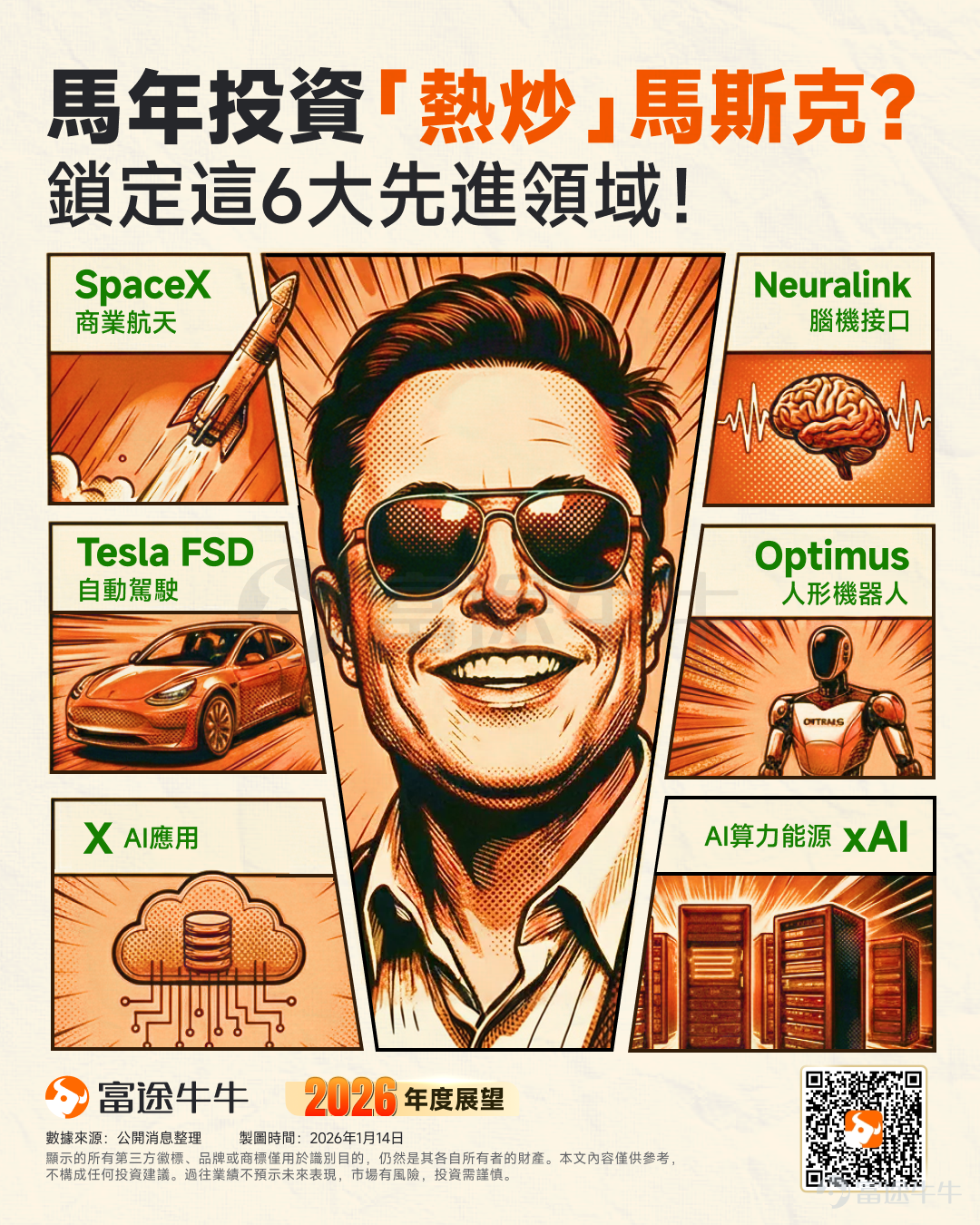
Learn investing from the experts | Should we 'ride' Musk in the Year of the Horse? Space, brain-computer interfaces... These six sectors are worth watching!
Since the beginning of this year, Elon Musk has continued to dominate market trends.From SpaceX to AI ventures, the keyboard in his hands seems to wield magic; a single tweet can instantly ignite investment frenzies, making global capital dance to his tune.
An adage circulating among investors goes: 'The year of the horse is the time to invest in Musk.'Looking ahead to 2026, investors' eyes should focus on the six strategic highlands of Musk's commercial empire:Commercial spaceflight, brain-computer interfaces, autonomous driving, humanoid robots, AI applications, and AI computing power and energy systems.
![Since the beginning of this year, Musk has continued to dominate market trends.From SpaceX to AI, the keyboard in his hands seems to wield magic; a single tweet can instantly ignite investment frenzy, making global capital dance to his tune. A popular saying in the investment community goes: 'In the Year of the Horse, ride Musk.'Looking ahead to 2026, investors should focus on six strategic high grounds within Musk's business empire:Commercial aerospace, brain-computer interfaces, autonomous driving, humanoid robots, AI applications, and AI computing power with energy systems. SpaceX's rumored IPO ignites a boom in space stocks SpaceX is leading the world into a new era of commercial aerospace. According to Bloomberg, SpaceX, under Musk, plans to go public as early as the second half of 2026, with financing far exceeding $30 billion.The company’s targeted valuation is approximately $1.5 trillion. Last Friday, the U.S. Federal Communications Commission (FCC) approved SpaceX to deploy an additional 7,500 second-generation Starlink satellites, bringing the total number of approved second-generation satellites to 15,000. The company currently operates about 9,400 satellites and aims to complete 154 launches by 2025, accounting for over 80% of total U.S. launches. Notably, SpaceX holds a contract from NASA worth approximately $4 billion to modify the Starship into a lunar lander, supporting the manned moon landing mission 'Artemis 3,' which is planned for execution as early as 2027. [Share Link: 2026 Outlook | The space industry is expected to have a breakout year! In addition to SpaceX, this 'list of promising opportunities' is worth collecting in advance][Share Link: 藏》]A previous article hinted at looking ahead...](https://nnqimage.futunn.com/sns_client_feed/948888/20260114/web-1768394757001-BA0rH1tk38.png/big?area=1&is_public=true&imageMogr2/ignore-error/1/format/webp)
SpaceX’s rumored IPO ignites a boom in space-related stocks
SpaceX is leading the world into a new era of commercial spaceflight. According to Bloomberg, SpaceX, under Musk, plans to go public as early as the second half of 2026, with financing far exceeding $30 billion.The company’s targeted valuation is approximately $1.5 trillion.
The US Federal Communications Commission (FCC) approved last Friday SpaceX's deployment of an additional 7,500 second-generation Starlink satellites, bringing the total number of approved second-generation satellites in orbit to 15,000. The company currently operates approximately 9,400 satellites and aims to complete 154 launches by 2025, accounting for over 80% of the total US launches.
Notably, SpaceX holds a contract worth about $4 billion from NASA to modify the Starship into a lunar lander, supporting the manned moon landing mission 'Artemis 3', scheduled as early as 2027.
2026 Outlook | Space industry set for a breakout year! Besides SpaceX, this 'list of promising stocks' is worth collecting in advance藏》An article previously suggested that looking ahead, investment opportunities in the space sector revolve around two main themes:The first is the application layer—satellite internet and commercial implementation,This is a monetization theme centered on 'connectivity,' covering rocket launches, satellite manufacturing, and ground equipment; core players include SpaceX and Amazon.The second is the infrastructure layer—new space-based infrastructure,Including reusable rockets and space data centers.
![Since the beginning of this year, Musk has continued to dominate market trends.From SpaceX to AI, the keyboard in his hands seems to wield magic; a single tweet can instantly ignite investment frenzy, making global capital dance to his tune. A popular saying in the investment community goes: 'In the Year of the Horse, ride Musk.'Looking ahead to 2026, investors should focus on six strategic high grounds within Musk's business empire:Commercial aerospace, brain-computer interfaces, autonomous driving, humanoid robots, AI applications, and AI computing power with energy systems. SpaceX's rumored IPO ignites a boom in space stocks SpaceX is leading the world into a new era of commercial aerospace. According to Bloomberg, SpaceX, under Musk, plans to go public as early as the second half of 2026, with financing far exceeding $30 billion.The company’s targeted valuation is approximately $1.5 trillion. Last Friday, the U.S. Federal Communications Commission (FCC) approved SpaceX to deploy an additional 7,500 second-generation Starlink satellites, bringing the total number of approved second-generation satellites to 15,000. The company currently operates about 9,400 satellites and aims to complete 154 launches by 2025, accounting for over 80% of total U.S. launches. Notably, SpaceX holds a contract from NASA worth approximately $4 billion to modify the Starship into a lunar lander, supporting the manned moon landing mission 'Artemis 3,' which is planned for execution as early as 2027. [Share Link: 2026 Outlook | The space industry is expected to have a breakout year! In addition to SpaceX, this 'list of promising opportunities' is worth collecting in advance][Share Link: 藏》]A previous article hinted at looking ahead...](https://nnqimage.futunn.com/sns_client_feed/948888/20260114/web-1768394755589-8dHycYDS1M.webp/big?area=1&is_public=true&imageMogr2/ignore-error/1/format/webp)
This chart clearly divides the space industry into five core sectors: orbital launch, satellite operations, infrastructure, manufacturing supply chain, and space funds. Below, we will break them down one by one, giving you an overview of these upcoming 'popping' investment opportunities.
1. Orbital Launch: The 'Toll Station' to the Universe
Launch capability is the bottleneck for all space commercial activities and represents the area with the deepest moat.
Industry Leaders and Challengers: Although SpaceX it is still a private company, it has defined industry standards. In the public market, $Rocket Lab (RKLB.US)$ is quickly establishing its position as the 'second pole,' with its Neutron rocket seen as a key growth engine. Additionally, $Firefly Aerospace (FLY.US)$ is a company dedicated to providing end-to-end space transportation services from low Earth orbit to the lunar surface. Known for its cost-effective light launch vehicles, Alpha and the lunar lander Blue Ghost , the company is also a core contractor for the US Department of Defense's Tactical Responsive Space mission, recognized as a leader in rapid space deployment and one of Rocket Lab’s strongest potential competitors in the small-to-medium launch market.
The alliance of traditional giants: The veteran military-industrial complexUnited Launch Alliance (ULA) remains solid, backed by the support of two major giants $Boeing (BA.US)$ and $Lockheed Martin (LMT.US)$ and holds a central position in heavy-duty national defense launch missions.
Space Tourism and New Models: $Virgin Galactic (SPCE.US)$ Continuing to explore the boundaries of commercialization in the suborbital tourism sector.
II. Satellite Operators: Space-based Internet and the 'God's Perspective'
This is currently the most commercialized track with the clearest cash flow.
Entry of Giants: $Amazon (AMZN.US)$ Amazon's Project Kuiper is the most anticipated constellation project after Starlink, with 2026 being the critical year for its production ramp-up.
Communications and IoT: This field is flourishing. $Iridium Communications (IRDM.US)$ and $Globalstar (GSAT.US)$ With a stable existing market and expectations of direct satellite-to-smartphone connectivity continuing to gain traction; $Viasat (VSAT.US)$ and $EchoStar (ECHO.US)$ Breakthroughs are being sought in the integration of traditional high-orbit and emerging low-orbit technologies; $Telesat (TSAT.US)$ is also actively deploying its Lightspeed network.
Direct satellite-to-smartphone: $AST SpaceMobile (ASTS.US)$ is the hottest player in this field, working on enabling ordinary smartphones to connect directly to satellites; the market has high hopes for the launch of its services by 2026.
Earth observation: The business model of 'selling data' is maturing. $Planet Labs PBC (PL.US)$ Owns the largest satellite constellation, $BlackSky Technology (BKSY.US)$ Focuses on real-time geospatial intelligence, $Satellogic (SATL.US)$ Known for high cost-effectiveness, while $Spire Global (SPIR.US)$ Specializes in radio occultation data (weather and shipping tracking).
III. Space Infrastructure: Lunar Economy and On-Orbit Services
These companies are the space version of 'selling shovels during a gold rush,' solving the problem of 'what to do after reaching space.'
Lunar Express: $Intuitive Machines (LUNR.US)$ Gained fame through its Commercial Lunar Payload Services (CLPS) and is a core target in the return-to-the-moon program.
Space stations and on-orbit services: $Voyager Technologies (VOYG.US)$ Dedicated to developing commercial space stations (Starlab), $Momentus (MNTS.US)$ They provide space tug services, helping satellites make precise orbital adjustments.
IV. Manufacturing and Supply Chain: The Most Hardcore 'Industrial Base'
This is the sector in the chart with the longest list and highest certainty. Regardless of whose rocket launch succeeds, companies providing materials, electronic components, and system integration will all get a share.
Defense and aerospace giants (system integrators): In addition to the aforementioned $Boeing (BA.US)$ and $Lockheed Martin (LMT.US)$ , $Northrop Grumman (NOC.US)$ 、 $RTX Corp (RTX.US)$ 、 $GE Aerospace (GE.US)$ 、 $L3Harris Technologies (LHX.US)$ and Europe's $AIRBUS SE (EADSY.US)$ and $BAE Systems plc Sponsored ADR (BAESY.US)$ , they are all stable recipients of space defense orders. Israel's $Elbit Systems (ESLT.US)$ also holds a position in specific electronic warfare fields.
Key Technologies and Materials:
◦ Materials: $Hexcel (HXL.US)$ They provide lightweight carbon fiber, which is crucial for reducing rocket weight.
◦ Electronics and Sensors: $Teledyne Technologies (TDY.US)$ 、 $Honeywell (HON.US)$ 、 $Heico-A (HEI.A.US)$ 、 $Astronics (ATRO.US)$ and $Trimble (TRMB.US)$ Provide indispensable navigation, control, and imaging sensors for satellites and rockets.
◦ Specialized Fields: $BWX Technologies (BWXT.US)$ Involved in nuclear thermal propulsion technology; $Kratos Defense & Security Solutions (KTOS.US)$ A leader in satellite ground communication systems and drone technologies; $Redwire (RDW.US)$Focused on advanced space infrastructure and manufacturing solutions,From solar arrays to 3D printing in space, their technology enables sustainable human exploration, satellite servicing, and lunar development; $Sidus Space (SIDU.US)$ Provides satellite manufacturing as a service; $KULR Technology (KULR.US)$ Addresses thermal management and battery safety issues in extreme space environments; $Leidos (LDOS.US)$ Offers complex systems engineering support.
AI Software: $Palantir (PLTR.US)$ Although it's a big data company, its software’s role in processing satellite intelligence and the military command chain has made it an important part of the space industry chain.
Five, Space Funds: A Shortcut to Basket Layout
For investors who don’t want to bet on a single technology route, ETFs offer a more robust choice.
Cathie Wood’s flagship: $ARK Space & Defense Innovation ETF (ARKX.US)$ It remains the most liquid actively managed space ETF in the market, covering many of the innovative companies mentioned above.
Democratization of Private Equity:$Destiny Tech100 (DXYZ.US)$ It provides a unique window for secondary market investors to indirectly hold shares of top private space tech companies like SpaceX.
Musk’s ‘Mass Production Teaser’ Sparks Brain-Computer Interface Boom
On January 1st,Musk suddenly announced on X: Neuralink’s brain-computer interface device will enter mass production this year.To date, Neuralink has implanted brain-computer interface devices in 13 patients. They can type, browse the web, and play games using their 'thoughts.' Musk has previously stated clearly that as Neuralink’s technology advances, it may enable remote control of Optimus robots through thought.Building the Ultimate Ecosystem of 'Human Brain + Robotics'。
![Since the beginning of this year, Musk has continued to dominate market trends.From SpaceX to AI, the keyboard in his hands seems to wield magic; a single tweet can instantly ignite investment frenzy, making global capital dance to his tune. A popular saying in the investment community goes: 'In the Year of the Horse, ride Musk.'Looking ahead to 2026, investors should focus on six strategic high grounds within Musk's business empire:Commercial aerospace, brain-computer interfaces, autonomous driving, humanoid robots, AI applications, and AI computing power with energy systems. SpaceX's rumored IPO ignites a boom in space stocks SpaceX is leading the world into a new era of commercial aerospace. According to Bloomberg, SpaceX, under Musk, plans to go public as early as the second half of 2026, with financing far exceeding $30 billion.The company’s targeted valuation is approximately $1.5 trillion. Last Friday, the U.S. Federal Communications Commission (FCC) approved SpaceX to deploy an additional 7,500 second-generation Starlink satellites, bringing the total number of approved second-generation satellites to 15,000. The company currently operates about 9,400 satellites and aims to complete 154 launches by 2025, accounting for over 80% of total U.S. launches. Notably, SpaceX holds a contract from NASA worth approximately $4 billion to modify the Starship into a lunar lander, supporting the manned moon landing mission 'Artemis 3,' which is planned for execution as early as 2027. [Share Link: 2026 Outlook | The space industry is expected to have a breakout year! In addition to SpaceX, this 'list of promising opportunities' is worth collecting in advance][Share Link: 藏》]A previous article hinted at looking ahead...](https://nnqimage.futunn.com/sns_client_feed/948888/20260114/web-1768394754600-i1Hfsf7NK5.png/big?area=1&is_public=true&imageMogr2/ignore-error/1/format/webp)
Previously,2026 Outlook | Musk’s ‘Mass Production Teaser’ Ignites Brain-Computer Interface! How to Capture Investment Opportunities? Keep This List of Concept Stocks Handy!It was previously noted that CITIC Securities pointed out,Brain-computer interface represents both a healthcare investment and a technology investment.In the short term, motion decoding products for rehabilitation purposes, such as for paralysis and ALS, are expected to be commercialized first. In the long term, if human enhancement capabilities can be achieved through integration with AI and robotics, this would unlock a trillion-dollar market.
Faced with a wide variety of companies in the market, how can investors develop a discerning eye to identify the true beneficiaries?We have compiled a list of relevant concept stocks for fellow investors to reference:
![Since the beginning of this year, Musk has continued to dominate market trends.From SpaceX to AI, the keyboard in his hands seems to wield magic; a single tweet can instantly ignite investment frenzy, making global capital dance to his tune. A popular saying in the investment community goes: 'In the Year of the Horse, ride Musk.'Looking ahead to 2026, investors should focus on six strategic high grounds within Musk's business empire:Commercial aerospace, brain-computer interfaces, autonomous driving, humanoid robots, AI applications, and AI computing power with energy systems. SpaceX's rumored IPO ignites a boom in space stocks SpaceX is leading the world into a new era of commercial aerospace. According to Bloomberg, SpaceX, under Musk, plans to go public as early as the second half of 2026, with financing far exceeding $30 billion.The company’s targeted valuation is approximately $1.5 trillion. Last Friday, the U.S. Federal Communications Commission (FCC) approved SpaceX to deploy an additional 7,500 second-generation Starlink satellites, bringing the total number of approved second-generation satellites to 15,000. The company currently operates about 9,400 satellites and aims to complete 154 launches by 2025, accounting for over 80% of total U.S. launches. Notably, SpaceX holds a contract from NASA worth approximately $4 billion to modify the Starship into a lunar lander, supporting the manned moon landing mission 'Artemis 3,' which is planned for execution as early as 2027. [Share Link: 2026 Outlook | The space industry is expected to have a breakout year! In addition to SpaceX, this 'list of promising opportunities' is worth collecting in advance][Share Link: 藏》]A previous article hinted at looking ahead...](https://nnqimage.futunn.com/sns_client_feed/948888/20260114/web-1768394754657-WUJPOYbHbw.webp/big?area=1&is_public=true&imageMogr2/ignore-error/1/format/webp)
Specifically:
Upstream component and infrastructure suppliers: Integer Holdings, Integra LifeSciences, ClearPoint Neuro, Ceribell, Lens Technology, and MicroPort Surgical Robotics-B.
$Integer Holdings (ITGR.US)$ These companies play a key 'picks-and-shovels' role in the brain-computer interface (BCI) field,As a global leader in medical device outsourcing manufacturing, it does not directly develop finished BCI products but provides essential core underlying components to BCI and neuromodulation companies like Neuralink.This includes critical hardware such as implantable batteries, precision leads, and pulse generator housings.
$Integra Lifesciences (IART.US)$They are indispensable 'infrastructure' suppliers in neurosurgical procedures.Any invasive brain-computer interface requires opening the skull and dura mater during implantation. The subsequent 'closing of the skull' and 'repair' stages are Integra’s absolute domain of expertise. Its flagship product, DuraGen (artificial dura mater), is the gold standard in global neurosurgery, used to repair damaged dura after chip implantation, preventing cerebrospinal fluid leakage and protecting the brain from infection — a key factor in ensuring the long-term survival of BCI implant recipients.
$ClearPoint Neuro (CLPT.US)$ This company provides crucial support to the brain-computer interface industryHigh-precision surgical navigation and implant platformIf we compare brain-computer interfaces to 'satellites' in the brain, ClearPoint is the 'rocket navigation system' that ensures satellites enter the intended orbit accurately. The core lies in utilizing an MRI-guided platform to develop robotic navigation and delivery systems for treating brain diseases, enabling doctors to perform surgeries like deep brain stimulation with greater precision. It’s a technology provider in the brain-computer interface field, directly integrating its technology with surgical procedures to achieve more precise interventions in the brain.
$Ceribell (CBLL.US)$ Its role in the brain-computer interface space can be summarized asThe vanguard of commercializing brain signal reading technologies.It has developed an AI-integrated rapid electroencephalogram (EEG) system focused on epilepsy monitoring in emergency rooms and intensive care units; its core technology involves precise acquisition and automated decoding of neural signals, falling under the diagnostic applications segment of 'non-invasive sensing and signal processing' within the brain-computer interface industry chain.
$LENS (06613.HK)$ is a strategic investor in Strong Brain Technology, a leading domestic company in China’s brain-computer interface field,exclusively undertaking mass production of Strong Brain Technology's core hardware modules.
$MEDBOT-B (02252.HK)$ It focuses on the hardware foundation (e.g., stent electrode carriers) and clinical channels for neural repair in 'interventional brain-computer interfaces.'
Core BCI developers include NeuroPace, NeuroOne Medical, Brainsway, Wearable Devices, Nexalin Technology, Brain Dynamics-B, and HeartCare Medical-B.
$NeuroPace (NPCE.US)$It is one of the very few companies that has successfully commercialized 'implantable brain-computer interfaces' and achieved widespread clinical application.Its core product, the RNS system, functions like a "brain pacemaker." Once implanted in the skull, it can monitor (read) brain waves in real time. Upon detecting precursor signals of an epileptic seizure, it automatically sends electrical impulses to intervene (write), thereby stopping the seizure. This is a typical example of a 'closed-loop brain-computer interface,' mainly used for treating drug-resistant epilepsy.
$NeuroOne Medical (NMTC.US)$Focuses on producing neural electrodes — the 'contact points' of brain-computer interfaces.It developed.Evo Thin-Film ElectrodesThey are thinner and clearer than traditional electrodes, enabling extremely high-precision brain signal recording and stimulation. They are essential 'consumable hardware' for various types of invasive brain-computer interface systems, whether used for diagnosis or treatment.
$Brainsway (BWAY.US)$This falls under the category of 'neuromodulation' within the broader definition of brain-computer interfaces, meaning 'computers sending signals to the brain.'It utilizes patented Deep TMS (Deep Transcranial Magnetic Stimulation) technology, which does not require craniotomy. Instead, it delivers magnetic waves externally via a special helmet to precisely stimulate deep brain regions. It does not read your thoughts but physically alters the activity of brain neural networks by 'writing' energy. It is primarily used for treating severe depression and obsessive-compulsive disorder.
$Wearable Devices (WLDS.US)$It aims to bring brain-computer interface technology into daily life, with its core product beingMudra Band(an Apple Watch strap). It does not come into contact with the head but instead utilizesSNC (Surface Nerve Conduction) A technology that reads the neural electrical signals sent from the brain to the fingers at the wrist. This allows users to control watches or AR glasses through subtle finger movements (an extension of thought), falling under 'neural gesture interaction'It is currently the form of non-invasive neural interface closest to ordinary consumers.
$Nexalin Technology (NXL.US)$ Similar to Brainsway, it belongs tonon-invasive neural treatmentcompanies. It has developed a specialfrequency stimulation technologythat sends specific frequency waveforms to the brain via electrodes placed behind the ear, attempting to resonate with the natural frequencies of the human brain to regulate neurotransmitter levels (such as dopamine and serotonin). It primarily focuses on treating anxiety, insomnia, and Alzheimer's disease, essentially using external devices to 'reset' brain states rather than controlling external machines.
$BRAINAURORA-B (06681.HK)$It is the first company in China to develop a medical-grade digital therapeutic product targeting cognitive impairment.Although it does not involve implanted hardware, it focuses on digital therapies and cognitive impairment assessment software, falling under 'software BCI' or digital applications in brain science, analyzing brain cognitive functions through algorithms.
$HEARTCARE-B (06609.HK)$ Previously collaborated with Nankai University on an invasive brain-computer interface, implanting electrode stents through minimally invasive vascular procedures, with plans to complete the first human implant by the end of 2026, targeting ALS and high-risk paraplegic patients. Additionally, the company has wholly established Wei Brain Intelligence, marking its strategic layout in the brain-computer interface (BCI) field entering a new phase of substantive implementation and independent operation, innovatively pursuing a technical route of implanting electrode stents into cerebral blood vessels via minimally invasive procedures.
Core devices are supplied by medical giants including Medtronic, Abbott Laboratories, Boston Scientific, LivaNova, Inspire Medical Systems, CVRx Inc, and MicroPort NeuroTech.
$Medtronic (MDT.US)$ GloballyA leader in deep brain stimulation (DBS) technology, considered a pioneering application of invasive brain-computer interfaces. Its latest Percept™️PC system features BrainSense™️technology, which not only performs electrical stimulation of the brain (writing) but also simultaneously captures and records the brain’s bioelectrical signals (reading).This achieves preliminary 'closed-loop' brain-computer interaction, laying the hardware foundation for more complex BCI therapies in the future.
$Abbott Laboratories (ABT.US)$ The company's connection to the brain-computer interface field is primarily reflected in its advancedneuromodulation technology,especially itsInfinity™️DBS SystemThis system uses directional lead technology to precisely stimulate specific brain regions to treat movement disorders such as Parkinson’s disease. While currently focused on therapeutic stimulation (unidirectional), its implantable pulse generator and wireless control technologies are key components for building future clinical-grade brain-computer interface systems.
$Boston Scientific (BSX.US)$ Through its Vercise™️Genus DBS Systemholds a significant position in the field of neural interfaces. The company focuses on high-precision current control and directional stimulation technology (MICC), aiming to more precisely 'communicate' with brain neural circuits and reduce side effects; its technological accumulation provides a mature engineering platform for precise intervention of brain signals, representing a direct clinical application of brain-computer interface technology.
$LivaNova (LIVN.US)$IsThe global leader in the Vagus Nerve Stimulation (VNS) field, a type of peripheral nerve interface technology. Although it does not directly implant into the cerebral cortex, by stimulating the vagus nerve connected to the brain, it modulates brain activity (treating epilepsy and treatment-resistant depression). This 'accessing the brain via peripheral nerves' pathway demonstrates the possibility of non-craniotomy neuromodulation and is an important component of a broader definition of neural interfaces.
$Inspire Medical Systems (INSP.US)$ Specializing inhypoglossal nerve stimulationtechnology to treat sleep apnea, which is an application ofperipheral nerve interfaces. While it does not involve signal reading or writing in the cerebral cortex, its core technology involves real-time interaction between implantable sensors (monitoring breathing patterns) and stimulators (controlling neuromuscular activity). This closed-loop 'sensing-stimulating' control logic aligns closely with the engineering principles of brain-computer interfaces.
$CVRx Inc (CVRX.US)$ developed Barostim™️ System, which focuses on stimulating the baroreceptors (nerve endings) in the carotid sinus to modulate the autonomic nervous system for treating heart failure. This falls under the category of bioelectronic medicine, using electrical signals rather than drugs to interact with the nervous system; it demonstrates the commercial potential of intervening in core physiological functions of the human body through neural interface technology and serves as a representative example of neuro-modulation technology extending into visceral organ control.
$MICROPORT NEURO (02172.HK)$ The current core business isneurointerventional medical devices(such as stents and coils for treating strokes), primarily providingvascular access technology supportfor brain-computer interfaces. As 'intravascular brain-computer interfaces' become a popular direction, the company’s extensive expertise in neurovascular anatomy and catheter technology positions it uniquely as a potential 'delivery channel' for intravascular brain-computer interface devices or a future co-development partner.
Indirect beneficiaries include Tesla, Meta Platforms, Microsoft, Snap Inc., and Lenovo Group.
$Tesla (TSLA.US)$ While not directly involved in brain-computer interface research, it is Neuralink's (Elon Musk’s brain-computer interface company) most powerful 'engineering sibling.' Both share Elon Musk as a core founder. Tesla’s expertise in high-precision robotics manufacturing, battery technology, and the Dojo supercomputer provides critical engineering and manufacturing support for Neuralink’s surgical robots and implantable chips. In the future, Musk has envisioned controlling Tesla vehicles or robots directly via Neuralink’s brain-control technology, achieving an integrated 'human-machine' ecosystem.
$Meta Platforms (META.US)$ is actively developing non-invasive brain-computer interface (BCI) technology, leveraging deep learning AI models like Brain2Qwerty to interpret EEG/MEG signals for 'thought-to-text' functionality and interaction with AR/VR devices. The goal is to enable users to control devices through thought, eventually integrating into social and metaverse environments, distinct from invasive methods like Neuralink. Despite technological breakthroughs, the technology remains in the lab stage, facing commercialization challenges such as high costs and signal interference.
$Microsoft (MSFT.US)$ has conducted in-depth research in the brain-computer interface field, particularly exploring technologies to measure and convert central nervous system activity through Microsoft Research. Recently, they partnered with Spanish company InBrain, utilizing their graphene technology alongside Microsoft’s Azure AI platform to develop a closed-loop AI system for real-time neural modulation, advancing BCI's medical applications.
$Snap Inc (SNAP.US)$ Through the acquisition of the French neurotech startup NextMind, directly entered thevisual cortex brain-computer interfacesector. NextMind's technology primarily uses headband devices to read signals from the brain's visual cortex, determining the user's focus of attention. Snap aims to integrate this 'visual thought control' technology into its Spectacles AR glassesecosystem, enabling users to trigger filters or operate interfaces merely by 'looking,' thereby freeing their hands and creating a more intuitive augmented reality social experience.
$LENOVO GROUP (00992.HK)$ Launched the world's first consumer-grade brain-computer interface headset, the 'Lenovo MindX1,' paired with its proprietary 'Lingxi' AI algorithm, achieving a thought-input speed of 12-15 words per minute with over 85% accuracy. This marks a major leap from laboratory-based BCI interactions to everyday life applications.
It is worth noting that amid the surge of brain-computer interface concept stocks, $Regencell Bioscience (RGC.US)$although stock prices are performing actively, their investment logic is entirely different from the main industry narrative.This companyis not engaged in neural signal engineering, but rather focuses on utilizingtraditional Chinese medicine therapyto address neurocognitive disorders such as ADHD and ASD. Despite its previous announcement that a new generation of neuromodulation chips received FDA approval and that it is collaborating with the Mayo Clinic for Parkinson’s disease treatment research,
Is autonomous driving on the verge of a breakout?
Today, Elon Musk announced on X that Tesla will stop selling the 'Full Self-Driving' (FSD) systemand fully transition to a monthly subscription service after February 14. The subscription service is currently priced at $99 per month.
Morgan Stanley previously noted,Tesla's FSD 14.3 could become the 'steam engine moment' for autonomous driving.Overall,Autonomous driving is considered one of the main investment themes on Wall Street for 2026.
The article '2026 Outlook | Is Autonomous Driving on the Eve of Explosion? NVIDIA's Model Ignites Market Enthusiasm; 5 Core Opportunities Worth Watching!'pointed out that Wall Street widely believes 2026 will be a critical turning point for the commercialization of autonomous driving technology. From underlying chips to end automakers, and on to mobility networks, an industry transformation is underway. Combining insights from Morgan Stanley’s report, we’ve outlined the autonomous driving industry chain for fellow investors to reference:
![Since the beginning of this year, Musk has continued to dominate market trends.From SpaceX to AI, the keyboard in his hands seems to wield magic; a single tweet can instantly ignite investment frenzy, making global capital dance to his tune. A popular saying in the investment community goes: 'In the Year of the Horse, ride Musk.'Looking ahead to 2026, investors should focus on six strategic high grounds within Musk's business empire:Commercial aerospace, brain-computer interfaces, autonomous driving, humanoid robots, AI applications, and AI computing power with energy systems. SpaceX's rumored IPO ignites a boom in space stocks SpaceX is leading the world into a new era of commercial aerospace. According to Bloomberg, SpaceX, under Musk, plans to go public as early as the second half of 2026, with financing far exceeding $30 billion.The company’s targeted valuation is approximately $1.5 trillion. Last Friday, the U.S. Federal Communications Commission (FCC) approved SpaceX to deploy an additional 7,500 second-generation Starlink satellites, bringing the total number of approved second-generation satellites to 15,000. The company currently operates about 9,400 satellites and aims to complete 154 launches by 2025, accounting for over 80% of total U.S. launches. Notably, SpaceX holds a contract from NASA worth approximately $4 billion to modify the Starship into a lunar lander, supporting the manned moon landing mission 'Artemis 3,' which is planned for execution as early as 2027. [Share Link: 2026 Outlook | The space industry is expected to have a breakout year! In addition to SpaceX, this 'list of promising opportunities' is worth collecting in advance][Share Link: 藏》]A previous article hinted at looking ahead...](https://nnqimage.futunn.com/sns_client_feed/948888/20260114/web-1768394755086-GroCWtYOCT.webp/big?area=1&is_public=true&imageMogr2/ignore-error/1/format/webp)
1. Brain (Computation and Decision-Making Layer): The race for computational power of the strongest minds
The core of autonomous driving lies in the 'brain,' which requires powerful chip computing power, cloud models, and software architecture. This layer is also the fiercest battleground for tech giants and emerging chip companies.
Computing Power and Chip Giants: The Undisputed Leader $NVIDIA (NVDA.US)$ , as well as $Qualcomm (QCOM.US)$ And architecture licensors $Arm Holdings (ARM.US)$ Traditional semiconductor giants such as $NXP Semiconductors (NXPI.US)$ 、 $Texas Instruments (TXN.US)$ 、 $STMicroelectronics (STM.US)$ and NVIDIA, known for its focus on visual computing, $Ambarella (AMBA.US)$ also occupies an important position in the supply chain. Of course, there is also $Advanced Micro Devices (AMD.US)$ which is quickly catching up.
Intelligent driving systems and software: NVIDIA, renowned for its visual solutions, $Mobileye Global (MBLY.US)$ as well as companies providing simulation environments $Unity Software (U.US)$ 。
Tech giants and cloud models: with strong AI infrastructure, $Alphabet-A (GOOGL.US)$ 、 $Microsoft (MSFT.US)$ 、 $Meta Platforms (META.US)$ 、 $Amazon (AMZN.US)$ along with Chinese tech giant $Alibaba (BABA.US)$ 、 $TENCENT (00700.HK)$ and $Baidu (BIDU.US)$ , which provide indispensable cloud training capabilities and large model support for autonomous driving.
In-house chip development and new forces: Representatives of full-stack in-house R&D $Tesla (TSLA.US)$ , as well as the rising star of smart driving chips listed in Hong Kong stocks $HORIZONROBOT-W (09660.HK)$ and $BLACK SESAME (02533.HK)$ 。
Second, autonomous driving integrators / solution providers: The main force behind Robotaxi deployment
Companies in this sector focus on providing complete L4/L5 level autonomous driving solutions and are the main force behind Robotaxi deployment.
Leading companies from the US and China: $Tesla (TSLA.US)$ 's FSD is moving towards Robotaxi; $Alphabet-A (GOOGL.US)$Waymo under is already operating in multiple cities; $Baidu (BIDU.US)$Apollo under is a benchmark in the Chinese market;$Amazon (AMZN.US)$under its umbrella,Zooxfocuses on unmanned taxi services.
Emerging companies:include$Aurora Innovation (AUR.US)$ 、 $Pony AI (PONY.US)$ 、 $WeRide (WRD.US)$ 、 $Kodiak AI (KDK.US)$ , as well as $DiDi Global Inc (DIDIY.US)$ 。
Third, perception systems: the vehicle's 'eyes'
To enable vehicles to 'see' the world, LiDAR and sensor technologies are crucial.
LiDAR leader:Chinese manufacturers have performed remarkably, including$Hesai (HSAI.US)$ and Hong Kong stocks $ROBOSENSE (02498.HK)$ 。
Global sensor players: Other companies receiving significant market attention include $Aeva Technologies (AEVA.US)$ 、 $Arbe Robotics (ARBE.US)$ 、 $Aptiv PLC (APTV.US)$ 、 $AEye (LIDR.US)$ 、 $Microvision (MVIS.US)$ 、 $Ouster (OUST.US)$ 、 $Innoviz Technologies (INVZ.US)$ 。
Traditional Tier 1 giants: $Magna International (MGA.US)$ are also actively deploying perception system integration.
Notably,Recently $Aeva Technologies (AEVA.US)$Announced cooperation with NVIDIA, In mass production vehicle projects, Aeva's technology platform will be integrated into the Hyperion system; $Arbe Robotics (ARBE.US)$Partnering with NVIDIA to integrate market-leading radar solutions with powerful AI computing capabilities, To create a cutting-edge AI driving platform; $Hesai (HSAI.US)$It was selected by NVIDIA as the LiDAR partner for the 'NVIDIA DRIVE AGX Hyperion 10 platform.'
IV. Auto Companies: The Carrier of Technology Implementation
All technologies ultimately need to be integrated into automobiles, where new forces compete with traditional automakers.
China's New Auto Forces: $NIO Inc (NIO.US)$ 、 $Li Auto (LI.US)$ 、 $XPeng (XPEV.US)$ The three key players continue iterating on smart driving features, and there’s also the newcomer who has performed strongly, $XIAOMI-W (01810.HK)$ 。
Traditional Automakers’ Transformation: Japanese brands like $Toyota Motor (TM.US)$ , American brands like $General Motors (GM.US)$ , and German brands like $MERCEDES-BENZ GROUP AG UNSP ADR EACH REP 0.25 ORD SHS (MBGYY.US)$ , as well as China's $GEELY AUTO (00175.HK)$ and $BYD COMPANY (01211.HK)$ are accelerating their intelligent transformation. Among them, Jensen Huang officially announced Alpamayo, the world's first dedicated thinking and reasoning model for autonomous driving, during his speech. The 2025 Mercedes-Benz CLA will integrate NVIDIA’s full self-driving technology stack.
New forces in the US: $Rivian Automotive (RIVN.US)$And$Lucid Group (LCID.US)$ are also striving to gain market share.
Robotics Industry May Face 'Commercialization Test'
In early December 2025, the Optimus team released a new video showcasing the robot's ability to run steadily on complex terrains, marking a generational contrast to its previously unsteady gait. This demonstrates a substantial leap in its "cerebellum" function (responsible for motion control).As the global pace-setter in industrial progress, Tesla's third-generation humanoid robot (Gen3) mass production pathway has become increasingly clear.
Based on information obtained by Nomura from supply chain companies,Tesla Optimus is expected to ramp up production after March 2026, with an estimated delivery of 60,000 to 80,000 Optimus units in 2026. By the second half of 2026, weekly production capacity is expected to reach 1,000 to 2,000 units.
Previously,The article '2026 Outlook | US-China Rivalry Enters New Arena! Robotics Industry May Face 'Commercialization Test'; Which Core Companies Did Morgan Stanley Highlight?'highlighted that Morgan Stanley identified 100 companies worth watching in the robotics era. We’ve screened related Hong Kong and US stock concepts for fellow investors to consider:
![Since the beginning of this year, Musk has continued to dominate market trends.From SpaceX to AI, the keyboard in his hands seems to wield magic; a single tweet can instantly ignite investment frenzy, making global capital dance to his tune. A popular saying in the investment community goes: 'In the Year of the Horse, ride Musk.'Looking ahead to 2026, investors should focus on six strategic high grounds within Musk's business empire:Commercial aerospace, brain-computer interfaces, autonomous driving, humanoid robots, AI applications, and AI computing power with energy systems. SpaceX's rumored IPO ignites a boom in space stocks SpaceX is leading the world into a new era of commercial aerospace. According to Bloomberg, SpaceX, under Musk, plans to go public as early as the second half of 2026, with financing far exceeding $30 billion.The company’s targeted valuation is approximately $1.5 trillion. Last Friday, the U.S. Federal Communications Commission (FCC) approved SpaceX to deploy an additional 7,500 second-generation Starlink satellites, bringing the total number of approved second-generation satellites to 15,000. The company currently operates about 9,400 satellites and aims to complete 154 launches by 2025, accounting for over 80% of total U.S. launches. Notably, SpaceX holds a contract from NASA worth approximately $4 billion to modify the Starship into a lunar lander, supporting the manned moon landing mission 'Artemis 3,' which is planned for execution as early as 2027. [Share Link: 2026 Outlook | The space industry is expected to have a breakout year! In addition to SpaceX, this 'list of promising opportunities' is worth collecting in advance][Share Link: 藏》]A previous article hinted at looking ahead...](https://nnqimage.futunn.com/sns_client_feed/948888/20260114/web-1768394755593-4VD1KDNx9a.webp/big?area=1&is_public=true&imageMogr2/ignore-error/1/format/webp)
Brain - Software and Core Computing:
Foundation models include $Baidu (BIDU.US)$ 、 $Meta Platforms (META.US)$ 、 $Alphabet-A (GOOGL.US)$ 、 $NVIDIA (NVDA.US)$ 、 $Microsoft (MSFT.US)$ ;
Data science and analytics include $Palantir (PLTR.US)$ 、 $Oracle (ORCL.US)$ 、 $Microsoft (MSFT.US)$ ;
Simulation and visualization software $Meta Platforms (META.US)$ 、 $Alphabet-A (GOOGL.US)$ 、 $NVIDIA (NVDA.US)$ 、 $Take-Two Interactive Software (TTWO.US)$ 、 $Roblox (RBLX.US)$ 、 $Unity Software (U.US)$ 、 $SIEMENS AG (SIEGY.US)$ ;
Visualization and computing chips $Intel (INTC.US)$ 、 $NVIDIA (NVDA.US)$ 、 $Mobileye Global (MBLY.US)$ 、 $Qualcomm (QCOM.US)$ 、 $Ambarella (AMBA.US)$ 、 $HORIZONROBOT-W (09660.HK)$
Chip design and manufacturing include $Arm Holdings (ARM.US)$ 、 $Synopsys (SNPS.US)$ 、 $Cadence Design Systems (CDNS.US)$ 、 $Taiwan Semiconductor (TSM.US)$ 、 $Intel (INTC.US)$ 。
Body - Hardware and drive components:
Actuators and parts include: bearings $RBC Bearings (RBC.US)$ 、 $The Timken (TKR.US)$ 、 $Regal Rexnord (RRX.US)$ , reducers/gears $The Timken (TKR.US)$ 、 $Regal Rexnord (RRX.US)$ , integrated actuators $Moog-A (MOG.A.US)$ 、 $Regal Rexnord (RRX.US)$ 、 $SANHUA (02050.HK)$ , motors $Sensata Technologies (ST.US)$ 、 $Regal Rexnord (RRX.US)$ 、 $Renesas Electronics (ADR) (RNECY.US)$ , Encoder $Novanta (NOVT.US)$ 、 $Sensata Technologies (ST.US)$ , Rare Earth/Magnetic Materials $MP Materials (MP.US)$ 、 $JLMAG (06680.HK)$ ;
Sensors include: Radar and LiDAR $Magna International (MGA.US)$ 、 $Intel (INTC.US)$ 、 $Aptiv PLC (APTV.US)$、 $Teledyne Technologies (TDY.US)$; Magnetic Induction Sensors $Allegro Microsystems (ALGM.US)$; Torque Sensors $Novanta (NOVT.US)$ 、 $Sensata Technologies (ST.US)$ 、 $TE Connectivity (TEL.US)$ ; Vision Sensors $Teledyne Technologies (TDY.US)$ 、 $Intel (INTC.US)$ 、 $ON Semiconductor (ON.US)$ 、 $TE Connectivity (TEL.US)$ 、 $Sony (SONY.US)$ 、 $ROBOSENSE (02498.HK)$ ;
Frame/Wired Control/Thermal Management includes $Magna International (MGA.US)$ 、 $Amphenol (APH.US)$ 、 $TE Connectivity (TEL.US)$ 、 $Aptiv PLC (APTV.US)$ 、 $SANHUA (02050.HK)$ ;
Integrator - End Manufacturer:
$Tesla (TSLA.US)$ 、 $Alibaba (BABA.US)$ 、 $Amazon (AMZN.US)$ 、 $Sony (SONY.US)$ 、 $Apple (AAPL.US)$ 、 $Toyota Motor (TM.US)$ 、 $Teledyne Technologies (TDY.US)$ 、 $XPeng (XPEV.US)$ 、 $UBTECH ROBOTICS (09880.HK)$ 、 $GAC GROUP (02238.HK)$ 、 $TENCENT (00700.HK)$ 、 $MIDEA GROUP (00300.HK)$ 、 $BYD COMPANY (01211.HK)$ 、 $XIAOMI-W (01810.HK)$ 。
More notably,Morgan Stanley's significant release of the 'Humanoid Tech 25' list,In the report, the bank advises investors to focus on the inner workings of machines, targeting suppliers that provide the 'brain' (AI), 'eyes' (sensors), and 'body' (actuators), rather than the robot brands themselves.This shift itself signals an important trend: the industry focus is transitioning from showcasing complete systems to emphasizing foundational capabilities.
![Since the beginning of this year, Musk has continued to dominate market trends.From SpaceX to AI, the keyboard in his hands seems to wield magic; a single tweet can instantly ignite investment frenzy, making global capital dance to his tune. A popular saying in the investment community goes: 'In the Year of the Horse, ride Musk.'Looking ahead to 2026, investors should focus on six strategic high grounds within Musk's business empire:Commercial aerospace, brain-computer interfaces, autonomous driving, humanoid robots, AI applications, and AI computing power with energy systems. SpaceX's rumored IPO ignites a boom in space stocks SpaceX is leading the world into a new era of commercial aerospace. According to Bloomberg, SpaceX, under Musk, plans to go public as early as the second half of 2026, with financing far exceeding $30 billion.The company’s targeted valuation is approximately $1.5 trillion. Last Friday, the U.S. Federal Communications Commission (FCC) approved SpaceX to deploy an additional 7,500 second-generation Starlink satellites, bringing the total number of approved second-generation satellites to 15,000. The company currently operates about 9,400 satellites and aims to complete 154 launches by 2025, accounting for over 80% of total U.S. launches. Notably, SpaceX holds a contract from NASA worth approximately $4 billion to modify the Starship into a lunar lander, supporting the manned moon landing mission 'Artemis 3,' which is planned for execution as early as 2027. [Share Link: 2026 Outlook | The space industry is expected to have a breakout year! In addition to SpaceX, this 'list of promising opportunities' is worth collecting in advance][Share Link: 藏》]A previous article hinted at looking ahead...](https://nnqimage.futunn.com/sns_client_feed/948888/20260114/web-1768394754835-tGP3M8FnXZ.webp/big?area=1&is_public=true&imageMogr2/ignore-error/1/format/webp)
Companies identified by Morgan Stanley as pillars of the humanoid robotics era:
'Brain': $Baidu (BIDU.US)$ 、 $Iflytek Co.,ltd. (002230.SZ)$ 、 $Alibaba (BABA.US)$ 、 $CSOP Samsung Electronics Daily (2x) Leveraged Product (07747.HK)$ 、 $NVIDIA (NVDA.US)$ 、 $Cadence Design Systems (CDNS.US)$ 、 $Texas Instruments (TXN.US)$ 、 $Synopsys (SNPS.US)$ 、 $Arm Holdings (ARM.US)$ 、 $Advanced Micro Devices (AMD.US)$ 、 $Huizhou Desay SV Automotive (002920.SZ)$ 、 $HORIZONROBOT-W (09660.HK)$ ;
Elon Musk ignites the GEO concept, with AI applications opening new growth opportunities
On January 10 Eastern Time,Musk announced that the platform's recommendation algorithm will be opened to the public within the next week, followed by regular updates every four weeks, along with detailed developer notes, aiming to establish a normalized transparency mechanism.Musk emphasized that X’s recommendation algorithm is gradually shifting to be fully AI-driven, relying particularly on its AI chatbot, Grok, to analyze and filter hundreds of millions of posts daily in order to enhance the quality of the information flow and user interaction efficiency.
This move has been widely interpreted by the market as a clear signal that Musk is entering the GEO (Generative Engine Optimization) field, while also igniting significant interest in the AI applications sector.
2026 Outlook | AI Applications Could Be the Main Investment Theme for 2026! Zhipu, MINIMAX Soaring Across the Board: Which Companies in Hong Kong and US Stocks Are Worth Watching?Also outlined are AI application-related stocks for investors' reference:
![Since the beginning of this year, Musk has continued to dominate market trends.From SpaceX to AI, the keyboard in his hands seems to wield magic; a single tweet can instantly ignite investment frenzy, making global capital dance to his tune. A popular saying in the investment community goes: 'In the Year of the Horse, ride Musk.'Looking ahead to 2026, investors should focus on six strategic high grounds within Musk's business empire:Commercial aerospace, brain-computer interfaces, autonomous driving, humanoid robots, AI applications, and AI computing power with energy systems. SpaceX's rumored IPO ignites a boom in space stocks SpaceX is leading the world into a new era of commercial aerospace. According to Bloomberg, SpaceX, under Musk, plans to go public as early as the second half of 2026, with financing far exceeding $30 billion.The company’s targeted valuation is approximately $1.5 trillion. Last Friday, the U.S. Federal Communications Commission (FCC) approved SpaceX to deploy an additional 7,500 second-generation Starlink satellites, bringing the total number of approved second-generation satellites to 15,000. The company currently operates about 9,400 satellites and aims to complete 154 launches by 2025, accounting for over 80% of total U.S. launches. Notably, SpaceX holds a contract from NASA worth approximately $4 billion to modify the Starship into a lunar lander, supporting the manned moon landing mission 'Artemis 3,' which is planned for execution as early as 2027. [Share Link: 2026 Outlook | The space industry is expected to have a breakout year! In addition to SpaceX, this 'list of promising opportunities' is worth collecting in advance][Share Link: 藏》]A previous article hinted at looking ahead...](https://nnqimage.futunn.com/sns_client_feed/948888/20260114/web-1768394755594-Ws35WhrtDR.webp/big?area=1&is_public=true&imageMogr2/ignore-error/1/format/webp)
Specifically, the current AI application stocks in the US stock market mainly include:
AI + Big Data: $Snowflake (SNOW.US)$ 、 $MongoDB (MDB.US)$ 、 $Confluent (CFLT.US)$ 、 $Oracle (ORCL.US)$ ;
AI + Enterprise Services: $Zoom Communications (ZM.US)$ 、 $UiPath (PATH.US)$ 、 $Workday (WDAY.US)$ 、 $Salesforce (CRM.US)$ 、 $monday.com (MNDY.US)$ 、 $SAP SE (SAP.US)$ 、 $C3.ai (AI.US)$ 、 $HubSpot (HUBS.US)$ 、 $Gitlab (GTLB.US)$ 、 $Atlassian (TEAM.US)$ 、 $Asana (ASAN.US)$ ;
AI application stocks in the Hong Kong stock market are similarly gaining strong market attention, beyond Musk's influence,Large model enterprisesZhipu,MiniMax recently went public on the Hong Kong stock exchange, sending a clear market signal: the 'commercial value realization' of the AI application layer has officially begun.
![Since the beginning of this year, Musk has continued to dominate market trends.From SpaceX to AI, the keyboard in his hands seems to wield magic; a single tweet can instantly ignite investment frenzy, making global capital dance to his tune. A popular saying in the investment community goes: 'In the Year of the Horse, ride Musk.'Looking ahead to 2026, investors should focus on six strategic high grounds within Musk's business empire:Commercial aerospace, brain-computer interfaces, autonomous driving, humanoid robots, AI applications, and AI computing power with energy systems. SpaceX's rumored IPO ignites a boom in space stocks SpaceX is leading the world into a new era of commercial aerospace. According to Bloomberg, SpaceX, under Musk, plans to go public as early as the second half of 2026, with financing far exceeding $30 billion.The company’s targeted valuation is approximately $1.5 trillion. Last Friday, the U.S. Federal Communications Commission (FCC) approved SpaceX to deploy an additional 7,500 second-generation Starlink satellites, bringing the total number of approved second-generation satellites to 15,000. The company currently operates about 9,400 satellites and aims to complete 154 launches by 2025, accounting for over 80% of total U.S. launches. Notably, SpaceX holds a contract from NASA worth approximately $4 billion to modify the Starship into a lunar lander, supporting the manned moon landing mission 'Artemis 3,' which is planned for execution as early as 2027. [Share Link: 2026 Outlook | The space industry is expected to have a breakout year! In addition to SpaceX, this 'list of promising opportunities' is worth collecting in advance][Share Link: 藏》]A previous article hinted at looking ahead...](https://nnqimage.futunn.com/sns_client_feed/948888/20260114/web-1768394754810-MIgfzMIMLZ.webp/big?area=1&is_public=true&imageMogr2/ignore-error/1/format/webp)
First, in terms of target selection, the market exhibits a pattern of 'resonance between old and new.' On one hand, $BABA-W (09988.HK)$ 、 $TENCENT (00700.HK)$ 、 $MEITUAN-W (03690.HK)$ 、 $KUAISHOU-W (01024.HK)$ leading internet companies remain key allocation targets;
on the other hand, $MINIMAX-W (00100.HK)$ and $KNOWLEDGE ATLAS (02513.HK)$ these two newly listed large model pioneers, due to their scarcity and growth expectations, are quickly becoming core focuses of capital pursuit.
Pacific Securities stated that the differences in revenue structure between the two companies reflect differences in their commercialization paths: 1) Zhipu’s H1 2025 revenue was approximately RMB 191 million, with around 85% from localized deployment income and 15% from cloud deployment income, meaning the company is mainly focused on B-end business; 2) MiniMax’s Q1-Q3 2025 revenue was about RMB 374 million, with roughly 71% from AI-native product revenue and 29% from open platform and other AI-based enterprise service income, indicating the company is primarily driven by C-end application revenue.
The brokerage believes that the difference in stock performance between the two companies is mainly influenced by their commercialization paths: Zhipu's valuation is robust due to the stability of its B-end business, while MiniMax’s valuation is higher because of the greater growth potential of its C-end business. Additionally, the listing of these two companies is expected to push the industry from the technical validation phase into the commercial value realization phase, significantly boosting attention toward AI applications.
Secondly, $DEEPEXI TECH (01384.HK)$this company, known as the 'Chinese version of Palantir,'its business logic does bear similarities to Palantir’s. By building an end-to-end capability chain from 'data-model-application,' it focuses on the deep layout of enterprise-level AI applications, driving continuous earnings growth. In H1 2025, DEEPEXI Technology reported revenue of RMB 132 million, increasing 118.4% year-over-year; gross profit reached RMB 72.71 million, with gross margin improving to 55%.
In the Hong Kong stock market's AI pharmaceuticals sector, a $XTALPI (02228.HK)$ and $INSILICO (03696.HK)$ 'dual-leader' pattern has formed:
– XtalPi Holdings: As a globally leading AI4Science platform, the company has built a unique technological closed loop of 'physical computing + AI + robotics', establishing a strong technical moat in drug discovery and new materials research.
– Insilico Medicine: The growth is driven by a dual-engine model of 'AI platform + proprietary pipeline'. Its core asset, the Pharma.AI platform, has achieved high commercialization, successfully penetrating 13 of the top 20 global pharmaceutical companies; meanwhile, the company monetizes through SaaS subscriptions and pipeline licensing (upfront payments/milestones/royalties).
Regarding GEO concepts, one can focus on $MARKETINGFORCE (02556.HK)$,Great Wall Securities issued a research report stating that Maifushi has launched the GEO Intelligent Assistant, providing a GEO Intelligent Assistant workstation. Users can enhance their GEO capabilities by building enterprise knowledge bases, content feeding, and refining AI prompts, while the platform supports data feedback for effect tracking, completing the full chain of GEO intelligent marketing. Additionally, the platform can identify a brand’s current visibility in AI, compare it with competitors within the industry, and provide optimization suggestions to continuously improve GEO effectiveness.
Furthermore, regarding Hong Kong stock applications, one can also pay attention to: content creation and entertainment-oriented $TME-SW (01698.HK)$ 、 $NETEASE MUSIC (09899.HK)$ 、 $CHINA LIT (00772.HK)$ 、 $DAMAI ENT (01060.HK)$ 、 $CHINA RUYI (00136.HK)$ 、 $NEWBORNTOWN (09911.HK)$ 、 $MEITU (01357.HK)$ 、 $VOBILE GROUP (03738.HK)$ ; marketing and e-commerce-oriented $MOBVISTA (01860.HK)$ ; AI gaming-related $XD INC (02400.HK)$ ; AI vision-related $SENSETIME-W (00020.HK)$ ; In the direction of smart driving and robotics $UBTECH ROBOTICS (09880.HK)$ 、 $DOBOT (02432.HK)$ 、 $HORIZONROBOT-W (09660.HK)$ 、 $XPENG-W (09868.HK)$ 、 $LI AUTO-W (02015.HK)$ 、 $MEDBOT-B (02252.HK)$ 、 $GEEKPLUS-W (02590.HK)$ ; In Physical AI $51WORLD (06651.HK)$ ; In AI+ solutions $KINGSOFT CLOUD (03896.HK)$ ; In AI+SaaS $KINGDEE INT'L (00268.HK)$ 、 $KINGSOFT (03888.HK)$ 、 $PHANCY (06682.HK)$ ; In AI+ healthcare $JD HEALTH (06618.HK)$ 、 $MICROPORT (00853.HK)$ 、 $ALI HEALTH (00241.HK)$ 、 $PA GOODDOCTOR (01833.HK)$ 、 $XUNFEIHEALTH (02506.HK)$ 。
Musk warns: AI is facing an electricity shortage crisis.
Musk previously stated in an interview program,Electricity production is a limiting factor in scaling AI systems, but 'people underestimate the difficulty of increasing power supply.'
Against the backdrop of an unreliable power grid, 'Bring Your Own Generation' (BYOG) has become an inevitable choice for AI giants. Companies like OpenAI and xAI have abandoned waiting for continuous power grid expansion and have started building their own gas turbine power plants.The xAI Memphis cluster completed the deployment of 100,000 GPU computational power in just four months, driven primarily by the rapid implementation capability of gas turbines.
According to the latest news, xAI company has purchased an additional five 380-megawatt natural gas turbines from Doosan Enerbility of South Korea. The first two units are expected to be delivered by the end of 2026. This will provide power support for more than 600,000 additional GB200NVL72 equivalent-scale clusters (or over 350,000 VR200NVL144 equivalent-scale clusters).
![Since the beginning of this year, Musk has continued to dominate market trends.From SpaceX to AI, the keyboard in his hands seems to wield magic; a single tweet can instantly ignite investment frenzy, making global capital dance to his tune. A popular saying in the investment community goes: 'In the Year of the Horse, ride Musk.'Looking ahead to 2026, investors should focus on six strategic high grounds within Musk's business empire:Commercial aerospace, brain-computer interfaces, autonomous driving, humanoid robots, AI applications, and AI computing power with energy systems. SpaceX's rumored IPO ignites a boom in space stocks SpaceX is leading the world into a new era of commercial aerospace. According to Bloomberg, SpaceX, under Musk, plans to go public as early as the second half of 2026, with financing far exceeding $30 billion.The company’s targeted valuation is approximately $1.5 trillion. Last Friday, the U.S. Federal Communications Commission (FCC) approved SpaceX to deploy an additional 7,500 second-generation Starlink satellites, bringing the total number of approved second-generation satellites to 15,000. The company currently operates about 9,400 satellites and aims to complete 154 launches by 2025, accounting for over 80% of total U.S. launches. Notably, SpaceX holds a contract from NASA worth approximately $4 billion to modify the Starship into a lunar lander, supporting the manned moon landing mission 'Artemis 3,' which is planned for execution as early as 2027. [Share Link: 2026 Outlook | The space industry is expected to have a breakout year! In addition to SpaceX, this 'list of promising opportunities' is worth collecting in advance][Share Link: 藏》]A previous article hinted at looking ahead...](https://nnqimage.futunn.com/sns_client_feed/948888/20260114/web-1768394754329-d2LADvFnbv.webp/big?area=1&is_public=true&imageMogr2/ignore-error/1/format/webp)
Previously,2026 Outlook | Collective warnings from Musk and Huang Renxun! Power shortage ignites new opportunities; keep this list of power 'gold mines' handyThe article also indicates that the gap between electricity supply and demand in the U.S. may continue to widen. To address the power shortage in the U.S., related industrial chains will embrace new opportunities:
Gas turbineshave emerged as the preferred choice for tech companies' 'self-generated power.' GE Vernova and Siemens Energy’s order schedules are already booked until 2028, reflecting high earnings visibility and pricing power that form the strongest investment rationale currently. Meanwhile,fuel cellsare capturing the high ground of rapid deployment markets thanks to their 'plug-and-play' agility; whereasEnergy storagethey have become the key balancing factor between supply and demand.
Take a long-term view,Nuclear powerwith its ultra-long service life and low marginal cost, remains the optimal solution for a long-term energy foundation; and as AI reshapes infrastructure,power grid equipmentupgrades are equally critical.
![Since the beginning of this year, Musk has continued to dominate market trends.From SpaceX to AI, the keyboard in his hands seems to wield magic; a single tweet can instantly ignite investment frenzy, making global capital dance to his tune. A popular saying in the investment community goes: 'In the Year of the Horse, ride Musk.'Looking ahead to 2026, investors should focus on six strategic high grounds within Musk's business empire:Commercial aerospace, brain-computer interfaces, autonomous driving, humanoid robots, AI applications, and AI computing power with energy systems. SpaceX's rumored IPO ignites a boom in space stocks SpaceX is leading the world into a new era of commercial aerospace. According to Bloomberg, SpaceX, under Musk, plans to go public as early as the second half of 2026, with financing far exceeding $30 billion.The company’s targeted valuation is approximately $1.5 trillion. Last Friday, the U.S. Federal Communications Commission (FCC) approved SpaceX to deploy an additional 7,500 second-generation Starlink satellites, bringing the total number of approved second-generation satellites to 15,000. The company currently operates about 9,400 satellites and aims to complete 154 launches by 2025, accounting for over 80% of total U.S. launches. Notably, SpaceX holds a contract from NASA worth approximately $4 billion to modify the Starship into a lunar lander, supporting the manned moon landing mission 'Artemis 3,' which is planned for execution as early as 2027. [Share Link: 2026 Outlook | The space industry is expected to have a breakout year! In addition to SpaceX, this 'list of promising opportunities' is worth collecting in advance][Share Link: 藏》]A previous article hinted at looking ahead...](https://nnqimage.futunn.com/sns_client_feed/948888/20260114/web-1768394754919-uTLGwCzr75.webp/big?area=1&is_public=true&imageMogr2/ignore-error/1/format/webp)
1. Upstream: Core technologies, equipment manufacturing, and fuel
 Nuclear technology and fuel – providing nuclear reactor technology and uranium fuel supply
This is currently the most heated sector in the market. In particular, SMR (Small Modular Reactor) technology is regarded as a dedicated power source for future data centers. Specifically:
$NuScale Power (SMR.US)$ is the first publicly listed SMR nuclear power company, with its core product being the SMR power module;
$Oklo Inc (OKLO.US)$ focuses on developing small modular reactors (SMRs), a company invested in by 'ChatGPT's father,' Altman;
$NANO Nuclear Energy (NNE.US)$ specializes in developing small modular reactors, covering four key areas of SMR-related content, including manufacturing, fuel, transportation, and other aspects, aiming to create a diversified vertically integrated industrial chain;
$BWX Technologies (BWXT.US)$ focuses on nuclear reactor component manufacturing and nuclear technology. The biggest difference between BWXT and SMR/OKLO is that BWXT serves as a large-scale equipment supplier and technical service provider, primarily offering nuclear reactor components, nuclear fuel, and defense-related nuclear technologies for both government and commercial sectors. Its clients include the U.S. government (such as providing nuclear reactors for naval submarines).
Uranium mining includes $Cameco (CCJ.US)$ 、 $Uranium Energy (UEC.US)$ 、 $Energy Fuels (UUUU.US)$ 、 $Centrus Energy (LEU.US)$ , among others.
Gas turbines — Natural gas remains an indispensable transitional and peak-shaving energy source before the full adoption of nuclear power.Amid the construction boom of data centers driven by advancements in artificial intelligence, American AI giants have not only signed substantial agreements for nuclear power procurement but have also hastily revived a technology largely abandoned by the mainstream power industry: gas turbines.
YesterdayThe Underrated AI Winner! GEV's Surge in Orders Doubles Stock Price — Here’s a List of Infrastructure ‘Golden Opportunities’ to Keep HandyA previous article also mentionedGas turbines are currently the most technologically mature and mainstream choice.
Currently, the world’s three largest gas turbine suppliers $GE Vernova (GEV.US)$ 、 $SIEMENS AG (SIEGY.US)$ 、 $Mitsubishi Heavy Industries (7011.JP)$ account for nearly 90% of the global gas turbine market share. Additionally, Caterpillar is one of the world’s leading manufacturers of gas engines and industrial gas turbines. In early November, Caterpillar announced plans to more than double its gas turbine production capacity to meet surging demand for natural gas power plants.
SOFC (Fuel Cell) — The New Favorite in AI Power SupplyThe lag in traditional power grids has also opened up a vast market space for 'behind-the-meter' (BTM) power solutions. Among these,fuel cell technology, with its unique advantages, is expected to capture 25% to 50% of the BTM solutions market, equivalent to 8-20 GW of installed capacity.
Fuel cells, particularly solid oxide fuel cells (SOFC), offer structural advantages over traditional gas turbines in terms of delivery time, noise, emissions, and flexibility.
And the company that represents enterprises here is none other than —— $Bloom Energy (BE.US)$ ,By deploying fuel cells on-site at data centers, companies can secure a stable and reliable power supply without waiting for grid upgrades or the construction of new transmission lines. This model not only enables rapid deployment but also provides data center operators with greater energy autonomy and cost control.
$Plug Power (PLUG.US)$ It is a leading enterprise in the global hydrogen fuel cell industry, one of the largest fuel cell integrators worldwide, and one of the highest-valued fuel cell companies globally, known as the first American hydrogen energy stock.
Since its founding in 1997, the company initially focused on stationary fuel cells, later becoming a leader in the fuel cell forklift segment, and in recent years has expanded its industrial chain through external collaborations to include hydrogen supply networks, raw materials, and hydrogen-related sectors,gradually forming a complete full-industry-chain layout.
Additionally, $FuelCell Energy (FCEL.US)$ It is a long-established clean energy technology company,specializing in proprietary molten carbonate fuel cell technology,primarily providing fixed base-load power generation solutions to utility and large industrial customers. Unlike Plug Power, FCEL’s systems excel in efficient 'combined heat and power' using natural gas or biogas, with a unique advantage of integrating carbon capture directly into the power generation process. The company is now actively leveraging its high-temperature technology strengths to enter the hydrogen production and industrial decarbonization markets.
Renewable Energy – A Short-Term Solution to Ease the Power CrisisIn the short term, solar energy and energy storage are solutions to address the power crisis. According to data from the U.S. Energy Information Administration (EIA), the U.S. power grid added 48.6 gigawatts (GW) of new installed capacity, of which approximately 80% was contributed by solar and energy storage. Specifically, this includes 30 GW of utility-scale solar and 10.3 GW of energy storage.
Key areas of focus include: $First Solar (FSLR.US)$ 、 $NextDecade (NEXT.US)$ 、 $Enphase Energy (ENPH.US)$ , and Brookfield, among others. However, attention must also be paid to issues such as poor power supply stability within this industry.
Backup power solution providers$Cummins (CMI.US)$ As the century-old leader in global power systems and the market dominator in data center backup power, it has become the "last line of defense" for tech giants like Microsoft and Amazon against power outages with its highly reliable diesel and natural gas generator sets; meanwhile, the company is aggressively transforming through its Accelera brand, heavily investing in electrolysis-based hydrogen production and fuel cell technologies, aiming to capture both the traditional stable power supply market and the future green energy sector.
$Power Solutions International (PSIX.US)$ This firm specializes in niche engine solutions powered by "alternative fuels," with a core advantage in manufacturing high-specification, low-emission engines compatible with natural gas, propane, and biogas, specifically designed to meet stringent environmental standards; supported by its major shareholder, Weichai Power, it provides data centers and industrial customers pursuing decarbonization with a practical transitional solution that is cleaner than traditional diesel, more mature than hydrogen, and cost-effective.
II. Midstream: Power Generation and Operations
The reason why power generation and operations have become key areas of focus in the current market can be summarized in one sentence: "Scarcity drives value." In the era of AI proliferation, stable and clean electricity has become the scarcest "fuel for computing power."
Previously, this sector was considered a slow-growth "defensive asset" (collecting electricity fees and paying dividends), but now it exhibits growth logic akin to tech stocks. In other words, midstream power generators have transformed from "utilities selling electricity" into "growth companies providing critical infrastructure for AI." Specific companies to watch include:
Independent power producersVertically integrated utilitiesDistributed Energy Services3. Supporting Infrastructure: Grid and Energy Storage
This industry serves as the "regulator and transmitter" — ensuring stable power transmission and addressing the volatility issues associated with renewable energy.
Electrical Equipment and Power Grids$Eaton (ETN.US)$ Eaton is the "power lifeline" and "final safeguard" for AI data centers; in an era where AI chips are causing explosive growth in energy consumption and power density, it provides comprehensive electrical management solutions from grid connection to rack outlets (e.g., high-voltage distribution equipment and UPS uninterruptible power systems). In simple terms, no matter which tech giant wins the AI race, they will all rely on Eaton’s equipment to ensure their expensive GPU computing power is not disrupted by power outages or overloads, making it a highly reliable "pick-and-shovel" winner in AI physical infrastructure.
Energy Storage — Providing battery technology, energy storage system integration, and long-duration energy storage solutions$Tesla (TSLA.US)$ : Not only a leader in electric vehicles,Tesla’s Megapack has become the "industry standard" and "capacity champion" for solving the intermittency challenges of green energy in AI data centers;For tech giants requiring 24/7 stable operations, Tesla provides the fastest-delivered and most integrated large-scale energy storage batteries currently available in the market, serving as critical infrastructure that converts solar energy into stable nighttime computing power fuel for AI.
$Fluence Energy (FLNC.US)$ : A leading energy storage integrator jointly created by Siemens and AES,In the AI era, Fluence plays a role akin to the "intelligent brain of the power grid"; it not only sells battery hardware but excels in utilizing AI-driven software systems for precise power dispatch, providing complex energy management services to hyperscale data centers. It is the preferred partner for tech giants seeking integrated hardware and software solutions while building green data centers.
$QuantumScape (QS.US)$ : Although its main focus currently lies in electric vehicles, QuantumScape’s solid-state batteries, which boast extremely high energy density and are "non-flammable,"are considered a potential upgrade option for future AI infrastructure;for data centers, where fire risk is a major concern and space is at a premium, if their technology achieves mass production, it will provide safer backup power in a smaller form factor, completely eliminating the fire hazards associated with traditional lithium-ion batteries.
$Eos Energy (EOSE.US)$ :offering unique zinc-based battery technology, positioning itself in AI data centers as delivering "ultimate safety" and "lithium alternatives."; since zinc batteries are entirely non-flammable and do not require expensive air conditioning cooling systems, they have become an attractive non-lithium differentiated choice for giants like Microsoft seeking safer alternatives to lithium-ion batteries, especially for backup power needs in the 3-12 hour range.
$ESS Tech (GWH.US)$ :specializing in all-iron flow batteries (Iron Flow), it represents the final piece of the puzzle for AI data centers aiming to achieve "100% round-the-clock green power";while traditional lithium-ion batteries can economically support discharges of up to four hours, ESS's technology is designed for long-duration energy storage (LDES) exceeding 12 hours, specifically addressing the prolonged power gap during the night after sunset, ensuring that AI servers can utilize inexpensive renewable energy stored during the day even at night.
$Microvast (MVST.US)$ : although initially focused on commercial heavy-duty truck batteries, it positions itself in the AI energy sector as a provider of high-performance industrial-grade battery components; its battery technology is characterized by high-rate charge-discharge capabilities and ultra-long cycle life, making it particularly suitable for data center energy storage systems that need to handle sudden load fluctuations (e.g., AI training peaks), offering high-power-density cell solutions for specific high-end industrial energy storage demands.
Summary
Looking at 2026, Musk’s six major battlefields may seem independent, but they are interconnected, weaving together a vast technological web leading to the future. From computational energy on the ground to Starlink networks in space, from virtual AI algorithms to physical robots and brain-computer interfaces, this is not only Musk’s personal business empire but alsoa 'microcosm' of the global hard-tech industry chain.。
The phrase 'the year of the horse, invest in Musk' might be a joke, but the investment logic behind it is incredibly serious:This is an era where the strong get stronger and winners take all. As the IPO curtain rises, production bottlenecks are overcome, and commercialization accelerates, 2026 will be the critical year to test this grand blueprint. For investors, understanding Musk's strategy is not only about capturing the next big opportunity but also about securing a ticket to the future amidst the torrent of technological change.
Risk Disclaimer: The above content only represents the author's view. It does not represent any position or investment advice of Futu. Futu makes no representation or warranty.Read more


Comments (181)
to post a comment
489
785