[2026 Outlook] Plan Ahead! Share the Investment Opportunities You Are Optimistic About

2026 Outlook | Space industry poised for a breakout year! Beyond SpaceX, this "list of key players" is worth bookmarking early.
Fellow investors, as we face a brand-new 2026, instead of anxiously chasing trends, it's better to calmly understand the direction. Stay tuned.@Niuniu Classroomto unlock your investment roadmap in real time. In the new year, let’s stay calm and patient, proceed steadily for long-term success, and slowly grow our wealth together.
In 2026, the global space economy will reach a pivotal turning point, transitioning from "exploration" to "commercialization."
This year, humanity’s journey to the stars will be unprecedentedly crowded: NASA’s Artemis II mission will restart manned lunar flybys, China’s Chang'e 7 aims for the lunar south pole in search of water ice, private newcomer Vast plans to launch the first commercial space station, and SpaceX intends to use a valuable launch window to send its "Starship" to Mars.
However, beyond the roar of these hardcore technologies,The capital markets are holding their breath for another milestone—SpaceX, under Musk, may ignite an IPO rush within the year, potentially becoming the ultimate catalyst to fuel investment enthusiasm across the entire space sector.
Looking ahead to 2026, we stand at the starting point of a new era of the "great space exploration age." With launch costs plummeting and commercialization accelerating, the space sector has become a super trend that investors simply cannot afford to ignore. This article will lead fellow investors in getting a head start on the industry’s prospects, helping to identify the standout companies likely to emerge victorious in future interstellar competition.
Why should the space sector be on your radar?
First, in December, Trump signed the 'Ensuring American Space Superiority' executive order, which explicitly outlines the strategic goal of establishing a permanent lunar base. Meanwhile, billionaire and Musk ally Jared Isaacman, after experiencing nomination turbulence, was ultimately confirmed by the Senate as NASA Administrator, further strengthening market expectations that commercial space will occupy a core position in future national strategy.
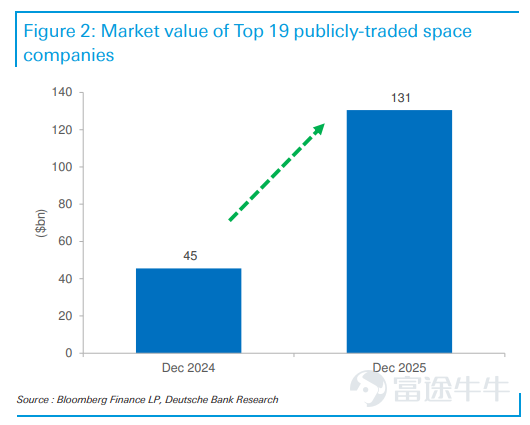
This series of policy moves has been interpreted by Wall Street as a major boon for the industry.Capital has the keenest sense of smell, and this wave of excitement has directly swept over the secondary market. The total market cap of leading U.S.-listed space companies skyrocketed nearly threefold in the past year. Institutional circles have formed a strong consensus:Space technology is strongly taking over from quantum computing as the next super赛道 (sector) to ignite a global capital feast.
![Fellow investors, as we face a brand-new 2026, instead of anxiously chasing trends, it's better to calmly understand the direction. Stay tuned.[Share Link: @Niuniu Classroom]to unlock your investment roadmap in real time. In the new year, let’s stay calm and patient, proceed steadily for long-term success, and slowly grow our wealth together. In 2026, the global space economy will reach a pivotal turning point, transitioning from "exploration" to "commercialization." This year, humanity’s journey to the stars will be unprecedentedly crowded: NASA’s Artemis II mission will restart manned lunar flybys, China’s Chang'e 7 aims for the lunar south pole in search of water ice, private newcomer Vast plans to launch the first commercial space station, and SpaceX intends to use a valuable launch window to send its "Starship" to Mars. However, beyond the roar of these hardcore technologies,The capital markets are holding their breath for another milestone—SpaceX, under Musk, may ignite an IPO rush within the year, potentially becoming the ultimate catalyst to fuel investment enthusiasm across the entire space sector. Looking ahead to 2026, we stand at the starting point of a new era of the "great space exploration age." With launch costs plummeting and commercialization accelerating, the space sector has become a super trend that investors simply cannot afford to ignore. This article will lead fellow investors in getting a head start on the industry’s prospects, helping to identify the standout companies likely to emerge victorious in future interstellar competition. Why should the space sector be on your radar? First, in December, Trump signed the "Ensuring American Space Superiority" executive order...](https://nnqimage.futunn.com/sns_client_feed/900080/20260106/web-1767702540979-2lxmqUIecb.png/big?area=1&is_public=true&imageMogr2/ignore-error/1/format/webp)
Goldman Sachs believes that this document provides positive fundamental support for space launch and exploration companies like Rocket Lab and Firefly Aerospace, as well as defense contractors such as L3Harris and AeroVironment.
Morgan Stanley believes that the rules of the game in the space sector have been completely rewritten by low Earth orbit (LEO) satellites.In this race, SpaceX's Starlink is like a fully operational cash-printing machine: controlling two-thirds of the world’s LEO satellites, with an average of one launch every two days by 2025, and user numbers skyrocketing at a rate of 100,000 per week. Behind this aggressive expansion lies the extreme efficiency brought by reusable rockets—costs are reduced tenfold while performance has increased a hundredfold, leaving competitors far behind.

Source: Morgan Stanley
This dimensional disruption operates on a physical level: compared to traditional geostationary orbit (GEO) satellites, Starlink lowers its orbital altitude to 550 kilometers, compressing latency from 600 milliseconds to around 25 milliseconds.This is not just a communications upgrade but also lays the physical foundation for future space data centers and high-definition IoT networks.
But the real crisis lies in the scarcity of resources. Recently, SpaceX announced lowering satellite orbits, ostensibly for safety reasons, but in reality, it’s a shrewd 'land grab' strategy.Our near-Earth space is not infinite; the safe distance between satellites is 50 kilometers, and low Earth orbit can accommodate only about 175,000 satellites at most.At the current launch rate, this 'parking lot' will soon reach full capacity. SpaceX’s strategy now is to occupy all the best parking spots early, leaving no room for latecomers.
Over the next decade, the space industry will undergo a paradigm shift from 'single communication coverage' to 'full-domain commercial development.'This may represent not just an extension of spatial boundaries but also a reshaping of value.
Which companies are worth watching?
Looking ahead, investment opportunities in the space sector revolve around two major themes:The first is the application layer—satellite internet and commercial implementation,This is a monetization theme centered on 'connectivity,' covering rocket launches, satellite manufacturing, and ground equipment; core players include SpaceX and Amazon.The second is the infrastructure layer—new space-based infrastructure,Including reusable rockets and space data centers.
We have compiled a list of companies related to the space field for fellow investors' reference:
![Fellow investors, as we face a brand-new 2026, instead of anxiously chasing trends, it's better to calmly understand the direction. Stay tuned.[Share Link: @Niuniu Classroom]to unlock your investment roadmap in real time. In the new year, let’s stay calm and patient, proceed steadily for long-term success, and slowly grow our wealth together. In 2026, the global space economy will reach a pivotal turning point, transitioning from "exploration" to "commercialization." This year, humanity’s journey to the stars will be unprecedentedly crowded: NASA’s Artemis II mission will restart manned lunar flybys, China’s Chang'e 7 aims for the lunar south pole in search of water ice, private newcomer Vast plans to launch the first commercial space station, and SpaceX intends to use a valuable launch window to send its "Starship" to Mars. However, beyond the roar of these hardcore technologies,The capital markets are holding their breath for another milestone—SpaceX, under Musk, may ignite an IPO rush within the year, potentially becoming the ultimate catalyst to fuel investment enthusiasm across the entire space sector. Looking ahead to 2026, we stand at the starting point of a new era of the "great space exploration age." With launch costs plummeting and commercialization accelerating, the space sector has become a super trend that investors simply cannot afford to ignore. This article will lead fellow investors in getting a head start on the industry’s prospects, helping to identify the standout companies likely to emerge victorious in future interstellar competition. Why should the space sector be on your radar? First, in December, Trump signed the "Ensuring American Space Superiority" executive order...](https://nnqimage.futunn.com/sns_client_feed/900080/20260106/web-1767702543539-LgYV0F80MN.png/big?area=1&is_public=true&imageMogr2/ignore-error/1/format/webp)
This chart clearly divides the space industry into five core sectors: orbital launch, satellite operations, infrastructure, manufacturing supply chain, and space funds. Below, we will break them down one by one, giving you an overview of these upcoming 'popping' investment opportunities.
1. Orbital Launch: The 'Toll Station' to the Universe
Launch capability is the bottleneck for all space commercial activities and represents the area with the deepest moat.
Industry Leaders and Challengers: Although SpaceX it is still a private company, it has defined industry standards. In the public market, $Rocket Lab (RKLB.US)$ is quickly establishing its position as the 'second pole,' with its Neutron rocket seen as a key growth engine. Additionally, $Firefly Aerospace (FLY.US)$ is a company dedicated to providing end-to-end space transportation services from low Earth orbit to the lunar surface. Known for its cost-effective light launch vehicles, Alpha and the lunar lander Blue Ghost , the company is also a core contractor for the US Department of Defense's Tactical Responsive Space mission, recognized as a leader in rapid space deployment and one of Rocket Lab’s strongest potential competitors in the small-to-medium launch market.
The alliance of traditional giants: The veteran military-industrial complexUnited Launch Alliance (ULA) remains solid, backed by the support of two major giants $Boeing (BA.US)$ and $Lockheed Martin (LMT.US)$ and holds a central position in heavy-duty national defense launch missions.
Space Tourism and New Models: $Virgin Galactic (SPCE.US)$ Continuing to explore the boundaries of commercialization in the suborbital tourism sector.
II. Satellite Operators: Space-based Internet and the 'God's Perspective'
This is currently the most commercialized track with the clearest cash flow.
Entry of Giants: $Amazon (AMZN.US)$ Amazon's Project Kuiper is the most anticipated constellation project after Starlink, with 2026 being the critical year for its production ramp-up.
Communications and IoT: This field is flourishing. $Iridium Communications (IRDM.US)$ and $Globalstar (GSAT.US)$ With a stable existing market and expectations of direct satellite-to-smartphone connectivity continuing to gain traction; $Viasat (VSAT.US)$ and $EchoStar (ECHO.US)$ Breakthroughs are being sought in the integration of traditional high-orbit and emerging low-orbit technologies; $Telesat (TSAT.US)$ is also actively deploying its Lightspeed network.
Direct satellite-to-smartphone: $AST SpaceMobile (ASTS.US)$ is the hottest player in this field, working on enabling ordinary smartphones to connect directly to satellites; the market has high hopes for the launch of its services by 2026.
Earth observation: The business model of 'selling data' is maturing. $Planet Labs PBC (PL.US)$ Owns the largest satellite constellation, $BlackSky Technology (BKSY.US)$ Focuses on real-time geospatial intelligence, $Satellogic (SATL.US)$ Known for high cost-effectiveness, while $Spire Global (SPIR.US)$ Specializes in radio occultation data (weather and shipping tracking).
III. Space Infrastructure: Lunar Economy and On-Orbit Services
These companies are the space version of 'selling shovels during a gold rush,' solving the problem of 'what to do after reaching space.'
Lunar Express: $Intuitive Machines (LUNR.US)$ Gained fame through its Commercial Lunar Payload Services (CLPS) and is a core target in the return-to-the-moon program.
Space stations and on-orbit services: $Voyager Technologies (VOYG.US)$ Dedicated to developing commercial space stations (Starlab), $Momentus (MNTS.US)$ They provide space tug services, helping satellites make precise orbital adjustments.
IV. Manufacturing and Supply Chain: The Most Hardcore 'Industrial Base'
This is the sector in the chart with the longest list and highest certainty. Regardless of whose rocket launch succeeds, companies providing materials, electronic components, and system integration will all get a share.
Defense and aerospace giants (system integrators): In addition to the aforementioned $Boeing (BA.US)$ and $Lockheed Martin (LMT.US)$ , $Northrop Grumman (NOC.US)$ 、 $RTX Corp (RTX.US)$ 、 $GE Aerospace (GE.US)$ 、 $L3Harris Technologies (LHX.US)$ and Europe's $AIRBUS SE (EADSY.US)$ and $BAE Systems plc Sponsored ADR (BAESY.US)$ , they are all stable recipients of space defense orders. Israel's $Elbit Systems (ESLT.US)$ also holds a position in specific electronic warfare fields.
Key Technologies and Materials:
◦ Materials: $Hexcel (HXL.US)$ They provide lightweight carbon fiber, which is crucial for reducing rocket weight.
◦ Electronics and Sensors: $Teledyne Technologies (TDY.US)$ 、 $Honeywell (HON.US)$ 、 $Heico-A (HEI.A.US)$ 、 $Astronics (ATRO.US)$ and $Trimble (TRMB.US)$ Provide indispensable navigation, control, and imaging sensors for satellites and rockets.
◦ Specialized Fields: $BWX Technologies (BWXT.US)$ Involved in nuclear thermal propulsion technology; $Kratos Defense & Security Solutions (KTOS.US)$ A leader in satellite ground communication systems and drone technologies; $Redwire (RDW.US)$Focused on advanced space infrastructure and manufacturing solutions,From solar arrays to 3D printing in space, their technology enables sustainable human exploration, satellite servicing, and lunar development; $Sidus Space (SIDU.US)$ Provides satellite manufacturing as a service; $KULR Technology (KULR.US)$ Addresses thermal management and battery safety issues in extreme space environments; $Leidos (LDOS.US)$ Offers complex systems engineering support.
AI Software: $Palantir (PLTR.US)$ Although it's a big data company, its software’s role in processing satellite intelligence and the military command chain has made it an important part of the space industry chain.
Five, Space Funds: A Shortcut to Basket Layout
For investors who don’t want to bet on a single technology route, ETFs offer a more robust choice.
Cathie Wood’s flagship: $ARK Space & Defense Innovation ETF (ARKX.US)$ It remains the most liquid actively managed space ETF in the market, covering many of the innovative companies mentioned above.
Democratization of Private Equity:$Destiny Tech100 (DXYZ.US)$ It provides a unique window for secondary market investors to indirectly hold shares of top private space tech companies like SpaceX.
Summary
The space industry in 2026 is no longer just about the romance of stargazing but solid commercial competition. Looking ahead, whether in long-term space exploration or short-term orbital resource contention, commercial aerospace holds profound strategic development significance.
However, the space industry belongs to a high-tech, high-risk field with fast technological iteration and significant policy impacts. Investors need to carefully assess the risks.
Fellow investors may also refer to previous articles in the 2026 outlook series.
Risk Disclaimer: The above content only represents the author's view. It does not represent any position or investment advice of Futu. Futu makes no representation or warranty.Read more


Comments (8)
to post a comment
393
744