
English
Back
Open Account
What kind of strategies do you use in options trading?
牛牛帶你飛
joined discussion · ·

How to use options to make money during the earnings season?

Publishing financial reports is an important day for a listed company. Each year's four earnings seasons are a sniper field for options users.
Publishing financial reports is an important day for a listed company. Each year's four earnings seasons are a sniper field for options users. The financial report conference brought official corporate news in stages, releasing the market sentiment, either positive or pessimistic. Faced with this kind of sentiment, the market will respond quickly, causing fluctuations in stock prices. Fluctuations are closely related to option prices. Three elements of options Before we begin to introduce options strategies for the earnings season, let's review the three factors that influence options: Time: If all other conditions are consistent, the closer the option is to the exercise date, the cheaper it is. The so-called “wear and tear” of options generally refers mainly to the decline in time value. As we said earlier, options are like insurance. The longer the insured, the more expensive the price. It is said that there are many dreams at night. The longer it is until the expiration date, the more expensive it is. 2) The price of the underlying stock. For call, the lower the exercise price, the more expensive; for put, the higher the exercise price. The so-called “buy low, sell high” is difficult to achieve, so the more valuable it is, and the price of the corresponding option is also more expensive. 3) Implied Volatility (IV): The higher the IV, the more expensive the option. The more likely the underlying stock is to fluctuate, the more expensive the options will be. It can be understood this way: the more it jumps up and down, the more unstable the trend, the more arbitrage opportunities there are, the more expensive the option price will be. So, what do you buy when you buy an option? As mentioned in the previous introduction, buying options is roughly equivalent to buying insurance. Let's be a little more professional today. If you think of an option as a valuable contract, then it includes:Intrinsic value+ time...
The financial report conference brought official corporate news in stages, releasing the market sentiment, either positive or pessimistic. Faced with this kind of sentiment, the market will respond quickly, causing fluctuations in stock prices.
Fluctuations are closely related to option prices.
Three elements of options
Before we begin to introduce options strategies for the earnings season, let's review the three factors that influence options:
Time: If all other conditions are consistent, the closer the option is to the exercise date, the cheaper it is. The so-called “wear and tear” of options generally refers mainly to the decline in time value.
As we said earlier, options are like insurance. The longer the insured, the more expensive the price. It is said that there are many dreams at night. The longer it is until the expiration date, the more expensive it is.
2) The price of the underlying stock. For call, the lower the exercise price, the more expensive; for put, the higher the exercise price. The so-called “buy low, sell high” is difficult to achieve, so the more valuable it is, and the price of the corresponding option is also more expensive.
3) Implied Volatility (IV): The higher the IV, the more expensive the option.
The more likely the underlying stock is to fluctuate, the more expensive the options will be. It can be understood this way: the more it jumps up and down, the more unstable the trend, the more arbitrage opportunities there are, the more expensive the option price will be.
Publishing financial reports is an important day for a listed company. Each year's four earnings seasons are a sniper field for options users. The financial report conference brought official corporate news in stages, releasing the market sentiment, either positive or pessimistic. Faced with this kind of sentiment, the market will respond quickly, causing fluctuations in stock prices. Fluctuations are closely related to option prices. Three elements of options Before we begin to introduce options strategies for the earnings season, let's review the three factors that influence options: Time: If all other conditions are consistent, the closer the option is to the exercise date, the cheaper it is. The so-called “wear and tear” of options generally refers mainly to the decline in time value. As we said earlier, options are like insurance. The longer the insured, the more expensive the price. It is said that there are many dreams at night. The longer it is until the expiration date, the more expensive it is. 2) The price of the underlying stock. For call, the lower the exercise price, the more expensive; for put, the higher the exercise price. The so-called “buy low, sell high” is difficult to achieve, so the more valuable it is, and the price of the corresponding option is also more expensive. 3) Implied Volatility (IV): The higher the IV, the more expensive the option. The more likely the underlying stock is to fluctuate, the more expensive the options will be. It can be understood this way: the more it jumps up and down, the more unstable the trend, the more arbitrage opportunities there are, the more expensive the option price will be. So, what do you buy when you buy an option? As mentioned in the previous introduction, buying options is roughly equivalent to buying insurance. Let's be a little more professional today. If you think of an option as a valuable contract, then it includes:Intrinsic value+ time...
So, what do you buy when you buy an option?
As mentioned in the previous introduction, buying options is roughly equivalent to buying insurance. Let's be a little more professional today.
If you think of an option as a valuable contract, then it includes:Intrinsic value+time value(Also commonly referred to as: real value and imaginary value) where the time value correlates with the option's implied volatility.
With the above foundation, let's get down to business (the following content is for study only and does not constitute investment advice):
What are some common operations during the earnings season?
1. Sharehold+buy put/sell put, or covered call
For more details, check out the previous article:
Options strategies in the face of declining shareholdinghttps://q.futunn.com/feed/107676081261700
Assuming I own tens of thousands of shares of Tencent, would I worry about his financial results plummeting after they are released? Generally speaking, before the financial report, many shareholders will be before the financial reportBuy some insurance for your underlying stock
1) Shareholding+buy put
If you pay a premium, you can lock in a small selling price, that is, lock in your own profits;
I need to explain here that this strategy is a bearish scenario. If you exercise power, you won't be able to hold shares in the end.
2) Shareholding+selling put
If you have collected rights and have sufficient funds, are optimistic about stocks for a long time, and plan to increase your position, then you can proceed this way and prepare to receive the goods.
This scenario is actually locking in the purchase price. If you exercise power, you will eventually buy the stock at the exercise price and hold the shares. You need to be careful to understand the differences and applicable market conditions between the “holding+sell put” scenario and the “holding+buy put” scenario.
3) Covered call
Hold the underlying stock plus sell the call, collect rights money, and worry that the stock will fall or not rise after the financial report.
Assuming today is March 9, 2022, I bought 1 lot of Tencent at a price of 380 HKD and spent 38,000 HKD. Tencent will release its financial report on March 23 (Wednesday), then I judge that Tencent's Q4 and annual reports for '21 may not meet expectations. It is expected that by Wednesday, March 30, Tencent's stock price will not exceed HK$400. If it rises to 400 HKD, it's OK to sell it.
[Sales call]
So on March 9, I sold a call with an expiration date of March 30 and an exercise price of HK$400. The price was HK$9.68. When I sold a call, I received a premium of HK$968. At this point, add this amount to my cost of ownership. My current 1 lot of Tencent, cost price = (38000-968) /1000 = 370.32 HKD
[Profit and loss calculation]
By March 30th
Situation 1:The stock price is less than 400 HKD, so this call won't exercise authority, IEarn HK$968The rights deposit continues to hold one hand of Tencent shares.
Situation 2:The stock price has reached 400 and above. At this point, I need to sell the stock at a price of 400. At this point, in addition to earning HK$2,968 in royalties, I can also earn a stock price difference: (400-380) *100=HK$2,000. In this wave, IEarn 968+2000 = HK$2968. However, if Tencent's stock price continues to rise and rises above 400, it has nothing to do with me.
Futu'sAdvanced options quotesIt provides rich profit and loss analysis to assist in decision-making.
Visit the detailed quotation page of the selling call from the options chain, and then click [Analysis] - [Profit and Loss Analysis]. In the case of selling a call, select [Buy the same amount of underlying shares] on the right. The profit and loss analysis at this point is a covered call's profit and loss analysis. As can be seen from the data, under this combination, as long as the stock rises to HK$373.56, it is profitable. It's just that the benefits are limited.
Publishing financial reports is an important day for a listed company. Each year's four earnings seasons are a sniper field for options users. The financial report conference brought official corporate news in stages, releasing the market sentiment, either positive or pessimistic. Faced with this kind of sentiment, the market will respond quickly, causing fluctuations in stock prices. Fluctuations are closely related to option prices. Three elements of options Before we begin to introduce options strategies for the earnings season, let's review the three factors that influence options: Time: If all other conditions are consistent, the closer the option is to the exercise date, the cheaper it is. The so-called “wear and tear” of options generally refers mainly to the decline in time value. As we said earlier, options are like insurance. The longer the insured, the more expensive the price. It is said that there are many dreams at night. The longer it is until the expiration date, the more expensive it is. 2) The price of the underlying stock. For call, the lower the exercise price, the more expensive; for put, the higher the exercise price. The so-called “buy low, sell high” is difficult to achieve, so the more valuable it is, and the price of the corresponding option is also more expensive. 3) Implied Volatility (IV): The higher the IV, the more expensive the option. The more likely the underlying stock is to fluctuate, the more expensive the options will be. It can be understood this way: the more it jumps up and down, the more unstable the trend, the more arbitrage opportunities there are, the more expensive the option price will be. So, what do you buy when you buy an option? As mentioned in the previous introduction, buying options is roughly equivalent to buying insurance. Let's be a little more professional today. If you think of an option as a valuable contract, then it includes:Intrinsic value+ time...
2. Price difference combination (Spread)
The spread strategy, as the name suggests, is that there is a price difference in this combination. It consists of a long option position and a short option position, and the options within the group have the same size and the same bullish and bearish direction (either two calls or two puts).
If the trading call is the most frequently used option combination, then the spread combination is the most versatile combination.
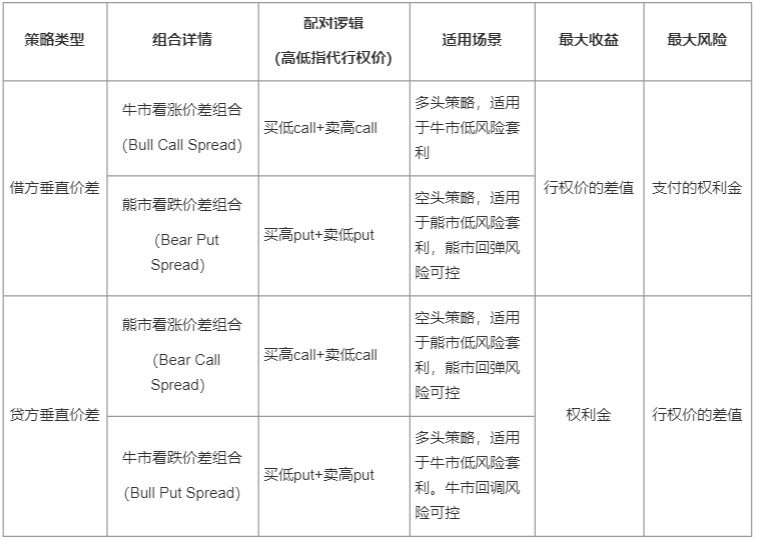
Common spread combinations include the following:
Publishing financial reports is an important day for a listed company. Each year's four earnings seasons are a sniper field for options users. The financial report conference brought official corporate news in stages, releasing the market sentiment, either positive or pessimistic. Faced with this kind of sentiment, the market will respond quickly, causing fluctuations in stock prices. Fluctuations are closely related to option prices. Three elements of options Before we begin to introduce options strategies for the earnings season, let's review the three factors that influence options: Time: If all other conditions are consistent, the closer the option is to the exercise date, the cheaper it is. The so-called “wear and tear” of options generally refers mainly to the decline in time value. As we said earlier, options are like insurance. The longer the insured, the more expensive the price. It is said that there are many dreams at night. The longer it is until the expiration date, the more expensive it is. 2) The price of the underlying stock. For call, the lower the exercise price, the more expensive; for put, the higher the exercise price. The so-called “buy low, sell high” is difficult to achieve, so the more valuable it is, and the price of the corresponding option is also more expensive. 3) Implied Volatility (IV): The higher the IV, the more expensive the option. The more likely the underlying stock is to fluctuate, the more expensive the options will be. It can be understood this way: the more it jumps up and down, the more unstable the trend, the more arbitrage opportunities there are, the more expensive the option price will be. So, what do you buy when you buy an option? As mentioned in the previous introduction, buying options is roughly equivalent to buying insurance. Let's be a little more professional today. If you think of an option as a valuable contract, then it includes:Intrinsic value+ time...

If I were to explain all these strategies once, it would take some time. There is a memory trick you can memorize first and then understand:
Buying high and selling low is a bear spread; buying low and selling high is a bullish spread; closing more than spending is a credit spread; spending more than income is a debit spread.
Today we'll pick two strategies that are suitable for operation during the earnings season.
Publishing financial reports is an important day for a listed company. Each year's four earnings seasons are a sniper field for options users. The financial report conference brought official corporate news in stages, releasing the market sentiment, either positive or pessimistic. Faced with this kind of sentiment, the market will respond quickly, causing fluctuations in stock prices. Fluctuations are closely related to option prices. Three elements of options Before we begin to introduce options strategies for the earnings season, let's review the three factors that influence options: Time: If all other conditions are consistent, the closer the option is to the exercise date, the cheaper it is. The so-called “wear and tear” of options generally refers mainly to the decline in time value. As we said earlier, options are like insurance. The longer the insured, the more expensive the price. It is said that there are many dreams at night. The longer it is until the expiration date, the more expensive it is. 2) The price of the underlying stock. For call, the lower the exercise price, the more expensive; for put, the higher the exercise price. The so-called “buy low, sell high” is difficult to achieve, so the more valuable it is, and the price of the corresponding option is also more expensive. 3) Implied Volatility (IV): The higher the IV, the more expensive the option. The more likely the underlying stock is to fluctuate, the more expensive the options will be. It can be understood this way: the more it jumps up and down, the more unstable the trend, the more arbitrage opportunities there are, the more expensive the option price will be. So, what do you buy when you buy an option? As mentioned in the previous introduction, buying options is roughly equivalent to buying insurance. Let's be a little more professional today. If you think of an option as a valuable contract, then it includes:Intrinsic value+ time...
2.1 Bull Market Bullish Spread Combination (Bull Call Spread)
Combination method:Buy a call with a low price, sell a call with a high price
Profit and loss situation:The biggest benefit is the price difference of the exercise price, and the biggest loss is the loss of the premium
Combined style:It is a “moderately bullish” combination. It is expected that after the earnings report, the stock price will rise slightly. It is suitable for arbitrage at this time to earn some living expenses
To show professionalism, let's use a profit and loss chart for a combination of bullish spreads in a bull market.
Publishing financial reports is an important day for a listed company. Each year's four earnings seasons are a sniper field for options users. The financial report conference brought official corporate news in stages, releasing the market sentiment, either positive or pessimistic. Faced with this kind of sentiment, the market will respond quickly, causing fluctuations in stock prices. Fluctuations are closely related to option prices. Three elements of options Before we begin to introduce options strategies for the earnings season, let's review the three factors that influence options: Time: If all other conditions are consistent, the closer the option is to the exercise date, the cheaper it is. The so-called “wear and tear” of options generally refers mainly to the decline in time value. As we said earlier, options are like insurance. The longer the insured, the more expensive the price. It is said that there are many dreams at night. The longer it is until the expiration date, the more expensive it is. 2) The price of the underlying stock. For call, the lower the exercise price, the more expensive; for put, the higher the exercise price. The so-called “buy low, sell high” is difficult to achieve, so the more valuable it is, and the price of the corresponding option is also more expensive. 3) Implied Volatility (IV): The higher the IV, the more expensive the option. The more likely the underlying stock is to fluctuate, the more expensive the options will be. It can be understood this way: the more it jumps up and down, the more unstable the trend, the more arbitrage opportunities there are, the more expensive the option price will be. So, what do you buy when you buy an option? As mentioned in the previous introduction, buying options is roughly equivalent to buying insurance. Let's be a little more professional today. If you think of an option as a valuable contract, then it includes:Intrinsic value+ time...

Just speaking, you have to practice.
Next, let's take Pinduoduo (PDD) as an example (the following data is fictional data, for study only)
Publishing financial reports is an important day for a listed company. Each year's four earnings seasons are a sniper field for options users. The financial report conference brought official corporate news in stages, releasing the market sentiment, either positive or pessimistic. Faced with this kind of sentiment, the market will respond quickly, causing fluctuations in stock prices. Fluctuations are closely related to option prices. Three elements of options Before we begin to introduce options strategies for the earnings season, let's review the three factors that influence options: Time: If all other conditions are consistent, the closer the option is to the exercise date, the cheaper it is. The so-called “wear and tear” of options generally refers mainly to the decline in time value. As we said earlier, options are like insurance. The longer the insured, the more expensive the price. It is said that there are many dreams at night. The longer it is until the expiration date, the more expensive it is. 2) The price of the underlying stock. For call, the lower the exercise price, the more expensive; for put, the higher the exercise price. The so-called “buy low, sell high” is difficult to achieve, so the more valuable it is, and the price of the corresponding option is also more expensive. 3) Implied Volatility (IV): The higher the IV, the more expensive the option. The more likely the underlying stock is to fluctuate, the more expensive the options will be. It can be understood this way: the more it jumps up and down, the more unstable the trend, the more arbitrage opportunities there are, the more expensive the option price will be. So, what do you buy when you buy an option? As mentioned in the previous introduction, buying options is roughly equivalent to buying insurance. Let's be a little more professional today. If you think of an option as a valuable contract, then it includes:Intrinsic value+ time...
Assuming that PDD plans to release financial reports on March 16, I judge that the stock price earnings report will exceed expectations after it is released on March 9. So on March 9th, I did the following
1. Buy one that expires on March 18. The exercise price is 38 calls. Pay the premium: 425 US dollars
2. When you sell a call that expires on March 18, the exercise price is 42 calls, you receive a premium of $239
Cumulative payment: $186 premium.
Thus, a combination of bullish bullish spreads was formed. Incidentally, this combination is a type of vertical spread combination, so you can enjoy Futu's margin reduction. For more details on the exemption rules, see this post:
The financial report was released on March 16. On March 18, the expiration date of the right:
Assumption 1: The stock price rises above $42 (including $42)
Both options will work, so it's equivalent to selling 100 shares at 42 US dollars and then buying 100 shares at 38 US dollars, so the profit is 100x (42-38) = 400 dollars. Plus the premium paid, the total profit is 400-186 = 214 US dollars. This is the biggest profit.
Assumption 2: If the stock price is below 38
All options will not be exercised, so loss = premium paid by buying call - premium received by selling call) = 425-239 = $186, which is the biggest loss.
Assumption 3: The share price is between 38 and 42
The profit balance point for this combination is 40.21 dollars. If the stock price exceeds 40.21 US dollars, it is profit, and below 40.21 US dollars is loss.
How do you view the break-even point of an option portfolio?
Currently, the option high price function of Bull Niu supports checking the profit and loss of option combinations. The specific path is as follows:
1. Select any option in the combination to go to the details page. I chose Call with an exercise price of 42, and then click “Analyze” for the detailed option price.
Publishing financial reports is an important day for a listed company. Each year's four earnings seasons are a sniper field for options users. The financial report conference brought official corporate news in stages, releasing the market sentiment, either positive or pessimistic. Faced with this kind of sentiment, the market will respond quickly, causing fluctuations in stock prices. Fluctuations are closely related to option prices. Three elements of options Before we begin to introduce options strategies for the earnings season, let's review the three factors that influence options: Time: If all other conditions are consistent, the closer the option is to the exercise date, the cheaper it is. The so-called “wear and tear” of options generally refers mainly to the decline in time value. As we said earlier, options are like insurance. The longer the insured, the more expensive the price. It is said that there are many dreams at night. The longer it is until the expiration date, the more expensive it is. 2) The price of the underlying stock. For call, the lower the exercise price, the more expensive; for put, the higher the exercise price. The so-called “buy low, sell high” is difficult to achieve, so the more valuable it is, and the price of the corresponding option is also more expensive. 3) Implied Volatility (IV): The higher the IV, the more expensive the option. The more likely the underlying stock is to fluctuate, the more expensive the options will be. It can be understood this way: the more it jumps up and down, the more unstable the trend, the more arbitrage opportunities there are, the more expensive the option price will be. So, what do you buy when you buy an option? As mentioned in the previous introduction, buying options is roughly equivalent to buying insurance. Let's be a little more professional today. If you think of an option as a valuable contract, then it includes:Intrinsic value+ time...
2. Underline the expiry equity profit and loss chart area, select [Combination], then click the option next to the long strategy, as shown on the right below. Select Bull Call Spread, then adjust the content in the 34th red frame to adjust the combination you plan to operate. The break-even chart of this combination will be shown below, and a more detailed profit and loss analysis will be calculated at the bottom.
Publishing financial reports is an important day for a listed company. Each year's four earnings seasons are a sniper field for options users. The financial report conference brought official corporate news in stages, releasing the market sentiment, either positive or pessimistic. Faced with this kind of sentiment, the market will respond quickly, causing fluctuations in stock prices. Fluctuations are closely related to option prices. Three elements of options Before we begin to introduce options strategies for the earnings season, let's review the three factors that influence options: Time: If all other conditions are consistent, the closer the option is to the exercise date, the cheaper it is. The so-called “wear and tear” of options generally refers mainly to the decline in time value. As we said earlier, options are like insurance. The longer the insured, the more expensive the price. It is said that there are many dreams at night. The longer it is until the expiration date, the more expensive it is. 2) The price of the underlying stock. For call, the lower the exercise price, the more expensive; for put, the higher the exercise price. The so-called “buy low, sell high” is difficult to achieve, so the more valuable it is, and the price of the corresponding option is also more expensive. 3) Implied Volatility (IV): The higher the IV, the more expensive the option. The more likely the underlying stock is to fluctuate, the more expensive the options will be. It can be understood this way: the more it jumps up and down, the more unstable the trend, the more arbitrage opportunities there are, the more expensive the option price will be. So, what do you buy when you buy an option? As mentioned in the previous introduction, buying options is roughly equivalent to buying insurance. Let's be a little more professional today. If you think of an option as a valuable contract, then it includes:Intrinsic value+ time...
Note: As you can see, there is a discrepancy between the analysis in the figure below and the calculation I gave above. These data are all calculated based on historical data, and the actual profit and loss needs to be determined based on the order transaction situation.
2.2 Bear Market Bearish Spread Combination (Bear Put Spread)
Combination method:Buy a high-priced put, sell a low-priced put
Profit and loss situation:The biggest benefit is the price difference between the exercise price, and the biggest loss is the payment of the premium
Combined style:It's a “moderately bearish” combination. It is expected to fall after the earnings report is released, but it won't drop much, and it's not expected to fall below a certain price.
Take Tesla stock as an example:
Publishing financial reports is an important day for a listed company. Each year's four earnings seasons are a sniper field for options users. The financial report conference brought official corporate news in stages, releasing the market sentiment, either positive or pessimistic. Faced with this kind of sentiment, the market will respond quickly, causing fluctuations in stock prices. Fluctuations are closely related to option prices. Three elements of options Before we begin to introduce options strategies for the earnings season, let's review the three factors that influence options: Time: If all other conditions are consistent, the closer the option is to the exercise date, the cheaper it is. The so-called “wear and tear” of options generally refers mainly to the decline in time value. As we said earlier, options are like insurance. The longer the insured, the more expensive the price. It is said that there are many dreams at night. The longer it is until the expiration date, the more expensive it is. 2) The price of the underlying stock. For call, the lower the exercise price, the more expensive; for put, the higher the exercise price. The so-called “buy low, sell high” is difficult to achieve, so the more valuable it is, and the price of the corresponding option is also more expensive. 3) Implied Volatility (IV): The higher the IV, the more expensive the option. The more likely the underlying stock is to fluctuate, the more expensive the options will be. It can be understood this way: the more it jumps up and down, the more unstable the trend, the more arbitrage opportunities there are, the more expensive the option price will be. So, what do you buy when you buy an option? As mentioned in the previous introduction, buying options is roughly equivalent to buying insurance. Let's be a little more professional today. If you think of an option as a valuable contract, then it includes:Intrinsic value+ time...
The date of Tesla's exercise of power is March 11 in the put option chain.
1. Sell a put with an exercise price of 790
2. Buy a put with an exercise price of 810
This forms a “bear market bearish spread” option strategy combination.
By March 11th:
Assumption 1: The stock price did not fall to 810, above 810
These two options were not exercised. Revenue = premium received from selling PUT - premium spent buying PUT = 915-1530 = -$615, which was the biggest loss.
Assumption 2: If the stock price is below 790
Both options were exercised, which is equivalent to selling 100 shares at the price of 810 and then buying them at the price of 790, so the profit was 100x (810-790) = 3,000 dollars. Plus the premium income, the total loss was 3000 - +580 = 3,580 US dollars.
Assumption 3: The share price is between 790 and 810
The balance point of profit and loss for this combination is $801.85. If the stock price exceeds $801.85, it is a loss; below $801.85 is a profit.
The estimate of the break-even point is shown in the figure below:
Publishing financial reports is an important day for a listed company. Each year's four earnings seasons are a sniper field for options users. The financial report conference brought official corporate news in stages, releasing the market sentiment, either positive or pessimistic. Faced with this kind of sentiment, the market will respond quickly, causing fluctuations in stock prices. Fluctuations are closely related to option prices. Three elements of options Before we begin to introduce options strategies for the earnings season, let's review the three factors that influence options: Time: If all other conditions are consistent, the closer the option is to the exercise date, the cheaper it is. The so-called “wear and tear” of options generally refers mainly to the decline in time value. As we said earlier, options are like insurance. The longer the insured, the more expensive the price. It is said that there are many dreams at night. The longer it is until the expiration date, the more expensive it is. 2) The price of the underlying stock. For call, the lower the exercise price, the more expensive; for put, the higher the exercise price. The so-called “buy low, sell high” is difficult to achieve, so the more valuable it is, and the price of the corresponding option is also more expensive. 3) Implied Volatility (IV): The higher the IV, the more expensive the option. The more likely the underlying stock is to fluctuate, the more expensive the options will be. It can be understood this way: the more it jumps up and down, the more unstable the trend, the more arbitrage opportunities there are, the more expensive the option price will be. So, what do you buy when you buy an option? As mentioned in the previous introduction, buying options is roughly equivalent to buying insurance. Let's be a little more professional today. If you think of an option as a valuable contract, then it includes:Intrinsic value+ time...
3. Neutral Strategy - Strangle (Strangle)
Straddle is commonly known as a saddle style, which refers to a combination of call and put where the purchase price and expiration date are the same. The exercise price is usually close to the current price.
The biggest advantage of this strategy: it doesn't judge the direction; it only requires large fluctuations; the fluctuation of the underlying stock is enough to make the profit on one side greater than the cost on both sides.
The strategy of cross-modality combinations is that the risk is that the price of the underlying stock does not fluctuate enough to offset the cost of purchasing two options.
After a company releases financial reports, stock prices often fluctuate greatly. You can check the historical fluctuations of stocks you are interested in on Niu Niu on Niu Niu after the publication of financial reports, study, and analyze them.
How can I check the changes in the company's stock price after the financial report?
As an example, on the detailed quotation page, the small dot in the circle indicates “company action”. After the K line moves to the same day, you can see that the financial report was published on that day, then click “View today's minutes” that appears below the little dot, then the full K line before, during, and after the day's session will appear below. As can be seen, after the post-market earnings report was released, the K-line after the market went all the way upward, with an increase of as high as 16%.
The picture on the right below is Meta (Facebook). After the earnings report was released on February 2, the stock price plummeted 20%.
Publishing financial reports is an important day for a listed company. Each year's four earnings seasons are a sniper field for options users. The financial report conference brought official corporate news in stages, releasing the market sentiment, either positive or pessimistic. Faced with this kind of sentiment, the market will respond quickly, causing fluctuations in stock prices. Fluctuations are closely related to option prices. Three elements of options Before we begin to introduce options strategies for the earnings season, let's review the three factors that influence options: Time: If all other conditions are consistent, the closer the option is to the exercise date, the cheaper it is. The so-called “wear and tear” of options generally refers mainly to the decline in time value. As we said earlier, options are like insurance. The longer the insured, the more expensive the price. It is said that there are many dreams at night. The longer it is until the expiration date, the more expensive it is. 2) The price of the underlying stock. For call, the lower the exercise price, the more expensive; for put, the higher the exercise price. The so-called “buy low, sell high” is difficult to achieve, so the more valuable it is, and the price of the corresponding option is also more expensive. 3) Implied Volatility (IV): The higher the IV, the more expensive the option. The more likely the underlying stock is to fluctuate, the more expensive the options will be. It can be understood this way: the more it jumps up and down, the more unstable the trend, the more arbitrage opportunities there are, the more expensive the option price will be. So, what do you buy when you buy an option? As mentioned in the previous introduction, buying options is roughly equivalent to buying insurance. Let's be a little more professional today. If you think of an option as a valuable contract, then it includes:Intrinsic value+ time...
Going back to the operational level of options strategies, if we were to judge that after a company releases financial reports, there will be large fluctuations; it may skyrocket; it may plummet. Well, options players commonly use cross-style strategies or broad-span strategies.
The principle of cross-style and wide-span style is the same. The difference from cross-style is that cross-style is a combination of call and put with the same expiration date, and the exercise price is usually in addition to the price. You can profit when the price breaks through a certain range (whether it rises or falls), andGambling VolatilityIt is suitable for stocks where the price of the underlying stock fluctuates greatly. Typical ones are growth stocks and technology stocks.
In the image below, the left side is a span style, and the right side is a wide span style.
Publishing financial reports is an important day for a listed company. Each year's four earnings seasons are a sniper field for options users. The financial report conference brought official corporate news in stages, releasing the market sentiment, either positive or pessimistic. Faced with this kind of sentiment, the market will respond quickly, causing fluctuations in stock prices. Fluctuations are closely related to option prices. Three elements of options Before we begin to introduce options strategies for the earnings season, let's review the three factors that influence options: Time: If all other conditions are consistent, the closer the option is to the exercise date, the cheaper it is. The so-called “wear and tear” of options generally refers mainly to the decline in time value. As we said earlier, options are like insurance. The longer the insured, the more expensive the price. It is said that there are many dreams at night. The longer it is until the expiration date, the more expensive it is. 2) The price of the underlying stock. For call, the lower the exercise price, the more expensive; for put, the higher the exercise price. The so-called “buy low, sell high” is difficult to achieve, so the more valuable it is, and the price of the corresponding option is also more expensive. 3) Implied Volatility (IV): The higher the IV, the more expensive the option. The more likely the underlying stock is to fluctuate, the more expensive the options will be. It can be understood this way: the more it jumps up and down, the more unstable the trend, the more arbitrage opportunities there are, the more expensive the option price will be. So, what do you buy when you buy an option? As mentioned in the previous introduction, buying options is roughly equivalent to buying insurance. Let's be a little more professional today. If you think of an option as a valuable contract, then it includes:Intrinsic value+ time...
For example: Now it's March 9. On March 11 (Friday), Futu will release financial reports. I expect the stock price to fluctuate greatly after the earnings report is released, but I don't know if it will rise or fall.
Click on Futu's options chain, go to the detailed price page for options due on March 18, then click Analyze to view the current volatility analysis. As can be seen, the volatility of options due on March 18 is much higher than the average for the past month.
Publishing financial reports is an important day for a listed company. Each year's four earnings seasons are a sniper field for options users. The financial report conference brought official corporate news in stages, releasing the market sentiment, either positive or pessimistic. Faced with this kind of sentiment, the market will respond quickly, causing fluctuations in stock prices. Fluctuations are closely related to option prices. Three elements of options Before we begin to introduce options strategies for the earnings season, let's review the three factors that influence options: Time: If all other conditions are consistent, the closer the option is to the exercise date, the cheaper it is. The so-called “wear and tear” of options generally refers mainly to the decline in time value. As we said earlier, options are like insurance. The longer the insured, the more expensive the price. It is said that there are many dreams at night. The longer it is until the expiration date, the more expensive it is. 2) The price of the underlying stock. For call, the lower the exercise price, the more expensive; for put, the higher the exercise price. The so-called “buy low, sell high” is difficult to achieve, so the more valuable it is, and the price of the corresponding option is also more expensive. 3) Implied Volatility (IV): The higher the IV, the more expensive the option. The more likely the underlying stock is to fluctuate, the more expensive the options will be. It can be understood this way: the more it jumps up and down, the more unstable the trend, the more arbitrage opportunities there are, the more expensive the option price will be. So, what do you buy when you buy an option? As mentioned in the previous introduction, buying options is roughly equivalent to buying insurance. Let's be a little more professional today. If you think of an option as a valuable contract, then it includes:Intrinsic value+ time...
Click “Profit and Loss Analysis” next to “Volatility Analysis” and click “Combine” under the “Options Profit and Loss Chart” to select the neutral strategy: strangle. As you can see, a wide range of buyers has been combined. You can check the earnings situation at different exercise prices by adjusting the target price according to your own predictions.
Publishing financial reports is an important day for a listed company. Each year's four earnings seasons are a sniper field for options users. The financial report conference brought official corporate news in stages, releasing the market sentiment, either positive or pessimistic. Faced with this kind of sentiment, the market will respond quickly, causing fluctuations in stock prices. Fluctuations are closely related to option prices. Three elements of options Before we begin to introduce options strategies for the earnings season, let's review the three factors that influence options: Time: If all other conditions are consistent, the closer the option is to the exercise date, the cheaper it is. The so-called “wear and tear” of options generally refers mainly to the decline in time value. As we said earlier, options are like insurance. The longer the insured, the more expensive the price. It is said that there are many dreams at night. The longer it is until the expiration date, the more expensive it is. 2) The price of the underlying stock. For call, the lower the exercise price, the more expensive; for put, the higher the exercise price. The so-called “buy low, sell high” is difficult to achieve, so the more valuable it is, and the price of the corresponding option is also more expensive. 3) Implied Volatility (IV): The higher the IV, the more expensive the option. The more likely the underlying stock is to fluctuate, the more expensive the options will be. It can be understood this way: the more it jumps up and down, the more unstable the trend, the more arbitrage opportunities there are, the more expensive the option price will be. So, what do you buy when you buy an option? As mentioned in the previous introduction, buying options is roughly equivalent to buying insurance. Let's be a little more professional today. If you think of an option as a valuable contract, then it includes:Intrinsic value+ time...
The combination pictured above is expected to be profitable if the stock price falls below $26.03 or above $38.47 in the week after the earnings report is released. The stock price is in the range of 26.03-38.47 US dollars. The biggest loss was the royalties for buying these two options. It is estimated to be 397 US dollars.
Publishing financial reports is an important day for a listed company. Each year's four earnings seasons are a sniper field for options users. The financial report conference brought official corporate news in stages, releasing the market sentiment, either positive or pessimistic. Faced with this kind of sentiment, the market will respond quickly, causing fluctuations in stock prices. Fluctuations are closely related to option prices. Three elements of options Before we begin to introduce options strategies for the earnings season, let's review the three factors that influence options: Time: If all other conditions are consistent, the closer the option is to the exercise date, the cheaper it is. The so-called “wear and tear” of options generally refers mainly to the decline in time value. As we said earlier, options are like insurance. The longer the insured, the more expensive the price. It is said that there are many dreams at night. The longer it is until the expiration date, the more expensive it is. 2) The price of the underlying stock. For call, the lower the exercise price, the more expensive; for put, the higher the exercise price. The so-called “buy low, sell high” is difficult to achieve, so the more valuable it is, and the price of the corresponding option is also more expensive. 3) Implied Volatility (IV): The higher the IV, the more expensive the option. The more likely the underlying stock is to fluctuate, the more expensive the options will be. It can be understood this way: the more it jumps up and down, the more unstable the trend, the more arbitrage opportunities there are, the more expensive the option price will be. So, what do you buy when you buy an option? As mentioned in the previous introduction, buying options is roughly equivalent to buying insurance. Let's be a little more professional today. If you think of an option as a valuable contract, then it includes:Intrinsic value+ time...
How can the combination security deposit be reduced?
All of the combined strategies mentioned above have corresponding margin relief offers. For details, please see:
Demo trading guide
Of course, as a newbie, I still recommend going to the demo market to find out how it feels to see how the three elements of options change over time and stock prices.
Futu Niu's simulated transaction cannot simulate the exercise of power; it can only simulate a cash delivery.
The operation is as follows: First, access the option chain - find the target option - the small square button below - simulate a transaction
Publishing financial reports is an important day for a listed company. Each year's four earnings seasons are a sniper field for options users. The financial report conference brought official corporate news in stages, releasing the market sentiment, either positive or pessimistic. Faced with this kind of sentiment, the market will respond quickly, causing fluctuations in stock prices. Fluctuations are closely related to option prices. Three elements of options Before we begin to introduce options strategies for the earnings season, let's review the three factors that influence options: Time: If all other conditions are consistent, the closer the option is to the exercise date, the cheaper it is. The so-called “wear and tear” of options generally refers mainly to the decline in time value. As we said earlier, options are like insurance. The longer the insured, the more expensive the price. It is said that there are many dreams at night. The longer it is until the expiration date, the more expensive it is. 2) The price of the underlying stock. For call, the lower the exercise price, the more expensive; for put, the higher the exercise price. The so-called “buy low, sell high” is difficult to achieve, so the more valuable it is, and the price of the corresponding option is also more expensive. 3) Implied Volatility (IV): The higher the IV, the more expensive the option. The more likely the underlying stock is to fluctuate, the more expensive the options will be. It can be understood this way: the more it jumps up and down, the more unstable the trend, the more arbitrage opportunities there are, the more expensive the option price will be. So, what do you buy when you buy an option? As mentioned in the previous introduction, buying options is roughly equivalent to buying insurance. Let's be a little more professional today. If you think of an option as a valuable contract, then it includes:Intrinsic value+ time...
All friends, let's do our best, because
Publishing financial reports is an important day for a listed company. Each year's four earnings seasons are a sniper field for options users. The financial report conference brought official corporate news in stages, releasing the market sentiment, either positive or pessimistic. Faced with this kind of sentiment, the market will respond quickly, causing fluctuations in stock prices. Fluctuations are closely related to option prices. Three elements of options Before we begin to introduce options strategies for the earnings season, let's review the three factors that influence options: Time: If all other conditions are consistent, the closer the option is to the exercise date, the cheaper it is. The so-called “wear and tear” of options generally refers mainly to the decline in time value. As we said earlier, options are like insurance. The longer the insured, the more expensive the price. It is said that there are many dreams at night. The longer it is until the expiration date, the more expensive it is. 2) The price of the underlying stock. For call, the lower the exercise price, the more expensive; for put, the higher the exercise price. The so-called “buy low, sell high” is difficult to achieve, so the more valuable it is, and the price of the corresponding option is also more expensive. 3) Implied Volatility (IV): The higher the IV, the more expensive the option. The more likely the underlying stock is to fluctuate, the more expensive the options will be. It can be understood this way: the more it jumps up and down, the more unstable the trend, the more arbitrage opportunities there are, the more expensive the option price will be. So, what do you buy when you buy an option? As mentioned in the previous introduction, buying options is roughly equivalent to buying insurance. Let's be a little more professional today. If you think of an option as a valuable contract, then it includes:Intrinsic value+ time...
Risk Disclaimer: The above content only represents the author's view. It does not represent any position or investment advice of Futu. Futu makes no representation or warranty.Read more
Respect
2
Sob
2
Heart
7
Lol
2
Emm
1
Thumbs Up
119
515K Views
Report
Comments (20)
Write a Comment...
20
133
453