OpenAI delays IPO; is Anthropic still aiming for a $2 trillion valuation?

Anthropic vs. OpenAI: ETF holdings of the two AI giants revealed, who is the biggest winner behind the scenes?
Anthropic is pushing the imagination of the AI capital market to a whole new level.
On August 25, citing sources familiar with the matter, The Wall Street Journal reported that Anthropic is preparing to present an extremely aggressive growth story to potential IPO investors:The company believes its Total Addressable Market (TAM) will exceed $30 trillion,surpassing $SpaceX (SPCX.US)$ the previously proposed $28.5 trillion, making it one of the most significant TAM narratives in the IPO market to date.
More importantly, Anthropic is not just "painting a rosy picture."
The company expects revenue to reach approximately$190 billion to $200 billion by 2028; market sources indicate that its IPO could raise up to approximately$100 billion, with a target valuation potentially reaching$2 trillion, with an IPO potentially completed as early as September or October.
If successfully executed, Anthropic may not just be the next mega-IPO,but rather the first to push the valuation of a pure-play AI model company into the "$2 trillion club."
But for secondary market investors, the more pressing question is actually:Which listed companies will Anthropic's IPO help bring to the table?
With a $30 trillion TAM, what narrative is Anthropic really selling?
TAM (Total Addressable Market) can be understood as: the theoretical annual revenue opportunity if a product ultimately captures 100% of its target market share.
Anthropic's calculation is highly aggressive—it doesn't just account for the chatbot, coding agent, or enterprise API markets, but attempts to include "all work that could potentially be performed by AI models" in the future.
In other words, what Anthropic is truly selling to Wall Street is not just Claude. It is selling a grander proposition:AI will ultimately become the new "digital workforce," permeating nearly all knowledge work and enterprise processes.
Therefore, the $30 trillion figure is not a revenue forecast for 2027 or 2028, but rather the "ceiling" Anthropic is attempting to set for the AI industry's total addressable market (TAM).
Here is an interesting comparison. Even based on Anthropic's projected 2028 revenue of $200 billion, it would only account for approximately0.7%。
Thus, what Anthropic needs to prove to investors is:If AI can truly capture just 1%, 2%, or even 5% of this market, the long-term revenue ceiling for a model company could be far higher than that of any current SaaS company.
This is also the core rationale behind the $2 trillion valuation narrative.
Anthropic vs. OpenAI: ETFs have already mapped out the two AI landscapes.
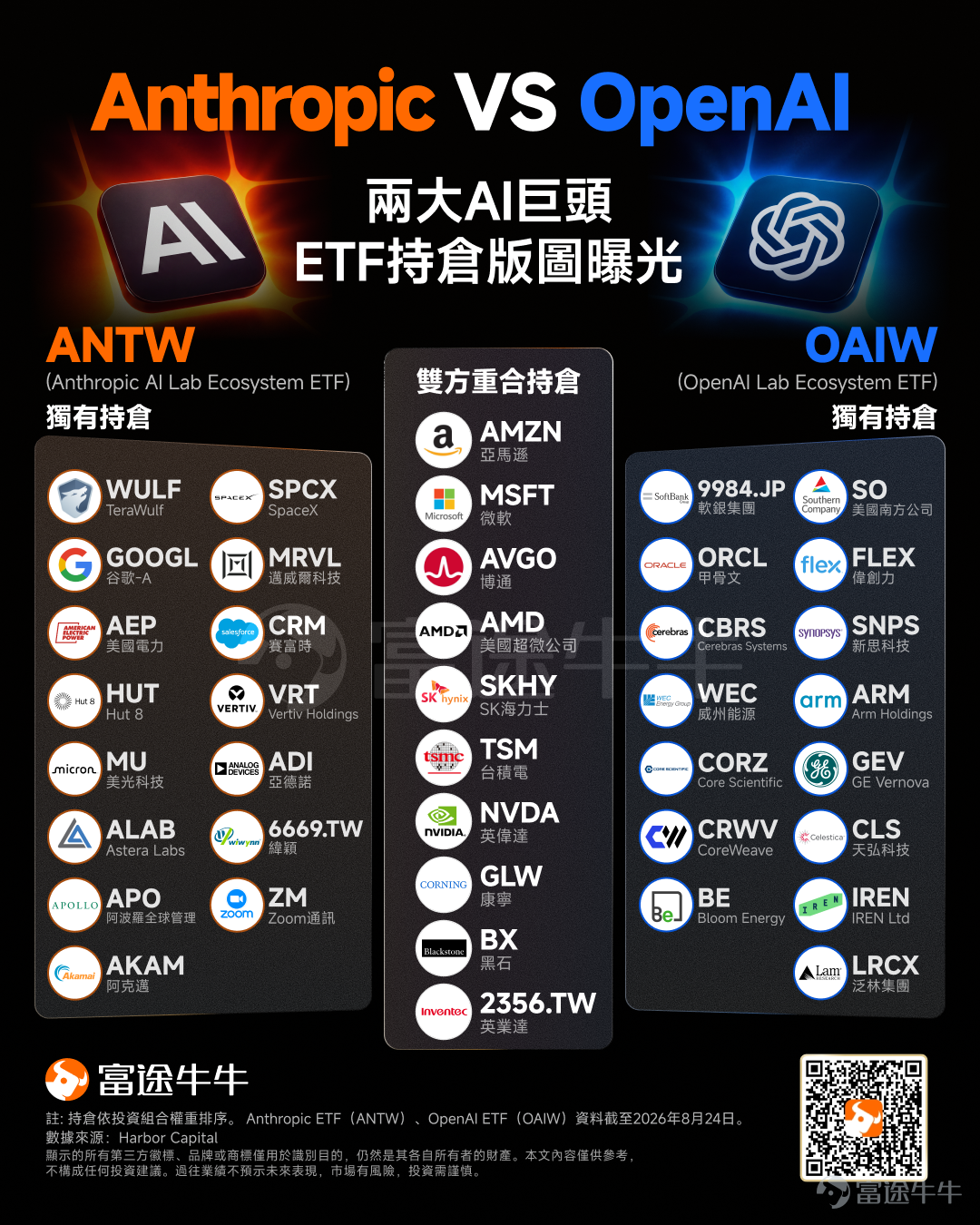
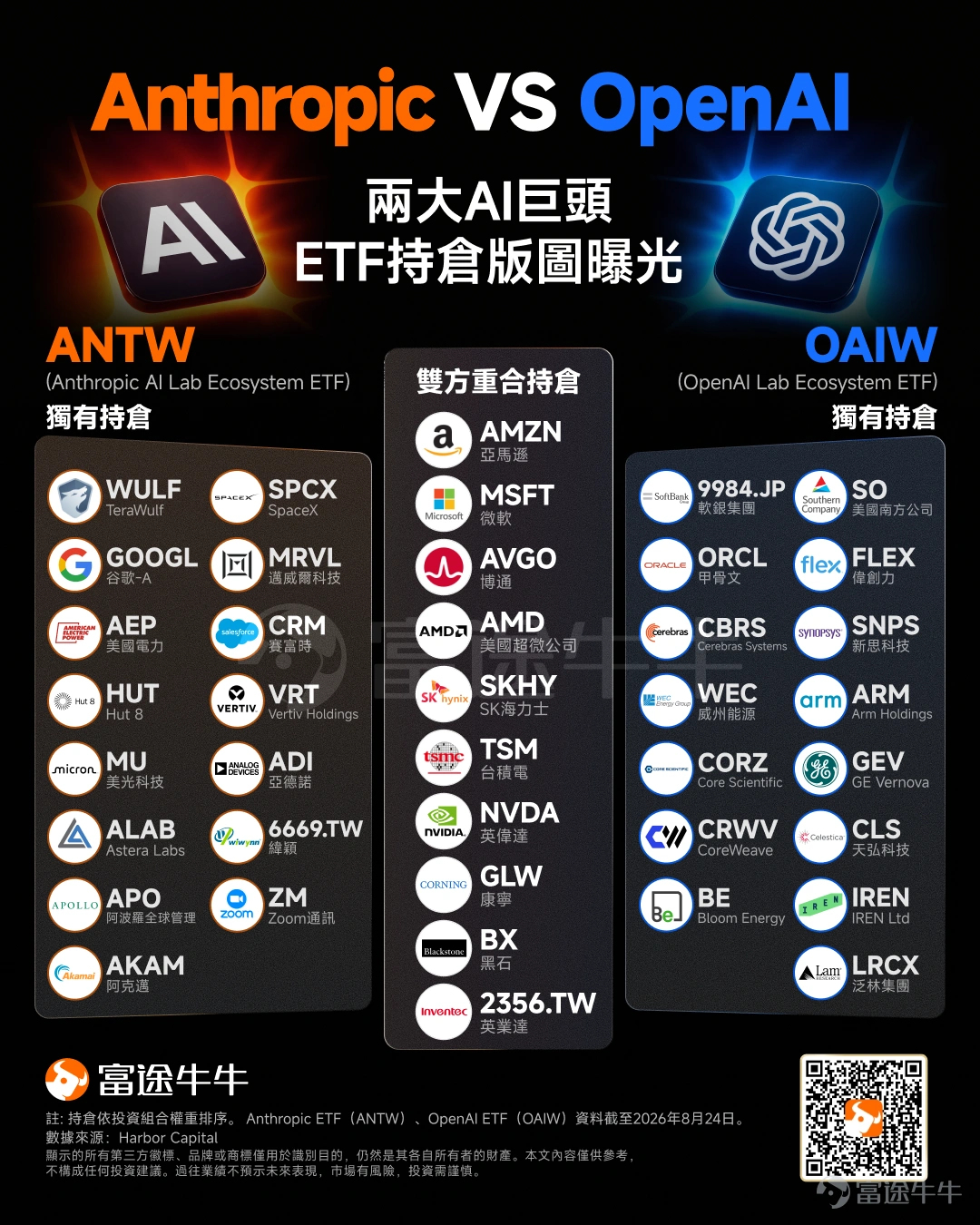
In mid-August, Harbor Capital launched a very interesting set of "AI Lab Ecosystem ETFs," which include: $Anthropic AI Lab Ecosystem ETF (ANTW.US)$and $OpenAI Lab Ecosystem ETF (OAIW.US)$ 。
--
--
--
These two ETFs do not simply buy into Anthropic or OpenAI; instead, they seek publicly listed companies with the closest economic ties to the two major AI labs through segments such as cloud computing, chips, storage, data centers, power, and software. Harbor states that it comprehensively considers factors such as strategic partnerships, supply chains, infrastructure, product integration, and customer relationships.
Looking at the latest holdings, the differences between the two portfolios are already very distinct.
Anthropic: More akin to a capital-intensive chain of "compute power + data centers + electricity"
$Anthropic AI Lab Ecosystem ETF (ANTW.US)$ Its characteristic holdings include: $TeraWulf (WULF.US)$、 $Alphabet-C (GOOG.US)$、 $American Electric Power (AEP.US)$、 $Hut 8 (HUT.US)$、 $Micron Technology (MU.US)$、 $Astera Labs (ALAB.US)$、 $Marvell Technology (MRVL.US)$、 $Analog Devices (ADI.US)$、 $Salesforce (CRM.US)$、 $Zoom Communications (ZM.US)$、 $Akamai (AKAM.US)$among others.
This portfolio reflects Anthropic's current, distinct capital expenditure path:Stronger models → Higher token demand → More compute power → More data centers → Simultaneous surge in storage, network, and electricity demand.
Therefore, an Anthropic IPO may not just reprice software companies; instead, the impact might first be reflected inthe AI infrastructure and energy supply chains。
OpenAI: More inclined towards "platform + compute supply chain + AI infrastructure"
OAIW presents a different structure, with its characteristic holdings including: $SoftBank Group (9984.JP)$ 、 $Oracle (ORCL.US)$ 、 $Cerebras Systems (CBRS.US)$ 、 $Synopsys (SNPS.US)$ 、 $Arm Holdings (ARM.US)$ 、 $Core Scientific (CORZ.US)$ 、 $CoreWeave (CRWV.US)$ 、 $Bloom Energy (BE.US)$ 、 $IREN Ltd (IREN.US)$ 、 $Lam Research (LRCX.US)$ 、 $GE Vernova (GEV.US)$ 、 $Flex Ltd (FLEX.US)$ 、 $Celestica (CLS.US)$ etc.
Compared to Anthropic, the OpenAI portfolio places greater emphasis onhyperscale compute construction, cloud platforms, custom chips, and data center infrastructure。
In other words:While both Anthropic and OpenAI will ultimately require massive computing power, the partners, cloud platforms, and infrastructure strategies chosen by the two companies are gradually diverging.
This also means that future AI investments may no longer be as simple as "just buy NVIDIA," but will evolve into supply chain selections among different AI ecosystems.
What truly deserves attention is who both sides are buying from.
Compared to the differentiated holdings of the two ETFs,the overlapping holdings are even more worthy of attention.Based on current portfolios, companies held in common by both sides include:
This list is actually very representative. Because regardless of whether OpenAI wins, Anthropic wins, or even if Google and Meta catch up later, the competition behind the models cannot bypass several key factors:GPU/ASIC, HBM, advanced process nodes, network interconnects, servers, data centers, and power supply.
What these companies are truly betting on is not any single model provider, but rather:Global demand for AI computing power will continue to grow.
Anthropic's IPO could trigger another revaluation of the AI valuation framework.
Therefore, the true significance of Anthropic's IPO extends far beyond a "$2 trillion valuation."
If an AI model company founded just a few years ago can secure a $2 trillion valuation based on projected 2028 revenue nearing $200 billion, the market will inevitably be forced to reconsider one key question:What is the actual value of the computing power, data centers, electricity, chips, and storage required to support that $200 billion in revenue?
ETF holdings in Anthropic and OpenAI have already provided a "capital market answer" in advance.
From NVIDIA, AMD, Taiwan Semiconductor, and SK Hynix to CoreWeave, TeraWulf, and Hut 8, and further to AEP, Bloom Energy, and GE Vernova,AI valuations are spreading from model companies to the entire physical infrastructure chain.
However, two risks warrant attention here: First, the $30 trillion TAM is essentially an extremely optimistic long-term assumption,and it does not guarantee that Anthropic will actually achieve revenue at such a scale;Second, $Anthropic AI Lab Ecosystem ETF (ANTW.US)$and $OpenAI Lab Ecosystem ETF (OAIW.US)$They are essentially "ecosystem ETFs",which is not equivalent to directly holding Anthropic or OpenAI. The prospectuses for both funds explicitly warn that there is no guarantee of being able to invest directly in these two private companies at present, so investors should not simply view them as "shadow stocks" of Anthropic or OpenAI.
But as Anthropic’s IPO enters its final sprint, Wall Street’s actions have become very clear:It is not just about valuing Claude, but beginning to value the entire Anthropic ecosystem.
And when OpenAI eventually goes public, the same valuation game will likely play out again.
 With Anthropic's IPO imminent, fellow investors can review our previous articles to map out its underlying equity and partnership structure in advance. Once the official prospectus is released, we will immediately follow up with analysis on its valuation, financial data, and potential investment opportunities.Topic Discussion:Previous articles:
Risk Disclaimer: The above content only represents the author's view. It does not represent any position or investment advice of Futu. Futu makes no representation or warranty.Read more


Comments (2)
to post a comment
71
119