
Recently, a forecast chart about the revenue trajectories of AI giants has swept through the investment community.
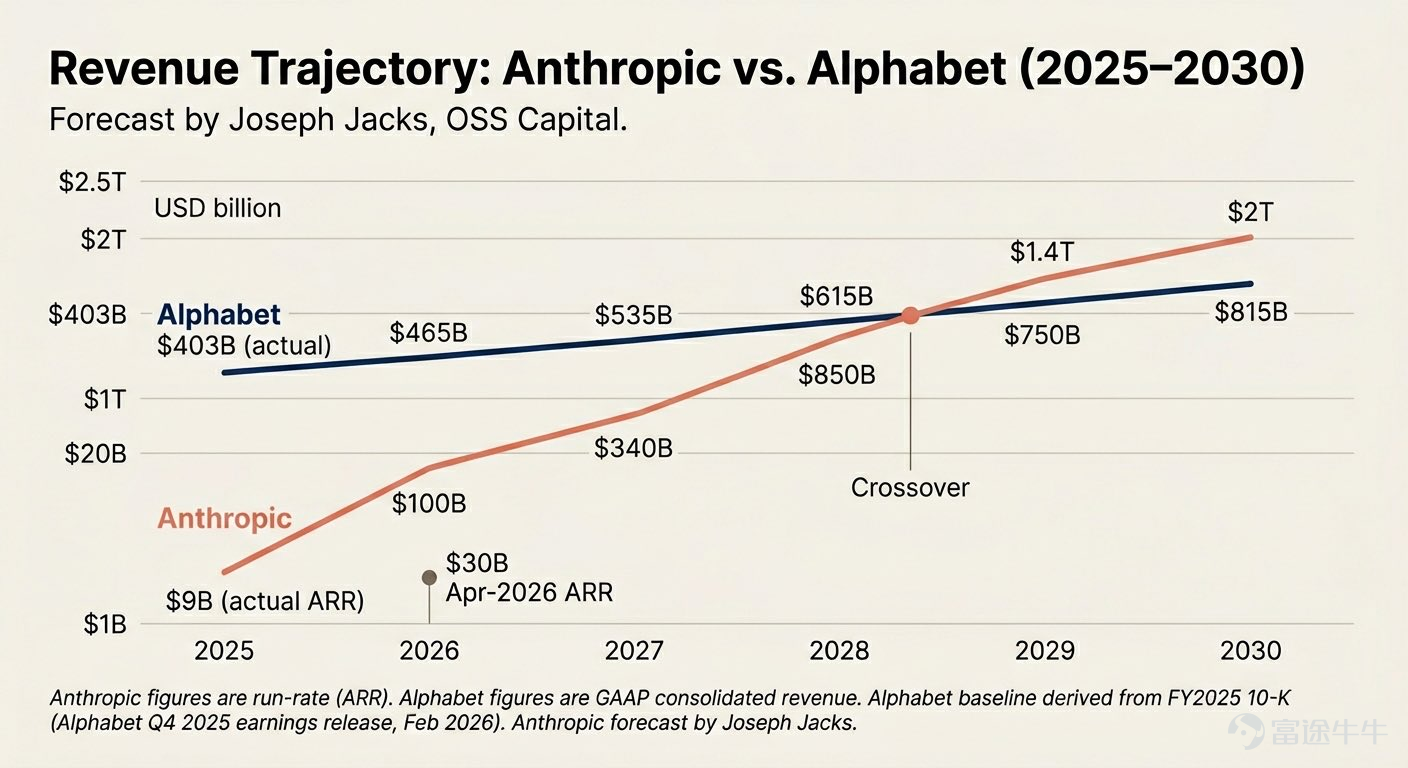
Joseph Jacks, founding partner of OSS Capital, presented a striking prediction: if Anthropic continues on its current growth curve, by mid-2028, its revenue scale will surpass that of Alphabet, Google's parent company; by 2029, Anthropic’s revenue may even double that of Alphabet.

Source: X Joseph Jacks
This is not a blindly optimistic fantasy but an objective extrapolation based on existing data. Anthropic’s penetration in the enterprise AI sector is translating into what can only be described as explosive Annual Recurring Revenue (ARR):
- January 2025: $1 billion
- December 2025: $9 billion
- April 2026: $30 billion
In just four months, its ARR surged 3.3 times, and the growth curve not only hasn't flattened but is actually accelerating.
Joseph Jacks pointed out that even assuming its growth gradually 'slows down' from now on, Anthropic's revenue trajectory remains astonishing: projected to reach $100 billion by the end of 2026, $340 billion in 2027, $850 billion in 2028, and surpass the $2 trillion mark by 2030.
The intersection with Alphabet is expected to reach approximately $575 billion by mid-2028, not because Anthropic’s growth rate exceeds current levels,but because Alphabet — with its mature advertising and cloud businesses growing at an annual rate of about 15% — cannot keep up with the adoption speed of enterprise-grade artificial intelligence.
Beyond the explosive revenue growth, the next moves in the capital markets are also sending strong signals.According to the latest reports from insiders, Anthropic is considering raising tens of billions of dollars this summer to significantly expand its computing power, a move that could boost its valuation beyond its competitor OpenAI, reaching nearly $1 trillion.
Faced with Anthropic's aggressive growth path, the key question for investors is: how will this explosive growth drive value transmission along the AI industry chain? What opportunities are hidden in the market during this process of valuation reshaping?
What does Anthropic's aggressive growth path imply?
For a long time, the market has been shrouded by a sense of 'AI high-valuation anxiety.' The core concern for investors lies in:CapEx (capital expenditure) is too heavy, but the commercialization loop is not yet fully clear.We’ve seen NVIDIA’s overflowing orders, aggressive spending by cloud giants, and the frenzied expansion of data centers; GPUs, power, networking, and storage are all burning cash like crazy. But the market has always struggled to intuitively imagine: just how much revenue scale will be needed in the future to absorb these massive infrastructure investments?
Anthropic's seemingly extreme growth forecast is precisely a disruption of this traditional pricing framework.
It demonstrates that the revenue from AI models isn’t following the ‘linear growth’ pattern typical of traditional SaaS but, instead, shows a boundless ‘exponential expansion’ as agent task execution, code generation, financial analysis, and scientific research assistance penetrate deeply into enterprise workflows. If this logic holds true, then the current market valuation of AI might still betoo conservative. There exists a significant expectation gap here:The market used to view AI as an advanced 'software tool,' but its essence is actually 'digital labor infrastructure' that reshapes production relations.
Of course, we must maintain rational boundaries. This forecast is based on an extremely optimistic evolution curve and cannot simply serve as the base case for investment decisions. As a private company, Anthropic has limited transparency in its financial data, and its real future revenue conversion, valuation realization, and financing pace still face high uncertainty.
However, stepping outside the perspective of a single company, this forecast releases a crucial investment signal:Anthropic has never been about 'isolated growth'; its explosive rise drives the lifeline of the entire AI industrial chain.
From an investment logic standpoint, the higher the revenue expectations and ceiling for leading large model companies like Anthropic, the stronger the 'absorption capacity' of computing infrastructure becomes. In a sense,The grander the growth narrative of large model applications, the more it bolsters the earnings certainty of the underlying AI hardware supply chain.
What hidden opportunities are present in the market?
In the face of this trillion-dollar wealth transfer, how can investors convert the AI narrative into excess returns in their accounts? The strategy can focus on two core approaches:
Approach One: Seizing the early advantage by gaining indirect exposure to Anthropic via ETFs and strategic shareholders
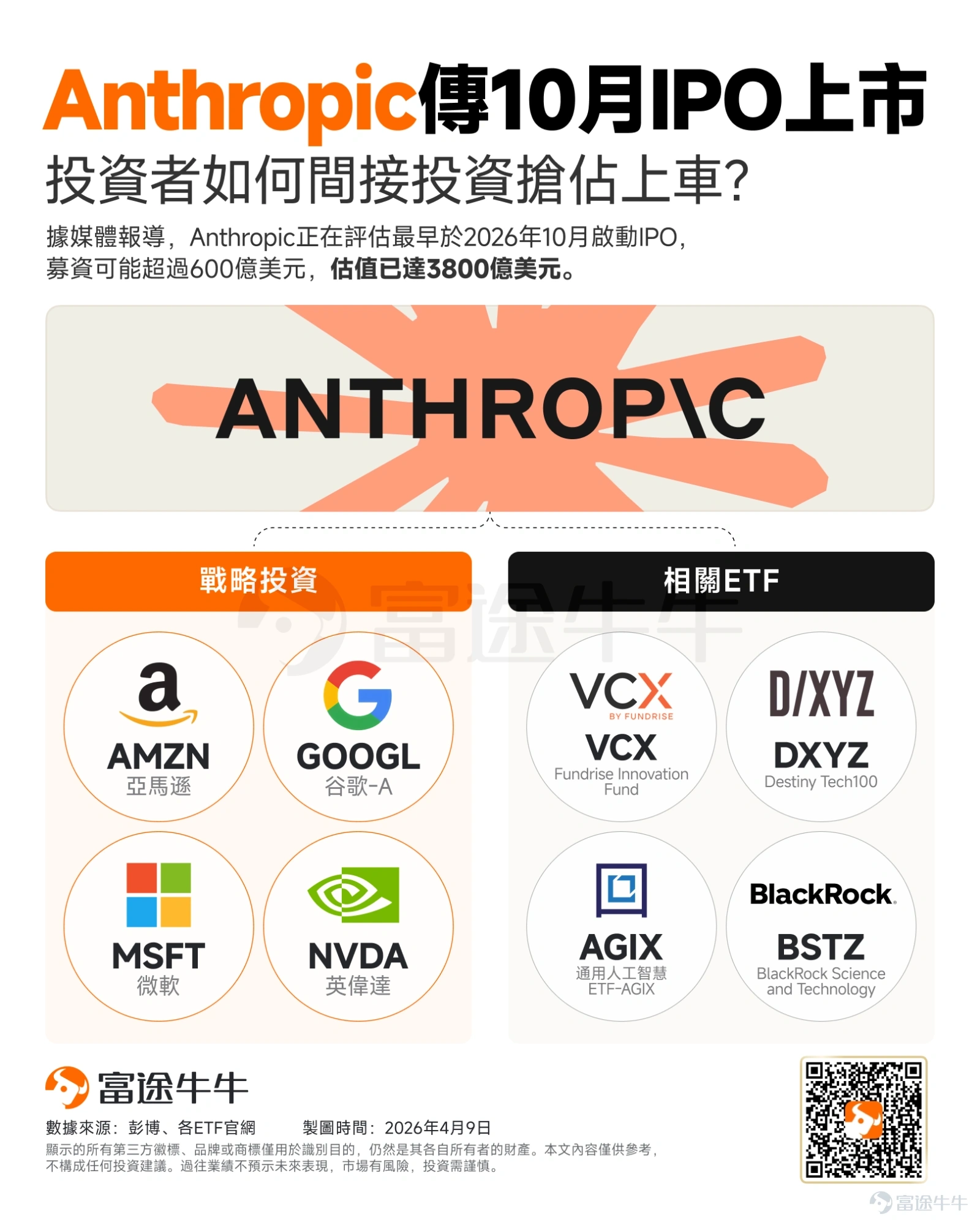
According to market rumors, Anthropic is evaluating a potential IPO launch as early as October 2026. Before the unicorn officially enters the secondary market, while ordinary investors may find it difficult to directly access primary market shares, they can fully position themselves early through "shadow stocks" and specific funds.
previously‘AI Unicorn Anthropic rumored to go public in October – How to gain indirect investment exposure ahead of time?’As previously mentioned in the article, if retail investors want to benefit from this wave of dividends, they can refer to two key indirect investment routes: strategic investment giants and relevant thematic ETFs.

1. Strategic tech giants behind the investments
Anthropic's growth has relied heavily on the financial and resource support of tech giants. Investing in these listed companies that are deeply tied to Anthropic presents a good indirect investment opportunity:
$Amazon (AMZN.US)$: As Anthropic's core investor and cloud service partner, Amazon plays a pivotal role in Anthropic's ecosystem and is also involved in the latest 'Project Glasswing' test.
$Alphabet-A (GOOGL.US)$:Google is another major backer of Anthropic, not only providing substantial funding but also entering into a long-term strategic partnership with Anthropic and Broadcom through 2031 for the latest TPU computing chips.
$Microsoft (MSFT.US)$& $NVIDIA (NVDA.US)$: Although Microsoft is the primary supporter of OpenAI, as the dominant leader in AI infrastructure and a participant in 'Project Glasswing,' Microsoft, together with NVIDIA, invested $15 billion in Anthropic last year.
2. Buy ETFs covering Anthropic
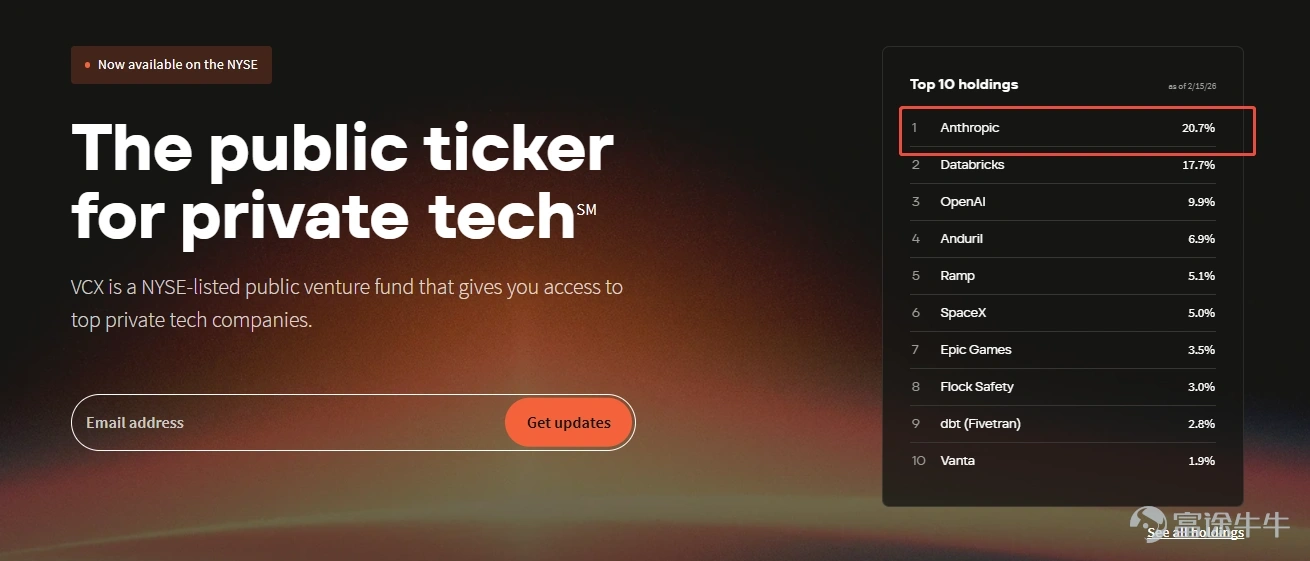
$Fundrise Innovation Fund (VCX.US)$ This fund focuses on investing in top-tier private technology companies and AI unicorns, offering a popular channel to access star AI enterprises in the primary market. In VCX’s portfolio, Anthropic accounts for up to 20.7%.

Source: VCX official website
$KraneShares Artificial Intelligence and Technology ETF (AGIX.US)$ It is currently one of the very fewstandard ETFs that directly hold shares in private companies. It does not go through an SPV (Special Purpose Vehicle) but is directly listed on Anthropic’s shareholder registry. Although the management fee is relatively high (0.99%), its liquidity and price discovery mechanism are better than traditional closed-end funds. Currently, Anthropic accounts for approximately 3%.

Source: AGIX official website
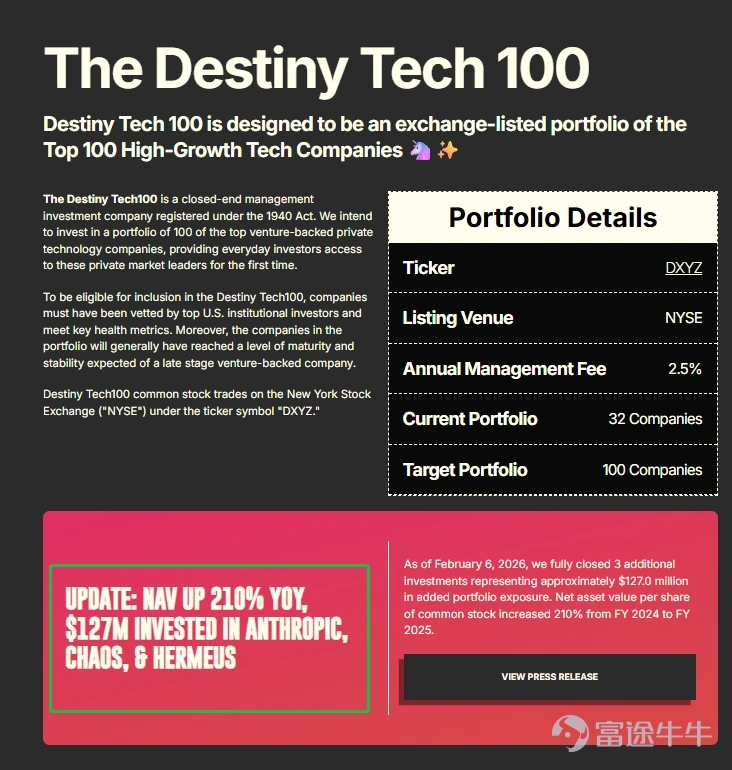
$Destiny Tech100 (DXYZ.US)$ A closed-end fund directly listed on the NYSE. Earlier this year, it completed a significant $100 million investment in Anthropic via an SPV (Magnitude ANC III), making it one of the most aggressive market instruments with exposure to Anthropic.

Source: DXYZ official website
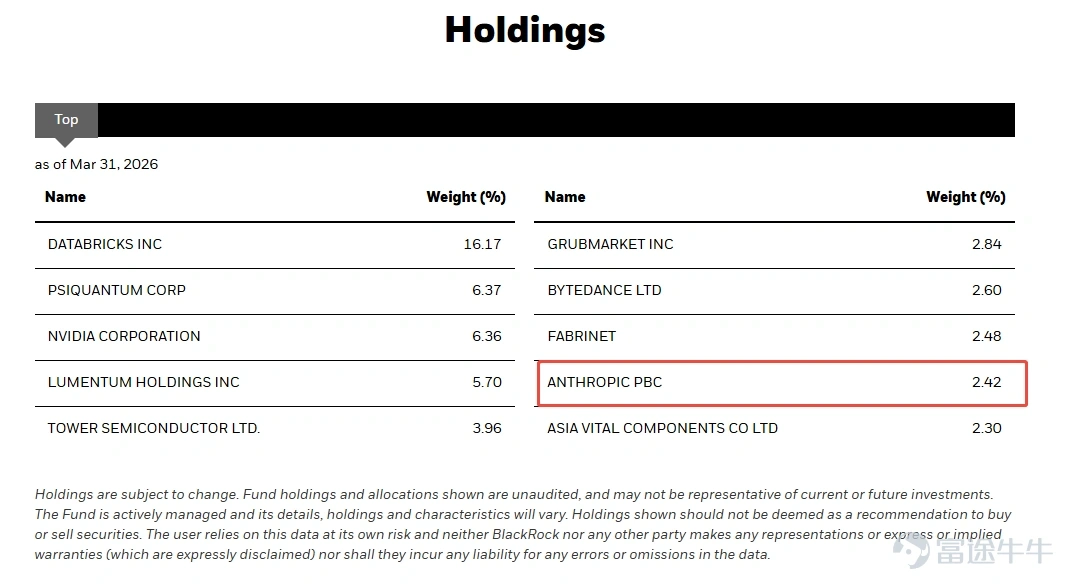
$BlackRock Science and Technology Trust II (BSTZ.US)$ A closed-end tech term trust issued by Blackrock. It employs a hybrid strategy of public and private offerings. As of Q3 2026 data, Anthropic accounts for about 2.42%。

Source: BSTZ official website
Approach Two: Following the clues, betting on the 'hardware backbone' of the computational power inflation era
As noted earlier, the higher Anthropic's expected revenue, the stronger the performance certainty of the hardware supply chain. The iterative updates of large models and massive token throughputare forcing an intergenerational expansion and upgrade of the entire underlying infrastructure.。
previouslyThe 'Inflation Era' of AI computing power has arrived! Unveiling how to capture price increases across the entire industrial chain and investment opportunities?As mentioned in a previous article, an industry-wide 'inflation' driven by AI is intensifying.
The core pricing logic lies in:The further upstream the computational power chain (chips, memory, GPUs),The greater the physical constraints and the better the industrial landscape,the stronger and longer-lasting the certainty of price increases.;The further downstream,(cloud services, IDCs), the more vendors there are and the fiercer the competition,the weaker the certainty of price increases.
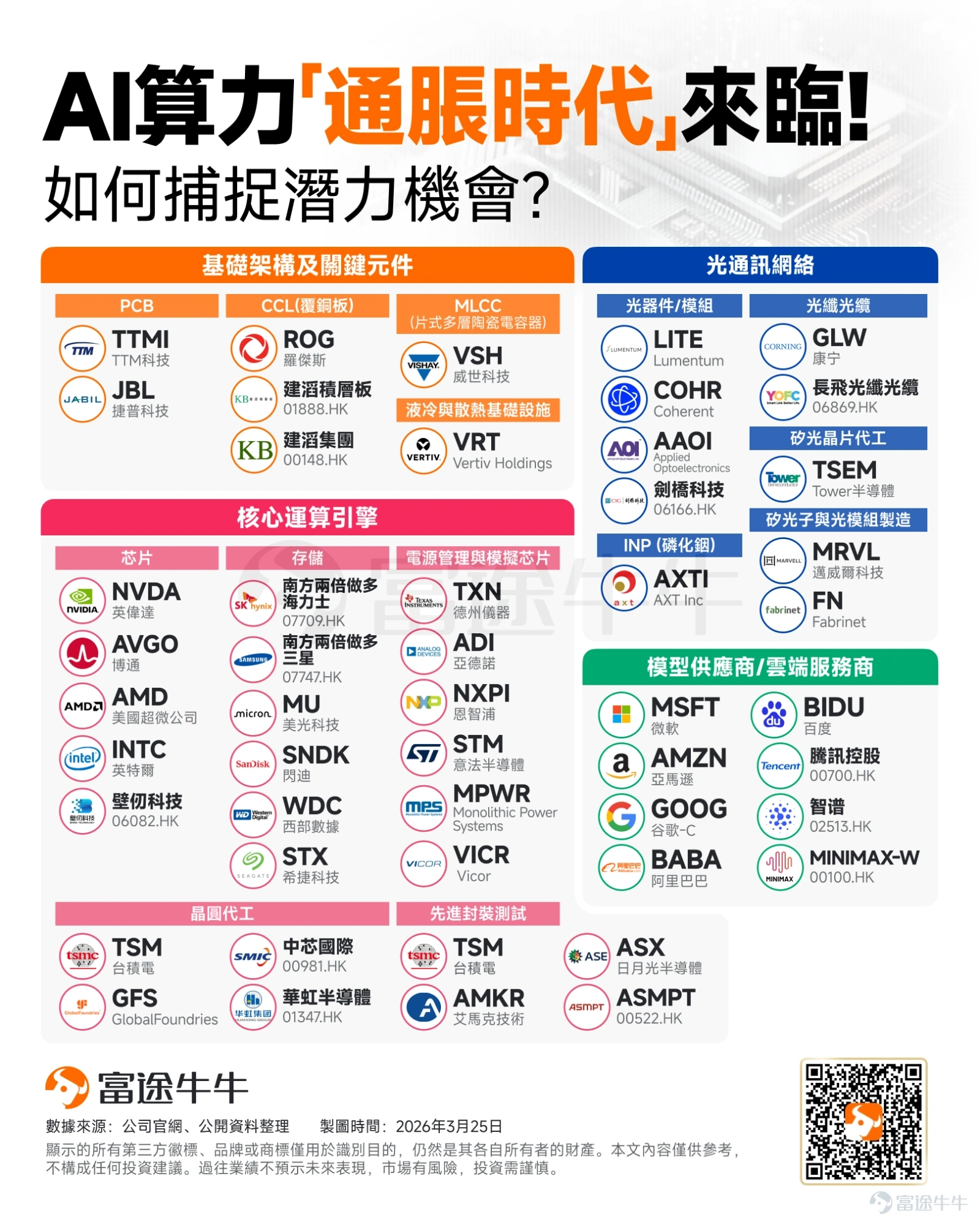
Based on this, Niuniu previously compiled a related infographic for investors' reference:

The first wave: The absolutely scarce 'core computing engines' and 'contract manufacturing/packaging'
Since GPU computing power directly determines the upper limit of Token supply,Core computing engine - chipsExploded first.
Computing brain:Dominating here are oligarchs with absolute pricing power, such as $NVIDIA (NVDA.US)$、 $Advanced Micro Devices (AMD.US)$、 $Broadcom (AVGO.US)$ 。
Capacity lifeline:Once a chip is designed, it must rely on“Wafer fabrication” and “advanced packaging and testing”. Taiwan Semiconductoroccupies a core position here, while companies like $SMIC (00981.HK)$ 、 $ASE Technology (ASX.US)$ 、 $Amkor Technology (AMKR.US)$and $ASMPT (00522.HK)$ are also experiencing a revaluation due to tight capacity.
The second wave: Expansion extends into 'storage' and 'communication networks'
As the demand for AI agents with ultra-long context memory surges, price hikes are spreading rapidly.
Storage price hikes: It's a foregone conclusion that storage chip prices will rise in 2026. DRAM is expected to increase by 60%-88% for the year, while NAND could see increases of 38%-74%. Related companies such as $CSOP Samsung Electronics Daily (2x) Leveraged Product (07747.HK)$、 $CSOP SK Hynix Daily (2x) Leveraged Product (07709.HK)$、 $Micron Technology (MU.US)$、 $SanDisk (SNDK.US)$have seen astonishing gains this year.
Optical communication infrastructure: The larger the computing cluster, the higher the communication requirements between nodes. This has spurred a massive 'optical communication network'sector rally. From silicon photonics manufacturers $Marvell Technology (MRVL.US)$ 、 $Fabrinet (FN.US)$, to optical module leaders $Lumentum (LITE.US)$ 、 $Coherent (COHR.US)$, to fiber-optic segment players $Corning (GLW.US)$and $YOFC (06869.HK)$ , indium phosphide $AXT Inc (AXTI.US)$ The entire supply chain is benefiting from the spillover of demand.
Third wave: Spreading to surrounding 'infrastructure' and 'cloud/model' sectors
The enormous computational power beast requires massive energy and extreme cooling to sustain operations.
Energy and Cooling:"Basic Infrastructure and Key Components"and intermediarypower management and analog chipsare beginning to gain momentum. $Texas Instruments (TXN.US)$、 $Monolithic Power Systems (MPWR.US)$Analog chip and power management giants, as well as those specializing in liquid cooling solutions, $Vertiv Holdings (VRT.US)$are becoming the "water carriers" of the market. Meanwhile, underlying materials like CCL copper-clad laminates (e.g., $KINGBOARD HLDG (00148.HK)$ 、 $KB LAMINATES (01888.HK)$ ) and MLCCs (e.g., $Vishay Intertechnology (VSH.US)$ ) are experiencing both volume and price increases due to a surge in high-end demand.
Cost pass-through: Ultimately, cost pressures will be passed on tomodel providers/cloud service providers.。 $Amazon (AMZN.US)$、 $Alphabet-C (GOOG.US)$、 $TENCENT (00700.HK)$As major players, and $KNOWLEDGE ATLAS (02513.HK)$、 $MINIMAX-W (00100.HK)$ have gradually started raising prices, passing inflation down to end users.
Investment Insight: Seeking Certainty Amid 'Computing Power Inflation'
The widely anticipated growth curve forecast of Anthropic not only reflects the commercial potential of a single company but also prompts the market to reassess the value of the global technology supply chain. As enterprise-level AI applications gradually become widespread, the linear growth logic of traditional internet is being challenged. Market focus has gradually shifted from early 'valuation anxiety' to a desire for tangible production capacity and discussions about the phenomenon of 'computing power inflation'.
In this industrial wave, the flow of capital and investment logic in the capital markets has gradually emerged. Some market participants choose to indirectly track the development of top-tier companies in the primary market through innovative ETFs and strategic tech giants, while others allocate resources along core computing engines, DCI optical communication networks, and high-frequency storage hardware supply chains. This reflects a current market consensus of risk aversion and strategic positioning:That is, attempting to balance the 'high volatility' during the commercialization process of large model applications with the relatively higher 'earnings certainty' of underlying infrastructure.
Overall, the development of the AI sector is entering an infrastructure phase that heavily relies on massive capital expenditures (CapEx). Although the final competitive landscape of the large model market has yet to be determined, the importance of infrastructure companies providing 'digital workforce' foundational support to the entire industry has significantly increased. In the future, as leading companies such as Anthropic potentially move towards public markets, continuously observing and objectively assessing the substantial value of each segment of the AI supply chain will be key to understanding and participating in this technological cycle.
Risk Disclaimer: The above content only represents the author's view. It does not represent any position or investment advice of Futu. Futu makes no representation or warranty.Read more
Comments (2)
to post a comment
38
120