
Focus on COMPUTEX 2026! Will the entire AI supply chain ignite?

A single statement from Jensen Huang is worth $60 billion! Behind Marvell's 32% surge, how deep is NVIDIA's 'optical' strategy?
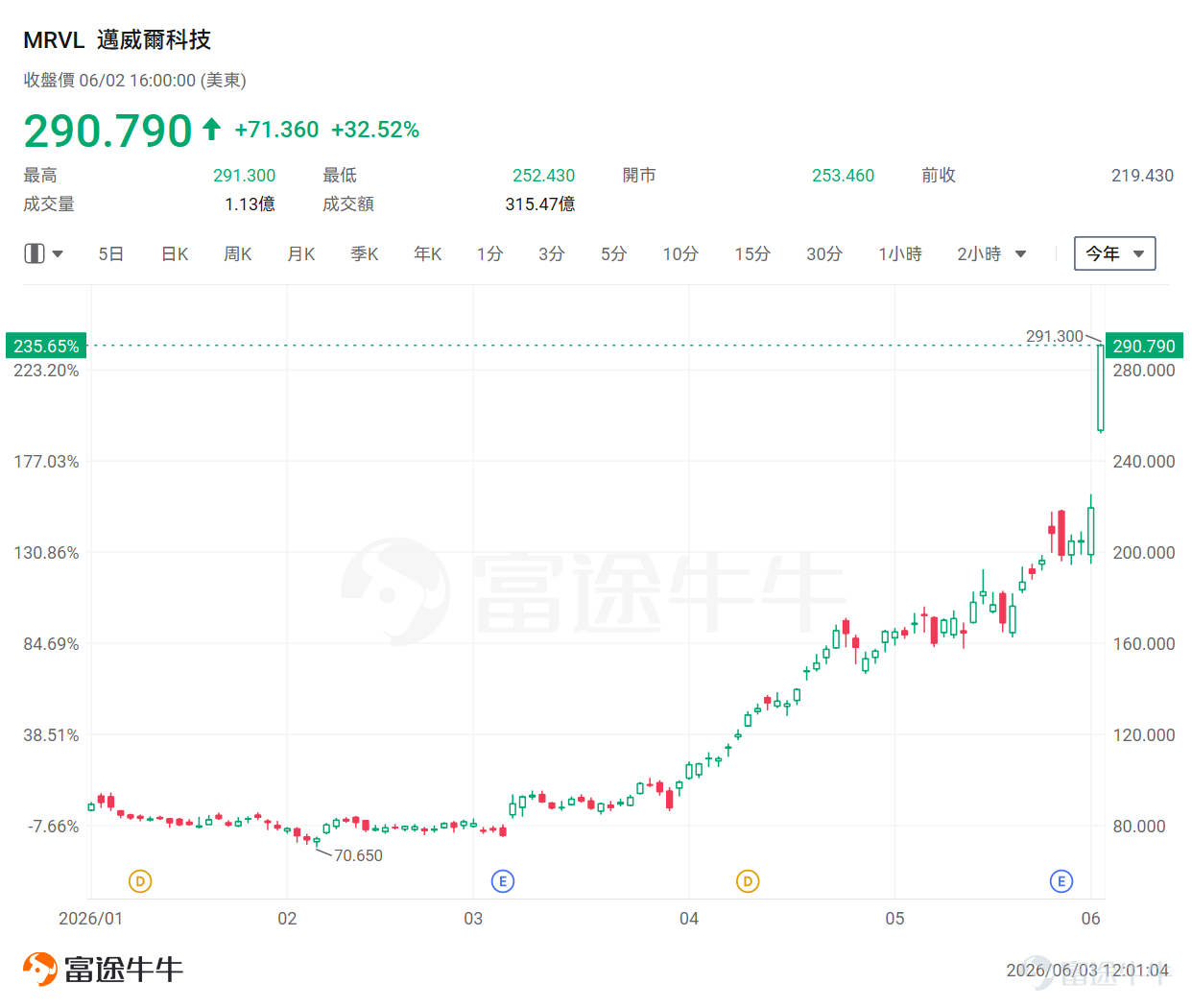
$NVIDIA (NVDA.US)$ CEO Jensen Huang’s statement, ' $Marvell Technology (MRVL.US)$ will become a trillion-dollar company,' triggered a single-day surge of 32% in the stock, boosting its market cap by over $60 billion instantly.

While strongly endorsing its peer, NVIDIA also announced its own major news—NVIDIA Spectrum-X Ethernet silicon photonics technology is now in full-scale production. Compared to networks using traditional transceivers, Spectrum-X Ethernet silicon photonics delivers 5x better energy efficiency, 5x higher AI uptime, and 1.3x faster deployment time.
Huang’s aforementioned comments not only propelled Marvell’s stock price sharply higher but also fully ignited bullish sentiment across the entireoptical communications sector. As of Tuesday’s U.S. market close, Coherent’s stock rose 17%, Lumentum gained nearly 14%, and Corning climbed more than 13%.
At this point, many fellow investors are undoubtedly curious:Why is Jensen Huang so bullish on Marvell Technology? What is NVIDIA’s strategic footprint in the optical communications space? And among this red-hot赛道, which other promising companies deserve our close attention?Next, this article will provide fellow investors with an in-depth analysis, uncovering the investment logic behind this optical communications rally.
Why is Jensen Huang so bullish on Marvell Technology?
Jensen Huang’s remark that “Marvell will become a trillion-dollar company” instantly catapulted this once traditional storage and networking chipmaker into the global AI spotlight. In fact, through precise acquisitions of Inphi, Innovium, and Celestial in recent years, Marvell has transformed itself into a pure-play AI data center chip powerhouse. Currently, the core businesses driving its valuation surge are primarily built uponthree hard-core segmentsthat form its foundation:
1. Optical Communications and DCI Networking: In AI superclusters, bandwidth is the bottleneck for data transmission. Marvell nearly monopolizes the 'core brain' of optical modules—the high-end PAM4 DSP (Digital Signal Processor) market. Meanwhile, in DCI (Data Center Interconnect) provides high-speed interconnection solutions across data centers and geographies, ensuring 'zero latency and zero packet loss' for massive AI data transmission over long-haul fiber networks.
2. Custom AI Compute Chips (ASICs): As tech giants seek to reduce costs and diversify away from sole reliance on NVIDIA, they have launched a wave of in-house AI chip development—naturally positioning Marvell Technology as the 'premier design partner.' Marvell is not only a core collaborator with Amazon AWS (on its Trainium chips) but also entered into an in-depth partnership with Google in 2026 to co-develop customized AI inference chips.
3. High-Speed Switching Gateways: AI data centers are rapidly transitioning toward Ethernet-based architectures. With its Teralynx series of switch chips, Marvell Technology is now directly competing with Broadcom in the high-end AI networking market, providing robust support for hyperscale compute routing.
Yesterday,Jensen Huang clearly articulated the fundamental logic behind connectivity technology’s rise as a core pillar of AI infrastructure:The emerging AI computing paradigm—represented by 'agents'—requires breaking down massive computational tasks and distributing them across entire data centers.
NVIDIA’s strategic vision is to efficiently aggregate compute, memory, and bandwidth within hyperscale clusters—and the essential connectivity technology serves as the critical enabler that links these compute nodes together,打通 their 'central and governing meridians.' As Jensen Huang highly praised:"This is precisely why Matt (CEO of Marvell Technology) has performed so exceptionally and why Marvell is indispensable in this era."
This morning,Marvell Technology released an explosive earnings outlook, raising its total revenue guidance for 2026 to $11.5 billion and setting a long-term target directly at $16.5 billion.This strong growth momentum primarily stems from its core interconnect business, which is projected to grow by over 70% in 2026, with the steepest growth trajectory coming from the scale-up segment.
Notably, its Celestial II platform and broader scale-up optical product lines are entering an accelerated revenue realization phase, expected to contribute over $2 billion in revenue within the next 15 months. Looking at the long-term revenue ramp schedule, quarterly revenue from the scale-up optical business is projected to reach $500 million by the end of 2027 and double again to $1 billion per quarter by the end of 2028, demonstrating exceptional revenue visibility and market dominance.
What is NVIDIA’s strategic footprint in the optical communications space?
Several months ago, NVIDIA announced a $2 billion strategic investment in Marvell Technology—a powerful alliance that underscores their joint commitment to advancing AI data center infrastructure.
In fact, NVIDIA has been highly active in the optical communications field in recent years. What may appear as scattered equity investments actually forms a tightly woven strategic network:From the underlying fiber-optic physical medium and core optical components to upper-layer control and I/O chips, NVIDIA is using real capital to fortify the entire 'high-speed interconnect supply chain' into a formidable moat.
previously‘Follow Jensen Huang's Strategy! NVIDIA Heavily Bets on Corning, the Strongest Dark Horse in the AI Investment Landscape Soars 350%’An earlier article also outlined Jensen Huang’s strategic layout:

A comprehensive breakdown of NVIDIA's 'integrated multi-dimensional' optical communications empire blueprint reveals its deep strategic布局 across multiple dimensions:
1. Heavy investment to secure foundational capacity: Grabbing entry tickets for the 800G/1.6T era
In the era of 10,000-card and even 100,000-card GPU clusters, AI’s massive scale-up risks being bottlenecked by component shortages—'even the best cook can’t make a meal without rice.' To avoid supply chain constraints on critical optical modules, NVIDIA is directly using capital investments to lock in scarce production capacity:
$Lumentum (LITE.US)$:As the global leader in optical chips, NVIDIA’s significant equity stake aims to secure foundational manufacturing capacity and R&D progress for next-generation high-end optical products such as 800G and future 1.6T CPO (Co-Packaged Optics).
$Coherent (COHR.US)$:Through deep equity partnerships, NVIDIA further strengthens supply chain security for high-speed optical transceivers and core optical components.
$Corning (GLW.US)$:Optical module data ultimately needs to be transmitted via fiber optics. NVIDIA’s major investment in Corning, a global fiber optics giant, is essentially aimed at securing top-tier, high-density fiber optic infrastructure resources ahead of the wave of hyperscale data center construction.
2. Strategic alliances with core chipmakers: Unlocking seamless inter-server connectivity ('unblocking the Ren and Du meridians')
With fiber optics and optical modules in place, top-tier chips are still needed to orchestrate and control data flows. NVIDIA leverages capital ties to bring aboard the industry’s leading players in networking and I/O:
$Marvell Technology (MRVL.US)$:Marvell Technology dominates the high-end PAM4 DSP (Digital Signal Processor) market. NVIDIA’s deep partnership with this networking chip giant not only optimizes large-model DCI (Data Center Interconnect) transmission efficiency across data centers and geographies but also paves the way for future volume production of silicon photonics technology.
Enfabrica:This unicorn specializing in next-generation I/O chips is a dark horse in eliminating internal bandwidth bottlenecks within AI clusters. NVIDIA’s investment aims to ensure massive data transfers between servers achieve extreme 'high throughput and low latency.'
3. Cross-industry expansion into communications infrastructure: Partnering with traditional telecom giants to pioneer new frontiers
$Nokia Oyj (NOK.US)$:The core of NVIDIA’s collaboration with Nokia lies in deeply integrating AI computing power with traditional communications infrastructure. This move not only positions them for next-generation optical communications technology but also represents a long-term strategic extension of NVIDIA’s AI reach into wide-area networks and carrier-grade data centers (telco clouds).
Just how explosive could the growth potential be for companies 'handpicked' by NVIDIA?A review of historical data shows that NVIDIA’s investment success rate and driving effect serve as a market benchmark.According to the latest statistics, among NVIDIA's recent core investment targets, several companies have experienced a major upward movement after announcing share purchases or capital increases:

Which other high-potential companies deserve close attention?
previously“Don’t Just ‘Believe in Light’—Learn to ‘Understand Light’! Goldman Sachs Breaks Down the Optical Communications Supply Chain; This Full-Spectrum Map Is Worth Saving”We’ve also written that optical communications is the next mega-trend in AI infrastructure. Goldman Sachs has mapped out the optical communications industry supply chain as follows:

1. IC Design and Manufacturing: The 'Brain' of Optical Communications
The performance of optical modules largely depends on the core chips inside. This stage is responsible for handling the conversion and computational logic of optoelectronic signals.
Diversification in chip design: The supply chain covers ASIC & xPU (such as $NVIDIA (NVDA.US)$ 、 $Broadcom (AVGO.US)$ 、 $Marvell Technology (MRVL.US)$ ), PIC (Photonic Integrated Circuits) responsible for optical signal processing, and EIC (Electronic Integrated Circuits) responsible for electrical signal amplification. Among these, the design of PICs is particularly crucial as it directly determines the miniaturization and transmission efficiency of optical modules.
Support from cutting-edge foundries: These highly complex chips rely on top-tier global foundries such as $Taiwan Semiconductor (TSM.US)$ 、 $Tower Semiconductor (TSEM.US)$ to bring them to life. Advancements in advanced processes are the absolute cornerstone for improving the performance of optical communication chips and reducing power consumption.
Relevant companies are listed below:
ASIC and xPU Design: $NVIDIA (NVDA.US)$ 、 $Marvell Technology (MRVL.US)$ 、 $Broadcom (AVGO.US)$ 、 $Intel (INTC.US)$ 、 $Advanced Micro Devices (AMD.US)$ 、 $Cisco (CSCO.US)$ , MediaTek;
Photonic Integrated Circuit Design: $NVIDIA (NVDA.US)$ 、 $Marvell Technology (MRVL.US)$ 、 $Broadcom (AVGO.US)$ 、 $Lumentum (LITE.US)$ 、 $Coherent (COHR.US)$ 、 $Zhongji Innolight (300308.SZ)$ 、 $Eoptolink Technology Inc., (300502.SZ)$ 、 $Accelink Technologies (002281.SZ)$ ;
Integrated electronic circuits: $NVIDIA (NVDA.US)$ 、 $Marvell Technology (MRVL.US)$ 、$Lumentum (LITE.US)$ 、 $Coherent (COHR.US)$ 、 $MACOM Technology Solutions (MTSI.US)$ 、 $Xiamen UX IC (688807.SH)$ ;
2. Base Materials: The 'Foundation' Enabling Optical Properties
Unlike traditional silicon-based semiconductors, the optical communication field heavily relies on compound semiconductor materials with special optoelectronic properties.
Key substrates and epitaxy: Indium phosphide (InP) and gallium arsenide (GaAs) are the core substrates for manufacturing laser emitters and receivers. High-quality epitaxial wafers supplied by upstream vendors (such as Sumitomo Electric, VPEC, and LianYa) directly determine the light-emitting efficiency and stability of the final laser components. Additionally, high-quality copper foil is indispensable for high-speed electrical transmission.
Relevant companies are listed below:
Indium phosphide substrate: $AXT Inc (AXTI.US)$ 、 $Yunnan Lincang Xinyuan Germanium Industry (002428.SZ)$ 、 $JX Advanced Metals (5016.JP)$ 、 $Sumitomo Electric Industries (5802.JP)$ ;
Indium phosphide epi-wafer: $Sumitomo Electric Industries (5802.JP)$ , IQE, IntelliEPI, LianYa Optoelectronics, VPEC;
Gallium arsenide substrate: $AXT Inc (AXTI.US)$ 、 $Yunnan Lincang Xinyuan Germanium Industry (002428.SZ)$ 、$Sumitomo Electric Industries (5802.JP)$ ;
3. Optical Components: A Vast and Precision-Driven Core Ecosystem
This is the most complex and diverse segment in the entire ecosystem, covering every detail from light emission, light guidance to final modular integration.
Dual progress in laser and light source technology: The current market is mainly divided into traditional EML (Electro-Absorption Modulated Laser) and emerging SiPh (Silicon Photonics) technologies. Silicon photonics, with its high level of integration and cost advantages, is rapidly gaining ground, while EML maintains a significant position in specific long-distance and mature applications. $Lumentum (LITE.US)$ 、 $Coherent (COHR.US)$ Major companies such as [missing company names] play a leading role in this field.
Passive components and optical arrays: Optical signals require splitting, filtering, and attenuation during transmission, which relies on various couplers, splitters, and wavelength division multiplexers (WDM). Meanwhile, fiber array units (FAU) are responsible for precisely aligning the optical paths on chips with external fibers, requiring extremely high sub-micron-level manufacturing processes.
Fiber optics, connectors, and final assembly: Major manufacturers like Corning and Changfei provide transmission media (fiber optics) and connect devices through various precision connectors (e.g., MPO, VSFF). Finally, $Zhongji Innolight (300308.SZ)$ 、 $Eoptolink Technology Inc., (300502.SZ)$ module assembly plants encapsulate all active and passive components into pluggable or co-packaged optical modules, delivering them to end data center customers.
Relevant companies are listed below:
Lasers/Light Sources (Silicon Photonics): $Lumentum (LITE.US)$ 、 $Coherent (COHR.US)$ 、 $Broadcom (AVGO.US)$ 、 $Applied Optoelectronics (AAOI.US)$ 、 $Yuanjie Semiconductor Technology (688498.SH)$ 、 $Jiangsu Etern (600105.SH)$ 、 $Suzhou Everbright Photonics (688048.SH)$ 、 $Henan Shijia Photons Technology (688313.SH)$ 、 $Accelink Technologies (002281.SZ)$ 、 $Sumitomo Electric Industries (5802.JP)$ 、 $Furukawa Electric (5801.JP)$ 、 $Mitsubishi Electric (6503.JP)$ , Lianya Optoelectronics;
Laser/Source (EML): $Lumentum (LITE.US)$ 、 $Coherent (COHR.US)$ 、 $Broadcom (AVGO.US)$ 、 $Yuanjie Semiconductor Technology (688498.SH)$ 、 $Jiangsu Etern (600105.SH)$ 、 $Suzhou Everbright Photonics (688048.SH)$ 、 $Henan Shijia Photons Technology (688313.SH)$ 、 $Suzhou Dongshan Precision Manufacturing (002384.SZ)$、 $Accelink Technologies (002281.SZ)$ 、 $Sumitomo Electric Industries (5802.JP)$ 、 $Furukawa Electric (5801.JP)$ 、 $Mitsubishi Electric (6503.JP)$ ;
Fiber Array Unit: $Suzhou TFC Optical Communication (300394.SZ)$ 、 $Shenzhen Zesum Technology (301486.SZ)$ 、 $Advanced Fiber Resources (300620.SZ)$ 、 $EverProX Technologies (300548.SZ)$ 、 $Focuslight Technologies Inc. (688167.SH)$ 、 $Shenzhen JPT Opto-Electronics (688025.SH)$ 、 $Sumitomo Electric Industries (5802.JP)$ , Shangquan;
Coupler/Splitter: $Lumentum (LITE.US)$ 、 $Coherent (COHR.US)$ 、 $Advanced Fiber Resources (300620.SZ)$ 、 $EverProX Technologies (300548.SZ)$ , Shangquan;
Attenuator: $Lumentum (LITE.US)$ 、$EverProX Technologies (300548.SZ)$ 、$Accelink Technologies (002281.SZ)$ , Shangquan;
Wavelength Division Multiplexer: $Lumentum (LITE.US)$ 、 $Ciena (CIEN.US)$ 、 $Advanced Fiber Resources (300620.SZ)$ 、 $EverProX Technologies (300548.SZ)$ 、$Accelink Technologies (002281.SZ)$ 、 $Suzhou TFC Optical Communication (300394.SZ)$ , Shangquan;
Optical module assembly and integration: $Lumentum (LITE.US)$ 、 $Coherent (COHR.US)$ 、 $Cisco (CSCO.US)$ 、 $Marvell Technology (MRVL.US)$ 、 $Fabrinet (FN.US)$ 、 $Nokia Oyj (NOK.US)$ 、 $CIG (06166.HK)$ 、 $Zhongji Innolight (300308.SZ)$ 、 $Eoptolink Technology Inc., (300502.SZ)$ 、$Accelink Technologies (002281.SZ)$ 、 $Hgtech (000988.SZ)$ 、$Suzhou Dongshan Precision Manufacturing (002384.SZ)$、 $Suzhou TFC Optical Communication (300394.SZ)$ ;
Optical fiber: $Corning (GLW.US)$ 、 $YOFC (06869.HK)$ 、 $Hengtong Optic-Electric (600487.SH)$ 、 $Sumitomo Electric Industries (5802.JP)$ 、 $Furukawa Electric (5801.JP)$ 、 $Fujikura (5803.JP)$, Prysmian;
VSFF Connector: $Corning (GLW.US)$ 、 $Amphenol (APH.US)$ 、 $Sumitomo Electric Industries (5802.JP)$ 、 $Fujikura (5803.JP)$, Bo Ruowei
4. Packaging and Testing: The 'Gatekeeper' Ensuring Yield
The alignment and packaging difficulty of optical components is much higher than that of traditional electronic components; any minor deviation can lead to significant attenuation of the optical signal.
Professional packaging and testing subcontracting services (such as ASE Group, Foxconn), along with packaging equipment providing ultra-high precision alignment and dispensing welding (such as ASMPT, Robatek), have emerged. Meanwhile, to ensure stable operation of modules in high-temperature and high-frequency environments, testing equipment (such as Teradyne, Keysight) acts as the final quality and yield checkpoint before leaving the factory.
Related Companies:
Packaging and Testing Services: $ASE Technology (ASX.US)$ 、 $Fabrinet (FN.US)$ 、 $Amkor Technology (AMKR.US)$ 、 $Jabil (JBL.US)$ 、 $JCET Group Co., Ltd. (600584.SH)$ 、 $TongFu Microelectronics (002156.SZ)$ ASE Group, Foxconn, Halma PLC;
Packaging Equipment: $Kulicke & Soffa Industries (KLIC.US)$ 、 $ASMPT (00522.HK)$ 、 $Robotechnik Intelligent Technology (300757.SZ)$ 、 $GKG Precision Machine (301338.SZ)$ 、 $Shibuya (6340.JP)$ Robatek, Chroma ATE, KOMachine;
Testing Equipment: $Teradyne (TER.US)$ 、 $Keysight Technologies (KEYS.US)$ 、 $FormFactor (FORM.US)$ 、 $Advantest (ADR) (ATEYY.US)$ 、 $Robotechnik Intelligent Technology (300757.SZ)$ 、 $Tokyo Electron (8035.JP)$ MPI Corporation, Chroma ATE, HongJin, KOMachine.
Conclusion: Understand the Fundamental Logic of 'Optics' to Capture Opportunities in AI Infrastructure
From Marvell Technology's better-than-expected earnings guidance to NVIDIA's frequent strategic moves in silicon photonics and its supply chain, the market is sending a clear signal: the evolution of AI infrastructure has officially transitioned from mere 'compute stacking' to a new phase centered on 'high-efficiency interconnects.' Current distributed computing demands—driven by AI agents—are placing unprecedented requirements on data center bandwidth, latency, and transmission efficiency.
Through strategic investments, NVIDIA has precisely covered the entire industrial chain—from underlying fiber optics and core photonic components to network control chips—effectively building a robust foundational ecosystem for the imminent 800G/1.6T era. Meanwhile, Marvell Technology’s explosive performance in DCI (Data Center Interconnect) networking and customized ASICs further confirms that this architectural upgrade is rapidly entering a period of tangible profit realization.
Overall, the rise of the optical communications sector has moved beyond sentiment-driven momentum and is now underpinned by a long-term industry trend supported jointly by capital expenditures and technological iteration from leading tech giants. Going forward, as the high-speed interconnect supply chain continues to mature, the flow of capital across the value chain and resulting revaluation of companies will serve as a key market window for observing the evolution of AI infrastructure.
Risk Disclaimer: The above content only represents the author's view. It does not represent any position or investment advice of Futu. Futu makes no representation or warranty.Read more


Comments (13)
to post a comment
166
622