
A key period of negotiations, will military conflict erupt again between the US and Iran?

Risk appetite makes a strong comeback! The optimal solution in an era of high volatility: AI infrastructure in one hand, defensive oil in the other?
The US and Iran announced a two-week ceasefire agreement, igniting a retaliatory rebound in global risk assets.
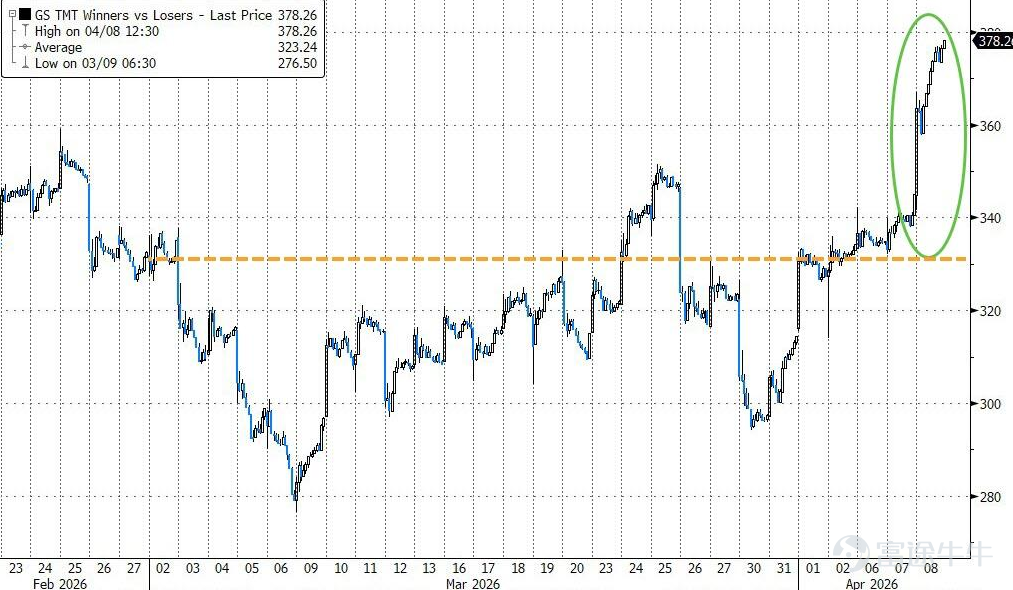
The sector rotation in the overnight US stock market sent a clear signal to investors: 'Risk appetite' is making a strong comeback. However, funds did not blindly scatter but precisely flowed back into previous tech winners such as memory, semiconductors, and optical communications sectors.

With the temporary easing of geopolitical tensions, the 'black swan' hanging over the market has temporarily receded, providing an excellent window for funds to refocus on fundamentals and industry trends. Looking at the core assets leading this year’s US stock rally, an extremely clear market mainline has emerged:One hand holds the 'AI hard-core infrastructure' that leads the era, while the other grips 'traditional energy' to hedge macro and geopolitical risks.

This 'growth + defense' barbell strategy is currently the optimal solution for large funds to navigate high-volatility markets. How should one position themselves specifically?
Mainline One: The 'Hardcore' of AI Infrastructure
In fact, competition among large language models has shifted from the early 'algorithm race' to the deep waters of 'computing power and infrastructure arms race.' The spotlight of the market is moving from pure GPU manufacturers,Expanding outward to every bottleneck link across the entire computing power ecosystem.
I. Data Granary (Memory) —— The Resonance of Cyclical Reversal and AI Premium
$SanDisk (SNDK.US)$ 、 $Western Digital (WDC.US)$ 、 $Seagate Technology (STX.US)$ These three companies have surged by as much as 229%, 97%, and 80% respectively this year. In addition, $Micron Technology (MU.US)$ another company has also risen by 42% within the year.

As we highlighted in'2026 Outlook | Nomura, JPMorgan and other investment banks unanimously predict: the memory industry is expected to usher in a super cycle by 2026! What investment opportunities should be on your radar?',the explosive global demand for AI training/inference computing power, along with the recovery cycle of consumer electronics driven by the edge AI boom, has comprehensively led to exponential growth in demand for DRAM/NAND memory products.Wall Street firms such as Nomura, JPMorgan, and Morgan Stanley are loudly proclaiming the arrival of a 'memory super cycle'.
The market realizes that training and inference for large AI models not only require extremely high computing power but also involve massive data throughput. After enduring a prolonged inventory reduction cycle, the traditional memory industry is now experiencing an inflection point with both volume and price increases. The rigid demand for high bandwidth memory (HBM) and enterprise-grade large-capacity solid-state drives (eSSD) in AI servers is giving the memory sector a dual boost from 'cyclical rebound + AI-driven demand explosion,' known as the double Davies effect.This represents not only a technological upgrade but also a revaluation of the value of data as the 'oil of the AI era.'
II. Computational Power Vessels (Optical Communication and Semiconductor Testing) — Breaking Down the 'Network Wall' Demand
$Lumentum (LITE.US)$ 、 $Ciena (CIEN.US)$ 、 $Corning (GLW.US)$ 、 $Teradyne (TER.US)$ These companies have risen more than 143%, 111%, 88%, and 85% respectively this year.

When hundreds of thousands of GPUs form a massive computing power cluster, the performance of a single chip is no longer the sole determining factor,The transmission speed of data between nodes (bandwidth) has become the biggest bottleneck.The deployment of 800G or even 1.6T silicon photonics modules and high-strength bend-resistant optical fibers has become the only viable solution for interconnecting computing clusters. At the same time, as AI chip manufacturing processes advance to 3nm or even more advanced nodes, the complexity of chip architecture is increasing exponentially, driving a surge in demand for advanced semiconductor testing equipment represented by companies like Teradyne.
As highlighted earlier this year“2026 Outlook | Don't Just Focus on NVIDIA! The Optical Communications Industry Could Become the Strongest Growth Sector by 2026—What Opportunities Should You Watch?”、“Semiconductor Equipment May Enter a Super Cycle—This Industry Chain Overview Is Worth Saving!”These articles also pointed out that as the boundaries of AI training and inference clusters continue to expand, the optical communications industry is entering a multi-year 'Optical Super Cycle,' while semiconductor equipment manufacturers are indispensable core suppliers in this AI-driven computing revolution. Fellow investors who are interested can click to read more.
III. Physical Enhancements (Cooling and Energy Solutions) — Breaking Through the 'Physical Limits' of Computing Centers
Liquid cooling specifically $Vertiv Holdings (VRT.US)$ , solid-state battery-related stocks $Bloom Energy (BE.US)$ They have risen over 73% and 68% respectively year-to-date.

This is the most surprising marginal increase in the market this year. The power consumption and heat generation of AI data centers have reached the physical limits of traditional air-cooling systems and grid capacity. The liquid cooling temperature control technology represented by Vertiv has transformed from an 'optional choice' into a 'must-have' for next-generation supercomputing centers.
The solid oxide fuel cell technology provided by Bloom Energy (BE) — not to be confused with conventional solid-state batteries used in cars, but rather microgrid power generation — perfectly addresses the dual concerns of insufficient grid power and low-carbon environmental protection faced by data centers.
Main theme two: Traditional energy as a hedge against macro risks
Although the AI wave is an undisputed long-term trend, in the current complex global geopolitical and macroeconomic environment, the risk-reward ratio of betting solely on tech stocks is becoming increasingly fragile.
Year-to-date, amid escalating conflicts in the Middle East, energy stocks have seen a strong rally, including Norway’s energy giant $Equinor (EQNR.US)$ rising more than 68%. In addition, $Occidental Petroleum (OXY.US)$ rose over 46%, $ConocoPhillips (COP.US)$ gained nearly 35%, $Exxon Mobil (XOM.US)$ climbed over 30%.

The 'temporary reconciliation' between the US and Iran is merely a pause, not an end. The underlying geopolitical conflicts in the Middle East have not been resolved and could escalate again at any time due to unexpected events. If conflict intensifies and triggers a disruption in crude oil supply or a spike in oil prices, it will directly drive up global inflation expectations, potentially forcing the Federal Reserve to maintain or even raise interest rates.
High interest rates and high inflation are the 'natural enemies' of high-valuation tech stocks. Including traditional energy stocks (such as EQNR) with strong free cash flow, high dividend yields, and resource monopolies in your portfolio is akin to purchasing a 'geopolitical conflict call option.' When tech stocks retreat due to geopolitical crises or inflation rebounds, the counter-cyclical rise of energy stocks can effectively smooth out portfolio volatility.
Summary
The current market is rewarding investors who can both envision the future (AI infrastructure) and respect reality (geopolitics and inflation). The rotation of funds into storage, optics, and power equipment indicates that AI hype is transitioning from the 'concept phase' to the 'earnings realization phase.' Meanwhile, retaining traditional energy as a base holding reflects a rational acknowledgment of this uncertain world.
Risk Disclaimer: The above content only represents the author's view. It does not represent any position or investment advice of Futu. Futu makes no representation or warranty.Read more


Comment (1)
to post a comment
29
66