English
Back
Open Account
Focus on GTC 2026! What signals did Jensen Huang's speech send?

牛牛名人追蹤
joined discussion · Mar 11 22:32 ·

Learn investing from the experts | Jensen Huang presents the 'Five-Layer Cake Theory'! In the era of trillion-dollar AI infrastructure, which companies are worth watching?

On March 10, $NVIDIA (NVDA.US)$CEO Jensen Huang has published a rare personal signed article systematically explaining the development logic of the AI industry. This is his seventh public long-form piece since 2016.
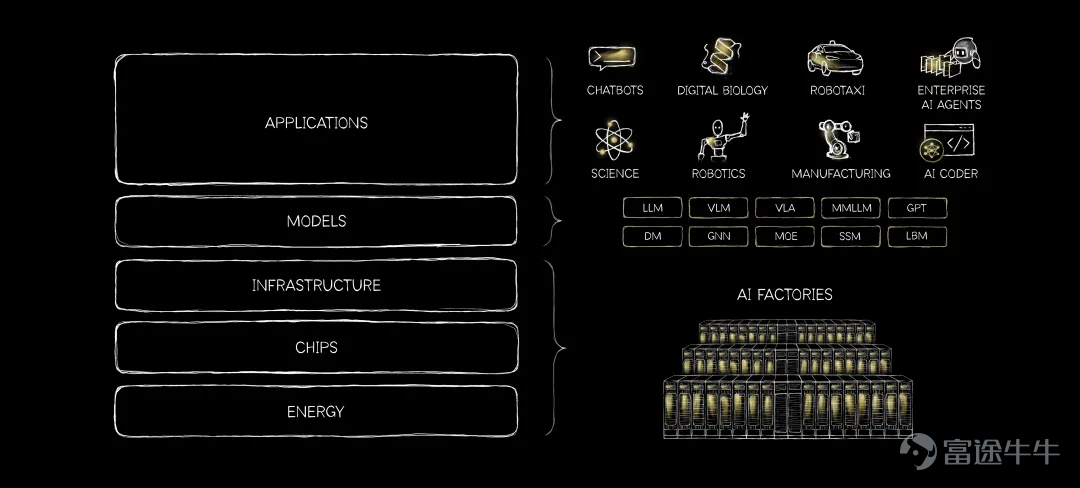
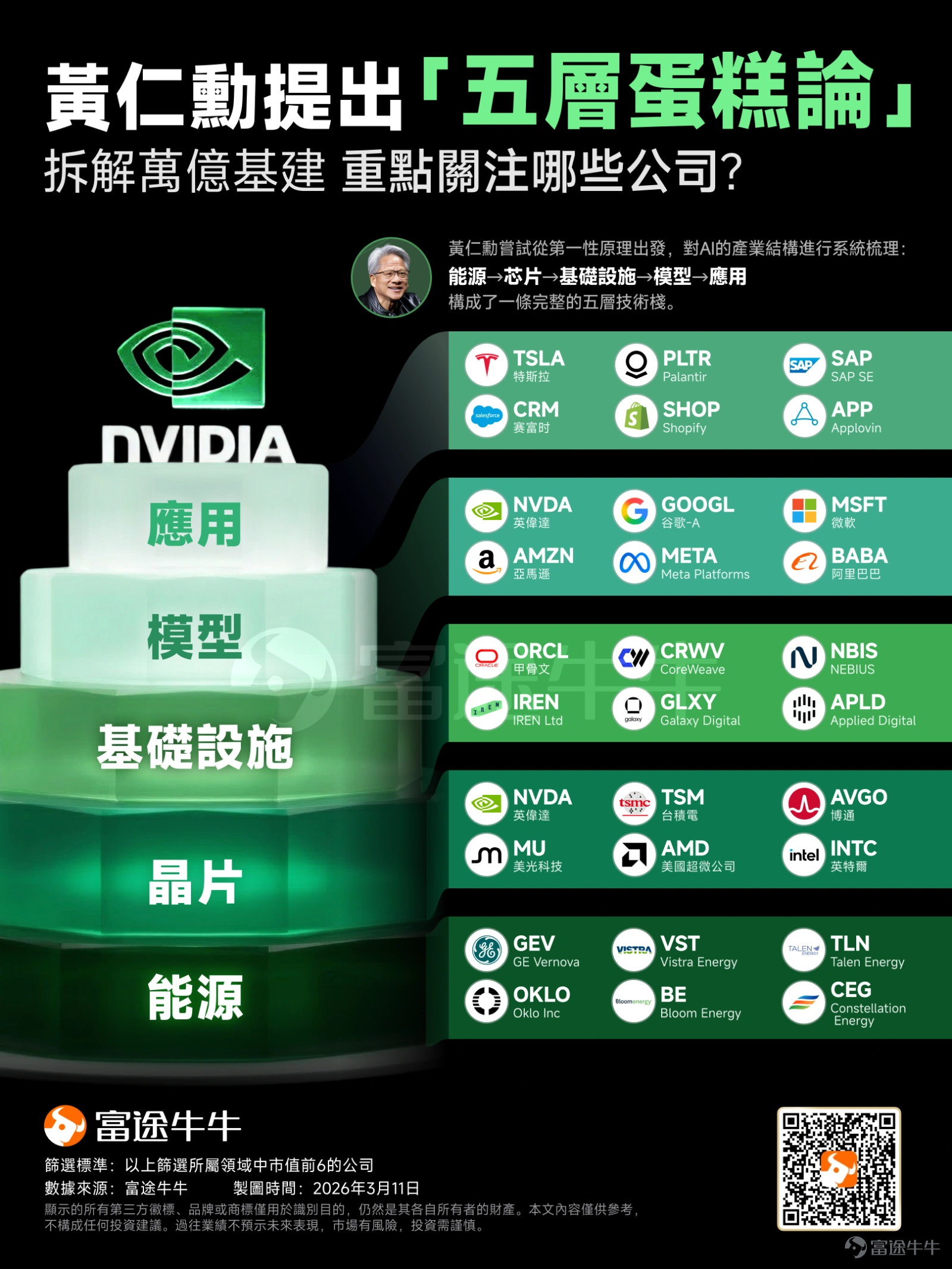
He pointed out that AI should not be understood as a single model or application but as an emerging infrastructure system. Huang likened this infrastructure vividly to a project requiring trillions of dollars to build."Five-layer Cake"from bottom to top, covering respectivelyenergy, chips, infrastructure, models, and applicationsHe boldly predicted thatthe traditional forms of software and apps will gradually disappear in the coming years, to be replaced by a new software paradigm centered on AI Agents.
Source: NVIDIA
Source: NVIDIA
This article will provide an in-depth breakdown of this AI industry landscape to help you understand Jensen Huang’s underlying strategic logic. We will not only explore these five foundational layers but also broaden our perspective to help fellow investors accurately identify future investment opportunities in the AI era.
AI is more than just chips: Deconstructing the "five-layer cake" full-stack architecture
According to an article on NVIDIA's official website, using a five-layer framework to examine the AI industry reveals a clear map of opportunities:
On March 10, $NVIDIA (NVDA.US)$ CEO Jensen Huang has published a rare personally signed article, systematically explaining the development logic of the AI industry. This is his seventh public long article since 2016. He pointed out that AI should not be understood as a single model or application, but rather as an infrastructure system that is currently taking shape. Huang vividly compared this infrastructure to a 'five-layer cake' requiring trillions of dollars to build.'Five-Layer Cake':spanning from bottom to topEnergy, chips, infrastructure, models, and applications。He boldly predicted thatTraditional software and app formats will gradually fade away in the coming years, replaced by a new paradigm of software centered around AI Agents (intelligent entities). This article will provide an in-depth breakdown of the AI industry's landscape, helping you understand Jensen Huang's underlying strategic logic. We will not only explore these five foundational layers but also broaden our perspective to help fellow investors accurately identify investment opportunities in the upcoming AI era. AI is more than just chips: Deconstructing the 'five-layer cake' full-stack architecture According to an article on NVIDIA's official website, using a five-layer framework to examine the AI industry reveals a clear map of opportunities: He emphasized that these five layers are strongly interdependent. Layer 1: Energy Layer — The foundation of computing power and the cornerstone of AI industry development The most fundamental layer of AI is energy.Real-time intelligence generation requires real-time electricity production. Every generated token...
He emphasized that these five layers are strongly interdependent.
Layer 1: Energy Layer —— The foundation of computing power, the cornerstone of AI industry development
The most fundamental layer of AI is energy.Real-time intelligent generation requires real-time electricity production. Every generated token is the result of electron movement, heat management, and energy transformation into computational power. Beneath this layer, there are no abstract layers. Energy is the first principle of AI infrastructure and a hard constraint determining how much intelligence the system can produce.
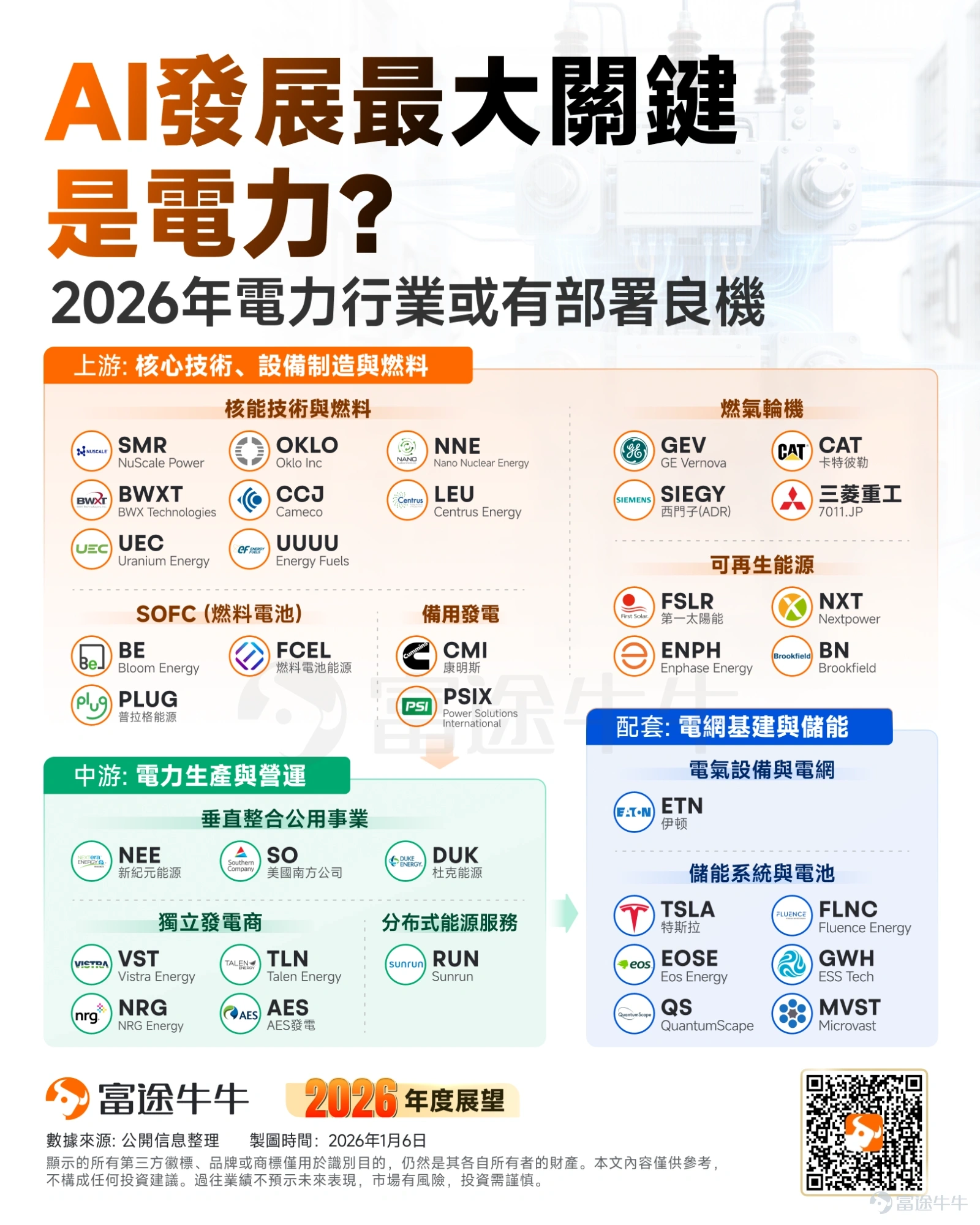
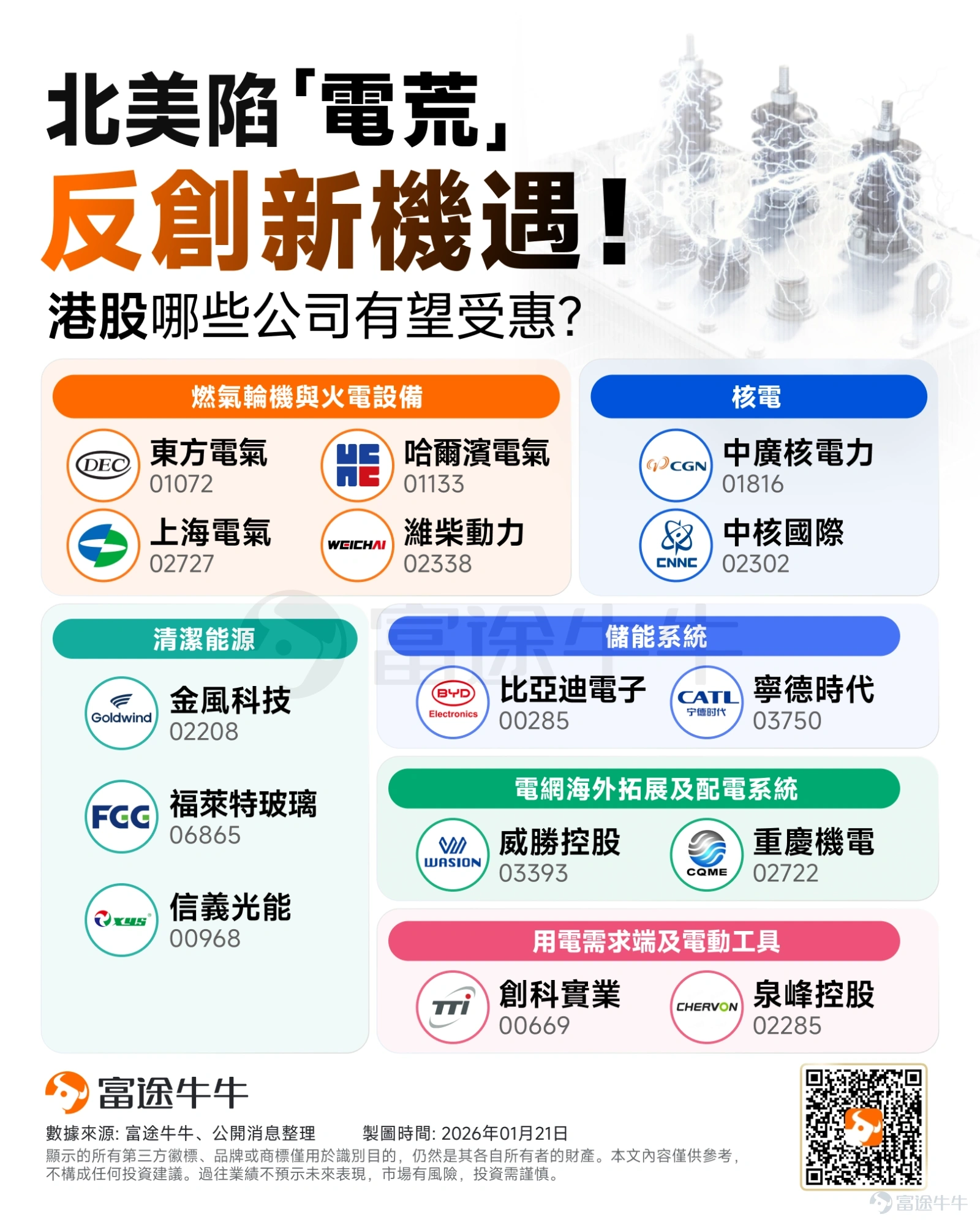
The first day of the lunar new year article2026 Outlook | Collective warnings from Musk and Huang Renxun! Power shortage ignites new opportunities; keep this list of power 'gold mines' handyalso mentioned that electricity has increasingly become the Sword of Damocles constraining AI development,Tech giants such as Elon Musk, NVIDIA's Huang Renxun, and OpenAI CEO Sam Altman have all expressed concerns about electricity shortages.
Overall, the supply-demand gap for electricity in the U.S. may continue to widen. To address the electricity shortage in the U.S., related industrial chains will face new opportunities:
Gas turbines have taken the lead, becoming the preferred choice for tech companies to generate their own electricity. Orders for GE Vernova and Siemens Energy are already scheduled until 2028. This extremely high level of performance certainty and pricing power constitutes the strongest investment logic at present. Meanwhile, fuel cells, with their 'plug-and-play' agility, are capturing the market high ground for rapid deployment; and energy storage has become a key balancing factor between supply and demand.
Looking further ahead, nuclear power, with its long service life and low marginal costs, remains the optimal solution for a long-term energy foundation; and with AI reshaping infrastructure, upgrading the power grid equipment cannot be overlooked either.
On March 10, $NVIDIA (NVDA.US)$ CEO Jensen Huang has published a rare personally signed article, systematically explaining the development logic of the AI industry. This is his seventh public long article since 2016. He pointed out that AI should not be understood as a single model or application, but rather as an infrastructure system that is currently taking shape. Huang vividly compared this infrastructure to a 'five-layer cake' requiring trillions of dollars to build.'Five-Layer Cake':spanning from bottom to topEnergy, chips, infrastructure, models, and applications。He boldly predicted thatTraditional software and app formats will gradually fade away in the coming years, replaced by a new paradigm of software centered around AI Agents (intelligent entities). This article will provide an in-depth breakdown of the AI industry's landscape, helping you understand Jensen Huang's underlying strategic logic. We will not only explore these five foundational layers but also broaden our perspective to help fellow investors accurately identify investment opportunities in the upcoming AI era. AI is more than just chips: Deconstructing the 'five-layer cake' full-stack architecture According to an article on NVIDIA's official website, using a five-layer framework to examine the AI industry reveals a clear map of opportunities: He emphasized that these five layers are strongly interdependent. Layer 1: Energy Layer — The foundation of computing power and the cornerstone of AI industry development The most fundamental layer of AI is energy.Real-time intelligence generation requires real-time electricity production. Every generated token...
It’s worth noting that Huang Renxun also previously mentioned that although the US is 'several generations ahead' in chips,China has twice the energy resources of the US.Without energy, it is impossible to build chip factories, supercomputers, and AI data centers.
Not coincidentally, Musk believes thatChina’s decisive advantage in the AI race lies in its ability to supply massive amounts of electricity.He estimates that by 2026, China's power generation may reach about three times that of the United States, thereby possessing the capability to support high-energy-consuming AI data centers.
Therefore, amidst the North American electricity shortage, Chinese companies, especially those closely linked to the North American market, have become highly sought-after in the capital markets. Previously,North America's Power Shortage Creates New Opportunities! Which Hong Kong-listed Companies Could Benefit?relevant concept stocks in the Hong Kong stock market were also analyzed for investors' reference:
On March 10, $NVIDIA (NVDA.US)$ CEO Jensen Huang has published a rare personally signed article, systematically explaining the development logic of the AI industry. This is his seventh public long article since 2016. He pointed out that AI should not be understood as a single model or application, but rather as an infrastructure system that is currently taking shape. Huang vividly compared this infrastructure to a 'five-layer cake' requiring trillions of dollars to build.'Five-Layer Cake':spanning from bottom to topEnergy, chips, infrastructure, models, and applications。He boldly predicted thatTraditional software and app formats will gradually fade away in the coming years, replaced by a new paradigm of software centered around AI Agents (intelligent entities). This article will provide an in-depth breakdown of the AI industry's landscape, helping you understand Jensen Huang's underlying strategic logic. We will not only explore these five foundational layers but also broaden our perspective to help fellow investors accurately identify investment opportunities in the upcoming AI era. AI is more than just chips: Deconstructing the 'five-layer cake' full-stack architecture According to an article on NVIDIA's official website, using a five-layer framework to examine the AI industry reveals a clear map of opportunities: He emphasized that these five layers are strongly interdependent. Layer 1: Energy Layer — The foundation of computing power and the cornerstone of AI industry development The most fundamental layer of AI is energy.Real-time intelligence generation requires real-time electricity production. Every generated token...
Layer 2: Chip Layer — The Core of Computing Power, Driving the Development of AI with the Most Hardcore Technology
Above energy are chips. These processors are designed to convert energy into computing power on a large scale and efficiently. AI workloads require enormous parallel computing power, high-bandwidth memory, and fast interconnection technology. Progress in the chip layer determines the speed of AI expansion and how affordable intelligence becomes.
“2026 Outlook | Wall Street Chip Stock 'Treasure Map' Revealed! NVIDIA, Broadcom top the list, what are the potential dark horses?”An article once outlined for fellow investors the most favored chip stocks of 2026 according to major banks, including not only GPUs and CPUs chased over the past few years but also storage chips and analog chips, which have become key areas of focus on Wall Street.
On March 10, $NVIDIA (NVDA.US)$ CEO Jensen Huang has published a rare personally signed article, systematically explaining the development logic of the AI industry. This is his seventh public long article since 2016. He pointed out that AI should not be understood as a single model or application, but rather as an infrastructure system that is currently taking shape. Huang vividly compared this infrastructure to a 'five-layer cake' requiring trillions of dollars to build.'Five-Layer Cake':spanning from bottom to topEnergy, chips, infrastructure, models, and applications。He boldly predicted thatTraditional software and app formats will gradually fade away in the coming years, replaced by a new paradigm of software centered around AI Agents (intelligent entities). This article will provide an in-depth breakdown of the AI industry's landscape, helping you understand Jensen Huang's underlying strategic logic. We will not only explore these five foundational layers but also broaden our perspective to help fellow investors accurately identify investment opportunities in the upcoming AI era. AI is more than just chips: Deconstructing the 'five-layer cake' full-stack architecture According to an article on NVIDIA's official website, using a five-layer framework to examine the AI industry reveals a clear map of opportunities: He emphasized that these five layers are strongly interdependent. Layer 1: Energy Layer — The foundation of computing power and the cornerstone of AI industry development The most fundamental layer of AI is energy.Real-time intelligence generation requires real-time electricity production. Every generated token...
Including AI computing power and core logic chips$Broadcom (AVGO.US)$$NVIDIA (NVDA.US)$$Marvell Technology (MRVL.US)$$Ambarella (AMBA.US)$
AI connectivity and high-speed interconnects $Astera Labs (ALAB.US)$$Credo Technology (CRDO.US)$
Electronic Design Automation (EDA) $Synopsys (SNPS.US)$$Cadence Design Systems (CDNS.US)$
Layer 3: Infrastructure Layer — The Carrier of Computing Power, the Hub Supporting AI Expansion at Scale
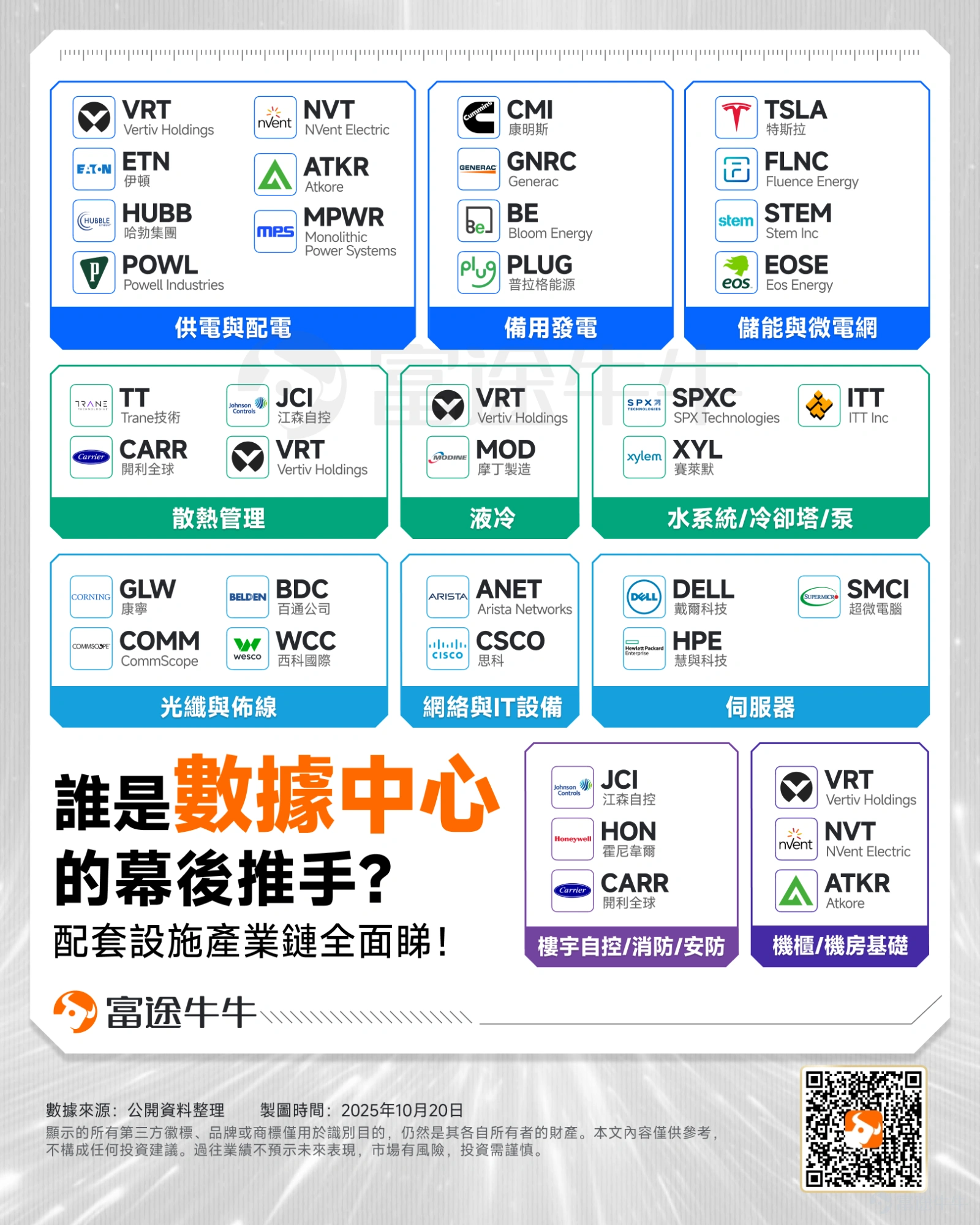
The infrastructure built on chips is foundational. This includes land, power delivery, cooling systems, construction, networking, and the systems that coordinate thousands of processors into a single machine. These systems are 'AI factories.' Their design purpose is not to store information but to generate intelligence.
Who’s Behind Data Centers? A Comprehensive Look at the Supporting Facilities Industry Chain!As previously noted, the essence of the AI race is fundamentally a competition over physical infrastructure. In this unprecedented gold rush ignited by AI,those supply chain giants that master core cooling and power supply technologies, capable of 'cooling down' and 'powering' massive computing capabilities, will undoubtedly emerge as the true winners.
On March 10, $NVIDIA (NVDA.US)$ CEO Jensen Huang has published a rare personally signed article, systematically explaining the development logic of the AI industry. This is his seventh public long article since 2016. He pointed out that AI should not be understood as a single model or application, but rather as an infrastructure system that is currently taking shape. Huang vividly compared this infrastructure to a 'five-layer cake' requiring trillions of dollars to build.'Five-Layer Cake':spanning from bottom to topEnergy, chips, infrastructure, models, and applications。He boldly predicted thatTraditional software and app formats will gradually fade away in the coming years, replaced by a new paradigm of software centered around AI Agents (intelligent entities). This article will provide an in-depth breakdown of the AI industry's landscape, helping you understand Jensen Huang's underlying strategic logic. We will not only explore these five foundational layers but also broaden our perspective to help fellow investors accurately identify investment opportunities in the upcoming AI era. AI is more than just chips: Deconstructing the 'five-layer cake' full-stack architecture According to an article on NVIDIA's official website, using a five-layer framework to examine the AI industry reveals a clear map of opportunities: He emphasized that these five layers are strongly interdependent. Layer 1: Energy Layer — The foundation of computing power and the cornerstone of AI industry development The most fundamental layer of AI is energy.Real-time intelligence generation requires real-time electricity production. Every generated token...
Layer 4: Model Layer — The intelligent hub that converges technological breakthroughs and open-source ecosystems.
Above the infrastructure lies the model layer. AI models can understand various types of information: language, biology, chemistry, physics, finance, medicine, and the physical world itself. Language models are just one category. Some of the most disruptive work currently underway is occurring in protein AI, chemical AI, physics simulations, robotics, and autonomous systems.
Major large model developers in the US and China include: America's OpenAI, Anthropic, $Alphabet-C (GOOG.US)$ 's Gemini, xAI, $Meta Platforms (META.US)$ and others; China's $Alibaba (BABA.US)$ , ByteDance, $MINIMAX-W (00100.HK)$$KNOWLEDGE ATLAS (02513.HK)$$Baidu (BIDU.US)$ , MoonShot, DeepSeek, StepFun Technologies, and more.
Layer 5: Application Layer —— Value realization, the endpoint for commercial implementation and economic benefits
The top layer is application, which is where economic value is created. Drug discovery platforms, industrial robots, legal assistants, and autonomous vehicles all belong to this category.Autonomous vehicles are AI applications embodied in machinesHumanoid robots, on the other hand, are AI applications embodied in physical forms.They utilize the same technology stack but yield different outcomes.
Among these, AI software stocksare worth focusing on, $Meta Platforms (META.US)$$Alphabet-A (GOOGL.US)$$Palantir (PLTR.US)$$Shopify (SHOP.US)$ especially companies with scarcity.
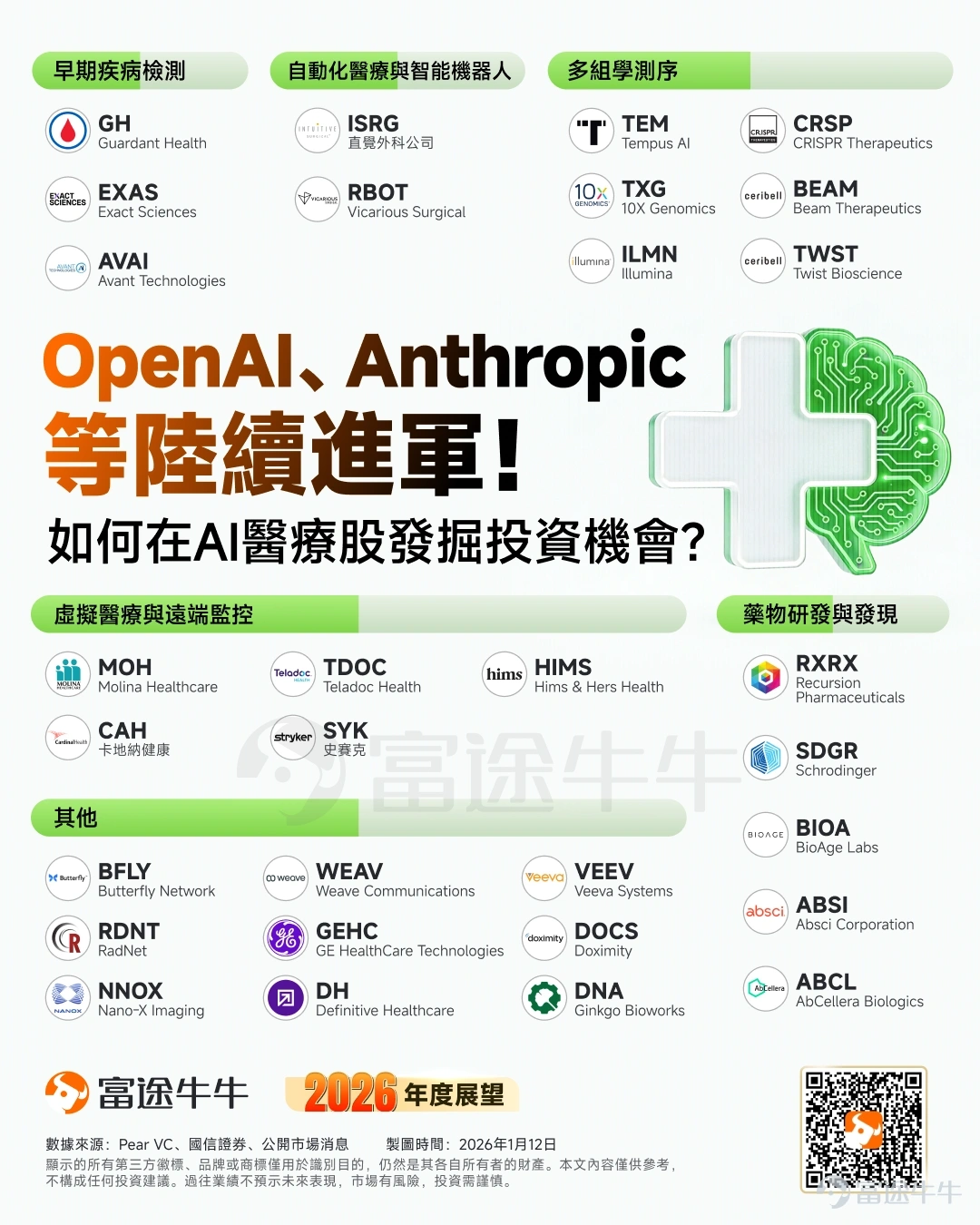
In terms of AI in healthcare,It is also becoming the most fiercely contested battleground for AI applications, with 'Cathie Wood' continuing to firmly increase her position in the AI healthcare sector. Previously, we also compiled a list of AI healthcare industry concept stocks for fellow investors to reference:
On March 10, $NVIDIA (NVDA.US)$ CEO Jensen Huang has published a rare personally signed article, systematically explaining the development logic of the AI industry. This is his seventh public long article since 2016. He pointed out that AI should not be understood as a single model or application, but rather as an infrastructure system that is currently taking shape. Huang vividly compared this infrastructure to a 'five-layer cake' requiring trillions of dollars to build.'Five-Layer Cake':spanning from bottom to topEnergy, chips, infrastructure, models, and applications。He boldly predicted thatTraditional software and app formats will gradually fade away in the coming years, replaced by a new paradigm of software centered around AI Agents (intelligent entities). This article will provide an in-depth breakdown of the AI industry's landscape, helping you understand Jensen Huang's underlying strategic logic. We will not only explore these five foundational layers but also broaden our perspective to help fellow investors accurately identify investment opportunities in the upcoming AI era. AI is more than just chips: Deconstructing the 'five-layer cake' full-stack architecture According to an article on NVIDIA's official website, using a five-layer framework to examine the AI industry reveals a clear map of opportunities: He emphasized that these five layers are strongly interdependent. Layer 1: Energy Layer — The foundation of computing power and the cornerstone of AI industry development The most fundamental layer of AI is energy.Real-time intelligence generation requires real-time electricity production. Every generated token...
In terms of robotics,PreviouslyThe article '2026 Outlook | US-China Rivalry Enters New Arena! Robotics Industry May Face 'Commercialization Test'; Which Core Companies Did Morgan Stanley Highlight?'An article once noted that 2026 is widely regarded as the 'big test year' for commercialization by robotics companies. Current integrators include Tesla, Alibaba, XPeng Motors, and Ubtech Robotics. However, Morgan Stanley believes what deserves more attention at this stage isthe upstream core components.
On March 10, $NVIDIA (NVDA.US)$ CEO Jensen Huang has published a rare personally signed article, systematically explaining the development logic of the AI industry. This is his seventh public long article since 2016. He pointed out that AI should not be understood as a single model or application, but rather as an infrastructure system that is currently taking shape. Huang vividly compared this infrastructure to a 'five-layer cake' requiring trillions of dollars to build.'Five-Layer Cake':spanning from bottom to topEnergy, chips, infrastructure, models, and applications。He boldly predicted thatTraditional software and app formats will gradually fade away in the coming years, replaced by a new paradigm of software centered around AI Agents (intelligent entities). This article will provide an in-depth breakdown of the AI industry's landscape, helping you understand Jensen Huang's underlying strategic logic. We will not only explore these five foundational layers but also broaden our perspective to help fellow investors accurately identify investment opportunities in the upcoming AI era. AI is more than just chips: Deconstructing the 'five-layer cake' full-stack architecture According to an article on NVIDIA's official website, using a five-layer framework to examine the AI industry reveals a clear map of opportunities: He emphasized that these five layers are strongly interdependent. Layer 1: Energy Layer — The foundation of computing power and the cornerstone of AI industry development The most fundamental layer of AI is energy.Real-time intelligence generation requires real-time electricity production. Every generated token...
Regarding autonomous driving, Huang Renxun has consistently stated thatautonomous driving technology is one of the most representative and core application fields of artificial intelligence.The article '2026 Outlook | Is Autonomous Driving on the Eve of Explosion? NVIDIA's Model Ignites Market Enthusiasm; 5 Core Opportunities Worth Watching!'An article also outlined the autonomous driving industry chain for fellow investors to reference:
On March 10, $NVIDIA (NVDA.US)$ CEO Jensen Huang has published a rare personally signed article, systematically explaining the development logic of the AI industry. This is his seventh public long article since 2016. He pointed out that AI should not be understood as a single model or application, but rather as an infrastructure system that is currently taking shape. Huang vividly compared this infrastructure to a 'five-layer cake' requiring trillions of dollars to build.'Five-Layer Cake':spanning from bottom to topEnergy, chips, infrastructure, models, and applications。He boldly predicted thatTraditional software and app formats will gradually fade away in the coming years, replaced by a new paradigm of software centered around AI Agents (intelligent entities). This article will provide an in-depth breakdown of the AI industry's landscape, helping you understand Jensen Huang's underlying strategic logic. We will not only explore these five foundational layers but also broaden our perspective to help fellow investors accurately identify investment opportunities in the upcoming AI era. AI is more than just chips: Deconstructing the 'five-layer cake' full-stack architecture According to an article on NVIDIA's official website, using a five-layer framework to examine the AI industry reveals a clear map of opportunities: He emphasized that these five layers are strongly interdependent. Layer 1: Energy Layer — The foundation of computing power and the cornerstone of AI industry development The most fundamental layer of AI is energy.Real-time intelligence generation requires real-time electricity production. Every generated token...
Summary
Over the past two years, market attention has almost entirely focused on the 'model layer' arms race — closely watching which large model has broken new benchmarks or reached another level in parameter scale.However, the 'five-layer architecture' provides us with a broader perspective: AI is not just a single breakthrough but an industrial ecosystem where upstream and downstream sectors are tightly interconnected and evolve in tandem; each layer holds unique business value and evolutionary logic.
As Huang Renxun mentioned, AI is becoming the 'electricity' of a new era. Facing this epic-level infrastructure restructuring, rather than trying to precisely bet on a single track, it’s better to cultivate a holistic perspective and keen adaptability. After all, in times of great change, understanding the bigger picture and staying in the game is often more important than guessing the final outcome.
Risk Disclaimer: The above content only represents the author's view. It does not represent any position or investment advice of Futu. Futu makes no representation or warranty.Read more
Thumbs Up
226
Heart
23
Emm
3
Respect
2
Thumbs Up
1
Lol
2
1.8M Views
Report
Comments (16)
Write a Comment...
16
257
760