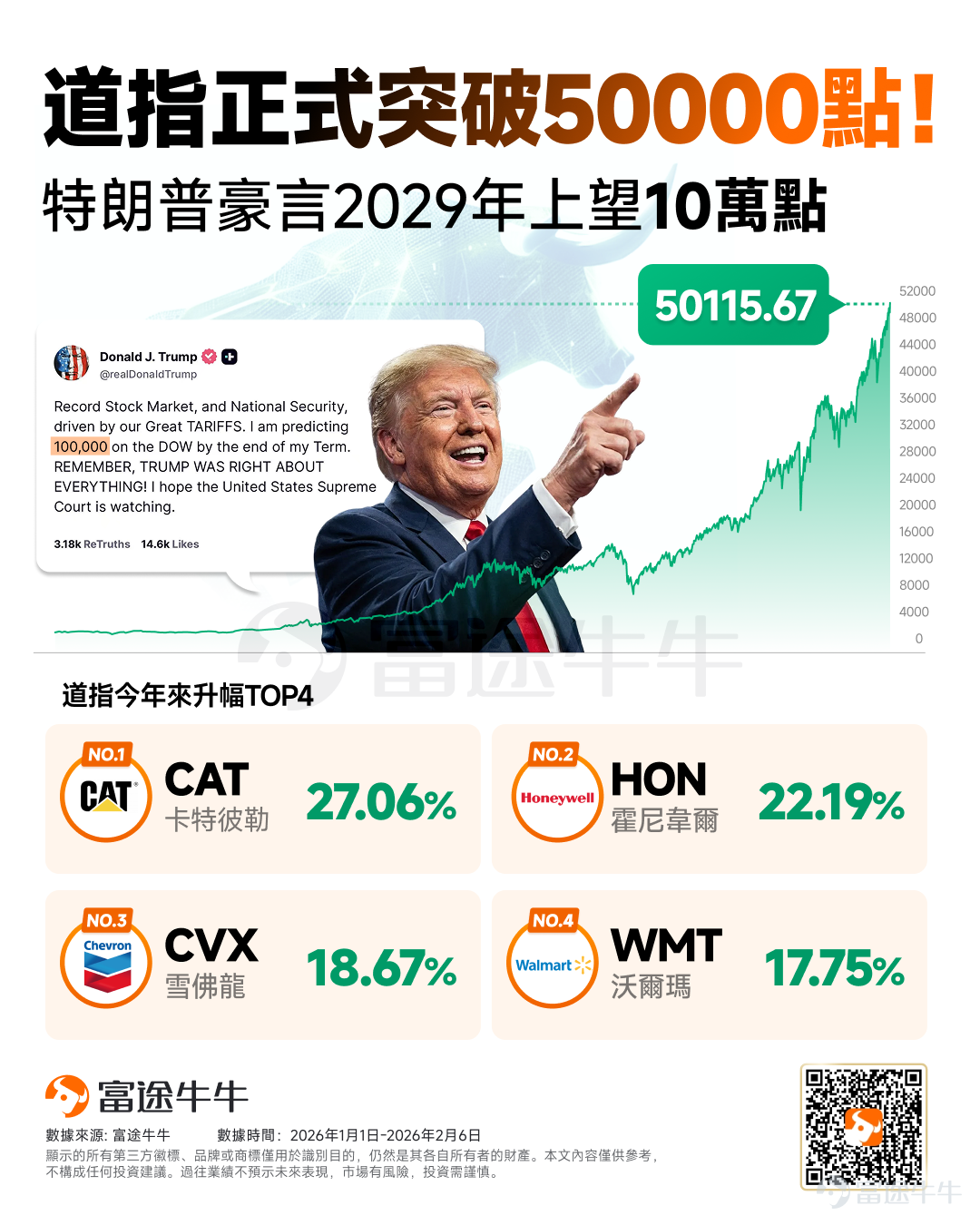

Trump cheers on towards 100,000! Will the Dow continue its surge after breaking through 50,000 point

Is the US stock market entering a recovery phase? Trump and Jensen Huang both 'chiming in' with these three key trends worth watching!
Last Friday, the US stock market witnessed a historic moment. Driven by strong buying,the Dow Jones Index broke through the 50,000-point mark,marking the largest single-day gain since May last year. In response, Trump quickly attributed this milestone to his tariff policies,and boldly predicted that the Dow would reach 100,000 points before the end of his term.

This is not the first time Trump has made an aggressive statement about the prospects of the US stock market recently.Last month, when the market was hit by selloffs due to tariff disputes and NATO geopolitical concerns, he predicted that the US stock market would double within a year, claiming that the short-term pullback of the S&P 500 index was 'insignificant' compared to the cumulative gains since he took office.
Beyond the optimistic rhetoric at the political level, significant signals have also emerged from the industry fundamentals.NVIDIA CEO Jensen Huang publicly refuted the view that 'AI is causing market panic.' He emphasized that the current large-scale AI capital expenditure is reasonable, appropriate, and sustainable, driven by 'extremely high' demand for computing power as part of 'the largest infrastructure construction effort in human history.'
Jensen Huang further pointed out,The construction of artificial intelligence infrastructure will continue for seven to eight years,which, to a certain extent, eliminates market concerns about whether 'AI investment is overheating and whether it can be sustained,' anchoring the investment logic in a nearly decade-long cycle of infrastructure certainty. He stated that as long as people are still willing to pay for artificial intelligence, and AI companies can achieve profitability,they will keep 'doubling, doubling, doubling, doubling' their investments.
Factual data also supports this point.These remarks by NVIDIA's CEO come after tech giants such as Meta, Microsoft, Alphabet, and Amazon released their earnings reports over the past two weeks. According to the latest earnings guidance, Microsoft, META, Google, and Amazon are expected to collectively reach approximately $650 billion in capital expenditures by 2026, with a year-over-year growth rate as high as 60%.

This means that the global data center construction boom is not cooling down but is instead accelerating comprehensively. The focus is onAI chips and memory chips.、Optical communication modules and high-speed cables, as well as includingBackup power generation, grid, and energy storageas part of the key supporting infrastructure. This article will also focus on introducing the investment logic and opportunities in the above three major fields to fellow investors.
I. AI chips and memory chips
Early 2026 Outlook Series“2026 Outlook | Wall Street Chip Stock 'Treasure Map' Revealed! NVIDIA, Broadcom top the list, what are the potential dark horses?”The article once indicated,Major Wall Street firms generally believe that 2026 will be a pivotal year for the semiconductor industry, transitioning from being 'solely AI-driven' to being propelled by both 'AI and the recovery of traditional cycles.'
Overall, the major players are no longer just chasing the infrastructure for 'AI training',but are starting to seek opportunities in cyclical recovery (analog chips) and AI edge expansion (storage).

Specifically, the following three main themes are highlighted:
Main Theme One: Establishment of the 'Double-Headed Eagle' Pattern – NVIDIA and Broadcom as Standard Components
Looking at the lists from the five major banks, the frequency of NVIDIA and Broadcom appearances is nearly 100%. This sends a strong signal:The construction of AI infrastructure is far from complete, with computing power and connectivity remaining core themes.
$NVIDIA (NVDA.US)$ Almost all investment banks have listed NVIDIA as a core holding. Goldman Sachs pointed out that its moat in AI training applications is hard to shake; Bank of America emphasized that NVIDIA's PEG (Price/Earnings to Growth ratio) remains attractive, currently at about 0.6 times, significantly lower than the overall level of nearly 2 times for S&P 500 index constituents.
$Broadcom (AVGO.US)$ Considered the 'best co-pilot' in the AI era. Goldman Sachs listed it as the top AI pick for 2026, optimistic about its dominance in custom chips (ASICs) and network transmission chips, making it an indispensable partner for major companies like Google TPU.
Overall, these two companies represent essential utilities of the AI era—while their explosive growth may not match the past two years, they offer the highest certainty.
Main Theme Two: Cyclical Recovery – The ‘Surprise’ Moment for Analog Chips
This is the biggest highlight in the 2026 outlook. Both Citi and Goldman Sachs have pointed out that after two years of inventory adjustments, analog chips are set to experience a strong cyclical rebound, potentially making it the sector with the highest return potential in 2026.
$Microchip Technology (MCHP.US)$ Citi and Goldman Sachs' top choice. The reason being its profit margin and stock price had undergone significant correction, and with inventory reduction completed, its rebound potential is the strongest.
Additionally, $Texas Instruments (TXN.US)$ 、 $Analog Devices (ADI.US)$ 、 $NXP Semiconductors (NXPI.US)$ All were included in the list of favored stocks. Overall, if AI is the attacker, analog chips will be the best defensive counterattack choice for 2026.
Main Theme Three: Selling Shovels – Semiconductor Equipment and Memory
As chip manufacturing processes become increasingly complex (such as GAA architecture, HBM stacking), demand for manufacturing equipment and memory will remain high.
Equipment stocks duo: $Applied Materials (AMAT.US)$ and $Lam Research (LRCX.US)$ Multiple investment banks are optimistic about LRCX. Citi particularly favors LRCX, while Goldman Sachs and Bank of America believe equipment stocks will benefit from double-digit growth in wafer fab spending in 2026.
Memory king: $Micron Technology (MU.US)$ Morgan Stanley's 'top memory pick.' Morgan Stanley predicts a structural shortage in DRAM supply and demand, which will be a significant boost for prices and profits.
In addition,Bank of America also bet on the leader in automatic test equipment (ATE), $Teradyne (TER.US)$, as chips become increasingly complex, the importance of the testing process is skyrocketing.
Moreover‘2026 Outlook | Nomura, J.P. Morgan, and other investment banks unanimously predict: The storage industry may see a super cycle by 2026! What investment opportunities should be watched?’The article also highlighted that,investment banks on Wall Street, including Nomura, JPMorgan, and Morgan Stanley, to proclaim the arrival of a 'storage supercycle.'

This industry includes the world's largest DRAM and HBM supplier, $CSOP SK Hynix Daily (2x) Leveraged Product (07709.HK)$ , the world's second-largest DRAM supplier, and the third-largest HBM supplier, $CSOP Samsung Electronics Daily (2x) Leveraged Product (07747.HK)$ , one of the top three DRAM suppliers globally, the second-largest HBM supplier, and the fourth-largest firm in the global NAND market, $Micron Technology (MU.US)$ , the fifth-largest firm in the global NAND market, $SanDisk (SNDK.US)$ , the world’s two largest hard drive manufacturers$Western Digital (WDC.US)$ 、 $Seagate Technology (STX.US)$ ;
as well as the global leader in NAND flash memory controller solutions, $Silicon Motion Technology (SIMO.US)$ , a U.S. memory IP company, $Rambus (RMBS.US)$ , a global leader in memory storage technology, $Marvell Technology (MRVL.US)$ , and memory packaging vendors.$Lam Research (LRCX.US)$ , a system specializing in thin-film deposition processes for memory chips$Applied Materials (AMAT.US)$ ; a leader in enterprise memory storage technology$NetApp (NTAP.US)$ , a global leader in memory storage technology$Everpure (P.US)$ 。
Second, optical communication modules and high-speed cables
2026 Outlook Series at the Beginning of the YearOutlook 2026 | Don’t Just Focus on NVIDIA! By 2026, the Optical Communication Industry May Become the Strongest Growth Area—What Opportunities Should You Watch?It was also suggested that the underlying logic of the market in 2026 might shift from simply "buying computing power" to "buying transport power",In this process, the strategic importance of optical communications may undergo a value reassessment, emerging as a critical factor that cannot be ignored in the second half of the AI era.
Industry observers note that CPO technology is evolving into two major camps, led respectively by Broadcom and NVIDIA. Broadcom has entered the market with its Tomahawk series of switches, which integrate CPO technology. Meanwhile, NVIDIA is leveraging its Spectrum-X ecosystem and next-generation Quantum Photonics silicon photonics network switches, including the official update of the Quantum-X silicon photonics switch solutions in December 2025, signaling that CPO products are entering a phase of volume production, thereby accelerating the deployment of AI data centers.

Photonic integrated circuit design (including DSP/electronic chips):Including $Intel (INTC.US)$ 、 $Broadcom (AVGO.US)$ 、 $Coherent (COHR.US)$ 、 $Cisco (CSCO.US)$ 、 $NVIDIA (NVDA.US)$ 、 $Lumentum (LITE.US)$ 、 $Marvell Technology (MRVL.US)$ 、 $POET Technologies (POET.US)$ 、 $Nokia Oyj (NOK.US)$ 、 $MACOM Technology Solutions (MTSI.US)$ 、 $Credo Technology (CRDO.US)$ 、 $Astera Labs (ALAB.US)$ 、 $Semtech (SMTC.US)$ 、 $ZTE (00763.HK)$ 。
Silicon photonics and CMOS wafer fabs:Including $Taiwan Semiconductor (TSM.US)$ 、 $United Microelectronics (UMC.US)$ 、 $Intel (INTC.US)$ 、 $GlobalFoundries (GFS.US)$、 $Tower Semiconductor (TSEM.US)$ 、 $STMicroelectronics (STM.US)$ 、 $SkyWater Technology (SKYT.US)$ 。
Intel has invested over two decades in silicon photonics technology and has collaborated with Taiwan-based silicon photonics epitaxy supplier Lianya for more than 10 years. In 2023, Intel sold its pluggable optical module business to Jabil and stated that it would focus on high-value optical I/O solutions tailored for artificial intelligence.
GlobalFoundries offers the GF Fotonix silicon photonics platform, which integrates optical components onto a single chip. The platform has already engaged in collaborations with key partners such as NVIDIA, Broadcom, and Marvell Technology.
Tower Semiconductor provides a 300mm silicon photonics platform tailored for silicon photonics products. It collaborates with companies like Coherent and Innolight to manufacture transceivers based on 1.6T and 3.0T silicon photonics technologies and is currently developing a single-channel 3.2T transceiver.
Optical module suppliersIncluding $Coherent (COHR.US)$ 、 $Lumentum (LITE.US)$ 、 $Applied Optoelectronics (AAOI.US)$ 、 $CIG (06166.HK)$ , among which, Coherent andLumentumA long-established powerhouse offering full vertical integration capabilities from chips to modules.
EMS (Electronic Manufacturing Services) / ConnectorsIncluding $Amphenol (APH.US)$ 、 $Celestica (CLS.US)$ 、 $Fabrinet (FN.US)$ 、 $Jabil (JBL.US)$ 、 $FIT HON TENG (06088.HK)$ 、 $TIME INTERCON (01729.HK)$Wait for the company;
System Equipment OpticalIncluding $Arista Networks (ANET.US)$ 、 $Cisco (CSCO.US)$ 、 $Nokia Oyj (NOK.US)$ 、 $Ciena (CIEN.US)$ 、 $Hewlett Packard Enterprise (HPE.US)$ 、 $Dell Technologies (DELL.US)$ ;
Packaging and TestingIncluding $ASE Technology (ASX.US)$ 、 $Amkor Technology (AMKR.US)$ ;Fiber Optic CablesIncluding $Corning (GLW.US)$ 、 $YOFC (06869.HK)$ ;Epitaxial Wafer SupplierIncluding $AXT Inc (AXTI.US)$ ;InP (Indium Phosphide) Wafer FabIncluding $Coherent (COHR.US)$ 、 $Lumentum (LITE.US)$ ;
Equipment - Data Communication DevicesIncluding $Arista Networks (ANET.US)$ 、 $Cisco (CSCO.US)$ 、 $NVIDIA (NVDA.US)$ 、 $Hewlett Packard Enterprise (HPE.US)$ 、 $Dell Technologies (DELL.US)$ ;Equipment - Telecommunication DevicesIncluding $Ciena (CIEN.US)$ 、 $Nokia Oyj (NOK.US)$ 、 $LM Ericsson Telephone (ERIC.US)$ 、 $ZTE (00763.HK)$ 。
3. Backup power generation, power grids, and energy storage and other data center supporting facilities
Who’s Behind Data Centers? A Comprehensive Look at the Supporting Facilities Industry Chain!An article once stated that this "density revolution," triggered by chips, is impacting the infrastructure of data centers from the bottom up, with its core battleground concentrated in two areas:Cooling Systems (Water) and Power Supply Systems (Electricity).

1. Power System: Ensuring Stable Power Supply and Distribution
⚡ Power Supply and Distribution (Uninterruptible Power Supply/Switchgear/Busbars/Power Distribution Units)
Positioning and Value:As the 'last mile' before electrical energy enters IT loads, this segment is crucial for ensuring continuous power supply and power quality in server rooms.
Relevant companies:
🔌 Backup power generation (diesel/fuel cell)
Positioning and value:As the ultimate power defense line for data centers, it assumes full load during a complete mains power outage to ensure zero business interruption. The technological route is evolving towards low-carbon and diversified fuel directions.
Relevant companies:
🔋Energy storage and microgrid
Positioning and value:Beyond traditional backup functionality, it reduces electricity costs through 'peak shaving and valley filling,' while supporting grid stability with rapid response, forming the core of building a green and efficient energy system for data center campuses.
Relevant companies:
2. Cooling systems: Ensuring equipment heat dissipation and environmental temperature control
❄️ Thermal Management (Chillers/Precision Air Conditioning)
Positioning and Value:As the cornerstone of data center temperature control, this sector directly ensures the operational environment for IT equipment through air-cooling technology and group control systems. Its efficiency is a key factor influencing the overall PUE (Power Usage Effectiveness) metrics.
Relevant Companies:
💧 Liquid Cooling (Cold Plates/Immersion/Heat Exchangers)
Positioning and Value:Rising alongside the explosive demand for AI computing power, this is the inevitable choice for addressing heat dissipation in high-density cabinets above 20kW. This technology not only significantly reduces PUE (Power Usage Effectiveness) but also supports the evolution of future computing infrastructure.
🌊 Water-Side Infrastructure (Cooling Towers/Pumps/Water Systems)
Positioning and Value:As the 'final outlet' of the cooling cycle, this segment is responsible for efficiently dissipating the internal heat of the data center to the external environment. Its reliability and efficiency are the foundation for the stable operation of the entire chilled water system and liquid cooling system.
3. Network and IT Equipment: The Core of Data Processing and Transmission
🔗Fiber optics and cabling (fiber/copper cables/connectors)
Positioning and Value:As the 'neural network' of the data center, this segment serves as the physical infrastructure ensuring high-speed data transmission, connecting servers and network equipment, and enabling interconnection between campus and backbone networks. Its performance directly determines the overall bandwidth and latency of the data center.
Related companies:$Corning (GLW.US)$ , $Vistance Networks (VISN.US)$ , $Belden (BDC.US)$ , $WESCO International (WCC.US)$
🖥️IT Equipment and Servers
Positioning and Value:As the ultimate carrier for realizing the computing power function of the data center, this segment covers network switching and computing hardware. Networking equipment acts as the 'transportation hub' for data interaction, while servers serve as the 'work units' executing computing tasks, collectively determining the core performance and efficiency of the data center.
Server manufacturer-related companies: $Dell Technologies (DELL.US)$ , $Hewlett Packard Enterprise (HPE.US)$ , $Super Micro Computer (SMCI.US)$
4. Others
📦Racks/Enclosed Aisles/Data Center Infrastructure
Positioning and Value:As the "physical carrier" and "spatial unit" of IT equipment, this sector leverages rack integration and aisle containment technology to build independent cold and hot aisles, effectively improving cooling efficiency and supporting higher deployment density. It forms the foundational infrastructure for achieving green, low-carbon data centers.
Summary
Standing at the historical starting point of the Dow Jones Index surpassing 50,000 points, we are witnessing a supercycle driven by the resonance of "policy easing" and "technological revolution." The strong expectations set by Trump provide emotional value to the market, while the tech giants' capital expenditure plans totaling $650 billion supply the most solid "resources" for this feast.
However, when investing in this "largest infrastructure project in human history," we must recognize the long-term certainty while staying alert to short-term volatility, such as valuation digestion pressure, geopolitical disruptions, and technological pathway changes.
Risk Disclaimer: The above content only represents the author's view. It does not represent any position or investment advice of Futu. Futu makes no representation or warranty.Read more


Comments (9)
to post a comment
256
422