
Big short investors turn bullish on Microsoft—could software stocks be staging a comeback?

Huang Renxun and Pichai are strongly supporting the software industry! But with the sharp drop in US stocks, why is 'hardware first, then software' still the best strategy?
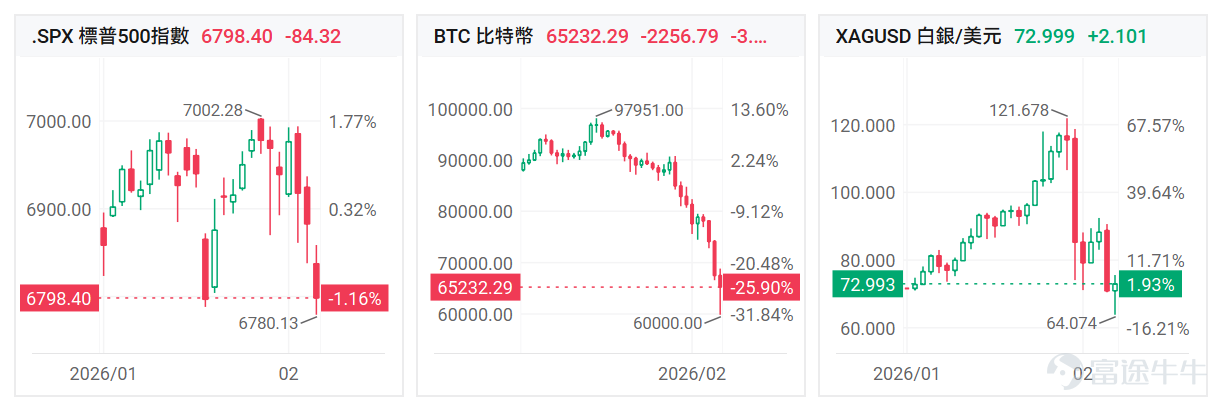
Since February, sentiment on Wall Street has shifted abruptly. The previous irrational exuberance over popular assets like tech stocks, gold, and cryptocurrencies has rapidly cooled, replaced by an overall risk-off retreat.
On the surface, the current cross-asset sell-off was not triggered by a single 'black swan' event — unlike the panic-driven plunge last April caused by Trump's 'Liberation Day' trade war. Instead, the current market seems to be experiencing a slow bleed from a series of negative news. These developments have continuously heightened collective anxiety over inflated valuations — given that many had long suspected the rally was overheated — ultimately prompting synchronized withdrawals by investors.

Why the sharp drop in US stocks? Is the pullback a risk or an opportunity? This article will lead fellow investors through the logic behind the decline and explore trading strategies and responses for the road ahead.
What are the reasons for the drop in US stocks?
Considering various factors, Guolian Minsheng Overseas Research believesThe market downturn may not be due to changes in macro narratives or AI industry trends,but rather stems primarily from capital behavior.
On a macro level,After the ADP data was released on February 4, the market is more likely to engage in rate-cut expectations trading or recession expectations trading when faced with soft data. For the former, the increase in rate-cut expectations driving liquidity release is potentially beneficial for technology; for the latter, comparing February 4 U.S. Treasury bonds and the U.S. Dollar Index, neither showed significant fluctuations, and some pro-cyclical sectors also demonstrated resilience. Based on this,The bank believes that the correlation between the decline and macro factors is not obvious.
If it's not macro, is it a change in the AI industry trend?
In fact, looking at the overall earnings reports of tech stocks this quarter,AI momentum remains high.
On one hand, capital expenditures continue to grow, and earnings reports show that tech giants are confident in accelerating revenue realization to recoup CapEx, while on the other hand, Clawdbot has also provided directions for AI application commercialization.
The bank believes that since January, the market’s trading pattern for the U.S. tech sector—'positive on storage, negative on software'—essentially reflects 'certainty premium'.Under the wave of AI, the narrative of 'large models devouring software' has led investors to seek sectors expected to benefit with long-term certainty, showing some degree of narrative-driven 'MEME' trading tendencies.
In summary, the bank believes this may be another case of excessive selling similar to the 'DeepSeek event,' and the industry trend has not reversed. Considering that there has been no change in macro contradictions or AI industry trends,The bank believes that the recent fluctuations in the US stock market may have been more impacted by the realization of momentum factors at the capital flow level.For example, the MSCI USA Momentum Factor ETF fell by 3.67% on February 4, 2026, showing a significant downward trend.
How to interpret the current weakness in software stocks?
Guolian Minsheng Overseas Research indicates that, from an industry trend perspective, although companies like Anthropic have recently launched AI agent products with initial success, traditional software companies may still maintain some short-term advantages over enterprise clients in areas such as long-term expansion, compliance, and maintenance.
The bank believes that the real impact of this wave of AI emergence on traditional software (especially SaaS) comes from financial budget constraints rather than the narrative shock of 'AI taking over everything.'
The rise of the AI industry may lead companies to accelerate investment in AI infrastructure/tools, thereby squeezing existing corporate IT budgets. In response to changes in industry trends, software companies are also attempting self-reform for updates; for instance, ServiceNow shared during its latest earnings call how it is transforming through acquisitions. However, under the influence of narrative trading, the bank believes the market may focus more on concerns about slowing organic growth behind these acquisition strategies.
Meanwhile, it is worth noting that CEOs of NVIDIA, Google, and Arm have recentlyrefuted the 'AI takeover theory':
Jensen Huang stated that selling software company stocks due to fears of disruptive AI technology makes no sense. The design purpose of AI systems is to work alongside existing software toolscollaboratively.Work with them, rather than completely replacing them.
Google CEO Sundar Pichai also disagrees with this view, stating that
Regarding the adoption of Gemini and its impact on the SaaS industry. At least from my perspective, we have many industry-leading excellent SaaS customers. I’ve found that successful companies are deeply integrating Gemini into critical workflows—whether for improving product experience, driving growth, or optimizing internal operational efficiency. I believe Gemini is an empowering tool, much like the role it plays in our products and services such as Search and YouTube. Companies that can seize this opportunity will have the same growth potential in the future.
Arm CEO Rene Haas stated that this week's stock market sell-off triggered by concerns that 'AI will erode software companies' revenue'is a minor panic,which does not align with how businesses are actually using these tools.

How should we respond in the future?
Guolian Minsheng Overseas Research stated thatthe AI industry trend has not shifted within the year but continues to advance further.Overall, AI is entering a phase of application implementation, accelerating demand, and resonating with industrial chain prosperity; we are fully bullish on the AI industry trend.
In terms of rhythm, the bank believes that the technology sector in the first half of the year may still focus on"Hardware first, then software"The realization of this momentum trading phase to some extent represents the congestion of earlier pair trading. However, a reversal in the software space might still require stronger proof of an industry logic loop. For the whole year,High volatility, high rotation, and mid-cap dominancemay become the main rhythm.
Guolian Minsheng Overseas Research suggests that in the short term, investors should focus on areas with clear certainty such as storage, $Micron Technology (MU.US)$ 、 $SanDisk (SNDK.US)$ CPU, $Intel (INTC.US)$ and AI-driven expansion logic, $Lumentum (LITE.US)$ 、 $Meta Platforms (META.US)$ 、 $Tesla (TSLA.US)$ 、 $Bloom Energy (BE.US)$ while in the medium term, watch for a potential reversal in the software sector (platform-oriented direction), and long-term value remains stable for leading AI companies. $Alphabet-A (GOOGL.US)$ 、 $NVIDIA (NVDA.US)$ 。
Previously‘2026 Outlook | Nomura, J.P. Morgan, and other investment banks unanimously predict: The storage industry may see a super cycle by 2026! What investment opportunities should be watched?’It was also pointed out that the traditional storage market is experiencing a strong 'super cycle' driven by supply shortages. Even NVIDIA has been affected by a shortage of memory chips, preventing them from releasing new gaming GPUs. Fellow investors previously identified key companies in the supply chain worth watching, providing reference for investors.

Moreover, as the global AI computing power race continues to escalate, optical communication, serving as the cornerstone of data transmission, is seeing its investment logic expand from leading companies to high-growth, high-barrier, or strategically positioned quality stocks. PreviouslyOutlook 2026 | Don’t Just Focus on NVIDIA! By 2026, the Optical Communication Industry May Become the Strongest Growth Area—What Opportunities Should You Watch?NiuNiu also compiled a list of optical communication-related companies for fellow investors to reference:

Additionally, while all eyes are on the battle for memory chips, CPUs, which serve as the heart of servers, are also sounding the alarm. According to industry insiders’ revelations to the media this week,Intel and AMD have recently notified their Chinese clients of a shortage in server CPU supply.Intel has even warned that delivery times could extend up to six months. Therefore, the CPU shortage situation also deserves attention.
Overall, despite market challenges such as high volatility and rapid sector rotation, the broader direction of AI 'application implementation' and 'industry chain synergy' remains clear. Strategically, investors are advised to adopt a 'combination of long-term and short-term' allocation approach: In the short term, focus on hardware sectors with clear certainty, particularly those driven by supply-demand gaps such as memory, CPUs, and optical communication; over the medium to long term, continue to hold onto AI cornerstones like Google and NVIDIA. By staying flexible with sector rotation amid the 'hardware-first, software-later' market dynamics, one can maintain an advantageous position in this AI marathon.
Risk Disclaimer: The above content only represents the author's view. It does not represent any position or investment advice of Futu. Futu makes no representation or warranty.Read more


Comments (6)
to post a comment
133
96