
The tech gala is here! Can CES 2026 ignite a tech rally?

NVIDIA Rubin steals the show! Besides storage, which other industries are expected to benefit?
On January 6, NVIDIA announced the launch of a new generation chip, named Rubin.
xAI founder Elon Musk: 'NVIDIA Rubin will become the rocket engine of artificial intelligence. If you want to train and deploy cutting-edge models at scale, this is the infrastructure you need to use — Rubin will once again prove that NVIDIA is the gold standard.'
OpenAI CEO Sam Altman: 'The scaling of intelligence depends on computing power. As we increase computing power, the capabilities of models become stronger, allowing them to solve more complex problems and bring greater impact to people. The NVIDIA Rubin platform helps us continuously expand this process, making advanced intelligence accessible to everyone.'
Jensen Huang's speech at CES this time undoubtedly reaffirmed his significant influence in the tech industry — because with just two short sentences, he determined the fate of two major AI-related sectors in the US stock market on Tuesday: the storage sector 'heated up' due to his remarks, while cooling equipment stocks 'plummeted into an abyss'...

So, what are the highlights worth paying attention to this time? And which concept stocks will benefit? This article will analyze them one by one for fellow investors.
What are the highlights worth paying attention to this time?
The most attention-grabbing focus of this release was undoubtedly Jensen Huang’s unveiling of the new AI supercomputer and its underlying hardware ecosystem.
1. New AI Supercomputer: Six self-developed chips, with a single rack delivering 3.6 EFLOPS of computing power.
According to Zhi Dongxi, NVIDIA's new AI supercomputer, the NVIDIA Vera Rubin POD, incorporates six self-developed chips: Vera CPU, Rubin GPU, NVLink 6 Switch, ConnectX-9 (CX9) smart NIC, BlueField-4 DPU, Spectrum-X 102.4T CPO.
Specifically, the new Rubin computing architecture includes six major chip components:
Vera CPU:88-core custom Arm cores, with twice the performance-per-watt of the industry's best CPU, equipped with 1.8TB Nvlink C2C, 1.5TB system memory, 1.2TB LPDDR5X, integrating 227 billion transistors.
Rubin GPU:Using NVFP4 technology, achieving a 75% reduction in AI model size, quadrupling inference speed without significant loss of accuracy. Single GPU inference power is 50 PFLOPS, training power is 35 PFLOPS, and NVLink bandwidth is 3.6TB/s.
CX-9 Supernic:CX-9 Supernic: 800G Ethernet, 200G Serdes, programmable RDMA and data path accelerator, integrating 23 billion transistors, responsible for east-west traffic within the data center.
BlueField-4:64-core Grace CPU paired with CX-9, integrating 126 billion transistors, responsible for north-south traffic such as storage connectivity.
NVLink 6 Switch:Single GPU bandwidth of 3.6TB/s, 400G Serdes, supports 100% liquid cooling.
Spectrum-X CPO:Spectrum-X CPO: 102.4T expanded bandwidth, 200G silicon photonics channels, 128*800G ports, integrating 352 billion transistors.
Two, three major new products revolutionize AI inference efficiency: new CPO devices, new context storage layers, new DGX SuperPOD.
At the same time, NVIDIA announced three important new products:NVIDIA Spectrum-X Ethernet Co-Packaged Optics, NVIDIA Inference Context Memory Storage Platform, and the NVIDIA DGX SuperPOD based on DGX Vera Rubin NVL72.
1. NVIDIA Spectrum-X Ethernet Co-Packaged Optics (CPO) This device is based on the Spectrum-X architecture, featuring a dual-chip design with 200Gbps SerDes technology, providing 102.4Tb/s bandwidth per ASIC.
Performance Leap: Compared to traditional solutions, the CPO switch system achievesa 5x improvement in energy efficiency,、a 10x improvement in reliability,andand a 5x increase in application uptime.。
Commercial Value: Significantly increase daily Token processing volume and notably reduce data center operational costs.
2. NVIDIA Inference Context Memory Storage PlatformThis is a POD-level AI-native storage infrastructure specifically designed for storing KV Cache. It does not directly reside in the host system but is connected outside the computing device via BlueField-4, functioning as a new storage tier.
Technical Principle: Based on BlueField-4 and Spectrum-X Ethernet acceleration, tightly coupled with Dynamo and NVLink to achieve coordinated context scheduling between memory, storage, and networking.
Key Advantages: Treats context as a first-class data type, capable of efficiently scaling storage pool sizes and avoiding redundant KV Cache computations.
Performance Improvement: Achieved5x inference performanceand5 times more energy efficiency。
3. NVIDIA DGX SuperPOD (based on Vera Rubin) This is NVIDIA's ultimate deployment blueprint for large-scale AI factories.
Architecture configuration: Utilizes 8 sets of DGX Vera Rubin NVL72 systems.
Network interconnect: Employs NVLink 6 for vertical scaling and Spectrum-X Ethernet for horizontal scaling.
Integration advantages: Incorporates the above 'inference context memory storage platform' with full engineering validation to ensure out-of-the-box readiness.
Which concept stocks will benefit?
The positive logic of this release extends from the simple 'selling shovels' to 'upgrading necessary complementary infrastructure to make the shovels more effective.' Specifically, investors can focus on industries such as storage, optical communication, liquid cooling, and power infrastructure.
 Storage industry
First, Jensen Huang emphasized the demand for memory and storage in AI systems during his Tuesday presentation,stating that 'this is a market that has never existed before, and it could very well become the largest storage market globally, essentially carrying the operational memory for global artificial intelligence.'
Market analysts believe that, according to NVIDIA’s latest statements at CES, every GPU adds 16TB of NAND, and each cabinet adds 1152TB of NAND. With 100,000 cabinets, NAND demand increases by 115.2 EB, accounting for 12% of the world's total NAND supply in 2025, presenting a significant demand for NAND.
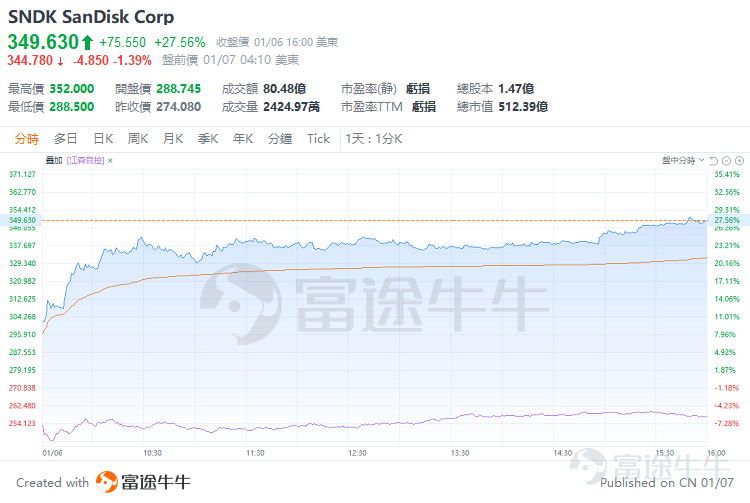
As a result, SanDisk surged over 27% overnight, leading gains in the storage sector,In fact, unlike early text-based AI, the popularization of multimodal AI means that systems need to handle and generate unstructured data such as images, videos, and audio. This data is not only vast in volume but also requires frequent read and write operations to support the 'monitor/verify/reintegrate' closed loop, making storage not just a passive archiving tool but an essential active participant in AI computing processes.
According to industry analyst Jake Silverman, increasing demand for AI training and inference, coupled with tight supply and surging memory prices, is helping boost storage stocks. He mentioned that Huang’s remarks at CES“indicate that the demand for NAND chips across NVIDIA systems will remain strong.”
Previously,‘2026 Outlook | Nomura, J.P. Morgan, and other investment banks unanimously predict: The storage industry may see a super cycle by 2026! What investment opportunities should be watched?’This article also thoroughly analyzed the investment logic of the storage industry. Fellow investors who are interested can click to view.

The storage industry includes the world's largest DRAM and HBM supplier. $CSOP SK Hynix Daily (2x) Leveraged Product (07709.HK)$ , the world's second-largest DRAM supplier and third-largest HBM supplier $CSOP Samsung Electronics Daily (2x) Leveraged Product (07747.HK)$ , one of the world’s top three DRAM suppliers, the second-largest HBM supplier, and the fourth-largest player in the global NAND market $Micron Technology (MU.US)$ , the fifth-largest player in the global NAND market $SanDisk (SNDK.US)$ , the world’s two largest hard drive manufacturers$Western Digital (WDC.US)$ 、 $Seagate Technology (STX.US)$ ;
, and the global leader in NAND flash memory controller solutions $Silicon Motion Technology (SIMO.US)$ , as well as a U.S.-based memory IP company $Rambus (RMBS.US)$ , a global leader in memory storage technology $Marvell Technology (MRVL.US)$ , and memory packaging vendors.$Lam Research (LRCX.US)$ , a system specializing in thin-film deposition processes for memory chips$Applied Materials (AMAT.US)$ ; a leader in enterprise memory storage technology$NetApp (NTAP.US)$ , a global leader in memory storage technology$Everpure (P.US)$ 。
Optical communication industryNext is the revolution in optical communications. Jensen Huang officially launched the Spectrum-6 Ethernet switch (SN688/SN6810) featuring 'Co-Packaged Optics (CPO)' technology.
He clearly stated: 'Compared with hardware that does not have silicon photonics technology, they perform better in terms of energy efficiency, reliability, and uptime.'
This means that CPO is no longer just a concept in the lab but has entered NVIDIA’s mass production list. The optical module industry chain will face a substantive moment transitioning from pluggable modules to CPO.
Previously,Outlook 2026 | Don’t Just Focus on NVIDIA! By 2026, the Optical Communication Industry May Become the Strongest Growth Area—What Opportunities Should You Watch?It was also noted that the global AI wave is driving robust demand for computing power, accelerating changes in the competitive landscape of the optical communication market and trends in high-speed optical interconnects. Fellow investors who are interested can click to view.

Optoelectronic Integrated Circuit Design:Including $Intel (INTC.US)$ 、 $Broadcom (AVGO.US)$ 、 $Coherent (COHR.US)$ 、 $Cisco (CSCO.US)$ 、 $NVIDIA (NVDA.US)$ 、 $Lumentum (LITE.US)$ 、 $Marvell Technology (MRVL.US)$ 、 $POET Technologies (POET.US)$ 、 $Nokia Oyj (NOK.US)$ 、 $MACOM Technology Solutions (MTSI.US)$ 、 $Credo Technology (CRDO.US)$ 、 $Astera Labs (ALAB.US)$ 、 $Semtech (SMTC.US)$ 、 $ZTE (00763.HK)$ 。
Silicon photonics and CMOS wafer fabs:Including $Taiwan Semiconductor (TSM.US)$ 、 $United Microelectronics (UMC.US)$ 、 $Intel (INTC.US)$ 、 $GlobalFoundries (GFS.US)$、 $Tower Semiconductor (TSEM.US)$ 、 $STMicroelectronics (STM.US)$ 、 $SkyWater Technology (SKYT.US)$ 。
Optical module suppliersIncluding $Coherent (COHR.US)$ 、 $Lumentum (LITE.US)$ 、 $Applied Optoelectronics (AAOI.US)$ 、 $CIG (06166.HK)$ , among which, Coherent and LumentumA long-established powerhouse offering full vertical integration capabilities from chips to modules.
EMS (Electronic Manufacturing Services) / ConnectorsIncluding $Amphenol (APH.US)$ 、 $Celestica (CLS.US)$ 、 $Fabrinet (FN.US)$ 、 $Jabil (JBL.US)$ 、 $FIT HON TENG (06088.HK)$ 、 $TIME INTERCON (01729.HK)$Wait for the company;
System Equipment OpticalIncluding $Arista Networks (ANET.US)$ 、 $Cisco (CSCO.US)$ 、 $Nokia Oyj (NOK.US)$ 、 $Ciena (CIEN.US)$ 、 $Hewlett Packard Enterprise (HPE.US)$ 、 $Dell Technologies (DELL.US)$ ;
Packaging and TestingIncluding $ASE Technology (ASX.US)$ 、 $Amkor Technology (AMKR.US)$ ;Fiber Optic CablesIncluding $Corning (GLW.US)$ 、 $YOFC (06869.HK)$ ;Epitaxial Wafer SupplierIncluding $AXT Inc (AXTI.US)$ ;InP (Indium Phosphide) Wafer FabIncluding $Coherent (COHR.US)$ 、 $Lumentum (LITE.US)$ ;
Equipment - Data Communication DevicesIncluding $Arista Networks (ANET.US)$ 、 $Cisco (CSCO.US)$ 、 $NVIDIA (NVDA.US)$ 、 $Hewlett Packard Enterprise (HPE.US)$ 、 $Dell Technologies (DELL.US)$ ;Equipment - Telecommunication DevicesIncluding $Ciena (CIEN.US)$ 、 $Nokia Oyj (NOK.US)$ 、 $LM Ericsson Telephone (ERIC.US)$ 、 $ZTE (00763.HK)$ 。
Liquid Cooling IndustryThe Rubin NVL72 rack achieves 100% liquid cooling and supports an inlet water temperature of 45 degrees Celsius. This means data centers no longer need high-energy-consuming chillers to produce cold water, relying instead on natural cooling or warm water circulation for heat dissipation. Jensen Huang proudly announced that this will save 6% of electricity for global data centers.
It is worth noting that the market misinterpreted 'no need for cooling' overnight, when in fact it was a lack of need for traditional cooling units.Instead, reliance shifts to purer direct liquid cooling components.
Among these, cooling units are key equipment $Johnson Controls (JCI.US)$ and $Trane Technologies (TT.US)$ provided by companies like Hitachi to data centers. Therefore, these companies suffered significant market sell-offs overnight.
For index options such as $Vertiv Holdings (VRT.US)$ For this type of liquid cooling company, Barclays analyst Julian Mitchell pointed out thatVertiv holds a strong position in the 'liquid cooling field',and may benefit from the technological development mentioned by Jensen Huang, although its chiller business could suffer. The company's shares closed up 0.6% on Tuesday, reversing earlier losses.

Of course, some industry insiders currently believe there is no need to be overly pessimistic about the prospects of these refrigeration equipment stocks. Citi analyst Andrew Kaplowitz told clients that investors’ selling of refrigeration equipment stocks was 'excessive.' He noted that cooling system manufacturers collaborate with chipmakers and data center operators, and as data center technology evolves, the risk of these companies falling behind is manageable.
Power equipment industryNVIDIA's Rubin roadmap has already publicly mentioned cabinets at the 600kW level. Although energy consumption per token is decreasing, the power density of individual cabinets has significantly increased, placing extremely high demands on power supply stability and high-voltage distribution.
Notably, NVIDIA previously announced over 20 'Power Revolution Corps' partners, divided into three major fields: GaN/SiC power chips and modules, power system component providers, and power system solution providers; these partners are expected to benefit from this.

Silicon wafer suppliers: $Analog Devices (ADI.US)$ 、 $Alpha & Omega Semiconductor (AOSL.US)$ 、 $Monolithic Power Systems (MPWR.US)$ 、 $Navitas Semiconductor (NVTS.US)$ 、 $ON Semiconductor (ON.US)$ 、 $Power Integrations (POWI.US)$ 、 $STMicroelectronics (STM.US)$ 、 $Texas Instruments (TXN.US)$ 、 $INNOSCIENCE (02577.HK)$ 、 $INFINEON TECHNOLOG (IFNNY.US)$ 、 $Renesas Electronics (ADR) (RNECY.US)$ 、 $Rohm (ADR) (ROHCY.US)$ , EPC, and Richtek Technology;
Power system component suppliers: $Flex Ltd (FLEX.US)$ 、 $GE Vernova (GEV.US)$ 、 $Shenzhen Megmeet Electrical (002851.SZ)$ , BizLink Holding, Delta Electronics, $BYD ELECTRONIC (00285.HK)$ Subsidiary Lead Wealth and Lite-On Technology;
Data center power system suppliers: $Eaton (ETN.US)$ 、 $GE Vernova (GEV.US)$ 、 $Vertiv Holdings (VRT.US)$、 $Mitsubishi Electric (ADR) (MIELY.US)$ 、 $SIEMENS AG (SIEGY.US)$ , ABB, Hitachi Energy, Heron Power, Schneider Electric.
Summary
As NVIDIA’s technology extends from chips to systems, permeating from the cloud into the physical world, the company is building not just a computing platform, but an AI-driven infrastructure for a new world.
Risk Disclaimer: The above content only represents the author's view. It does not represent any position or investment advice of Futu. Futu makes no representation or warranty.Read more


Comments (13)
to post a comment
207
492