Trump's Visit to the UK Brings a Major Tech Gift! Time to Strategize?

Microsoft and Musk continue to place their bets! Tech giants are transforming into AI infrastructure powerhouses, and this list of investments is worth collecting!
Technology giants are transforming into AI infrastructure powerhouses, ramping up investments in data center construction.
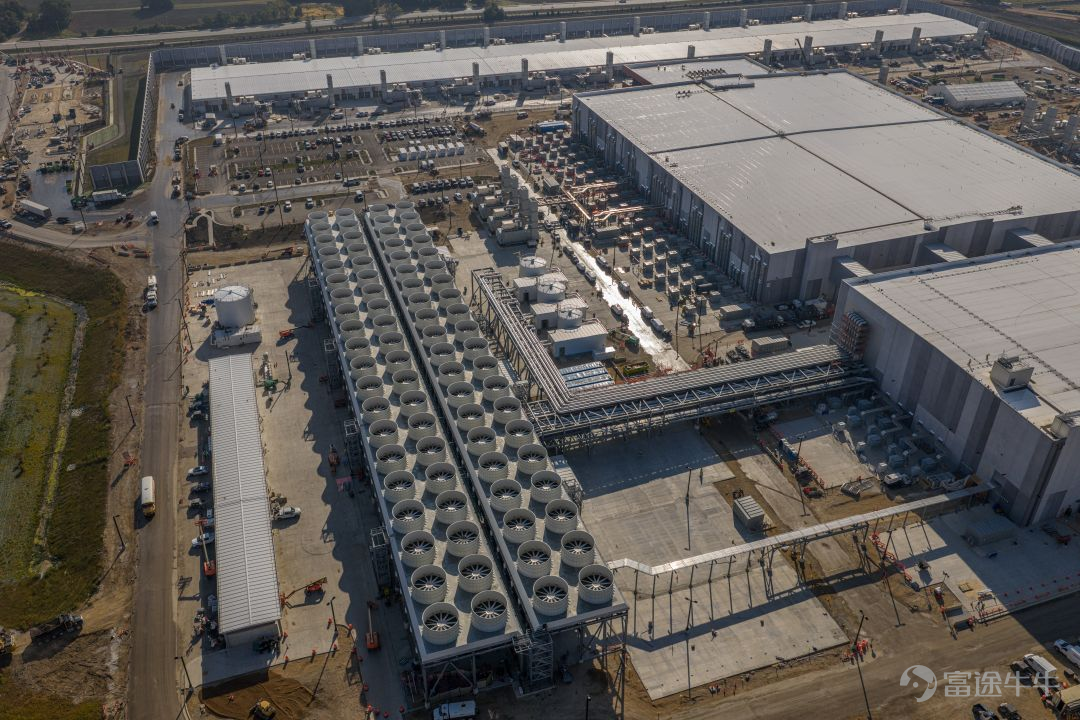
$Microsoft (MSFT.US)$ It was announced on Thursday that the company's $3.3 billion investment in building a data center in Wisconsin, United States,dubbed the 'world's most powerful AI data center,' will become operational by early 2026.,An additional $4 billion is planned to be invested,to construct a second data center of equivalent scale in the same state, bringing the total investment in the stateto over $7 billion.
Microsoft President Brad Smith stated that the data center integrates the most advanced NVIDIA GPUs, robust network connectivity, and system architecture, enabling it to train more sophisticated AI models than ever before. CEO Satya Nadella remarked that Fairwater's performance will be ten times that of the current world’s fastest supercomputer.

In a related development,Elon Musk’s 'Project Hardening' new initiative has also been officially unveiled:A computing power cluster was built from scratch within six months, achieving a power supply scale of 200MW, sufficient to support 110,000 NVIDIA GB200 GPUs in the NVL72 configuration.This feat was accomplished in just six months, compared to the 15 months taken by OpenAI and Oracle for similar projects, setting a new record once again.
Microsoft has become a key component of Elon Musk’s business empire, with the Colossus II computing cluster being closely tied to Microsoft’s strategic initiatives.According to the plan, the first phase of Colossus II will deploy 110,000 NVIDIA GB200 GPUs, with the ultimate goal of exceeding 550,000 GPUs. The peak power demand is expected to surpass 1.1 gigawatts. Longer-term roadmaps even envision scaling the total number of GPUs to one million.
Previously,"Trump Releases the 'American AI Initiative'! Four Major Investment Themes You Must Know"had also pointed out that in the Trump 2.0 era, data centers and power infrastructure could be beneficiaries of this AI wave.

The continued expansion of capital expenditures on data centers by technology giants underscores that the wave of artificial intelligence remains robust and shows no signs of abating.This implies that every segment of the data center industry value chain warrants close attention from investors—whether it pertains to infrastructure, power equipment, or cooling solutions, all are poised for a new wave of growth.This article will provide an in-depth exploration of sectors such as infrastructure and power-cooling solutions, uncovering hidden investment opportunities.
Computing power has become the "oil" of a new era.
First, driven by AI, computing power has become the "oil" of a new era.
Industries such as chips, switches, and optical communications are worthy of investors' attention. Previously,"Ellison Once Surpassed Musk to Become the World’s Richest Person! Behind Oracle’s Soaring Stock Price, What Hidden Investment Opportunities Lie Ahead?"an article highlighted relevant opportunities:

Specifically,AI chips include $NVIDIA (NVDA.US)$ 、 $Advanced Micro Devices (AMD.US)$ 、 $Broadcom (AVGO.US)$ 、 $Taiwan Semiconductor (TSM.US)$ ;
SwitchYou may follow $Broadcom (AVGO.US)$ 、 $Cisco (CSCO.US)$ 、 $Arista Networks (ANET.US)$ 、 $Celestica (CLS.US)$ ;
Upgrading of optical communication technologyincludes $Lumentum (LITE.US)$ 、 $Astera Labs (ALAB.US)$ 、 $Credo Technology (CRDO.US)$ 、 $Lumen Technologies (LUMN.US)$ 、 $Ciena (CIEN.US)$ 、 $Applied Optoelectronics (AAOI.US)$ 、 $Coherent (COHR.US)$ 、 $Corning (GLW.US)$ ;
In addition, recently, $NEBIUS (NBIS.US)$ Take down $Microsoft (MSFT.US)$ a massive AI computing power order worth nearly USD 19.4 billion briefly ignited market enthusiasm,《Seizing the New Era of AI! Infrastructure Becomes the Next Battleground, Who is Expected to Become the New Gold for Investors?》 with multiple articles highlighting infrastructure-related opportunities.

These includeThe two giants of AI infrastructure $CoreWeave (CRWV.US)$ 、 $NEBIUS (NBIS.US)$ ; emerging AI infrastructure providers $WhiteFiber (WYFI.US)$ ; data center service providers $TSS Inc (TSSI.US)$
mining transformation companies $Applied Digital (APLD.US)$ 、 $IREN Ltd (IREN.US)$ 、 $TeraWulf (WULF.US)$ 、 $Core Scientific (CORZ.US)$ 、 $Hut 8 (HUT.US)$ 、 $HIVE Digital Technologies (HIVE.US)$ 、 $Keel Infrastructure (KEEL.US)$ 、 $Bitdeer Technologies Group (BTDR.US)$ 、 $Galaxy Digital (GLXY.US)$ 、 $Cipher Digital (CIFR.US)$ 、 $Riot Platforms (RIOT.US)$ 、 $MARA Holdings (MARA.US)$ 。
Securing a Nearly $20 Billion Mega Contract with Microsoft! NEBIUS Soars Over 50%, and These Companies Show Explosive Potential!A detailed analysis of the above companies' operations and future potential has been conducted; interested fellow investors can click to view.
In the AI era, electricity and cooling emerge as invisible winners.
The Trump administration is aggressively advancing large-scale power infrastructure projects to meet the surging electricity demand driven by artificial intelligence and data centers.
Thursday,The U.S. Department of Energy announced the launch of the 'Speed to Power' initiative,aiming to mobilize its technical expertise and billions of dollars in funding support to address this significant rise in energy demand, the first in two decades.
The department is soliciting information from state energy offices, utility companies, and other stakeholders,to identify large-scale power and grid projects that can be expedited.
Previously,Tech Giants 'Burn Cash' to Boost AI! These Two Industries May Be Hidden Winners?It was also noted that with the rapid development of the global artificial intelligence industry, competition for electricity demand has become increasingly fierce, and high power consumption has driven growth in the cooling systems market. Media analysis shows,the biggest bottleneck in AI data center construction currently lies in "electricity" and "cooling", rather than GPUs. Futubull has also compiled a list of relevant companies in these two industries for mooers to reference:not GPUs.

1. Electricity
Goldman Sachs data shows that, AI deployment has driven a 160% surge in data center electricity demand, while the International Energy Agency (IEA) predicts that global data center power consumption will double from 460 terawatt-hours in 2022 to 2026. From the demand side, every aspect of AI is a significant consumer of electricity.
From the perspective of the entire electricity industry chain, all sectors—including independent power producers, electrical equipment manufacturers, vertically integrated utility companies, and nuclear power—are expected to emerge as major winners in the AI boom.
Independent power producers
Independent power producers include $Vistra Energy (VST.US)$、 $Talen Energy (TLN.US)$These two companies have recorded increases of 50% and 104%, respectively, this year.

Specifically, Vistra is one of the largest electricity producers and retail energy suppliers in the United States, with a capacity of up to 37 gigawatts (GW). This capacity is sufficient to meet the power needs of 20 million households, demonstrating its strong presence in the power supply sector. Notably, VST also has 2.4 GW of nuclear power generation capacity, making it the fourth-largest nuclear power supplier in the U.S.
Talen Energy, on the other hand, is an independent power company in the U.S. The company recently partnered with Amazon to initiate a nuclear transition, supporting the sustainable development of AI data centers.
It is worth noting that,Another key difference between Vistra and Talen Energy is that Vistra owns battery storage systems.With the growth of intermittent power supply, these assets will be critical as they provide power trading options, an area where Vistra is increasing its investments.
Electrical Equipment
Electrical equipment to watch includes $GE Vernova (GEV.US)$ 、 $Eaton (ETN.US)$ 、 $Bloom Energy (BE.US)$ 、 $SIEMENS AG (SIEGY.US)$ 、 $Honeywell (HON.US)$ 、 $Emerson Electric (EMR.US)$ 、 $Graham (GHM.US)$ 。
Among these, $GE Vernova (GEV.US)$A global leader in power technology, the company operates across three major segments: power, wind energy, and electrification.Its technology plays a significant role in the global power supply, generating approximately 30% of the world's electricity. The company's stock price has doubled this year.
GE Vernova's financial performance in the second quarter of 2025 demonstrated its market strength. Driven by robust demand in the power and electrification divisions, revenue surged to $9.1 billion, marking an 11% year-over-year increase. The electrification segment, a key growth driver, saw its revenue rise to $2.2 billion, with EBITDA margin nearly doubling to 14.6%.This highlights the high-profit potential of AI-enabled services such as predictive maintenance and grid analytics.

Additionally, $Bloom Energy (BE.US)$Bloom Energy, a global leader in power solutions, has recently partnered with Oracle to provide fuel cell power for AI data centers.
Bloom Energy's energy solutions power some of the world's most critical digital infrastructure, having previously entered into agreements with Equinix, American Electric Power (AEP), and Quanta Computing.To date, Bloom Energy has deployed over 400 MW of power for global data centers.
Moreover, Bloom Energy's microgrid system demonstrates clear advantages over traditional power grids, diesel generators, battery systems, and solar-plus-battery combinations in terms of power supply stability and continuity:
● AlwaysON:Bloom Energy systems feature the 'AlwaysON' characteristic, providing uninterrupted power supply and avoiding issues such as line failures in traditional grids or cold starts of diesel generators.
● Reliability:Unconstrained by traditional power grid lines, battery charging requirements, or solar sunlight exposure, it provides stable electricity across various environments.
● Fuel Supply:Self-sufficient, not dependent on power storage or fuel transportation, ensuring uninterrupted power supply.
● No Pollutant Emissions:Compared to the exhaust emissions from diesel generators, Bloom's technology produces no air pollution, making it a cleaner option.
Based on this year's performance, Bloom Energy has surged nearly 256%, with its share price repeatedly reaching new highs.

Vertically integrated utility company
Due to the surge in AI-driven electricity demand, utility stocks have emerged as beneficiaries of AI, such as the U.S. energy giant. $Constellation Energy (CEG.US)$ 、 $PG&E Corp (PCG.US)$ 、 $Dominion Resources (D.US)$ 、$Exelon (EXC.US)$ 、 $Southern (SO.US)$ 、 $Sempra Energy (SRE.US)$ 、 $The AES Corp (AES.US)$ 、 $American Electric Power (AEP.US)$ 、 $Duke Energy (DUK.US)$ 、 $NextEra Energy (NEE.US)$ and so on.
Among these, Constellation Energy, which doubled last year, has continued its strong performance this year, with a cumulative increase of over 43% year-to-date.This company is a leader in green power generation, primarily utilizing clean energy sources such as nuclear, wind, solar, and hydroelectric power. Impressively, CEG holds a full 10% share of the carbon-free electricity market.
Earlier this year, the company signed two agreements with the U.S. government to provide over $1 billion in power and services to upgrade the capacity of the country's largest nuclear power plant. Additionally, CEG has entered into 20-year power purchase agreements with Microsoft and Meta.

Nuclear Power
Nuclear energy stocks have become the darlings of the market since the AI boom.
Wall Street generally considers nuclear energy to be the ideal alternative energy source because it provides stable, pollution-free electricity while reducing overall decarbonization costs by limiting grid investments and battery storage needs to transmit and consolidate solar and wind power supplies. As a result, nuclear energy stocks are also expected to experience a strong upward trend.
Former President Trump announced a new nuclear energy policy: a plan to initiate the construction of 10 large nuclear power plants by 2030 and quadruple U.S. nuclear power capacity by 2050. This news also spurred significant gains in some nuclear energy concept stocks.
Futubull AI previously highlighted that the nuclear power industry chain could emerge as a standout performer in 2025.Among them, $Oklo Inc (OKLO.US)$ Up more than 394% year-to-date, $Centrus Energy (LEU.US)$ Up more than 294%, $Energy Fuels (UUUU.US)$ Up more than 174%, $NuScale Power (SMR.US)$ Up more than 112%.
According to a research report by Guosheng Securities, the SMR nuclear power industry chain encompasses all stages from upstream uranium mining, midstream research and construction, to downstream operation and waste management.

According to a research report by Guosheng Securities, the SMR nuclear power industry chain encompasses all stages from upstream uranium mining, midstream research and construction, to downstream operation and waste management.
Upstream: Raw Materials and Processing
The upstream supply chain primarily involves the essential raw materials, key equipment, and nuclear fuel required for nuclear energy development, which mainly includes uranium mining and uranium enrichment.
Specifically, uranium mining includes $Cameco (CCJ.US)$ 、$Uranium Energy (UEC.US)$ 、$Energy Fuels (UUUU.US)$ 、$Denison Mines (DNN.US)$ 、$NexGen Energy (NXE.US)$ Nuclear fuel processing$Centrus Energy (LEU.US)$ 。
Midstream: Design, Research and Development, and Construction
The midstream includes design, research and development, and construction. Among these,
$NuScale Power (SMR.US)$ is the first SMR (Small Modular Reactor) nuclear power company to go public, with its core product being the SMR power module.
$Oklo Inc (OKLO.US)$ focuses on the development of small modular reactors (SMRs). The company has received investment from Sam Altman, the 'father of ChatGPT';
$NANO Nuclear Energy (NNE.US)$ Focused on the development of small modular reactors, the main business covers four areas related to SMRs, encompassing multiple stages such as manufacturing, fuel, and transportation, with the aim of building a diversified vertically integrated industrial chain;
$BWX Technologies (BWXT.US)$ focuses on the manufacturing of nuclear reactor components and nuclear energy technology. The main difference between BWXT and SMR/Oklo is that BWXT is a major supplier of large equipment and technical services, primarily providing nuclear reactor components, nuclear fuel, and defense-related nuclear technologies to the government and commercial sectors, with clients including the U.S. government (such as providing nuclear reactors for naval submarines).
Downstream: Operations, Sales, and Waste Management
The downstream segment mainly involves the operation of nuclear power plants and energy supply.Participants include $Constellation Energy (CEG.US)$ 、 $Vistra Energy (VST.US)$ 、 $American Electric Power (AEP.US)$ 、 $Southern (SO.US)$ 、 $Exelon (EXC.US)$ 、 $Duke Energy (DUK.US)$ 、 $Entergy (ETR.US)$ 、 $Public Service Enterprise Group (PEG.US)$ and so on.
Furthermore, electrical equipment includes $GE Vernova (GEV.US)$ 、 $Eaton (ETN.US)$ 、 $Honeywell (HON.US)$ 、 $Emerson Electric (EMR.US)$ 、 $Graham (GHM.US)$ and so on.
The latest Goldman Sachs report on the nuclear energy industry indicates that the global uranium market is heading towards a period of structural shortage. This trend will accelerate starting in 2025, with a projected global uranium shortfall of 130 million pounds by 2040.Simultaneously, nuclear power demand is surging in the AI era, leading to a comprehensive boom in global nuclear power installations.
The analysis points out that the imbalance in uranium supply and demand, the surge in nuclear power demand, and other electrification trends will collectively drive the nuclear energy industry.
II. Cooling
The global liquid cooling system market is expected to benefit from the growth of data centers driven by AI, machine learning, and edge computing.
According to relevant research institutions, the global liquid cooling systems market size reached USD 6.5 billion in 2024 and is projected to double by 2034, reaching USD 13 billion, with a CAGR of 7.3% from 2025 to 2034.
Traditional data center cooling solutions involve the use of fans, air conditioners, and other air-cooling methods, which still result in power consumption during operation. Amid the growing trend toward reducing the PUE energy efficiency metric,liquid cooling solutions are gradually becoming the mainstream choice.Liquid cooling technology achieves system heat exchange through external cooling water or chilled water systems.
Among these, Liquid cooling solution providers and related industry chains include $Vertiv Holdings (VRT.US)$ 、 $nVent Electric (NVT.US)$ 、 $Super Micro Computer (SMCI.US)$ 、 $Dell Technologies (DELL.US)$ 、 $Hewlett Packard Enterprise (HPE.US)$ 、 $Amazon (AMZN.US)$ 、 $CoreWeave (CRWV.US)$ 。
As a leading company in the liquid cooling sector, Vertiv's liquid cooling technology achieves highly efficient heat dissipation by directly contacting the chips, making it 3,000 times more effective than traditional air cooling.This company has become a hidden big winner in the US stock market, thanks to the AI boom, with its stock price more than doubling over the past two years.
A previous article provided a detailed analysis of the company, which fellow investors can view by clicking here:[Opportunity Express] VRT, the global leader in liquid cooling technology, still has significant upside potential?

In addition, several companies in the U.S. stock market have made related investments in liquid cooling technology:
$nVent Electric (NVT.US)$ The company offers a variety of liquid cooling solutions, including air-liquid hybrid and fully liquid cooling systems. In the future, it will focus on providing highly customized in-rack cooling designs for AI data centers.
$Super Micro Computer (SMCI.US)$ The company launched a new generation of direct liquid cooling solution, DLC-2, this year. This solution can reduce electricity, water, noise, and space usage in data centers, potentially reducing power consumption by up to 40%.
$Dell Technologies (DELL.US)$ : Starting from its 14th-generation servers, DellDell provides pre-installed PowerEdge XE9712 servers for CoreWeave's GB300 NVL72 platform, which are designed for high-density AI workloads and support full immersion liquid cooling.。Dell provides pre-installed PowerEdge XE9712 servers for CoreWeave's GB300 NVL72 platform, which are specifically designed for high-density AI workloads.Dell provides pre-installed PowerEdge XE9712 servers for CoreWeave's GB300 NVL72 platform, which are designed for high-density AI workloads and support full immersion liquid cooling.
Launched the Smart Cooling solution in collaboration with partners such as Intel.,Dell also collaborates with specialized liquid cooling vendors such as Vertiv to offer end-to-end thermal management solutions, making it one of NVIDIA’s most important server partners.
$Hewlett Packard Enterprise (HPE.US)$ This company integrates its liquid cooling solutions primarily within its server business, specifically targeting high-performance computing (HPC) and AI applications. These solutions aim to enhance energy efficiency and reduce cooling costs, making them suitable for high-density workloads. HPE holds approximately 15-16% market share in the server market, reflecting its leading position in this field. Although specific liquid cooling market share data has not been disclosed, HPE is a key player in the liquid-cooled server market, particularly in AI and HPC domains.
$Amazon (AMZN.US)$ To meet the large-scale computing cooling needs of its AWS subsidiary,Amazon launched its self-developed liquid cooling system IRHX, whichfeatures high mobility, enhancing data center space utilization and cooling efficiency.
$CoreWeave (CRWV.US)$ CoreWeave focuses on large-scale deployment of the most advanced NVIDIA GPUs and collaborates with partners such as Dell and Super Micro Computer.It has built one of the world's largest liquid-cooled AI computing clusters and is a core driver of the demand for liquid cooling technology.
Traditional temperature control/cooling companies include: $Trane Technologies (TT.US)$ 、 $Quanta Services (PWR.US)$ and $Carrier Global (CARR.US)$ 。
$Trane Technologies (TT.US)$ Trane Technologies is a major manufacturer of cooling systems, providing innovative solutions in the data center cooling sector, including air-cooled chiller units and collaborations on liquid cooling technology. Specifically, they have introduced magnetic levitation chillers and Ascend chillers, aimed at improving cooling efficiency in data centers. Additionally, Trane Technologies collaborates with LiquidStack, a provider of liquid cooling solutions, to jointly advance liquid cooling technology in data centers.
$Quanta Services (PWR.US)$ The QoolRack liquid cooling cabinets and servers designed for NVIDIA GPUs serve as the cornerstone for constructing AI computing clusters in the vast majority of hyperscale data centers globally.
$Carrier Global (CARR.US)$ It is a leading global provider of HVAC (Heating, Ventilation, and Air Conditioning) and refrigeration solutions. In the data center cooling field, it focuses on high-efficiency air cooling technology while also exploring natural cooling and liquid cooling integration.
Overall, Goldman Sachs previously projected that the server cooling market would grow to USD 10.6 billion by 2026.
According to the bank's forecast, liquid cooling will become more prevalent in this market, with its penetration rate in AI servers reaching 57% in 2026, up from just 23% in 2024. This will bring higher profits to cooling system suppliers due to the more complex design of these systems.
JPMorgan also noted that, considering the complexity of building liquid cooling systems, the cost of liquid cooling systems is three to four times that of air cooling systems, which would lead to higher profit margins for cooling system suppliers.
Overall, the wave of AI continues, and both upstream and downstream sectors of the industry chain are expected to benefit continuously.Fellow investors can also use Futubull AI to assist with stock selection and portfolio analysis!

Risk Disclaimer: The above content only represents the author's view. It does not represent any position or investment advice of Futu. Futu makes no representation or warranty.Read more


Comments (10)
to post a comment
495
1673