
NVIDIA's Q4 earnings report was impressive, but why is the market not responding positively?

13F Big Reveal | NVIDIA Surprisingly Heavily Underweighted, What Are the Smart Money Buying? These Two Key Trends You Must Know!
As the 13F filing season concludes, the true capital allocation of Wall Street giants has finally come to light.
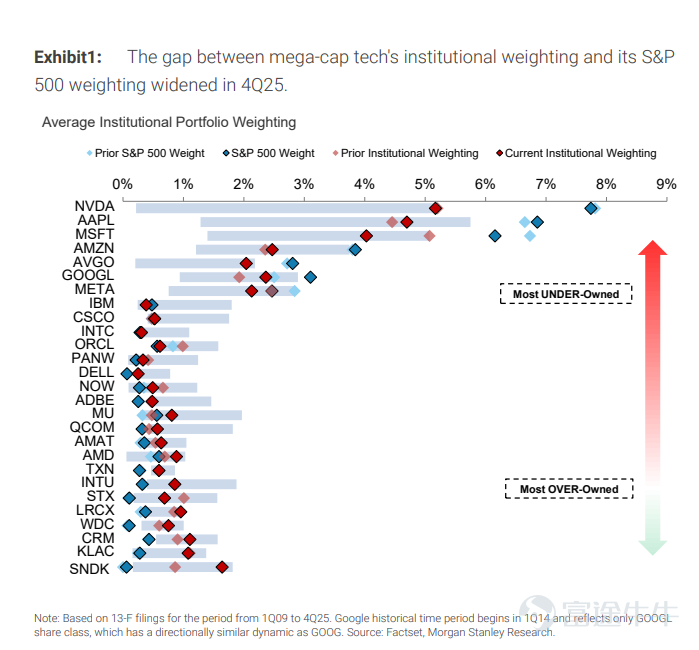
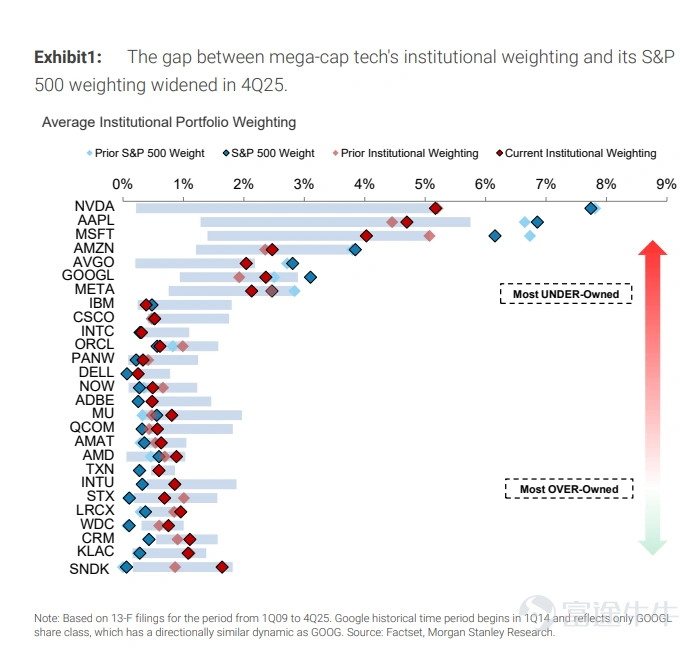
Morgan Stanley's latest Q4 large-cap tech stock holdings report reveals a strikingly contrasting core truth:Institutional holdings in tech giants have quietly dropped to a historical low not seen in 17 years!As market consensus begins to fracture, where exactly is this massive pool of capital flowing? In this article, we'll break down the current holdings of top-tier institutions for fellow investors and explore the most probable investment themes offering certainty in today’s market of probabilistic games.
I. Extreme Game Around Core Assets: NVIDIA Severely Underweight
According to Morgan Stanley's data, institutional holdings in large-cap tech stocks are currently at their lowest level in the past 17 years. Most surprisingly, $NVIDIA (NVDA.US)$ it is the most severely underweight position among actively managed institutional funds within the tracked universe of large tech stocks.
Based on Morgan Stanley's data, as of the end of Q4 2025, the gap between active institutional holdings of the largest U.S. tech companies by market cap (including $NVIDIA (NVDA.US)$ 、 $Apple (AAPL.US)$ 、 $Microsoft (MSFT.US)$ 、 $Amazon (AMZN.US)$ 、 $Alphabet-C (GOOG.US)$ and $Meta Platforms (META.US)$ ) and their weightings in the S&P 500 index has widened to -155 basis points.
Among them, NVIDIA's institutional holding difference reached -2.57% compared to its benchmark weight in the S&P 500 Index. Close behind are other underweighted giants such as Apple, Microsoft, and Amazon.
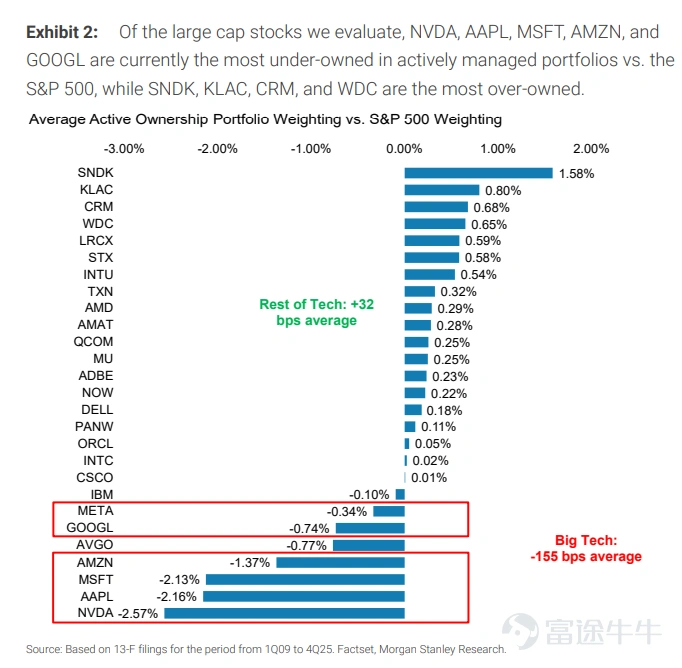
Why is this set of data important? Morgan Stanley’s analysis points out that when a stock’s active holdings are significantly lower than its market weight, it tends to experience a technical upward rebound.This means that the upside potential and technical momentum for rebounding in core assets like NVIDIA may be stronger than most people expect.
Secondly, where are the ‘smart monies’ placing overweight bets? A strong push on memory and semiconductor hardware.
If institutions have heavily underweighted key tech companies, then where has their money gone?The answer lies precisely in the memory and semiconductor equipment sectors.
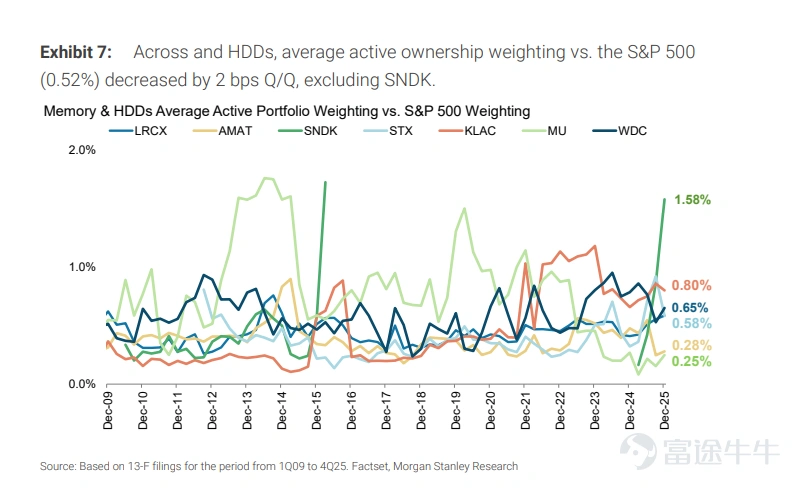
The report clearly indicates that entering 2026, actively managed institutional fund managers showed an evident preference for AI “enablers” (underlying computing power and infrastructure stocks). Among semiconductor and hardware stocks, $SanDisk (SNDK.US)$ 、 $KLA Corp (KLAC.US)$ 、 $Western Digital (WDC.US)$ 、 $Lam Research (LRCX.US)$ and $Seagate Technology (STX.US)$ were notably 'overweight.'
Particularly, memory giant $SanDisk (SNDK.US)$ , after relisting in Q1 and being included in the S&P 500 Index in Q4, saw its institutional ownership steadily rise. Its current overweight percentage stands at +1.58%, ranking highest among all large-cap tech stocks tracked by Morgan Stanley. This perfectly underscores the market consensus regarding the robust cycle for memory (NAND/DRAM) and semiconductor equipment.
Third, the collective 'fall from grace' of traditional software stocks
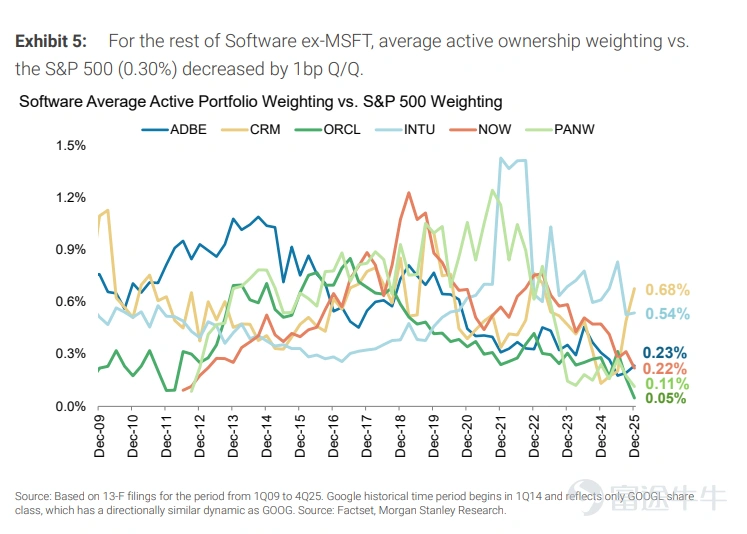
In sharp contrast to the booming semiconductor hardware sector, Morgan Stanley found that institutional holdings of software stocks such as [unspecified] are significantly low. The flow of capital is very clear: withdrawing from traditional software and more decisively flowing into underlying computing power and hardware equipment supply chains. $Oracle (ORCL.US)$ 、 $Palo Alto Networks (PANW.US)$ 、 $ServiceNow (NOW.US)$ and $Adobe (ADBE.US)$ The flow of capital is extremely clear: withdrawing from traditional software and moving more decisively towards underlying computing power and hardware supply chains.
IV. Conclusion
Institutions have been overweight on companies like $SanDisk (SNDK.US)$ 、 $Western Digital (WDC.US)$ , memory-related stocks, as well as $KLA Corp (KLAC.US)$ 、 $Lam Research (LRCX.US)$ , semiconductor equipment providers, which accurately reflects the current substantial pull effect of AI-driven demand for hardware infrastructure. Notably, $SanDisk (SNDK.US)$ has now become the most overweight tech stock in Morgan Stanley’s coverage universe. This confirms a strong market consensus around the reversal of the NAND/DRAM memory cycle and the AI-driven supercycle in hardware.
Of course, professional investment strategies should not only focus on these popular names. The heavy concentration of capital in semiconductor hardware also hints at dynamic shifts between sectors. While continuing to invest in AI infrastructure, optical communication, and advanced packaging supply chains, those currently underweight but fundamentally strong software leaders with solid cash flows—or other undervalued sub-sectors of technology—may be brewing long-term valuation recovery and rotation opportunities.
Overall, Morgan Stanley's report offers investors key insights for 2026:
On one hand,NVIDIA, which serves as the absolute backbone for AI, is currently in a severely 'underweight' position, making it ripe for potential upward technical rebound effects.
On the other handInstitutional funds are aggressively investing in the semiconductor equipment and memory industry chain with real capital.
After identifying the trend, iterative actions often matter more than striving for the perfect entry point. Focusing on the main theme of AI infrastructure, understanding the supply-demand dynamics of core computing power and semiconductor components could be key to capturing this year's highest-probability and most certain profit opportunities.
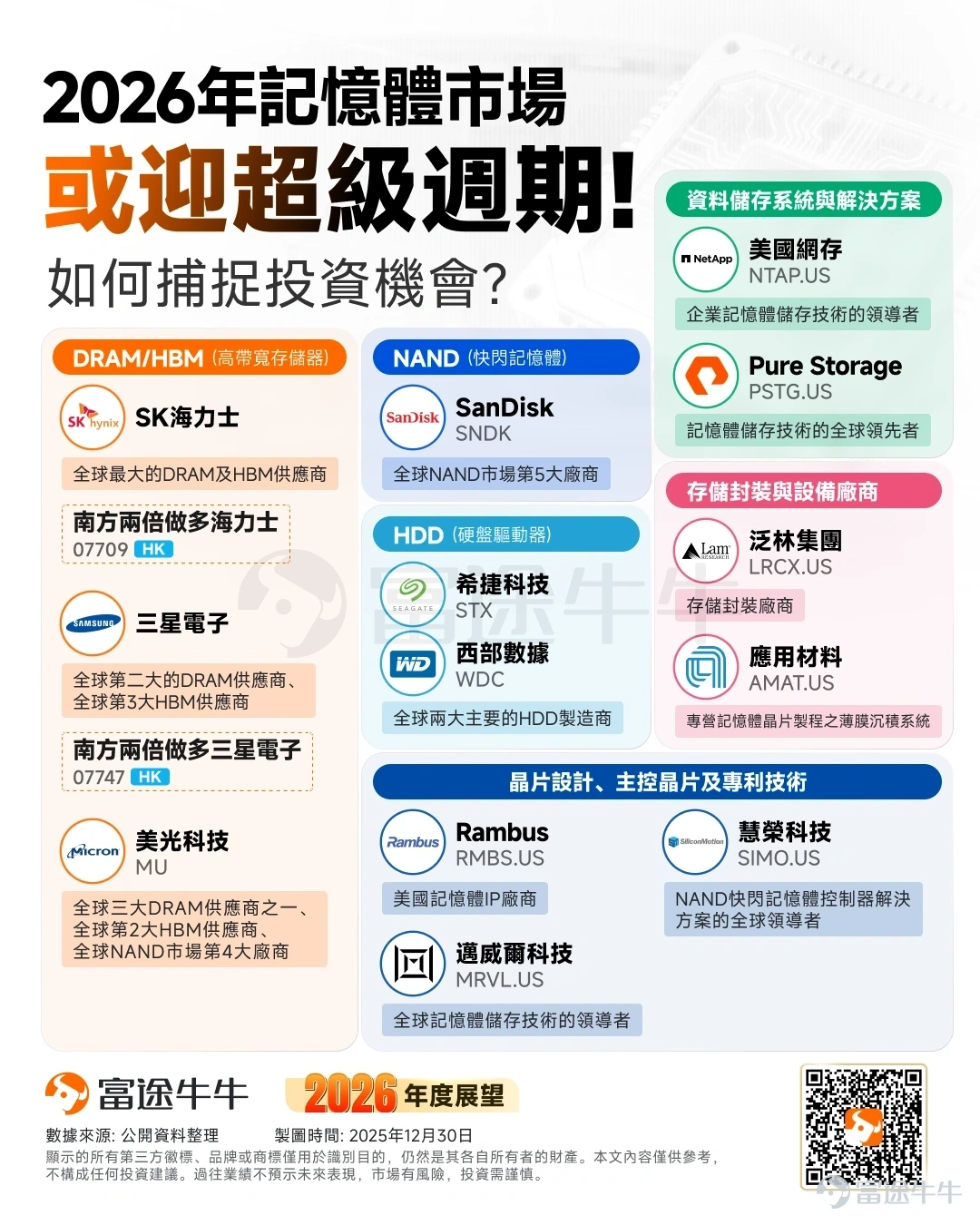
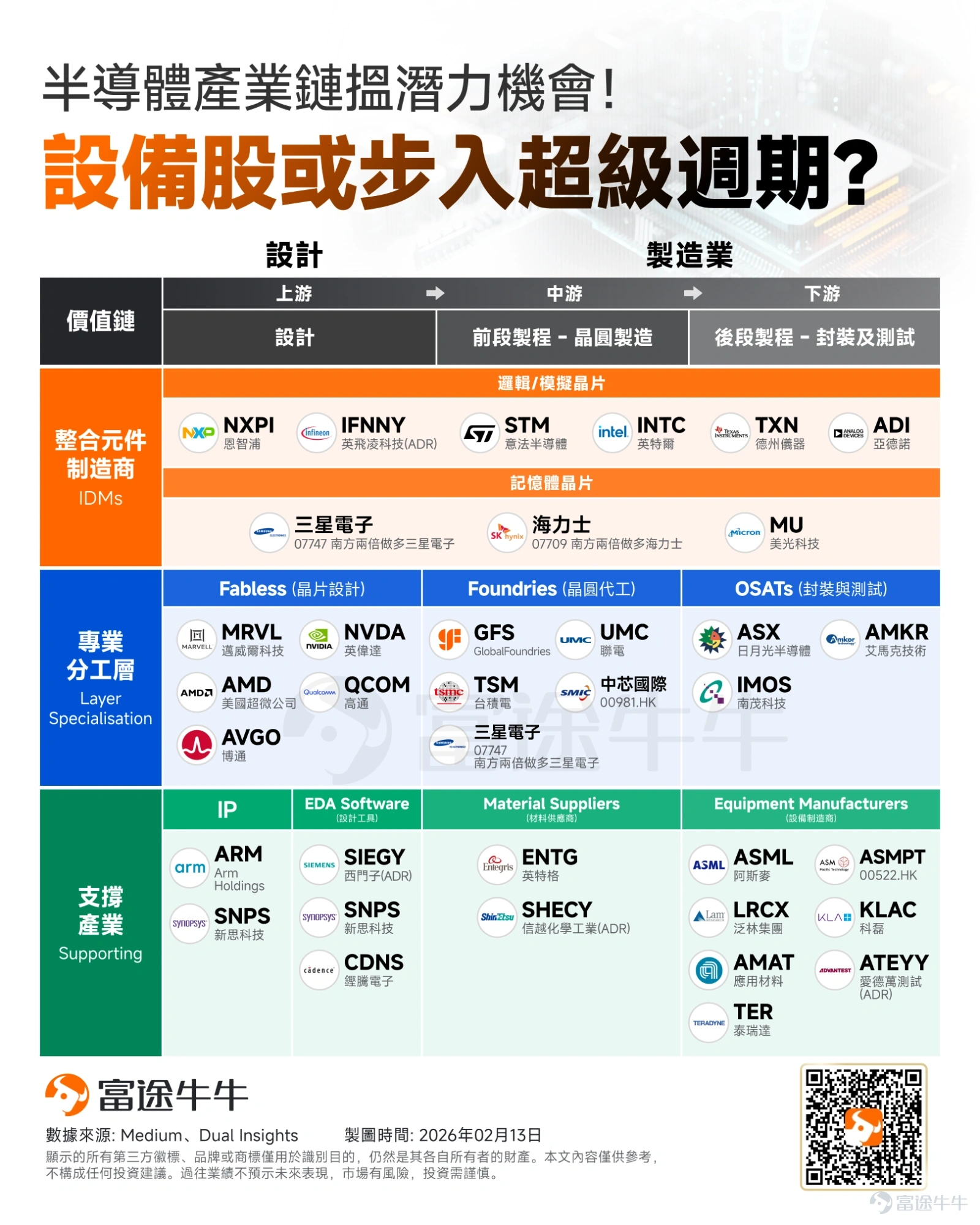
Previously,‘2026 Outlook | Nomura, J.P. Morgan, and other investment banks unanimously predict: The storage industry may see a super cycle by 2026! What investment opportunities should be watched?’、Applied Materials' earnings guidance blew up! The semiconductor equipment sector may be on the verge of a super cycle; this panoramic view of the industrial chain is worth saving!This article reviewed memory and semiconductor equipment companies. Fellow investors who are interested can click to check it out.
 Stay updated on institutional holdings to keep up with the latest investment trends: Market > US Stocks > Institutional Tracking, click to view more content!
Risk Disclaimer: The above content only represents the author's view. It does not represent any position or investment advice of Futu. Futu makes no representation or warranty.Read more


Comments (9)
to post a comment
91
189