NVIDIA's revenue doubles, beating expectations; is the AI trade narrative making a comeback?

Musk and NVIDIA are collectively "grabbing for power"! As the "chip shortage" turns into a "power shortage," who will be the next "shovel seller"?
The bottleneck in the AI industry is shifting from "whether there are enough chips" to "whether there is sufficient power available for timely grid connection."
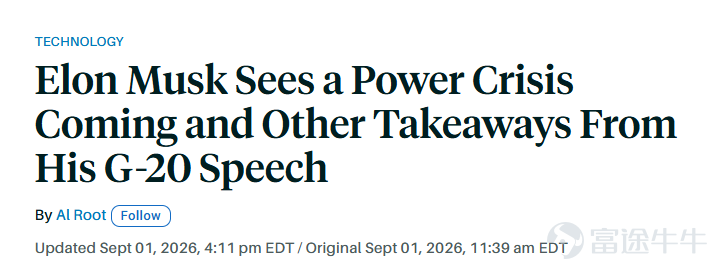
On September 1, Musk stated at the G20 meeting that AI is expected to increase the global economic scale by 20% to 30%, equivalent to adding approximately $20 trillion to $30 trillion in annual output. However, while painting this grand vision, he also issued a more realistic warning:The AI industry is facing a severe power supply gap.
Musk predicts that among the AI chips produced in 2027,computing power corresponding to at least 15GW may fail to secure sufficient power support in that year, as AI chip production is growing at an annual rate of approximately 40% to 50%,while the expansion of power generation, transmission, and grid-connection infrastructure is far too slow to keep pace.

On the surface, this appears to be a supply-demand gap in total electricity capacity; but from the perspective of the industry's fundamental nature,The AI power crisis is not simply a matter of "insufficient electricity," but rather a severe mismatch between the supply and demand sides in terms of timing, location, and quality.。
Behind the tech giants' rush to "secure power" and "generate power," they are essentially paying for this structural contradiction. To clarify the main investment themes in the power sector, we first need to dissect the three underlying mismatches causing the AI power shortage, thereby identifying which segments of the industrial chain will receive capital inflows by being the first to resolve these issues.
Why is there a structural electricity shortage in AI?
In fact, power constraints have moved beyond the realm of industry forecasts and are now beginning to influence the actual business decisions of AI companies. $SpaceX (SPCX.US)$ Previously, it successively invested in Anthropic, $Alphabet-C (GOOG.US)$ renting out AI computing power. In late August, Elon Musk further revealed thatSpaceX plans to manufacture gas turbine blades and guide vanes in-house.
$NVIDIA (NVDA.US)$is also extending upstream into power infrastructure.According to The Information, NVIDIA plans to invest up to $3 billion in Lancium, a Texas-based power and data center infrastructure developer. This includes an initial investment of $2 billion for approximately a 20% equity stake, with the remaining $1 billion tied to Lancium's progress in grid connectivity.
From SpaceX manufacturing its own gas turbine components to NVIDIA investing in power infrastructure, AI giants are shifting from "buying computing power" to "controlling the power resources behind it."
The latest forecasts from the International Energy Agency (IEA) indicate that global data center electricity consumption could nearly double, rising from approximately 485 TWh in 2025 to around 950 TWh in 2030; within this, electricity usage by AI data centers is projected to grow to roughly three times current levels.

Source: International Energy Agency
However, the AI power shortfall is not simply a matter of insufficient generation capacity, but rather the result of three concurrent mismatches:
First, a mismatch in construction cycles.While production capacity for AI chips and servers can ramp up quickly within one to two years, large-scale power generation units, transmission lines, substations, and grid connection projects typically require several years to complete.
Second, a geographic mismatch.Even if a region has sufficient power generation capacity, it does not guarantee that electricity can be transmitted via the existing grid to where data centers are located. The U.S. Federal Energy Regulatory Commission (FERC) has already required six major regional grid operators to reform rules for connecting large loads to accelerate grid access for projects such as data centers.
Third, a mismatch in power quality.AI data centers require 24/7 continuous operation and have extremely low tolerance for power outages, frequency fluctuations, and voltage instability. Relying solely on intermittent wind and solar power is difficult to meet these requirements; they typically need supporting energy storage, natural gas generation, grid power, or nuclear power.
Therefore, the core of AI power investment is not about betting on a single energy source, but rather revolving around"faster grid connection, continuous power supply, and stable electricity transmission"to form a complete infrastructure system.
How to break down the main investment themes in AI power?
At the beginning of the year,in the article "2026 Outlook | Musk and Huang Renxun Issue Joint Warning! Power Shortage Crisis Ignites New Opportunities, Save This Power 'Gold Rush List'"we previously outlined companies in the upstream and midstream power sectors as well as supporting facilities for fellow investors' reference:

--
--
--
From an industry chain perspective, opportunities driven by AI power demand can be divided into three major directions: upstream core technologies and equipment, midstream power generation and operations, and grid and energy storage support.
Upstream: Who can provide new power capacity the fastest?
The upstream sector benefits first are nuclear power, gas turbines, fuel cells, and backup power generation equipment. These segments collectively address the challenge of providing dispatchable, 24/7 power to data centers as quickly as possible before grid expansion is completed.
The core advantages of nuclear power lie in its stability, low carbon emissions, and suitability for baseload power. As tech giants begin exploring Small Modular Reactors (SMRs) and the revival of nuclear power, nuclear technology providers, equipment manufacturers, and fuel suppliers are poised to benefit collectively. Relevant companies include $NuScale Power (SMR.US)$ 、 $Oklo Inc (OKLO.US)$、$NANO Nuclear Energy (NNE.US)$、$X-Energy (XE.US)$、 $BWX Technologies (BWXT.US)$ 、$Cameco (CCJ.US)$、$Centrus Energy (LEU.US)$、 $Uranium Energy (UEC.US)$ and $Energy Fuels (UUUU.US)$ etc.
However, the approval and construction cycles for nuclear power projects are lengthy, making it difficult to fully bridge the AI electricity gap in the short term.Therefore,Gas turbines may be one of the most realistic transitional solutions in the coming years.Gas-fired power generation offers quick startup times and sustainable operation, while also complementing wind and solar power. Equipment suppliers such as GE Vernova, Siemens Energy, Caterpillar, and Mitsubishi Heavy Industries deserve attention.
Another pathway is for data centers to build their own "behind-the-meter" power sources. $Bloom Energy (BE.US)$ 、 $FuelCell Energy (FCEL.US)$ fuel cell companies such as , as well as $Cummins (CMI.US)$ 、 $Power Solutions International (PSIX.US)$ backup power equipment providers such as , can reduce a project's reliance on grid connection timelines. Although these solutions may not offer the lowest generation costs, they could enable earlier operational status and computing revenue through shorter deployment cycles.
Midstream: Revaluation of companies with power assets
If electricity consumption by AI data centers continues to climb, beneficiaries will include not only power generation equipment manufacturers but also utility companies that possess actual generation assets, marketable power capacity, and regional grid resources.
Among them, $NextEra Energy (NEE.US)$ 、 $Southern (SO.US)$ and $Duke Energy (DUK.US)$ Vertically integrated utility companies such as , which possess generation, transmission, and distribution capabilities, hold strong coordination advantages when undertaking large data center loads; $Vistra Energy (VST.US)$ 、 $Talen Energy (TLN.US)$ 、 $NRG Energy (NRG.US)$ 、 $Constellation Energy (CEG.US)$ and $The AES Corp (AES.US)$ Independent power producers (IPPs) may benefit from growing electricity demand, an increase in long-term power purchase agreements (PPAs), and a shift upward in the central tendency of electricity prices in certain regions.
$Sunrun (RUN.US)$ Distributed energy service providers represent another direction: deploying generation capacity closer to load centers through rooftop solar PV, energy storage, and microgrids.
From this perspective, the valuation logic for utility companies may also change. The market has historically viewed them as low-growth, high-dividend assets; however, in regions with concentrated AI data center deployments, some utilities may gradually exhibit growth characteristics, including accelerated load growth, expanded capital expenditure, and upward revisions to earnings expectations.
Supporting segments: Beyond generating electricity, the more critical task is delivering it into data centers.
The most easily overlooked part of the AI power shortfallis transmission, transformation, and distribution equipment.
Even if new power generation projects are successfully commissioned, electricity cannot be promptly converted into usable computing power if there are insufficient transformers, switchgear, transmission lines, and internal data center distribution systems. Therefore, AI-related power investment will inevitably extend from the generation side to the grid side. Electrical equipment companies such as Eaton are expected to benefit from upgrades to data center power distribution and grid expansion.
Energy storage is equally indispensable.Energy storage systems can smooth out the volatility of wind and solar power, and also provide backup power during grid failures or rapid load increases. $Tesla (TSLA.US)$ 、 $Fluence Energy (FLNC.US)$ 、 $Eos Energy (EOSE.US)$ 、 $ESS Tech (GWH.US)$ 、 $QuantumScape (QS.US)$ and $Microvast (MVST.US)$ Companies such as these cover areas including large-scale energy storage systems, long-duration energy storage, and battery technologies.
Renewable energy primarily addresses the new power demands and carbon reduction needs of AI data centers. $First Solar (FSLR.US)$ 、 $Nextpower (NXT.US)$ 、 $Enphase Energy (ENPH.US)$ and $Brookfield (BN.US)$ These companies cover photovoltaic equipment, project development, and renewable energy assets. However, wind and solar power typically need to be paired with energy storage, natural gas, or nuclear power to meet the 24/7 operational requirements of data centers.
Which directions offer higher certainty?
In terms of the order of benefits,short-term certainty may be more concentrated in gas turbines, backup power generation, electrical equipment, and grid expansion.This is because these segments can directly reduce the time required to energize facilities, which is the most urgent issue currently facing large-scale data centers.
In the medium term, focus on utility companies with power generation assets, transmission capabilities, and data center client resources, as well as suppliers of nuclear power equipment, nuclear fuel, and energy storage systems.
In the long run, if the demand for AI computing power continues to grow rapidly, nuclear power, Small Modular Reactors (SMRs), long-duration energy storage, and distributed energy resources may become the next areas of incremental growth,but the pace of commercialization will still depend on regulatory approvals, financing, technological maturity, and the speed of project implementation.
However, a power shortage does not mean that all electricity-related stocks will benefit indiscriminately.In some regions of the US, data center power applications have seen duplicate filings and "phantom demand." After some utilities raised security deposit requirements, project scales have declined significantly.
Therefore, to determine whether a company can truly benefit, we must ultimately monitor four key indicators: whether formal orders have been secured, whether customers have paid advance deposits, whether projects have obtained grid connection approvals and permits, and whether incremental revenue can be converted into free cash flow.
In the AI era, the true scarcity is no longer just chips, but "computing power with timely access to electricity." Those who can deliver stable power to data centers at the fastest speed are likely to become the most important "shovel sellers" in the next phase of AI infrastructure.
Risk Disclaimer: The above content only represents the author's view. It does not represent any position or investment advice of Futu. Futu makes no representation or warranty.Read more


Comments (18)
to post a comment
105
224