
US Treasury repo operations may expand again; will the global central banks' annual meeting set the

Persistent JPY weakness: Japanese equity market analysis — 3160.HK: Currency hedging to focus on potential returns from Japanese equities
I. The Japanese economy is undergoing a structural turning point
Japan is gradually moving away from three decades of deflation and zero interest rates. With rising inflationary pressures and accelerating wage growth, the Bank of Japan (BOJ) has entered a rate-hiking cycle. Market pricing for the terminal rate has exceeded 2%[1], significantly higher than the BOJ’s official forecast of 1.50%[2], reflecting strong market expectations for monetary policy normalization in Japan.
Meanwhile, Japanese corporate earnings continue to improve. Nominal GDP growth is projected to reach 4.5% in 2025, with robust growth in recurring corporate profits and tax revenues.[3] Export-oriented companies are benefiting from yen depreciation, while domestic-demand sectors are also gradually recovering. Japanese equities remain among the cheapest globally, with both price-to-book (PB) and price-to-earnings (PE) ratios offering room for valuation repair. Coupled with ongoing corporate governance reforms (increased share buybacks and dividends), the attractiveness of Japanese assets is rising.
II. Yen weakness is not a short-term phenomenon but a structural trend
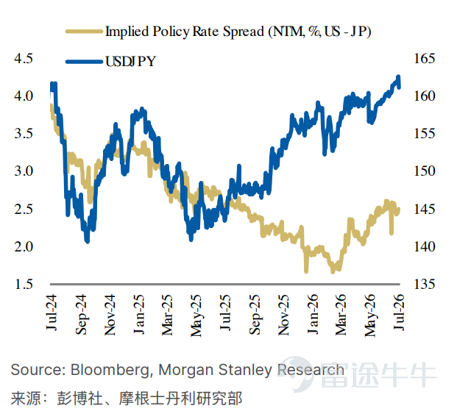
On July 23, according to Wind data, $USD/JPY (USDJPY.FX)$ the exchange rate continued to rise, briefly hitting 163.65—the highest level since December 1986—with an intraday gain of approximately 0.3%. Key drivers include:
• Widening interest rate differentials between Japan and the U.S.;
• Accumulated digital trade deficits with the U.S. (payments for cloud services, software downloads, etc.).
• Fiscal reforms are progressing slowly, and fiscal risk premia are weighing on the yen.
These factors are not short-term disruptions but deep structural forces. Even if the Bank of Japan intervenes in the currency market, the impact is likely to be limited and temporary. USD/JPY is currently near fair value (around 160) and is expected to remain in the 160 range through Q3 2026, until markets begin clearly pricing in the Fed’s rate-cut path for 2027 [4].
Market expectations for the Japan–U.S. interest rate differential and USD/JPY exchange rate 12 months ahead
![I. The Japanese economy is undergoing a structural turning point Japan is gradually moving away from three decades of deflation and zero-interest-rate policy. With rising inflationary pressures and accelerating wage growth, the Bank of Japan (BOJ) has entered a rate-hiking cycle. Market pricing for the terminal rate has already exceeded 2%[1], significantly higher than the BOJ’s official forecast of 1.50%[2], reflecting strong market expectations for monetary policy normalization in Japan. Meanwhile, Japanese corporate earnings continue to improve. Nominal GDP growth is projected to reach 4.5% in 2025, with robust ongoing growth in corporate recurring profits and tax revenues.[3] Export-oriented companies are benefiting from JPY depreciation, while domestic-demand sectors are also gradually recovering. Japanese equities remain undervalued globally, with both price-to-book (PB) and price-to-earnings (PE) ratios offering room for revaluation. Coupled with ongoing corporate governance reforms—such as increased share buybacks and dividends—the attractiveness of Japanese assets is rising. II. JPY weakness is not a short-term phenomenon but a structural trend On July 23, according to Wind data, $USD/JPY (USDJPY.FX)$ the exchange rate continued to rise, briefly reaching 163.65 during the session—the highest level since December 1986—with an intraday gain of approximately 0.3%. Key drivers include: • Persistently widening interest rate differentials between Japan and the U.S.; • Accumulated digital trade deficits (payments to the U.S. for cloud services, software downloads, etc.); • Fiscal reform is progressing slowly, and fiscal risk premia are weighing on the yen. These factors are not short-term disruptions, but...](https://nnqimage.futunn.com/sns_client_feed/12917760/20260727/web-1785145514618-PN2esaYtqe.png/big?area=2&is_public=true&imageMogr2/ignore-error/1/format/webp)
Source: Bloomberg, Morgan Stanley Research, July 13, 2026
1. Rising rate cycles benefit the financial sector: Bank stocks account for approximately 19% of the MSCI Japan Index, with the three major banks alone comprising nearly 9% combined weight. Higher rates directly widen net interest margins, potentially boosting profitability [5];
2. Rotation between AI and non-AI sectors: Earnings revisions for AI-related stocks may have already reached historic highs. Since April 2026, gains in AI stocks have been heavily concentrated in a few names. Rotation signals strengthened in early July, with the TOPIX outperforming $Nikkei 225 (.N225.JP)$ , as semiconductor stocks declined while auto and defense stocks attracted buying support. PGIM Japan expects the re-rating of undervalued stocks to persist for at least 1–2 months, guided by the April–June earnings season [6];
3. Global capital reallocation: With U.S. equities appearing overvalued, Europe facing economic weakness, and A-shares subject to policy-driven volatility, Japan—offering low valuations and ongoing reforms—is emerging as a key destination in the global 'multi-polar rotation' of capital.
4. In a yen depreciation environment, USD hedging mechanisms carry greater practical significance: $ChinaAMC MSCI Japan Hedged to USD ETF (03160.HK)$ By selling JPY forward contracts, the aim is to hedge against JPY/USD $JPY/USD (JPYUSD.FX)$ exchange rate risk. Against the structural trend of persistent yen weakness and a sustained high USD/JPY level, this mechanism helps investors avoid the erosion of Japanese equity returns caused by currency depreciation, allowing them to focus more purely on the performance of the Japanese equity market rather than bearing additional uncertainty from FX volatility.
5. However, investors should note the costs and risks associated with hedging strategies: hedging involves derivative-related risks (counterparty, liquidity, and OTC trading risks) and ongoing hedging costs (forward points reflecting the negative interest rate differential between Japan and the U.S.). Moreover, if the yen unexpectedly appreciates, the hedged position may incur relative losses, meaning FX volatility risk cannot be entirely eliminated.
IV. Conclusion
Yen weakness is not a short-term disruption but rather a reflection of Japan’s ongoing economic structural transformation. Meanwhile, Japan is transitioning from a 'zero-interest-rate' regime to a 'positive-interest-rate' environment, reshaping asset pricing dynamics. $ChinaAMC MSCI Japan Hedged to USD ETF (03160.HK)$ With its USD-hedged mechanism, low cost, and broad market coverage, it offers investors an efficient avenue to access Japan’s structural opportunities.
Japanese market performance may be influenced by macroeconomic conditions, policy shifts, exchange rate movements, and changes in capital flows. The above analysis and trends warrant close monitoring for any shifts.
China AMC MSCI Japan Equity ETF (3160 HK): Asia’s first USD-hedged Japan equity ETF, designed to reduce the impact of FX volatility and track Japanese equity performance [7]
• China AMC MSCI Japan Equity ETF (3160 HK) is Asia’s first USD-denominated Japan equity ETF employing a USD-hedging strategy.
• Aims to deliver investment returns closely tracking the performance of the MSCI Japan Equity Index (100% USD hedged).
• The Fund seeks to hedge against JPY/USD exchange rate risk by selling Japanese yen forward contracts, aiming to reduce the impact of currency fluctuations on fund returns and thereby help investors capture potential gains from the Japanese equity market while mitigating uncertainty arising from currency movements.
$Mitsubishi UFJ Financial Group (MUFG.US)$$Toyota Motor (TM.US)$$Tokyo Electron Device (2760.JP)$$Sumitomo Mitsui Financial Group (8316.JP)$$Hitachi (6501.JP)$$Sony (SONY.US)$$Advantest (6857.JP)$$SoftBank Group (9984.JP)$$Kioxia Holdings (285A.JP)$$Micron Technology (MU.US)$$NVIDIA (NVDA.US)$$Amazon (AMZN.US)$$Alphabet-C (GOOG.US)$$Meta Platforms (META.US)$$Tesla (TSLA.US)$$HSTECH (LIST91332.HK)$$Hang Seng Index (800000.HK)$$SSE 50 Index (000016.SH)$$CSI 300 Index (000300.SH)$$CSI 1000 Index (000852.SH)$$SSE Science and Technology Innovation Board 50 Index (000688.SH)$$ChinaAMC CSI 300 Index ETF (03188.HK)$$SSE Composite Index (000001.SH)$$XIAOMI-W (01810.HK)$$JD.com (JD.US)$$TENCENT (00700.HK)$$Shenzhen Component Index (399001.SZ)$$Kweichow Moutai (600519.SH)$$Contemporary Amperex Technology (300750.SZ)$$PING AN (02318.HK)$$Alibaba (BABA.US)$$ICBC (01398.HK)$$CHINA MOBILE (00941.HK)$$Micron Technology (MU.US)$$SanDisk (SNDK.US)$$SpaceX (SPCX.US)$
Important Notes Regarding China AMC MSCI Japan Equity (USD Hedged) ETF
Investing involves risks, including the loss of principal. Past performance is not indicative of future results. Before investing in the China AMC MSCI Japan Equity (USD Hedged) ETF (the “Fund”), investors should refer to the offering documents, including a thorough review of the risk factors. You should not make an investment decision based solely on this information. Please note:
• The Fund aims to achieve investment results that, before fees and expenses, closely correspond to the performance of the MSCI Japan Equity Index (100% USD hedged).
• The Fund primarily invests in Japanese equities and carries concentration risk due to its focus on a single country (Japan). Concentrated investments are generally more volatile than diversified investments and are more susceptible to adverse developments in Japan, which may lead to greater fluctuations in the Fund’s value.
• The Fund uses currency forward contracts for hedging purposes. While this approach aims to minimize the impact of currency fluctuations on the Fund’s returns, the Fund remains exposed to hedging costs, as well as risks associated with derivatives and over-the-counter (OTC) transactions.
• The Fund’s trading price may trade at a significant premium or discount relative to its net asset value per unit.
• The Fund is subject to tracking error risk.
• The Fund is exposed to risks associated with financial derivative instruments, including counterparty/credit risk, liquidity risk, valuation risk, volatility risk, and over-the-counter (OTC) trading risk.
• This fund is subject to foreign exchange risk.
• This fund may, at its discretion, pay dividends out of capital or effectively from capital. Any distribution paid out of capital or effectively from capital represents a return or withdrawal of part of the unitholders’ original investment or any capital gains attributable to that original investment. Any such distribution may result in an immediate reduction in the fund’s net asset value per unit.
Sources:
1. Former Bank of Japan official: Terminal rate of current hiking cycle could exceed 2%, Xinhua Finance, July 9, 2026, https://www.cnfin.com/hs-lb/detail/20260709/4437751_1.html
2. Survey: Yen continues to hit 40-year lows; BOJ may launch new rate hike cycle as early as October, Huitong Network, July 23, 2026, https://forex.hexun.com/2026-07-23/224690564.html
3. [Global Finance] Japan's Q4 2025 GDP growth significantly below market expectations, Xinhua Finance, February 16, 2026, https://m.cnfin.com/wx/share?url=//m.cnfin.com/hg-lb//zixun/20260216/4380178_1.html
4. Japan Equity Strategy & Global Economics: Asia Trip Feedback: Renewed Interest in the Banking Sector, Morgan Stanley, July 13, 2026.
5. iShares MSCI Japan ETF (EWJ) Holdings, July 24, 2026, https://www.financecharts.com/etfs/EWJ/holdings
6. Buying Japanese Stocks Expands to Non-AI Sectors, THE NIKKEI via scoutAsia, July 8, 2026, https://clientportal.jpx.co.jp/jpxjoinEN/s/news/buying-japanese-stocks-expands-to-non-ai-sectors-20260708-equities-equityderivat-MCXVHWQE24FNC35IGXRPYLPAIIHQ
【7】Source: China AMC (HK), Bloomberg, as of July 24, 2026.
Investing involves risks, including the possible loss of principal. Any forecasts, outlooks, or opinions contained herein are for your reference only and are not guaranteed to materialize. The information provided reflects market conditions and our views as of the date of publication, which are subject to change without notice. This document is issued by China AMC (HK) Limited. This material has not been reviewed by the Securities and Futures Commission of Hong Kong. For full details and risk factors regarding the funds mentioned herein, please refer to our official website and the fund offering documents.
Risk Disclaimer: The above content only represents the author's view. It does not represent any position or investment advice of Futu. Futu makes no representation or warranty.Read more

Comment (1)
to post a comment
1