
Bessent may tap the TGA to buy bonds; how will Warsh set the market tone at the annual meeting?

[Must-read for beginners] How will the Warsh hearing impact your wallet? 💰
Hello fellow investors! 👋
Two major events are unfolding in the financial world this week:‘Fed Chair Warsh testifies at Congressional hearings’ and Latest CPI inflation data released 。
Many beginners might feel overwhelmed as soon as they hear terms like 'the Fed' or 'congressional hearings.' Especially on Monday, Fed Governor Waller suddenly delivered an unexpectedly hawkish speech, saying that if inflation data rises further, the Fed would need to consider tightening monetary policy (i.e., raising interest rates)—sending market expectations for a rate hike soaring instantly.The probability of a July rate hike is nearing 50%!
‘How do these politicians’ remarks actually affect my wallet?’ 🤔
Don’t worry! Today, we’ll break down—in plain, everyday language—how this ‘financial storm’ impacts your assets in just 3 minutes!
📌 First: Understand two key terms to decode policymakers’ ‘jargon’—What are ‘hawkish’ and ‘dovish’?
In financial circles, Fed officials are often grouped into two camps, and their statements directly determine whether money becomes ‘looser’ or ‘tighter’:
🦅 Hawkish: Favors a tough stance and is most concerned about inflation (soaring prices). Whenever they see prices rising, they advocate ‘raising interest rates’ or ‘tightening monetary policy.’ Think of them like a thrifty farmer worried that too many eggs will spoil, so he cuts back on feed to control output (i.e., tightens liquidity).
◦ Latest developments: On Monday, Waller released the 'hawk,' signaling that the Fed's patience has reached its limit!
🕊️ Dovish: Dovish policymakers are温和 in stance and prioritize stimulating the economy and boosting employment. They advocate for interest rate cuts or maintaining an accommodative monetary policy—like gentle farmers overfeeding hens to lay more eggs (injecting liquidity to spur growth).
📌 Second: Link to your wallet! How do hawkish and dovish signals impact your assets?
When the Fed turns 'hawkish' or 'dovish,' your stocks, RMB holdings, and gold experience ripple effects:
1. 🦅 When the Fed goes 'hawkish' (expectations for rate hikes intensify):
– Stock market 📉: Borrowing costs for businesses rise, increasing corporate expenses.This especially affects U.S. tech stocks and today’s hottest AI hardware stocks (e.g., chips and semiconductor sectors), as they heavily rely on debt financing to fund massive R&D and production expansion. When rates rise, financing costs surge, dragging down valuations.Stock prices usually face significant downward pressure 。
– USD 📈 & CNY 📉: With higher interest rates, global capital will rush to buy USD for yield,the US dollar strengthens . Conversely,non-USD currencies like the Chinese yuan will face depreciation pressure 。
– Gold 📉: As the dollar becomes stronger and yields rise, assets that don’t generate interest—like gold—become less attractive,making gold prices prone to decline 。
2. 🕊When the Fed turns 'dovish' (expectations for rate cuts increase)
– Stock market 📈: Borrowing costs have stabilized, making it easier for tech stocks to access financing and increasing market liquidity,which typically boosts the stock market (especially the tech sector) 。
– USD 📉 & CNY 📈: Lower USD interest rates lead to capital outflows,weakening the US dollar and strengthening currencies like the Chinese yuan 。
– Gold 📈: With lower interest rates and a weaker dollar, investors tend to buy gold as a safe haven,pushing gold prices higher 。
📌 Third: [In-depth Analysis of Current Situation] US-Iran tensions + sharp tech stock sell-off—how will today’s Waller speech impact markets?
The current market environment is highly complex:
1. Escalating geopolitical tensions in the Middle East: U.S.-Iran tensions suddenly escalated, with the U.S. reimposing a naval blockade on Iranian ports,causing international crude oil (USOIL) to surge by approximately 10%(Brent crude spiked sharply), and markets are extremely concerned that inflation could reignite due to rising oil prices.
2. Technology and semiconductor stocks plunged: Heightened risk-off sentiment combined with capital outflowsled to a sharp drop in the Philadelphia Semiconductor Index, with memory chip stocks tumbling 。
3. Safe-haven assets diverged: as inflation and rate hike expectations became too strongGold fell instead of rising, dropping directly below the $4,000 mark 。
🚨 In this environment of 'high oil prices, weak semiconductors, and soft gold,' what impact will today's congressional testimony by Fed Chair Waller bring?
– Worst-case scenario (Waller turns hawkish 🦅): If Waller adopts a strongly hawkish tone during his testimony—emphasizing that surging oil prices pose a new inflation threat and hinting that the Fed may need to 'restart rate hikes'—thenUS tech stocks (especially AI chip stocks) could face another round of sell-offs and pullbacks,the US dollar would strengthen further, and both gold and the broader market would remain under pressure.
– More favorable scenario (Waller reassures markets 🕊️): If Waller strikes a relatively dovish tone—stating that geopolitical-driven oil price volatility is temporary and that the Fed remains data-dependent and in no rush to hike rates blindly—thenmarket panic would ease significantly, and oversold semiconductor and tech stocks could see a strong rebound. 。
📌 Fourth: How should novice investors respond in real-world investing?
In the face of such dramatic macro market shifts, beginners must not panic and should always remember the following "Three Don'ts Principle" Protect your capital:
1. Maintain a stable core position; don’t go all-in recklessly: Choose high-quality, defensive assets with stable cash flows (such as energy sector stocks or broad-market ETFs) as your core holding—this can effectively hedge against volatility in tech stocks under current market conditions.
2. Avoid full positions; keep dry powder ready: Geopolitical developments and Federal Reserve policy could reverse at any moment, so always maintain sufficient cash reserves. If Waller’s comments trigger a 'panic-driven market sell-off,' you’ll have the firepower to gradually buy your favorite high-quality AI tech stocks at lower levels.
3. Stay level-headed; avoid emotional trading: Don’t chase oil futures aggressively just because crude prices surged 10%, and don’t panic-sell your chip stocks after only a 5% dip.Macro volatility is temporary—keep sight of the bigger trend and wait for key data releases before making decisions.
📌 Fifth: Where can beginners follow this kind of macro market information?
If you don’t want to always be a step behind, you can proactively get real-time insights through the following channels:
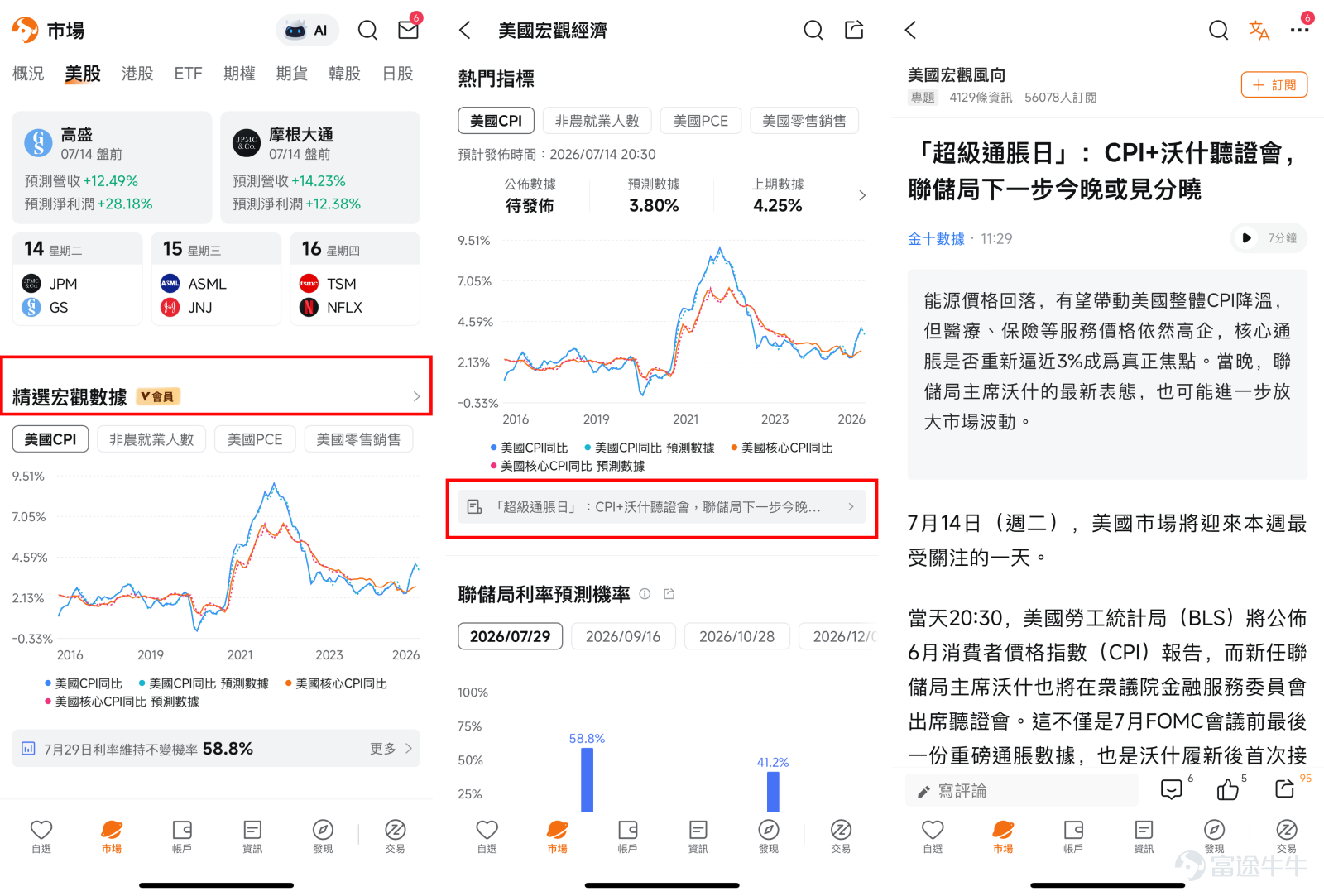
1. Futu App – Core Features 📊:
a.Path: Go to Futu App → Market → US Stocks 。
b. Scroll down to find “Featured Macro Data,” which includes key economic indicators, Fed rate hike probability forecasts, and other essential content. You can intuitively and quickly track current macroeconomic data changes and read professional market interpretations of the latest figures.

2. Futu App – News Module 📰:
a. Path: Go to Futu app → News module.
b. In the“Top News”section, major upcoming macro events are typically flagged in advance, accompanied by high-quality analysis and popular market discussions to help you quickly spot market shifts and pinpoint precise investment opportunities.

3. Ask “Futubull AI” directly 🤖 (the laziest and fastest method):
a.approachesIf you still find it confusing or can’t be bothered digging through data and researching on your own, you can directly use “Futubull AI”to ask questions directly.
b.For example, type:"What impact does Waller sounding hawkish have?" or "Which assets are worth investing in if the Fed raises rates?", Futubull AI will instantly provide you with a clear investment logic breakdown, helping you do your homework and easily keep up with market rhythms!

💡 Key takeaways from your fellow investor: Investing isn't gambling—don’t panic over one or two officials’ comments. Understand the patterns of 'hawks vs. doves,' manage your position size wisely, and leverage Futu’s powerful tools to steadily achieve your goal of 'getting rich slowly' in volatile markets! 💪
Do you think Waller will sound dovish or hawkish tonight?
Amid this bout of volatility,have you already prepared enough cash waiting to buy the dip, or are you fully invested and holding on tight?Feel free to share your strategy in the comments below! 👇
Risk Disclaimer: The above content only represents the author's view. It does not represent any position or investment advice of Futu. Futu makes no representation or warranty.Read more


Comments
to post a comment
16
16