
NVIDIA issues $25 billion in bonds—a rare move! What AI investment opportunities lie behind this?
As one of the world's 'most profitable companies,' chip giant $NVIDIA (NVDA.US)$ announced on Monday that it would raise $25 billion through the issuance of investment-grade bonds—marking NVIDIA’s return to the bond market after a five-year hiatus.
The bond offering drew exceptionally strong demand. According to market data,this issuance attracted subscription orders totaling $85 billion, representing an oversubscription ratio of more than three times.This reflects investors’ robust appetite for high-quality technology assets and underscores global capital’s eagerness to capture AI-driven gains through the bond market with relatively lower risk.
According to the consensus analyst forecast, NVIDIA is expected to generate over $200 billion in free cash flow in the fiscal year ending January 31 next year. Against the backdrop of such abundant free cash flow and sustained high profitability,why is NVIDIA—the cash-generating machine running at full throttle—opting to raise such a massive amount of capital from the market?
Silicon Valley giants collectively 'suck up capital': AI enters the infrastructure-heavy phase
In fact, NVIDIA's fundraising activity is not an isolated case. Since the beginning of this year, Silicon Valley giants appear collectively gripped by an intense thirst for cash. Leading tech companies are flooding into the debt market, having raised hundreds of billions of dollars in aggregate so far this year. To date, the market has absorbed this wave of bond issuance fairly well:
$Amazon (AMZN.US)$ : Completed a single bond issuance worth $37 billion, setting a record for the largest single fundraising deal in the U.S. investment-grade bond market this year.
The reason these seemingly cash-rich giants are aggressively issuing debt lies in the underlying logic thatgenerative AI is gradually evolving into an 'infrastructure-intensive heavy industry',and NVIDIA, as a key architect and foundational pillar of the AI ecosystem, is no exception:The parameter scale of large AI language models (LLMs) is growing exponentially, and the training and inference processes behind them require building massive-scale computing clusters. This involves not only GPU hardware procurement but also extends to liquid-cooled data center retrofits, high-bandwidth network interconnects, and dedicated power infrastructure—each step representing a massive 'cash sink.'
However, as tech companies continue to take on ever-larger debt financing, some industry insiders have started expressing concern. Tom Murphy, Global Head of Investment-Grade Credit at Columbia Threadneedle Investments, noted that increasingly frequent financial guarantee arrangements, coupled with the high degree of interdependence among AI firms, are fueling bond investors' worries about 'excessive risk concentration.'
Deep Financial Strategy Behind Bond Market Financing
For NVIDIA, issuing $25 billion in bonds isn’t driven by a shortage of funds but rather stems from deeper corporate financial strategy optimization:
1. Extremely low borrowing costs
NVIDIA’s bond issuance was exquisitely timed to capitalize on a favorable macro window. Following last weekend’s successful ceasefire agreement between the U.S. and Iran, bond markets rebounded. The indicator measuring investment-grade credit risk has dropped to its lowest level since early February, spurring a surge in borrowing activity across the credit market.
According to informed sources, NVIDIA issued bonds across an exceptionally wide maturity spectrum, offering seven tranches ranging from 2-year to 30-year terms. Strong investor demand led the yield on the 30-year tranche to tighten by 25 basis points from initial guidance, resulting in a final spread of just 65 basis points over comparable U.S. Treasuries.
Andy Li, analyst at CreditSights, stated: 'Given NVIDIA’s dominant market position and financial strength, it doesn’t need to aggressively market itself—its 'flash issuance' strategy is therefore unsurprising.'
2. Optimizing capital allocation and leverage
Industry research analyst Robert Schiffman wrote in a client report that by issuing relatively low-cost, long-dated bonds, NVIDIA aims to reduce its average cost of capital and provide additional funding support for strategic AI partnerships—including with OpenAI—without jeopardizing its AA credit rating.
From a sole GPU chip supplier to the 'ecosystem kingmaker' driving global AI development, NVIDIA is continuously supporting companies that fuel AI demand through massive capital deployment. A key reason its bond issuances are highly sought after in the market is that they avoid the typical infrastructure construction and project timeline risks inherent in traditional data center financing, allowing investors direct exposure to the long-term growth of NVIDIA’s expansive AI ecosystem—an especially attractive proposition.
Breaking Down NVIDIA’s 2026 AI Investment Landscape
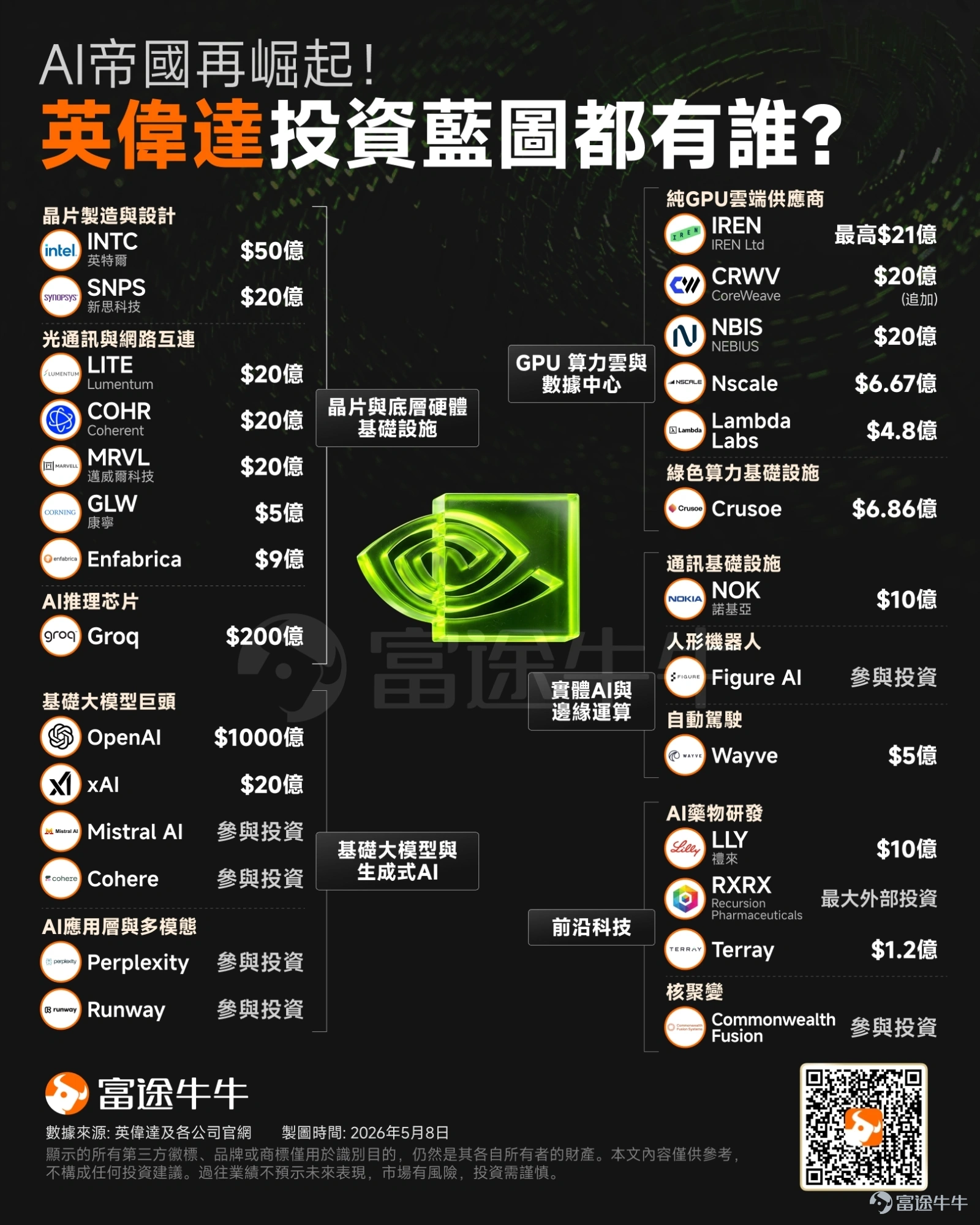
According to NVIDIA’s disclosed 2026 investment roadmap, its investment ecosystem now comprehensively spans the AI value chain—from foundational hardware and infrastructure to core customers and cutting-edge applications.
Earlier, the article "Follow Jensen Huang's strategy! NVIDIA heavily invests in Corning, the strongest dark horse in the AI investment landscape surges 350%" also outlined NVIDIA’s strategic layout:
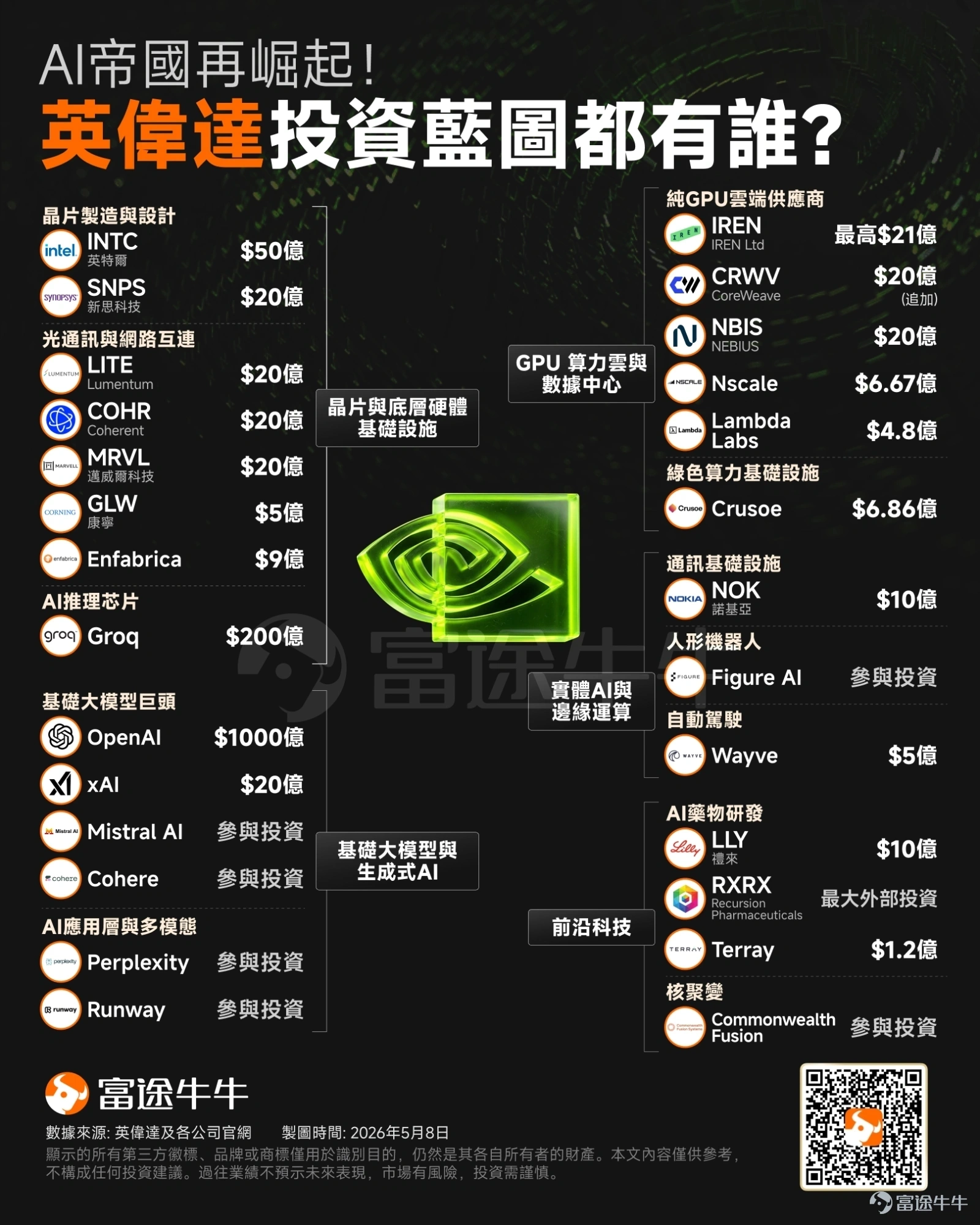
Detailed sector analysis is as follows:
1. Chips and Foundational Hardware Infrastructure
As AI clusters continue to scale, relying solely on GPU chips is no longer sufficient to meet peak computational demands. Core bottlenecks—particularly in chip-level design and inter-node data transfer efficiency (bandwidth constraints)—have become critical limiting factors. NVIDIA’s investments in this segment focus on securing supply chain stability and overcoming data transmission bottlenecks.
Chip manufacturing and design:Its strategic investment in EDA giant $Synopsys (SNPS.US)$ aims to accelerate the development of next-generation GPUs using AI technologies; meanwhile, its strategic equity stake in $Intel (INTC.US)$, aims to secure a reliable backup solution for future advanced packaging and wafer fabrication capacity beyond Taiwan Semiconductor.
Optical communications and network interconnects:Data transfer speed determines the upper limit of AI cluster computing power. By investing in leading optical communications company$Lumentum (LITE.US)$ And, $Coherent (COHR.US)$to gain control over core optical module technology, and forming an alliance with$Corning (GLW.US)$to secure fiber optic production capacity. Additionally, partnering with networking chip leader$Marvell Technology (MRVL.US)$and emerging companyEnfabrica, it focuses on enabling high-volume data interconnects between servers.
AI inference chips:CorrectGroq has committed up to $20 billion,which is particularly noteworthy. Groq specializes in ultra-low-latency inference chips; NVIDIA’s move serves both to fill a specific technological gap and to strategically absorb a potential disruptor in the AI inference market.
2. GPU Computing Cloud and Data Centers
To prevent the Big Three cloud providers (AWS, Azure, GCP) from monopolizing computing power distribution, NVIDIA is actively supporting its own 'computing alliance.'
Pure GPU cloud provider: Strongly backing $CoreWeave (CRWV.US)$ 、 $IREN Ltd (IREN.US)$ 、 $NEBIUS (NBIS.US)$ 、NscaleandLambdaLabsand other emerging computing platforms, granting them priority access to top-tier chips. The rise of these 'new cloud' players not only ensures a stable outlet for NVIDIA GPUs but also helps counterbalance traditional cloud giants, compelling them to keep purchasing NVIDIA hardware to maintain their competitive edge.
Green computing infrastructure: Addressing the pain point of soaring AI energy consumption, it has invested inCrusoefirms that generate electricity from wasted energy. This shows NVIDIA is getting ahead of the curve on greening its data centers, seeking to overcome the future 'power wall' that could constrain computing capacity expansion.
3. Foundational Large Models and Generative AI
Top-tier hardware requires a thriving software ecosystem to support it. NVIDIA secures a continuous stream of the world’s largest computing demands by deeply integrating with leading large models.
Foundational large model giants:Whether in the closed-source campOpenAIwith Musk'sxAI, or MistralAI, a leader in open-source and enterprise AI,MistralAIandCohere, are all on the investment list. This move aims to ensure that the world’s most critical AI models remain heavily reliant on NVIDIA’s CUDA software stack for foundational training and inference optimization.
AI application layer and multimodal:Strategic investments in AI search platformsPerplexityand video generation toolsRunway. In particular, applications involving video and multimodal technologies drive exponential growth in demand for computing power and memory bandwidth—precisely the end-use scenarios NVIDIA most desires to sustain its high growth and premium pricing.
4. Physical AI and Edge Computing
Once language models reach a certain level of maturity, deploying AI into the physical world (embodied intelligence) will become the next major catalyst for hardware demand.
– Telecommunications Infrastructure:Partnering with telecommunications equipment giants $Nokia Oyj (NOK.US)$ , committed to extending powerful AI inference capabilities to the edge of 5G/6G networks.
– Humanoid Robots:Participating in investmentFigure AI. As a key physical embodiment of AI, humanoid robots will generate massive demand in the future for edge computing chips, machine vision processing, and virtual simulation training environments.
– Autonomous Driving:Betting on rising stars focused on end-to-end autonomous drivingWayve, aiming to integrate purely data-driven AI models into real-world traffic conditions and further solidify its dominance in smart mobility.
5. Frontier Technologies
NVIDIA is not only focused on near-term commercial monetization but is also dedicated to applying its powerful computing capabilities to foundational scientific fields capable of transforming the course of human development.
AI Drug Discovery:Biopharmaceuticals is a sector highly dependent on computing power and holds immense commercial potential. By partnering with traditional pharmaceutical giants $Eli Lilly and Co (LLY.US)$ and making significant investments $Recursion Pharmaceuticals (RXRX.US)$ With ChemSpace ExplorationTerray, NVIDIA is attempting to disrupt the lengthy and expensive traditional drug discovery process using its powerful GPU computing capabilities.
– Nuclear Fusion:Participated in the investment of a commercial nuclear fusion companyCommonwealth Fusion, demonstrating highly forward-looking strategic vision. Exploring limitless and clean ultimate energy aims to fundamentally support the insatiable power demands of future super artificial intelligence.
Conclusion
NVIDIA's $25 billion corporate bond issuance essentially providesfinancial leveragefor its expansive ecosystem spanning 'semiconductor manufacturing—data transmission—computing power distribution—foundation models—cutting-edge real-world applications.' Through systematic capital deployment, NVIDIA is steadily transforming from a standalone GPU hardware supplier into an 'ecosystem integrator' that defines and dominates the foundational infrastructure of the global AI industry—its AI ecosystem blueprint is gradually unfolding in the real world.
Risk Disclaimer: The above content only represents the author's view. It does not represent any position or investment advice of Futu. Futu makes no representation or warranty.Read more


Comments (16)
to post a comment
52
171