
English
Back
Open Account
Waller makes his debut early Thursday! How will Fed policy shift?
DL HOLDINGS GP
joined discussion · Jun 10 16:47

Delin's Weekly Outlook (June 8, 2026)

Market Review
1
US Inflation Pressures Intensify
Data released by the U.S. Bureau of Labor Statistics shows that the U.S. labor market staged a strong rebound in May, surpassing all market expectations. Nonfarm payrolls rose by 172,000 in May—nearly double the market forecast of 88,000 and significantly higher than April’s gain of 115,000. This has markedly eased prior concerns about a cooling labor market and introduced new uncertainty into the Federal Reserve’s monetary policy path.
Data from the Institute for Supply Management (ISM) shows that the U.S. services sector index rose to a three-month high of 54.5 in May, above the forecast of 53.8 and the prior reading of 53.6. Both the new orders and business activity components improved, underscoring resilient consumer demand. Meanwhile, rising energy and transportation costs pushed ISM’s prices paid index to 71.3 last month—the highest level since August 2022.
The latest ADP report shows that private-sector employment increased by 122,000 in May, slightly exceeding the market expectation of 120,000 and marking the strongest monthly gain since January 2025. This data followed the same day’s robust JOLTS job openings report, further reinforcing the view that the U.S. labor market remains solid. This trend could prompt markets to increasingly bet that the Fed’s next move will be a rate hike rather than a cut.
Data released by Eurostat shows that eurozone CPI rose 3.2% year-over-year in May, up from April’s 3.0% increase and reaching its highest level since September 2023, though in line with market expectations. The main driver was a 10.9% annual increase in energy costs. On a monthly basis, CPI rose 0.1% in May, down from April’s 1.0% increase.
Strong U.S. employment data this week has raised market concerns that the Federal Reserve may gain room to hike rates, potentially turning hawkish at its next meeting. Markets are now pricing in a 72% probability of a rate hike at the December FOMC meeting, and the 10-year U.S. Treasury yield has risen above 4.5%. However, we note that the leisure and hospitality sector—the largest contributor to job growth—may have been boosted by the World Cup, suggesting a possible seasonal factor. We urge investors not to overreact and to closely monitor this week’s inflation data. Meanwhile, U.S. equities have exhibited heightened volatility due to high concentration and significant recent gains. We maintain our view that the AI trend remains intact, but investors should keep well-balanced portfolios and avoid speculative positions. In terms of asset allocation, we believe investors should closely watch long-end bond yields and may cautiously extend portfolio duration by allocating to high-quality bonds to lock in attractive interest income.
2
China's New Real Estate Development Model
According to data released by the National Bureau of Statistics, China’s official Manufacturing PMI stood at 50.0% in May, down 0.3 percentage points from last month, right at the expansion-contraction threshold. The Composite PMI Output Index came in at 50.5%, up 0.4 percentage points from the previous month, indicating that overall business activity among Chinese enterprises remains in expansionary territory.
According to data released by the National Bureau of Statistics, China’s Non-Manufacturing Business Activity Index reached 50.1% in May, up 0.7 percentage points from last month, signaling an improvement in non-manufacturing sector sentiment. Within services, industries such as railway transportation, telecoms, broadcasting, satellite transmission services, and insurance all reported business activity indices above the robust 55.0% mark.
The State Council has issued the first five-year special plan for urban renewal, incorporating a new real estate development model, the construction of 'high-quality housing,' and revitalization of existing assets into its top-level design. During the upcoming '15th Five-Year Plan' period (2026–2030), the target for renovating dilapidated and outdated housing units will double from the '14th Five-Year Plan' level to 500,000 units. Urban village redevelopment will remain elevated at 4,000 projects, which is expected to unlock housing demand. The plan also provides stronger support for revitalizing idle land and facilitating changes in land use, helping the real estate sector transition from 'incremental development' to a model centered on 'existing asset operations plus quality services.'
Data shows that Shanghai’s second-hand home transactions reached 28,023 units in May, the highest level in nearly six years. In Beijing, second-hand home sales declined modestly by 10.5% month-over-month in May but did not follow the usual post-peak seasonal cooling pattern, demonstrating notably stronger resilience compared to the same period in prior years. Analysts note that listing prices for second-hand homes have stabilized further, sending a clearer signal of market recovery and marking a shift from the previous 'price cuts for volume' phase into a new stage of stable transaction volumes and prices.
This week’s economic data indicates that China’s economy remains primarily driven by manufacturing exports, with signs of growing divergence in economic performance across sectors. We advise investors to closely monitor external developments and export trends to assess whether the central government has sufficient impetus to roll out additional policies aimed at stimulating household consumption and livelihood-related sectors. Separately, we observe early signs of stabilization in property markets in certain tier-one cities; however, we believe the current stability remains confined to a few major cities and does not indicate a broad-based recovery. Investors should therefore track nationwide inventory reduction progress as well as the relationship between mortgage rates and rental yields. In terms of asset allocation, we continue to recommend diversified portfolios and avoiding overcrowded investment themes.
3
Delin Securities Perspective
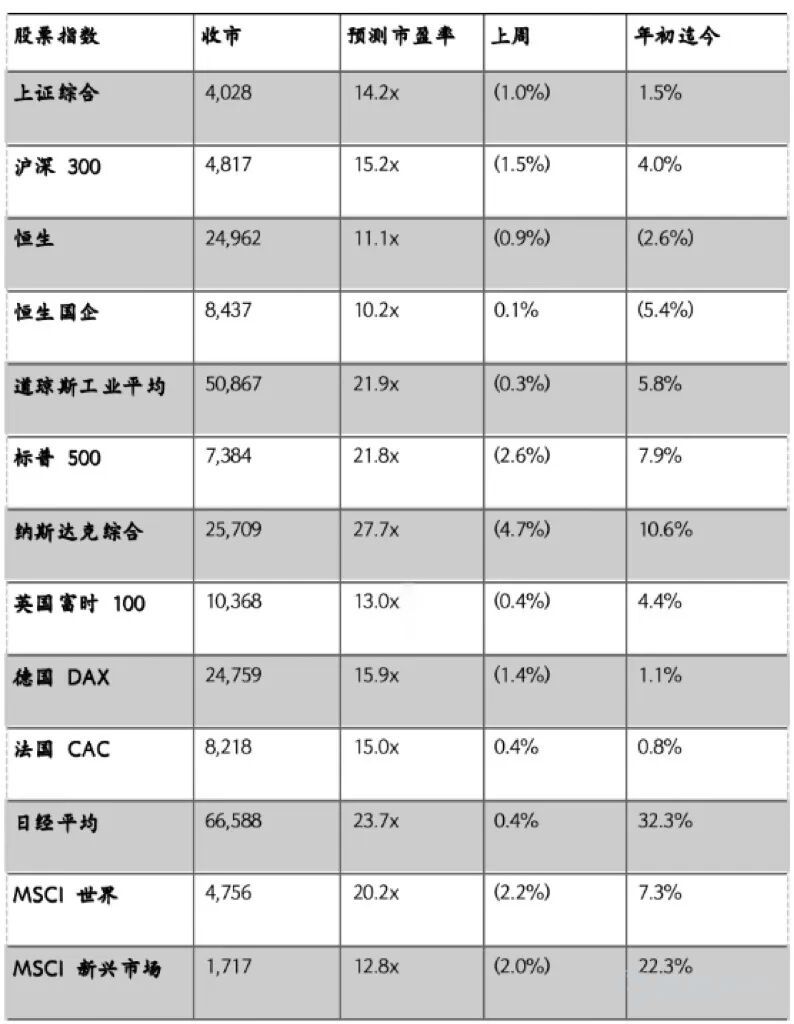
Kenty Wong, Deputy CEO of Delin Securities, observed that Hong Kong’s stock market last week showed a 'sharp rally followed by a steep decline' pattern, logging three consecutive trading days of losses. On Friday, the Hang Seng Index closed below the psychologically important 25,000 level for the first time in two months. For the week, the index lost 220 points cumulatively. Average daily turnover last week approached HK$33 billion, but amid prevailing bearish sentiment, the market’s overall weak tone persisted. Sector-wise, semiconductor stocks were hit hardest due to negative news flow and concerns over potential intensified U.S. sanctions, with leading names suffering significant price declines. Additionally, the Hang Seng Index quarterly rebalance took effect after market close on Friday, prompting index-tracking funds to reallocate holdings and amplifying price volatility in affected stocks. On the external front, U.S. May employment data released Friday significantly exceeded expectations, and ongoing instability in the Middle East kept oil prices elevated, sharply increasing market expectations for Fed rate hikes this year.
Looking ahead to this week, under the dual pressures of rising rate-hike fears and global semiconductor sector corrections, Asia-Pacific equity markets—including Hong Kong—are expected to face headwinds. The Hang Seng Index may continue to test lower levels, and we advise investors to remain vigilant. Heightened market volatility is likely to drive up overall trading volumes.
Since the China Securities Regulatory Commission (CSRC) began cracking down on illegal cross-border securities activities on the 22nd of last month, market reports emerged last week indicating that the CSRC met with senior executives of several Hong Kong-based brokerages in Shenzhen to review their progress in handling existing mainland clients and reiterated key regulatory requirements. These include prohibiting individuals holding only mainland Chinese identification documents from opening accounts, winding down non-compliant client relationships, and adjusting onshore service arrangements. The three brokerages previously named by the CSRC have already implemented specific adjustments accordingly. Regarding market concerns that mainland investors might rush to sell Hong Kong-listed stocks due to regulatory pressures, recent trading activity over the past two weeks shows no evidence of mass sell-offs by mainland investors triggered by these rules. Indeed, as an international financial center, Hong Kong attracts capital from around the globe, and mainland investors can still access Hong Kong stocks through compliant channels like Stock Connect. Market movements remain closely tied to broader macroeconomic conditions, and we believe these tightened regulatory requirements will not undermine the long-term development of Hong Kong’s equity market.
4
Mainland Market Observation
Last week, China's A-share market experienced broad volatility and adjustments, with major indices generally ending lower. The Shanghai Composite Index fell 1.00% for the week, slipping below the 4,050 mark, while the STAR 50 Index declined by 4.74%.
The market exhibited a pronounced rotation from high-flying to low-valuation sectors: cyclical and resource-related stocks bucked the trend, led by coal, which rose over 6% for the week on expectations of peak summer electricity demand and supply-side constraints. Within the tech sector, divergence intensified; sentiment spilled over from sharp declines in U.S. semiconductor stocks cooled previously hot segments like AI computing power and optical modules. However, niche themes such as commercial aerospace, humanoid robots, and glass substrates attracted capital inflows and remained active despite the broader pullback.
In terms of trading volume, average daily turnover shrank to RMB 2.95 trillion (hereinafter in RMB), reflecting increasingly cautious market sentiment. Looking ahead, external liquidity disruptions combined with domestic sectoral rotation suggest the market may continue consolidating sideways in the near term.
Key News
1
Trading activity in real-world assets (RWA) and stablecoins weakened,
Global efforts to accelerate tokenization are intensifying.
The latest weekly industry data shows that the global real-world asset (RWA) and stablecoin markets are exhibiting a structural pattern of 'user accumulation but declining activity.' Data indicates that the total on-chain market cap of RWA edged up slightly to USD 31.53 billion, with retail investor participation driving a nearly 12% surge in holder counts. However, institutional demand for large-value settlements has plummeted, and stablecoin market capitalization has declined for three consecutive months, with monthly transfer volumes dropping sharply by 40.12% month-over-month. Against this backdrop, regulators and financial and payments giants worldwide are accelerating the development of tokenized bond and stablecoin infrastructure.
On the regulatory and market development front, the Hong Kong Monetary Authority (HKMA) announced the formal establishment of an expert panel on tokenized bonds. Comprising experienced representatives from industry associations, financial institutions, legal advisory firms, and financial infrastructure and technology providers, the panel will build on the HKMA’s prior progress in tokenized bonds to jointly explore policy measures, market practices, and innovative solutions. The initiative aims to further advance the application and expansion potential of tokenized bonds in Hong Kong and foster a more mature ecosystem.
Meanwhile, strategic collaborations among traditional payments giants have become a market focal point. Global payment networks Stripe, Visa, and Mastercard are preparing to launch a new stablecoin platform, which is now nearing its official release. According to informed sources, the U.S.-listed exchange Coinbase is also considering joining the initiative. Recently, Stripe and Mastercard have bolstered their capabilities in stablecoin-enabled cards, enterprise payouts, and 24/7 settlement through acquisitions of relevant infrastructure companies. This tripartite alliance is expected to further bridge the gap between traditional finance and on-chain assets.
2
Meituan delivers better-than-expected earnings
Meituan reported total revenue of RMB 91 billion for the first quarter of 2026, up 5.6% year-over-year, slightly exceeding market expectations. Its adjusted net loss stood at RMB 4.97 billion, also better than the market’s forecast of RMB 6.8 billion. Most encouraging for investors was the significant sequential improvement—operating losses narrowed from RMB 16.1 billion in the previous quarter to RMB 6.5 billion, representing a nearly RMB 10 billion reduction in quarterly losses. The company’s share price surged over 9% the day after the earnings release.
Revenue from Meituan’s Core Local Commerce segment grew only marginally by 0.1% year-over-year, while operating profit plummeted from RMB 13.5 billion a year ago to an operating loss of RMB 2 billion. The primary driver was a 51.1% year-over-year surge in marketing expenses, which reached RMB 23 billion—the heavy toll of subsidy wars persists. However, a critical shift lies in operational efficiency: Meituan Waimai’s per-order loss has narrowed from approximately RMB 1.6 in Q4 to RMB 1.0–1.1, whereas Alibaba’s Ele.me still reports per-order losses exceeding RMB 3, widening the efficiency gap to roughly RMB 2. CEO Wang Xing explicitly stated that Meituan Waimai is on track to approach breakeven in Q2.
The New Initiatives segment emerged as a bright spot, with revenue rising 21.3% year-over-year to RMB 27 billion and the operating loss ratio narrowing from 10.2% to 7.8%. Meituan disclosed data for its XiaoXiang Supermarket for the first time: product sales revenue reached approximately RMB 21 billion, up about 41% year-over-year, and the service now covers 55 cities. Overseas operations under Keeta have expanded into markets including Hong Kong, Saudi Arabia, and Brazil, with unit economics improving faster than Meituan’s domestic operations did at a comparable stage of maturity.
AI was another key narrative thread in this quarter’s earnings report. R&D expenses rose 22% year-over-year to RMB 7 billion, significantly outpacing revenue growth. Meituan’s AI assistant ‘Xiao Tuan’ now occupies the prime position in the app’s navigation bar, while ‘Smart Shopkeeper’ and ‘Digital Employee’ solutions cover over 700,000 restaurant merchants and 300,000 service retail merchants, respectively. Notably, Meituan is set to integrate its AI agents with Tencent’s AI assistant ‘Yuanbao’—enabling seamless transaction handoffs when users express local service needs within the WeChat ecosystem. This represents a subtle yet powerful strategic countermove against Douyin’s traffic advantage.
3
Broadcom’s Q2 revenue surged 48%
Broadcom reported fiscal Q2 2026 results with consolidated revenue of USD 22.2 billion, up 48% year-over-year and exceeding the guided USD 22.07 billion; net income reached USD 9.31 billion, soaring approximately 88% year-over-year and far surpassing Wall Street’s expectation of USD 8.2 billion. The AI semiconductor business served as the core growth engine, generating USD 10.8 billion in quarterly revenue—a staggering 143% year-over-year increase—and accounting for nearly half of total revenue.
The explosive growth in AI revenue was primarily driven by surging demand for custom AI accelerators, with large customers like Google TPU continuing to scale orders, allowing Broadcom to maintain a differentiated competitive moat against NVIDIA. In the prior quarter (Q1), AI revenue already reached USD 8.4 billion, up USD 1.9 billion sequentially, and climbed further to USD 10.8 billion in Q2—a sequential net increase of USD 2.4 billion—indicating that the growth trajectory remains steeply upward.
On the software front, infrastructure software revenue remained robust, with VMware customer conversion to subscription-based models surpassing 85%, signaling the effective conclusion of the integration phase. Going forward, this segment will contribute more predictable recurring revenue. Broadcom’s dual-engine structure—combining semiconductor solutions and software—has resulted in significantly higher revenue quality and profit stability compared to pure-play hardware chip companies.
Looking ahead, management expects AI semiconductor revenue to accelerate further in the third quarter, though the specific guidance came in slightly below the most optimistic market expectations, triggering short-term sentiment volatility. Overall, Broadcom has established a highly certain AI revenue growth path through its ASIC customization strengths and deep partnerships with leading cloud providers, making it one of the most fundamentally solid names in the current semiconductor sector.
4
Unitree Robotics fast-tracks its IPO
Unitree Robotics achieved a remarkably swift IPO process—its application was accepted by the Shanghai Stock Exchange’s STAR Market and cleared the listing committee review in just over 70 days. The offering plans to issue no fewer than 40.44 million shares, aiming to raise RMB 4.202 billion. Proceeds will be allocated toward four key initiatives: intelligent robot model development, robot hardware R&D, new intelligent robot product development, and related areas. Upon listing, Unitree will become the first humanoid robotics company on China’s A-share market.
From a business fundamentals perspective, Unitree Robotics has achieved a product leap from quadrupedal robotic dogs to humanoid robots. In the first half of 2025, sales revenue from its humanoid robot G1 reached RMB 399 million, accounting for 51.8% of total core business revenue, surpassing quadrupedal robots for the first time as the largest revenue contributor. Full-year 2025 shipments of humanoid robots exceeded 5,500 units, setting a new global record.
On the technology front, Unitree has adopted a differentiated open strategy. Founder Wang Xingxing has fully open-sourced the company’s self-developed embodied large models, including the WMA and VLA architectures, along with datasets, training code, and deployment code. In early 2026, the industrial-grade embodied large model UnifoLM-X1-0 completed pilot deployment at the company’s own factory, autonomously performing tasks such as joint motor assembly—making it one of the world’s first cases of factory-level validation of an embodied large model.
In terms of commercialization, Unitree is rapidly expanding beyond academic and educational applications into industrial and consumer markets. Institutions including China Mobile, Tongji University, and the China Science and Technology Museum have successively procured its products, with China Mobile’s contract valued at RMB 460.5 million. Wang Xingxing estimates that, if technological development proceeds smoothly, by the end of 2026, the robots will be able to respond to any command and generate corresponding actions in real time. By the second half of 2027, they could achieve 'autonomous task execution in unknown environments,' marking the true inflection point for the commercial value of general-purpose robots.
5
Anthropic officially selects IPO lead underwriters
Anthropic has formally appointed Morgan Stanley and Goldman Sachs as lead underwriters for its IPO, with JPMorgan also participating in the offering; additional investment banks may join the syndicate in the future. The confirmation of this underwriting team marks the IPO’s entry into a substantive phase. The company is considering going public as early as October 2026 and has already confidentially filed its IPO application with the SEC. Following its latest funding round, Anthropic’s valuation has reached USD 965 billion, surpassing OpenAI for the first time and making it one of the world’s most valuable private companies.
In the AI large-model arena, Anthropic and OpenAI are locked in a fierce race to become the 'first AI stock' to go public. OpenAI has also engaged with Goldman Sachs, Morgan Stanley, Citi, and JPMorgan regarding its listing plans. Founded in 2021 by former OpenAI employees, Anthropic positions itself around 'more responsible AI,' and its Claude product line has deeply penetrated enterprise markets in finance, healthcare, and legal services.
Technologically, Anthropic’s flagship model Mythos has drawn attention at the geopolitical level—the model is described as being capable of 'identifying and exploiting vulnerabilities in mainstream operating systems and browsers.' Anthropic restricts access to this model to a select group of major tech firms and Wall Street institutions. This breakthrough has directly prompted the Trump administration to accelerate the formulation of AI cybersecurity policies. Additionally, Anthropic’s automated legal and financial research tool, launched in February this year, triggered global stock market volatility immediately upon its debut.
On compute capacity, SpaceX has signed an agreement with Anthropic to supply computing power equivalent to approximately 325,000 NVIDIA chips, at a monthly cost of USD 1.25 billion, with the agreement valid through May 2029. Notably, SpaceX itself plans to go public as early as June 12, 2026, at a valuation of USD 1.8 trillion. Its Grok chatbot directly competes with Claude—creating a complex dynamic where SpaceX simultaneously serves as both a supplier and a competitor to Anthropic.
Market statistics
Market Review 1 US Inflation Pressures Intensify Data released by the U.S. Bureau of Labor Statistics shows that the U.S. labor market staged a strong rebound in May, surpassing all market expectations. Nonfarm payrolls rose by 172,000 in May—nearly double the market forecast of 88,000 and significantly higher than April’s gain of 115,000. This has markedly eased prior concerns about a cooling labor market and introduced new uncertainty into the Federal Reserve’s monetary policy path. Data from the Institute for Supply Management (ISM) shows that the U.S. services sector index rose to a three-month high of 54.5 in May, above the forecast of 53.8 and the prior reading of 53.6. Both the new orders and business activity components improved, underscoring resilient consumer demand. Meanwhile, rising energy and transportation costs pushed ISM’s prices paid index to 71.3 last month—the highest level since August 2022. The latest ADP report shows that private-sector employment increased by 122,000 in May, slightly exceeding the market expectation of 120,000 and marking the strongest monthly gain since January 2025. This data followed the same day’s robust JOLTS job openings report, further reinforcing the view that the U.S. labor market remains solid. This trend could prompt markets to increasingly bet that the Fed’s next move will be a rate hike rather than a cut. Data released by Eurostat shows that eurozone CPI rose 3.2% year-over-year in May, up from April’s 3.0% increase and reaching its highest level since September 2023, though in line with market expectations. The main driver was a 10.9% annual increase in energy costs. On a monthly basis, May...
This week's economic data schedule
Market Review 1 US Inflation Pressures Intensify Data released by the U.S. Bureau of Labor Statistics shows that the U.S. labor market staged a strong rebound in May, surpassing all market expectations. Nonfarm payrolls rose by 172,000 in May—nearly double the market forecast of 88,000 and significantly higher than April’s gain of 115,000. This has markedly eased prior concerns about a cooling labor market and introduced new uncertainty into the Federal Reserve’s monetary policy path. Data from the Institute for Supply Management (ISM) shows that the U.S. services sector index rose to a three-month high of 54.5 in May, above the forecast of 53.8 and the prior reading of 53.6. Both the new orders and business activity components improved, underscoring resilient consumer demand. Meanwhile, rising energy and transportation costs pushed ISM’s prices paid index to 71.3 last month—the highest level since August 2022. The latest ADP report shows that private-sector employment increased by 122,000 in May, slightly exceeding the market expectation of 120,000 and marking the strongest monthly gain since January 2025. This data followed the same day’s robust JOLTS job openings report, further reinforcing the view that the U.S. labor market remains solid. This trend could prompt markets to increasingly bet that the Fed’s next move will be a rate hike rather than a cut. Data released by Eurostat shows that eurozone CPI rose 3.2% year-over-year in May, up from April’s 3.0% increase and reaching its highest level since September 2023, though in line with market expectations. The main driver was a 10.9% annual increase in energy costs. On a monthly basis, May...
Disclaimer
This report was prepared by DL Family Office (Hong Kong) Limited based on publicly available information. DL Family Office (Hong Kong) Limited is licensed by the Hong Kong Securities and Futures Commission to engage in Type 4 (advice on securities) and Type 9 (asset management) regulated activities.
The content and opinions in this report are for reference only and do not constitute recommendations, offers, solicitations, advertisements, or promotions for the relevant securities or financial instruments. DL Family Office (Hong Kong) Limited strives for accuracy and reliability in the information provided but does not guarantee independent verification of the public data used.
DL Family Office (Hong Kong) Limited, its branches, affiliates, directors, staff, employees, and agents assume no responsibility for any expressions, warranties, implications, correctness, fairness, or completeness of the information contained in this report. They also bear no liability for any errors, ambiguities, omissions, or misunderstandings arising therefrom.
This report is distributed exclusively to specific individuals. Without written authorization from DL Family Office (Hong Kong) Limited, no recipient may copy, distribute, disseminate, quote, reproduce, or provide any part or all of the content to third parties.
DL Family Office (Hong Kong) Limited reserves all rights to this report.
Risk Disclaimer: The above content only represents the author's view. It does not represent any position or investment advice of Futu. Futu makes no representation or warranty.Read more
13K Views
Report
Comments
Write a Comment...