
Big short investors turn bullish on Microsoft—could software stocks be staging a comeback?

The Two Faces of AI: Walmart Leverages AI to Hit Trillion-Dollar Valuation, While the Software Industry Enters Its 'Darkest Hour' – How Should Investors Navigate the Fog and Seize Opportunities?
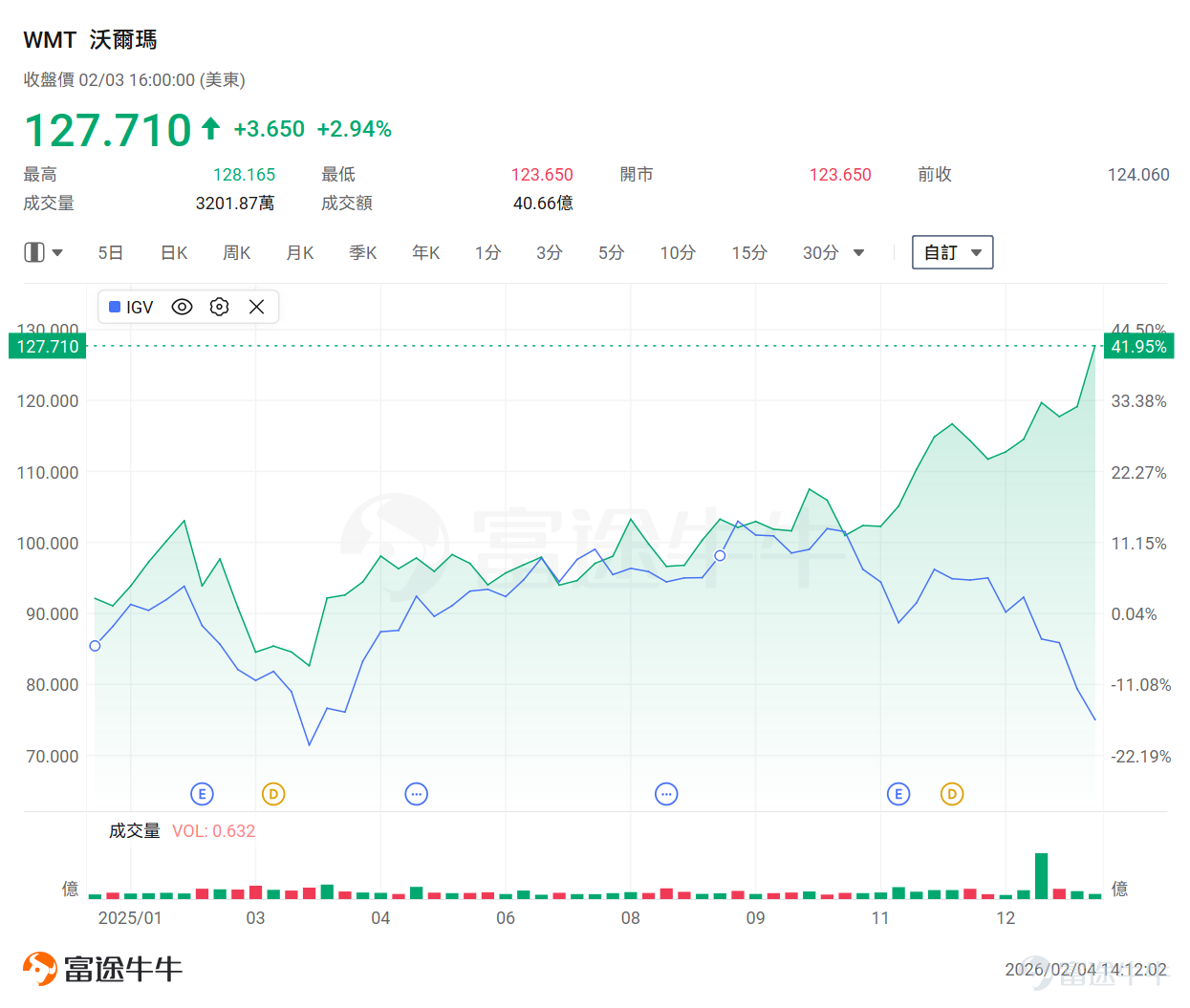
This year, the capital markets have staged a highly symbolic "Tale of Two Cities." On one side, the traditional retail giant $Walmart (WMT.US)$ broke through the $1 trillion market cap against the market trend, officially entering the "trillion-dollar club" controlled by tech giants; on the other side, the once high-flying software sector has been mired in panic selling, $iShares Expanded Tech-Software Sector ETF (IGV.US)$ dropping nearly 30% from its previous high.

This is not just about stock price fluctuations but also represents a profound restructuring of AI value distribution:Capital is rewarding those "old money" players that can harness AI while mercilessly abandoning those "old tech" sectors that are likely to be replaced by AI.
Walmart hits new highs against the trend, while software stocks experience their "darkest hour"—what exactly is the market trading?This article will reveal to fellow investors the new capital preferences in the AI era: analyzing how Walmart uses AI to reshape the value of "old money," as well as the trust crisis the software industry is undergoing, questioning whether it's about "survival or destruction."
Walmart Joins the 'Trillion-Dollar Club' – Tech Transformation Reshapes Retail Valuation Logic
Overnight, the US retail giant $Walmart (WMT.US)$ saw its stock price rise against the market trend, with the company’s market cap breaking through the $1 trillion mark for the first time, joining the 'trillion-dollar club' dominated by tech companies. Notably, this veteran giant has surged over 14% year-to-date, outpacing many tech behemoths.

Walmart's historic breakthrough is both abarometerof the market embracing defensive assets and proof of its successful navigation of the AI wave, avoiding being left behind by the times.best self-validation。
Walmart's trillion-dollar market cap milestone signifies that the market is buying into its tangible 'AI efficiency conversion rate.'In recent years, the company has deepened its AI strategy, with significant results in its technological transformation. On the supply chain side, over 60% of goods in distribution centers are now handled automatically, with automated replenishment orders accounting for 90%; inventory turnover has been reduced to 30 days, just half of the industry average. On the consumer side, AI-driven 'instant checkout' functionality has boosted product conversion rates by 22%.
In fact, Walmart's recent proactive embrace of artificial intelligence and automation technologies has drawn investor enthusiasm. The company announced a collaboration with Google to provide an AI-enhanced shopping experience on the Gemini platform; more recently, it partnered with OpenAI to allow consumers to browse and purchase Walmart products directly through ChatGPT.
Analysts believe that Walmart's recent investments in the artificial intelligence field have further accelerated the rise in its stock price.The company is pushing to integrate AI across all its operations, and has already utilized the technology to improve scheduling, supply chain management, and other operational efficiencies.
Recently, investment bank Tigress Financial Partners and UBS Group both raised their target price for Walmart to $135,clearly pointing out that AI investment has become a key driver of Walmart’s future growth potential.
Walmart has proven that traditional giants with extensive physical operations, proprietary data, and supply chain barriers can unleash even greater explosive power than many tech companies once they plug into AI.
The software industry faces its 'darkest hour' — the 'Software-Private Equity' model trapped in a 'death spiral'
Since the beginning of the year, the sudden popularity of Claude Code, an AI startup under Anthropic, has reignited market concerns about the disruption of the software industry by AI, with US software stocks experiencing their worst start to the year in years.
According to CNBC, investors are increasingly worried that artificial intelligence will erode demand for traditional SaaS software and workflow software. This fear of business model disruption has caused the iShares Expanded Tech Software ETF (IGV), which tracks the software sector, to fall about 27% from its recent high.
This anxiety intensified further on Tuesday,when AI startup Anthropic released a productivity tool for corporate legal teams, causing the share prices of legal software and publishing companies to plummet.

Most notably, since $PayPal (PYPL.US)$ and $ServiceNow (NOW.US)$ both giants suffered significant market selloffs post-earnings. Payment giant PayPal’s announcement of a CEO change alongside its weaker-than-expected Q4 results severely impacted the stock price; meanwhile, software giant ServiceNow, despite beating earnings and guidance, failed to alleviate investor anxiety over AI potentially disrupting its business model.
*Notably, Pelosi and Cathie Wood have both been selling PayPal recently. Fellow investors interested can click to view:

In fact, the market is reassessing the future of the software industry: “Models as software” is reshaping the rules of the game. The advancement of AI technology poses a dimensional attackon traditional software companies, rendering their competitive advantages quickly obsolete and eroding pricing power. Traditional software giants that fail to transform will ultimately face being completely replacedby AI-native applications.
Thomas Shipp, Head of Equity Research at LPL Financial, also pointed out that,The uncertainty brought by AI has widened the range of growth outcomes for software companies, making it difficult for the market to assign them a reasonable valuation and to determine what constitutes 'cheap'.
More importantly,As equity valuations of software companies plummet, private credit institutions face pressure to revalue their balance sheets, which could lead to tighter credit. This, in turn, may further squeeze the growth space of already struggling software companies, creating a 'death spiral'.
Currently, the core question for investors looking to buy software stocks is: how to distinguish between winners and losers in the AI field. Clearly, some companies will thrive, meaning their stocks are effectively on sale after recent sharp declines. But it may still be too early to tell who will come out on top.
Jefferies' Favuzza stated, 'The harshest perspective is,The future of the software industry could become the next print media or department store.'The scales have tipped so dramatically towards 'sell everything,' signaling highly attractive opportunities ahead. However, we are all waiting for an acceleration in earnings. When I look ahead to 2026 or 2027 data, it's hard to see much upside.If even Microsoft is struggling, imagine how bad it might be for companies on the disruption path or without Microsoft’s dominance.」
JPMorgan noted in its latest research report, 'We believe no one knows the answer.On one hand, market participants worry about the commercialization of AI or an AI bubble, but on the other hand, they think AI will end the software industry. Like all disruptive changes, there will be winners and losers in the software sector, but it’s impossible to determine who the winners are from an outside perspective.
As investors, what can we trade right now?
As the market shifts from 'AI hype' to 'AI performance evaluation,' investors’ trading logic must evolve accordingly. The divergence between Walmart and software stocks points to three main themes for current allocation:
1. Going long on industry leaders with high 'AI content'
Walmart's success demonstrates that AI’s impact on traditional industries is immediate. Investors should look for industry giants with 'physical moats' and 'high operational leverage.' Since AI cannot generate physical goods or logistics networks, but can significantly compress management costs, the profit elasticity of these companies will be greater than that of pure tech stocks. These companies also possess both offensive and defensive capabilities in the current market.
🔍Areas to watch: High-end manufacturing and logistics — Companies like Walmart, with large supply chains that can optimize routes and inventory through AI (such as FedEx, industrial giant Caterpillar, etc.).
Looking at the Dow Jones Index components, this year, $Caterpillar (CAT.US)$ ranks at the top of the list with a gain of 23% year-to-date, marking its highlight moment in the AI era.
As a leading global manufacturer of mining and construction equipment, Caterpillar has always been regarded as a 'barometer' of the global economy. Now, its power and energy business is accelerating growth by riding the wave of AI data center construction.
The power and energy division has become the largest and fastest-growing business segment of the company. Once a slow-growing part of its overall operations, this division now sells products such as generators, diesel and natural gas engines, and industrial gas turbines, providing power for buildings, factories, and data centers.

$FedEx (FDX.US)$Similarly hitting new highs, the company recently announced the launch of two AI-based digital tools—FedEx Tracking+ and FedEx Returns+—designed to help e-commerce sellers improve logistics tracking and returns management efficiency.
These two white-label tools, developed in collaboration with parcelLab, can be integrated into sellers' own platforms, offering real-time visibility on delivery and returns, automatically responding to common customer inquiries like 'Where’s my order?', and identifying operational bottlenecks through data analysis.

2. Focus on 'AI Infrastructure'
Regardless of how competitive the software layer becomes or which traditional industry prevails, the underlying demand for computing power and energy is rigid. This represents the 'water, electricity, and coal' of the AI era. If the software industry is the gold prospector, then infrastructure is the shovel seller; now even the 'electricity seller' behind the shovel seller has become a scarce resource.
🔍Areas of focus: In the AI era, computing power, transportation capacity, storage capacity, and electricity are interwoven into a network that supports the accelerated operation of the entire ecosystem.
Previously'Inflation in AI Computing Power' Fully Explodes! Price hikes across storage, CPUs, and cloud services—these four sectors are raking in massive profits!It was also mentioned that computing power determines the ceiling, storage and transport determine efficiency, and electricity determines survival. In the grand narrative of large AI models, the extreme demand for computing power must be supported by strong storage capacity and delivered by high-speed transport. These three elements form the 'iron triangle' of AI performance.Electricity, meanwhile, is the physical foundation supporting all of this.At the same time, technological progress is reshaping the energy landscape, enabling a two-way empowerment between power supply and computing efficiency.

3. Software Stocks’ 'Separating the Wheat from the Chaff'
For the plummeting software sector, 'bottom-fishing' now is akin to catching a falling knife unless the company proves it is more than just a simple 'tool.'
🔍Focus direction: data monopolists. Only companies with 'exclusive, irreplaceable data' can survive. No matter how powerful the AI model is, without private data (such as medical records, government data, exclusive financial intelligence), it cannot make precise inferences.
Like the number one in AI applications$Palantir (PLTR.US)$The latest earnings results prove that the enterprise-level AI market is paying a high premium for 'deterministic delivery.'The company's Q4 2025 earnings report shocked the market: key metrics such as revenue, profit margins, and cash flow all surged, with growth momentum far exceeding Wall Street’s most optimistic expectations; the stock price rose nearly 7% post-earnings.
By restructuring customer business processes to become their 'operating system,' the company achieved a 57% operating profit margin without significantly expanding its sales team, proving its 'product-driven' growth model and strong operational leverage.

Strategy: For investors, regarding the SaaS sector, the best strategy now is to wait for a 'right-side trade' — entering only after earnings demonstrate that its moat has not been eroded by AI, rather than trying to catch a rebound during a downturn.
The chart shown last weekend by Goldman Sachs’ Prime Brokerage also reveals that the gap between hedge funds’ investment allocations in semiconductor companies (widely seen as beneficiaries of the AI supercycle) and software companies (increasingly viewed as the biggest losers from AI) has never been as wide as it is now.Therefore, investors need to be cautious about bottom-fishing.

Summary
The 2026 market no longer believes in PowerPoint presentations but only in income statements. Walmart’s trillion-dollar market cap tells us: AI will not eliminate traditional industries; traditional industries leveraging AI will eliminate those refusing to adapt. This might just be the sexiest investment story right now.
Risk Disclaimer: The above content only represents the author's view. It does not represent any position or investment advice of Futu. Futu makes no representation or warranty.Read more


Comments (13)
to post a comment
96
122