
Trump delivers a nationwide address! Will it boost the US stock market?

Comprehensive Analysis of Trump's New Policy: Space and Nuclear Energy as the 'Dual Drivers'—Is This Interstellar Gold Rush Just Beginning?
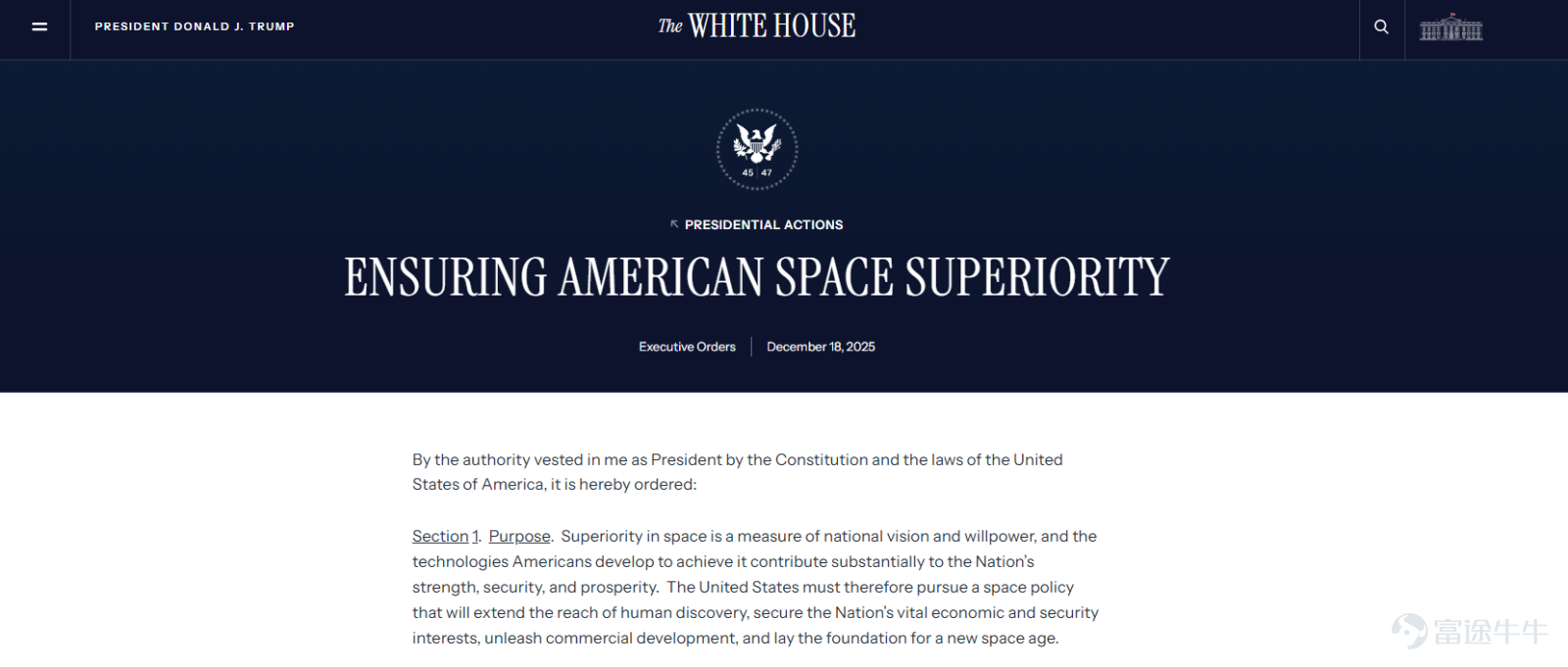
On Thursday Eastern Time, Trump signed an executive order outlining a vision for an "America First" space policy to ensure U.S. leadership in space exploration, security, and commerce.

The main objectives of this executive order include:
Return to the Moon:Directing the National Aeronautics and Space Administration (NASA) to return Americans to the Moon by 2028 through the Artemis program.
Lunar Base:Establishing preliminary infrastructure for a permanent lunar outpost by 2030.
Space Nuclear Power:Advancing the deployment of nuclear reactors on the lunar surface and in orbit, with plans to be launch-ready by 2030.
Commercialization and the International Space Station:By upgrading infrastructure and developing commercial pathways, the goal is to replace the International Space Station (ISS) by 2030, stimulating private sector investment.
Space Security:Developing next-generation missile defense technology (as part of the 'Golden Dome' program) and enhancing detection capabilities for threats in cislunar space.
Overall, this executive order represents a comprehensive plan addressing many aspects of space policy, including proposing ways the government can reform its acquisition of space assets and invest in technological fields,with expectations that the U.S. space market will attract at least $50 billion in additional investments by 2028.
Market observers view this plan as marking a further push by the U.S. in the space race, transitioning from a 'quantity-focused' phase (launching satellites) to a 'quality-focused' phase (building infrastructure). Additionally,This could also potentially benefit companies operating in the space, nuclear energy, and related supply chain sectors.What specific companies are worth watching?
1. Space Industry
Previously,The Era of Trump 2.0 is Approaching: Will it Ignite U.S. Space-Related Stocks?、Are Space-Based AI Data Centers on the Horizon? In the Era of Trump 2.0, Which Space-Related Stocks Are Likely to Benefit?It was previously noted thatIn the era of Trump 2.0, the space sector is poised to see significant opportunities.。Additionally, recent developments have sparked renewed market interest in the space sector.SpaceXRumors of upcoming IPOs have ignited market enthusiasm, drawing further attention to the space industry.

Specifically:
1. Launch service provider
American commercial small rocket company $Rocket Lab (RKLB.US)$ It is a commercial aerospace enterprise specializing in small to medium-sized rocket launch services and occupies an absolute leading position globally, second only to SpaceX.
The 'first stock of space tourism' $Virgin Galactic (SPCE.US)$ is the world's first publicly listed human space commercial flight company, offering suborbital flight services. The company has completed two test flights to the edge of space and has already received deposits totaling nearly $80 million from 603 individuals across 60 countries and regions who have reserved seats.
2. Space infrastructure and services
"the first stock of lunar infrastructure", American space exploration company $Intuitive Machines (LUNR.US)$: As an emerging player in the field of lunar exploration, this company plans to launch its IM-2 mission to the Moon by late 2024 or early 2025.The company also announced that it has signed additional contracts with NASA's Near Space Network (NSN) program, which will enable the company to fully leverage the maximum potential value of the $4.82 billion Near Space Network initiative.。
A cornerstone of space infrastructure, $Redwire (RDW.US)$ : Unlike the glamorous packaging of other space companies, Redwire positions itself as 'pragmatic' and can be regarded as the 'screws and bolts' of the space infrastructure layer. As a leading enterprise in space infrastructure, Redwire’s business scope covers multiple key areas, ranging from space manufacturing to advanced space robotics technology. Its core technologies are crucial for future space missions and the commercialization beyond Earth.
In addition, it also includes commercial space companies $Momentus (MNTS.US)$ , the leader in space infrastructure $Sidus Space (SIDU.US)$ 、aerospace and defense technology company. $Voyager Technologies (VOYG.US)$ ,Voyager is collaborating with NASA and has secured a $217.5 million R&D grant to design the 'Starlab' commercial space station, which is expected to replace the soon-to-be-retired International Space Station by 2030.
3. Satellite Communications
The first US low Earth orbit satellite stock $AST SpaceMobile (ASTS.US)$ Committed to building a global low-orbit satellite internet, utilizing existing 4G/5G communication frequency bands and standards to enable direct satellite connectivity for devices such as smartphones without modifications.
In addition, there are two major operators providing geostationary orbit (GEO) broadband services in North America — $EchoStar (SATS.US)$ and $Viasat (VSAT.US)$ 。Notably, Barron's reported that SpaceX may merge with EchoStar Communications to go public.
Satellite communications service provider $Iridium Communications (IRDM.US)$ , which delivers global voice and data services through a constellation of 66 satellites, with potential for steady growth by expanding its user base and securing government contracts.
American low-orbit satellite communications company $Globalstar (GSAT.US)$ One of the earliest companies to enter the low Earth orbit satellite communications sector and achieve commercial success, it has been in operation for two decades and remains a key industry player. However, its user base has seen limited growth, profitability is insufficient, and operational pressures are significant.
4. Earth Observation and Imaging
$Planet Labs PBC (PL.US)$ An Earth imaging company with over 13 years of history, it has an important and intriguing mission: to capture images of the Earth every day. The company operates the world's largest constellation of remote sensing satellites, providing change monitoring and geospatial insights to governments and commercial clients globally through high-frequency collection of surface imagery and advanced AI analysis techniques.
$BlackSky Technology (BKSY.US)$ A leading provider of real-time geospatial intelligence services, the company operates a small constellation of high-resolution remote sensing satellites and offers high-frequency imaging, analysis, and monitoring services for targeted areas or objects. Notably, this company has also entered into a strategic partnership with $Palantir (PLTR.US)$ Palantir, integrating its imagery and data into Palantir's platform.
$Spire Global (SPIR.US)$ A space data, analytics, and services provider, the company recently announced a collaboration with NVIDIA to develop AI-driven weather forecasting. It stated that it would be capable of delivering rapid updates to global forecasts and other functionalities unattainable by traditional numerical weather prediction models.
5. Technological Instruments
$Teledyne Technologies (TDY.US)$ Specializes in advanced aerospace systems and solutions, such as avionics, defense systems, and satellite technology, while also serving markets including factory automation, environmental tracking, and pharmaceutical research.
6. Space Batteries
$KULR Technology (KULR.US)$ A battery technology company primarily offering cutting-edge energy storage solutions for space, aerospace, and defense applications.The National Aeronautics and Space Administration (NASA) is also one of its clients.
7. Aerospace and defense companies
Among them,Lockheed Martin provides NASA with various technical support and projects, including the development of supersonic aircraft and participation in other space exploration initiatives.
In addition,Heavily invested closed-end funds in SpaceX $Destiny Tech100 (DXYZ.US)$are also noteworthy.
2. Nuclear Technology
The nuclear energy sector is receiving a dual catalyst. On one hand, this plan also promotes the deployment of nuclear reactors on the lunar surface and in orbit, with the goal of being launch-ready by 2030.
On the other hand, Trump Media and Technology Group (DJT) has agreed to merge with a nuclear fusion energy company endorsed by Alphabet in an all-stock transaction valued at over $6 billion. The strategic merger aims to construct a series of large-scale fusion power plants,to address the significant energy supply gap brought about by the rapid development of artificial intelligence (AI).

In detail,Uranium mining includes $Cameco (CCJ.US)$ 、$Uranium Energy (UEC.US)$ 、$Energy Fuels (UUUU.US)$ 、$Denison Mines (DNN.US)$ 、$NexGen Energy (NXE.US)$ ; nuclear fuel processing$Centrus Energy (LEU.US)$ 。
Midstream includes design, research and development, and construction, including:
$NuScale Power (SMR.US)$ is the first publicly listed SMR nuclear power vendor, with its core product being the SMR power module;
$Oklo Inc (OKLO.US)$ focuses on developing small modular reactors (SMRs), a company invested in by 'ChatGPT's father,' Altman;
$NANO Nuclear Energy (NNE.US)$ specializes in developing small modular reactors, covering four key areas of SMR-related content, including manufacturing, fuel, transportation, and other aspects, aiming to create a diversified vertically integrated industrial chain;
$BWX Technologies (BWXT.US)$ focuses on nuclear reactor component manufacturing and nuclear technology. The biggest difference between BWXT and SMR/OKLO is that BWXT serves as a large-scale equipment supplier and technical service provider, primarily offering nuclear reactor components, nuclear fuel, and defense-related nuclear technologies for both government and commercial sectors. Its clients include the U.S. government (such as providing nuclear reactors for naval submarines).
Among these, the most noteworthy is,BWX Technologies, a company that previously collaborated with NASA to jointly develop nuclear-powered rockets, is responsible for the design and manufacturing of nuclear reactors as well as the required nuclear fuel.
Summary
An executive order issued by Trump not only extends the 'America First' policy into the space domain but also marks the transition of the global space race from a mere 'launch competition' to a substantive phase of 'ecosystem infrastructure.'
It is worth noting that,The combination of 'space + nuclear energy + AI' is forming a powerful logical closed loop. Space exploration requires nuclear energy to provide sustained power, AI data centers need nuclear energy to address electricity bottlenecks, and advancements in space technology, in turn, enhance the computational boundaries of AI.
However, behind these opportunities lie significant challenges. Both space and nuclear energy belong to industries characterized byhigh technological barriers, high capital expenditures, and long return cycles,and are highly susceptible to policy changes and technological iterations. While investors position themselves for the 'Trump trade,'they should focus on companies’ ability to secure orders and their cash flow conditions,identifying targets with strong competitive moats amid market volatility.
Risk Disclaimer: The above content only represents the author's view. It does not represent any position or investment advice of Futu. Futu makes no representation or warranty.Read more


Comments (24)
to post a comment
362
542