
Targeting Power Shortages? NVIDIA's Closed-Door Summit May Be Held This Week.

Urgently Seeking the 'Power Solution'! NVIDIA May Hold a Closed-Door Summit Next Week, Comprehensive Industry Chain 'Gold Mining Map' Released
As artificial intelligence experiences explosive growth, 'electricity' is becoming a critical infrastructure bottleneck constraining its development. As the undisputed leader in the AI chip sector, NVIDIA has set its sights on this formidable challenge.
According to a report by The Information citing sources familiar with the matter, NVIDIA plans to hold a closed-door summit next week at its headquarters in Santa Clara, California. The core agenda of the meeting,will explore and address the issue of 'data center power shortages,' which could hinder the development of artificial intelligence.
Notably, NVIDIA CEO Jensen Huang recently stated in a podcast interview,the future of artificial intelligence will not be constrained by chips, but rather by electricity,In order to meet the enormous demand for computing power,tech giants may even need to 'build their own nuclear reactors' to power data centers in the future.
Upon the release of the news, market focus quickly shifted to potential beneficiaries. This summit, which centers on "energy bottlenecks," is expected to catalyze stock price performance for several key companies. Below is our detailed analysis and compilation of relevant targets.
Which companies are worth watching?
According to reports,The summit will bring together executives from startups specializing in the fields of power and electrical engineering.Notably, among the participants are companies that have received equity investments from NVIDIA.
This demonstrates that NVIDIA's strategy extends beyond mere technical discussions to delve into capital engagement, constructing an ecosystem of energy solutions capable of supporting its core business through investments. These startups offer a wide range of products, from software to physical power equipment technology, indicating that NVIDIA is seeking a multidimensional, integrated hardware-software solution to address power challenges.
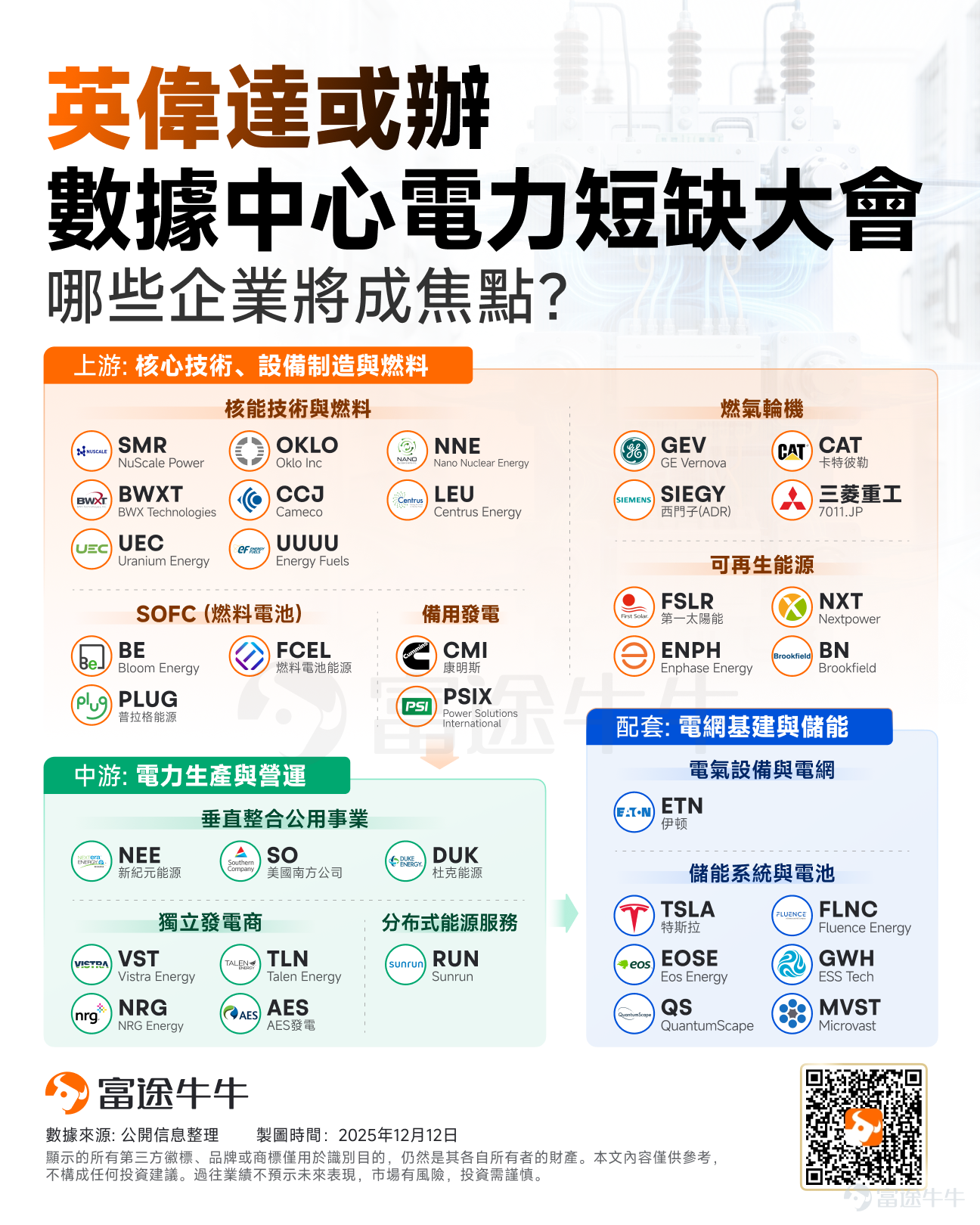
We have also compiled a list of companies involved in upstream and midstream power sectors as well as related infrastructure for fellow investors' reference:

1. Upstream: Core technologies, equipment manufacturing, and fuel
 Nuclear technology and fuel – providing nuclear reactor technology and uranium fuel supply
This is currently the most heated sector in the market. In particular, SMR (Small Modular Reactor) technology is regarded as a dedicated power source for future data centers. Specifically:
$NuScale Power (SMR.US)$ is the first publicly listed SMR nuclear power company, with its core product being the SMR power module;
$Oklo Inc (OKLO.US)$ focuses on developing small modular reactors (SMRs), a company invested in by 'ChatGPT's father,' Altman;
$NANO Nuclear Energy (NNE.US)$ specializes in developing small modular reactors, covering four key areas of SMR-related content, including manufacturing, fuel, transportation, and other aspects, aiming to create a diversified vertically integrated industrial chain;
$BWX Technologies (BWXT.US)$ focuses on nuclear reactor component manufacturing and nuclear technology. The biggest difference between BWXT and SMR/OKLO is that BWXT serves as a large-scale equipment supplier and technical service provider, primarily offering nuclear reactor components, nuclear fuel, and defense-related nuclear technologies for both government and commercial sectors. Its clients include the U.S. government (such as providing nuclear reactors for naval submarines).
Uranium mining includes $Cameco (CCJ.US)$ 、 $Uranium Energy (UEC.US)$ 、 $Energy Fuels (UUUU.US)$ 、 $Centrus Energy (LEU.US)$ among others.
Gas turbines — Natural gas remains an indispensable transitional and peak-shaving energy source before the full adoption of nuclear power.Amid the construction boom of data centers driven by advancements in artificial intelligence, American AI giants have not only signed substantial agreements for nuclear power procurement but have also hastily revived a technology largely abandoned by the mainstream power industry: gas turbines.
YesterdayThe Underrated AI Winner! GEV's Surge in Orders Doubles Stock Price — Here’s a List of Infrastructure ‘Golden Opportunities’ to Keep HandyA previous article also mentionedGas turbines are currently the most technically mature and mainstream choice.
Currently, the world’s three largest gas turbine suppliers $GE Vernova (GEV.US)$ 、 $SIEMENS AG (SIEGY.US)$ 、 $Mitsubishi Heavy Industries (7011.JP)$ account for nearly 90% of the global gas turbine market share. Additionally, Caterpillar is one of the world’s leading manufacturers of gas engines and industrial gas turbines. In early November, Caterpillar announced plans to more than double its gas turbine production capacity to meet surging demand for natural gas power plants.
SOFC (Fuel Cell) — The New Favorite in AI Power SupplyThe lag in traditional power grids has also opened up a vast market space for 'behind-the-meter' (BTM) power solutions. Among these,fuel cell technology, with its unique advantages, is expected to capture 25% to 50% of the BTM solutions market, equivalent to 8-20 GW of installed capacity.
Fuel cells, particularly solid oxide fuel cells (SOFC), offer structural advantages over traditional gas turbines in terms of delivery time, noise, emissions, and flexibility.
And the company that represents enterprises here is none other than —— $Bloom Energy (BE.US)$ ,By deploying fuel cells on-site at data centers, companies can secure a stable and reliable power supply without waiting for grid upgrades or the construction of new transmission lines. This model not only enables rapid deployment but also provides data center operators with greater energy autonomy and cost control.
$Plug Power (PLUG.US)$ It is a leading enterprise in the global hydrogen fuel cell industry, one of the largest fuel cell integrators worldwide, and one of the highest-valued fuel cell companies globally, known as the first American hydrogen energy stock.
Since its founding in 1997, the company initially focused on stationary fuel cells, later becoming a leader in the fuel cell forklift segment, and in recent years has expanded its industrial chain through external collaborations to include hydrogen supply networks, raw materials, and hydrogen-related sectors,gradually forming a complete full-industry-chain layout.
Additionally, $FuelCell Energy (FCEL.US)$ It is a long-established clean energy technology company,specializing in proprietary molten carbonate fuel cell technology,primarily providing fixed base-load power generation solutions to utility and large industrial customers. Unlike Plug Power, FCEL’s systems excel in efficient 'combined heat and power' using natural gas or biogas, with a unique advantage of integrating carbon capture directly into the power generation process. The company is now actively leveraging its high-temperature technology strengths to enter the hydrogen production and industrial decarbonization markets.
Renewable Energy – A Short-Term Solution to Ease the Power CrisisIn the short term, solar energy and energy storage are solutions to address the power crisis. According to data from the U.S. Energy Information Administration (EIA), the U.S. power grid added 48.6 gigawatts (GW) of new installed capacity, of which approximately 80% was contributed by solar and energy storage. Specifically, this includes 30 GW of utility-scale solar and 10.3 GW of energy storage.
Key areas of focus include: $First Solar (FSLR.US)$ 、 $NextDecade (NEXT.US)$ 、 $Enphase Energy (ENPH.US)$ , and Brookfield, among others. However, attention must also be paid to issues such as poor power supply stability within this industry.
Backup power solution providers$Cummins (CMI.US)$ As the century-old leader in global power systems and the market dominator in data center backup power, it has become the "last line of defense" for tech giants like Microsoft and Amazon against power outages with its highly reliable diesel and natural gas generator sets; meanwhile, the company is aggressively transforming through its Accelera brand, heavily investing in electrolysis-based hydrogen production and fuel cell technologies, aiming to capture both the traditional stable power supply market and the future green energy sector.
$Power Solutions International (PSIX.US)$ This firm specializes in niche engine solutions powered by "alternative fuels," with a core advantage in manufacturing high-specification, low-emission engines compatible with natural gas, propane, and biogas, specifically designed to meet stringent environmental standards; supported by its major shareholder, Weichai Power, it provides data centers and industrial customers pursuing decarbonization with a practical transitional solution that is cleaner than traditional diesel, more mature than hydrogen, and cost-effective.
II. Midstream: Power Generation and Operations
The reason why power generation and operations have become key areas of focus in the current market can be summarized in one sentence: "Scarcity drives value." In the era of AI proliferation, stable and clean electricity has become the scarcest "fuel for computing power."
Previously, this sector was considered a slow-growth "defensive asset" (collecting electricity fees and paying dividends), but now it exhibits growth logic akin to tech stocks. In other words, midstream power generators have transformed from "utilities selling electricity" into "growth companies providing critical infrastructure for AI." Specific companies to watch include:
Independent power producersVertically integrated utilitiesDistributed Energy Services3. Supporting Infrastructure: Grid and Energy Storage
This industry serves as the "regulator and transmitter" — ensuring stable power transmission and addressing the volatility issues associated with renewable energy.
Electrical Equipment and Power Grids$Eaton (ETN.US)$ Eaton is the "power lifeline" and "final safeguard" for AI data centers; in an era where AI chips are causing explosive growth in energy consumption and power density, it provides comprehensive electrical management solutions from grid connection to rack outlets (e.g., high-voltage distribution equipment and UPS uninterruptible power systems). In simple terms, no matter which tech giant wins the AI race, they will all rely on Eaton’s equipment to ensure their expensive GPU computing power is not disrupted by power outages or overloads, making it a highly reliable "pick-and-shovel" winner in AI physical infrastructure.
Energy Storage — Providing battery technology, energy storage system integration, and long-duration energy storage solutions$Tesla (TSLA.US)$ : Not only a leader in electric vehicles,Tesla’s Megapack has become the "industry standard" and "capacity champion" for solving the intermittency challenges of green energy in AI data centers;For tech giants requiring 24/7 stable operations, Tesla provides the fastest-delivered and most integrated large-scale energy storage batteries currently available in the market, serving as critical infrastructure that converts solar energy into stable nighttime computing power fuel for AI.
$Fluence Energy (FLNC.US)$ : A leading energy storage integrator jointly created by Siemens and AES,In the AI era, Fluence plays a role akin to the "intelligent brain of the power grid"; it not only sells battery hardware but excels in utilizing AI-driven software systems for precise power dispatch, providing complex energy management services to hyperscale data centers. It is the preferred partner for tech giants seeking integrated hardware and software solutions while building green data centers.
$QuantumScape (QS.US)$ : Although its main focus currently lies in electric vehicles, QuantumScape’s solid-state batteries, which boast extremely high energy density and are "non-flammable,"are considered a potential upgrade option for future AI infrastructure;for data centers, where fire risk is a major concern and space is at a premium, if their technology achieves mass production, it will provide safer backup power in a smaller form factor, completely eliminating the fire hazards associated with traditional lithium-ion batteries.
$Eos Energy (EOSE.US)$ :offering unique zinc-based battery technology, positioning itself in AI data centers as delivering "ultimate safety" and "lithium alternatives."; since zinc batteries are entirely non-flammable and do not require expensive air conditioning cooling systems, they have become an attractive non-lithium differentiated choice for giants like Microsoft seeking safer alternatives to lithium-ion batteries, especially for backup power needs in the 3-12 hour range.
$ESS Tech (GWH.US)$ :specializing in all-iron flow batteries (Iron Flow), it represents the final piece of the puzzle for AI data centers aiming to achieve "100% round-the-clock green power";while traditional lithium-ion batteries can economically support discharges of up to four hours, ESS's technology is designed for long-duration energy storage (LDES) exceeding 12 hours, specifically addressing the prolonged power gap during the night after sunset, ensuring that AI servers can utilize inexpensive renewable energy stored during the day even at night.
$Microvast (MVST.US)$ : although initially focused on commercial heavy-duty truck batteries, it positions itself in the AI energy sector as a provider of high-performance industrial-grade battery components; its battery technology is characterized by high-rate charge-discharge capabilities and ultra-long cycle life, making it particularly suitable for data center energy storage systems that need to handle sudden load fluctuations (e.g., AI training peaks), offering high-power-density cell solutions for specific high-end industrial energy storage demands.
Summary
In summary, current power supply technologies for data centers in the United States include SMRs (small modular reactors), large-scale nuclear power, gas turbines, SOFCs (solid oxide fuel cells), and renewable energy storage solutions such as wind and solar. However, each method has its own advantages and disadvantages, as summarized by Haitong Securities as follows:

Moreover, among all energy solutions, cryptocurrency mining companies, with their readily available power access permits, are evolving into the "fast track" in the field of AI infrastructure. Interested fellow investors can click to view more>>The Second Half of the AI Race — Electricity! Four Key Investment Themes in U.S. Stocks You Must Know
Overall, with the rapid development of the global artificial intelligence industry, competition for electricity demand is becoming increasingly intense. Perhaps whoever controls electricity will control the future of AI? In the second half of the AI data center evolution, electricity will be the main focus of development.
Risk Disclaimer: The above content only represents the author's view. It does not represent any position or investment advice of Futu. Futu makes no representation or warranty.Read more


Comments (11)
to post a comment
292
480