English
Back
Open Account
Amazon Releases Latest AI Chip to Compete with NVIDIA and Google!
牛牛課堂
joined discussion · Nov 25, 2025 17:20 ·

New Trends in AI Investment! Google Emerges as the Strongest Leader Among the Magnificent Seven; Which Companies Are the 'Hidden Champions'?

As the artificial intelligence trading frenzy reignites,capital markets are rapidly rallying around the “Google Chain.”
Recently, investors have reacted positively to Google’s latest large-scale AI model, Gemini 3, the upcoming seventh-generation Tensor Processing Unit (TPU), advancements in the AI image generation platform Nano Banana Pro, and the new intelligent agent platform named “Google Antigravity.”
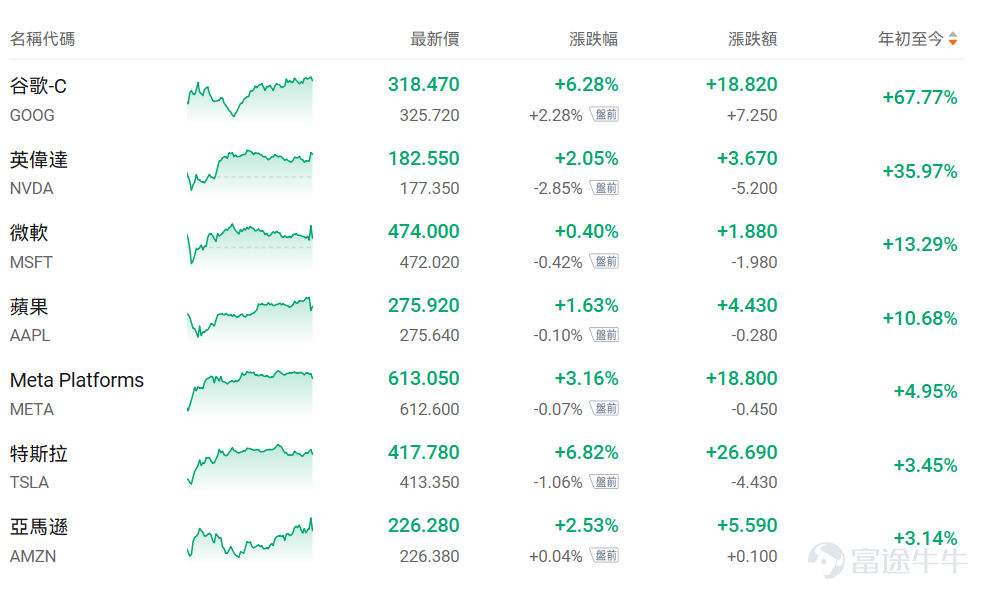
Overnight, $Alphabet-C (GOOG.US)$ The stock price surged to a new all-time high.becoming the best-performing company among the Magnificent Seven in the U.S. stock market,and is poised to become the fourth company to enter the four-trillion-dollar club.
As competition in artificial intelligence heats up once again,capital markets are rapidly consolidating around the 'Google Ecosystem.' Recently, investors have responded positively to Google's latest AI developments: the Gemini 3 large model, the upcoming seventh-generation Tensor Processing Unit (TPU), advancements in the AI image generation platform Nano Banana Pro, and a new intelligent agent platform called 'Google Antigravity.' Overnight, $Alphabet-C (GOOG.US)$ The stock price has surged to new all-time highs,making it the best-performing company among the Magnificent Seven in the U.S. stock market.and is expected to become the fourth company to enter the four-trillion-dollar club. Melius analyst Ben Reitzes pointed out that Google has achieved a "strong comeback in the artificial intelligence field" with its latest upgraded Gemini AI model and self-developed TPU,which has led some investors to "fear deeply that Alphabet may win the AI war ahead of schedule." This article will outline for fellow investorsGoogle's recent investment logic,, as well asWhich companies in the "Google ecosystem" are benefiting? What is the investment logic behind Google? In its Q3 earnings report, Google comprehensively showcased its“full-stack AI”competitive advantages across the board. Goldman Sachs analyst Eric Sheridan pointed out that from foundational model development, cloud computing infrastructure to consumer and enterprise applications, Google has already established a strong presence at every level of the AI industry chain...
Melius analyst Ben Reitzes pointed out that Google has achieved a 'powerful comeback in the artificial intelligence field,' with its latest upgraded Gemini AI model and self-developed TPU,causing some investors to 'fear that Alphabet may win the AI war ahead of schedule.'
This article will outline for fellow investorsGoogle's recent investment logic,, as well asWhich companies in the 'Google ecosystem' are benefiting?
What is the investment rationale behind Google?
Google comprehensively showcased its"Full-Stack AI"Competitive advantages stemming from strategic positioning. Goldman Sachs analyst Eric Sheridan pointed out that Google has established strongholds across all segments of the AI industry chain, from foundational model development and cloud computing infrastructure to consumer and enterprise applications. This vertical integration capability is translating into tangible financial returns.
Previously,"Targeting NVIDIA! Google Launches Most Powerful Chip—What Opportunities in the Supply Chain Should Investors Watch?",It was previously noted,By building a complete technological closed-loop ranging from chips (TPU), networking (OCS), models (Gemini), to applications (cloud computing/search/advertising), Google has constructed a formidable AI moat. The company’s sustained increase in capital expenditures will inject robust momentum into its entire ecosystem.
As competition in artificial intelligence heats up once again,capital markets are rapidly consolidating around the 'Google Ecosystem.' Recently, investors have responded positively to Google's latest AI developments: the Gemini 3 large model, the upcoming seventh-generation Tensor Processing Unit (TPU), advancements in the AI image generation platform Nano Banana Pro, and a new intelligent agent platform called 'Google Antigravity.' Overnight, $Alphabet-C (GOOG.US)$ The stock price has surged to new all-time highs,making it the best-performing company among the Magnificent Seven in the U.S. stock market.and is expected to become the fourth company to enter the four-trillion-dollar club. Melius analyst Ben Reitzes pointed out that Google has achieved a "strong comeback in the artificial intelligence field" with its latest upgraded Gemini AI model and self-developed TPU,which has led some investors to "fear deeply that Alphabet may win the AI war ahead of schedule." This article will outline for fellow investorsGoogle's recent investment logic,, as well asWhich companies in the "Google ecosystem" are benefiting? What is the investment logic behind Google? In its Q3 earnings report, Google comprehensively showcased its“full-stack AI”competitive advantages across the board. Goldman Sachs analyst Eric Sheridan pointed out that from foundational model development, cloud computing infrastructure to consumer and enterprise applications, Google has already established a strong presence at every level of the AI industry chain...
OpenAI CEO Sam Altman recently made a rare concession in an internal memo,acknowledging that "Google's latest AI advancements have temporarily created economic headwinds for the company,"stating bluntly that OpenAI is facing "the fiercest competition since its founding." Google’s competitive edge lies precisely in its full-chain capabilities encompassing TPU chips, the Gemini model, and cloud infrastructure.
Previously,Follow the Titans to Learn Investing | Debunking the AI Bubble Theory! Warren Buffett Makes a Large Investment in Google: What Are the Underlying Logics?It was also mentioned that Buffett's investment in Google may not be about its cutting-edge AI technology itself,but rather Google's strategic positioning as the 'water, electricity, and coal' of a new era.a form of infrastructure that becomes indispensable to businesses and society once adopted.This is Buffett: always cutting to the essence of business while others chase appearances.
More importantly, Amin Vahdat, head of Google's AI infrastructure, recently stated at an all-hands meeting that the company must double its AI computing power every six months and achieve an additional 1,000-fold increase over the next four to five years to meet the growing demand for AI services. Regarding employees' concerns about an AI investment bubble, he noted that the risk lies not in overinvestment but in underinvestment.
In addition,Meta Platforms is reportedly considering spending billions of dollars to purchase Google's TPUs,including for the construction of Meta's data centers.
Beyond technical competition,Google's significant financial strength is also a key reason why investors are turning to the 'Google supply chain'.
Compared to OpenAI’s substantial cash burn in its pursuit of artificial general intelligence—expected to exceed $100 billion in the coming years, necessitating frequent capital raises—Google has demonstrated robust financial resilience.Valued at $3.5 trillion, Google generated over $70 billion in free cash flow in just the past four quarters.
Which companies in the 'Google supply chain' are benefiting?
As Google continues to reach new highs, the 'Google supply chain' is undoubtedly becoming one of the hottest investment trends in the U.S. stock market recently...
The market widely anticipates that with upward revisions in TPU shipment forecasts, increasing OCS penetration rates, and the ramp-up of 1.6T optical modules, related hardware suppliers will encounter significant growth opportunities. Previously,Is Google fueling the 'AI bull market narrative'? The stunning release of Gemini 3 makes this industry chain checklist worth watching.a detailed analysis of the Google supply chain was provided:
Google’s TPU chips are primarily co-designed with $Broadcom (AVGO.US)$ Collaborative design; manufacturing by $Taiwan Semiconductor (TSM.US)$$Amkor Technology (AMKR.US)$ , utilizing CoWoS packaging technology; modules are mainly $Celestica (CLS.US)$ Secured an 80% market share, and $Jabil (JBL.US)$ ; rack assembly $Jabil (JBL.US)$ accounts for a 60% market share, $Flex Ltd (FLEX.US)$ accounts for 35%; the PCB supply chain is represented by $TTM Technologies (TTMI.US)$ Among others, the leading cable suppliers are $Amphenol (APH.US)$ ; optical modules encompass $Lumentum (LITE.US)$$Coherent (COHR.US)$ , in the field of optical fiber, it is $YOFC (06869.HK)$ , its single-mode G.652.D products are used for OCS backbone optical cables with a 60% market share; as for MPO, $TIME INTERCON (01729.HK)$ is the main supplier for Google; switches include $Broadcom (AVGO.US)$$Celestica (CLS.US)$
As competition in artificial intelligence heats up once again,capital markets are rapidly consolidating around the 'Google Ecosystem.' Recently, investors have responded positively to Google's latest AI developments: the Gemini 3 large model, the upcoming seventh-generation Tensor Processing Unit (TPU), advancements in the AI image generation platform Nano Banana Pro, and a new intelligent agent platform called 'Google Antigravity.' Overnight, $Alphabet-C (GOOG.US)$ The stock price has surged to new all-time highs,making it the best-performing company among the Magnificent Seven in the U.S. stock market.and is expected to become the fourth company to enter the four-trillion-dollar club. Melius analyst Ben Reitzes pointed out that Google has achieved a "strong comeback in the artificial intelligence field" with its latest upgraded Gemini AI model and self-developed TPU,which has led some investors to "fear deeply that Alphabet may win the AI war ahead of schedule." This article will outline for fellow investorsGoogle's recent investment logic,, as well asWhich companies in the "Google ecosystem" are benefiting? What is the investment logic behind Google? In its Q3 earnings report, Google comprehensively showcased its“full-stack AI”competitive advantages across the board. Goldman Sachs analyst Eric Sheridan pointed out that from foundational model development, cloud computing infrastructure to consumer and enterprise applications, Google has already established a strong presence at every level of the AI industry chain...
This article will focus on introducing Broadcom, a key chip partner of Google, and Lumentum, a network optics supplier, to fellow investors.
Broadcom
On Monday, as a key chip partner of Google, $Broadcom (AVGO.US)$ 's stock price also surged. By the close of trading, Broadcom's stock soared 11.1% in a single day, marking its best daily performance since April 9.
As competition in artificial intelligence heats up once again,capital markets are rapidly consolidating around the 'Google Ecosystem.' Recently, investors have responded positively to Google's latest AI developments: the Gemini 3 large model, the upcoming seventh-generation Tensor Processing Unit (TPU), advancements in the AI image generation platform Nano Banana Pro, and a new intelligent agent platform called 'Google Antigravity.' Overnight, $Alphabet-C (GOOG.US)$ The stock price has surged to new all-time highs,making it the best-performing company among the Magnificent Seven in the U.S. stock market.and is expected to become the fourth company to enter the four-trillion-dollar club. Melius analyst Ben Reitzes pointed out that Google has achieved a "strong comeback in the artificial intelligence field" with its latest upgraded Gemini AI model and self-developed TPU,which has led some investors to "fear deeply that Alphabet may win the AI war ahead of schedule." This article will outline for fellow investorsGoogle's recent investment logic,, as well asWhich companies in the "Google ecosystem" are benefiting? What is the investment logic behind Google? In its Q3 earnings report, Google comprehensively showcased its“full-stack AI”competitive advantages across the board. Goldman Sachs analyst Eric Sheridan pointed out that from foundational model development, cloud computing infrastructure to consumer and enterprise applications, Google has already established a strong presence at every level of the AI industry chain...
As one of the largest suppliers of ASICs for hyperscale data centers, Broadcom’s stock price has risen 60% year-to-date. CNBC pointed out that Broadcom is closely tied to Google through its ASIC business, assisting in the design and manufacturing of Google’s Tensor Processing Units (TPUs). These chips are at the core of Google’s internal AI infrastructure and are considered strong competitors to NVIDIA's Graphics Processing Units (GPUs) in AI workloads.
Wall Street analysts have recently been upgrading their ratings for Broadcom, viewing the company as being at a pivotal turning point.Dan Ives of Wedbush Securities stated that the market is 'rediscovering' the vast potential of the ASIC chip market. Google is primarily leading this trend, with its TPU being one of the most mature ASIC chips available.
Jefferies analyst Blayne Curtis noted that as the number of tokens processed by Google surges, ASIC production will become increasingly significant between 2026 and 2027, particularly against the backdrop of growing demand for computing power in multimodal models.He named Broadcom as his top pick and raised the target price to $480.
Melius Research analyst Ben Reitzes also highlighted that since 2016, Google and Broadcom have been collaborating on custom chips, now advancing to the seventh generation. This long-term partnership is translating into AI revenue growth for Broadcom and business expansion for Google Cloud.
Key beneficiaries of OCS optical switching technology: Lumentum, Coherent, Changfei Optical Fiber, among others.
Why is Google able to continuously release leading models?One of its core advantages lies in the OCS optical switching network architecture within hyperscale clusters.
According to LightCounting, a renowned market research firm, annual shipments of OCS are projected to exceed 50,000 units by 2029, with a compound annual growth rate (CAGR) of 15% from 2025 to 2030.Currently, Google is the largest proponent and user of OCS technology.However, in the future, as competition in AI intensifies, cloud giants such as Amazon AWS, Microsoft Azure, and Meta Platforms are expected to adopt this highly efficient architecture, collectively driving rapid growth in the OCS market.
Currently, Google's direct suppliers are mainly overseas manufacturers. $Lumentum (LITE.US)$ and $Coherent (COHR.US)$ These two companies have also seen robust trends in their stock prices recently.
As competition in artificial intelligence heats up once again,capital markets are rapidly consolidating around the 'Google Ecosystem.' Recently, investors have responded positively to Google's latest AI developments: the Gemini 3 large model, the upcoming seventh-generation Tensor Processing Unit (TPU), advancements in the AI image generation platform Nano Banana Pro, and a new intelligent agent platform called 'Google Antigravity.' Overnight, $Alphabet-C (GOOG.US)$ The stock price has surged to new all-time highs,making it the best-performing company among the Magnificent Seven in the U.S. stock market.and is expected to become the fourth company to enter the four-trillion-dollar club. Melius analyst Ben Reitzes pointed out that Google has achieved a "strong comeback in the artificial intelligence field" with its latest upgraded Gemini AI model and self-developed TPU,which has led some investors to "fear deeply that Alphabet may win the AI war ahead of schedule." This article will outline for fellow investorsGoogle's recent investment logic,, as well asWhich companies in the "Google ecosystem" are benefiting? What is the investment logic behind Google? In its Q3 earnings report, Google comprehensively showcased its“full-stack AI”competitive advantages across the board. Goldman Sachs analyst Eric Sheridan pointed out that from foundational model development, cloud computing infrastructure to consumer and enterprise applications, Google has already established a strong presence at every level of the AI industry chain...
At present, there are four main technological solutions for OCS: MEMS, Digital Liquid Crystal (DLC), Direct Beam Steering (DBS), and optical waveguide solutions. Among these, MEMS is currently considered the more mainstream solution, but a trend towards convergence with DLC and DBS solutions is also evident.Lumentum represents the leading vendor for MEMS, while Coherent is the representative vendor for DLC.
Among these, $Lumentum (LITE.US)$They are the primary supplier of high-speed optical transceivers for AI data centers,and also a key supplier of other optoelectronic components, industrial lasers, and 3D sensors. Notably, in 2010, Google became the first cloud vendor to deploy 10G SFP+ optical modules on a large scale,with Lumentum serving as Google’s first supplier of 10G short-reach modules at that time.
Lumentum maintains its market position through continuous technological innovation and product iteration, particularly in the high-end optical chip sector, such as high-speed EML and coherent optical communication chips. Lumentum continues to hold a clear technological advantage and strong market influence.
Notably, the company's latest earnings report showed both revenue and profits exceeded expectations, with Q2 revenue guidance raised to the upper limit of market consensus. During the earnings call, the company explicitly stated that the supply-demand gap for EML optical chips has widened from 20% in the previous quarter to 25-30%, and the company has initiated a "targeted pricing mechanism."
Investment bank Needham recently raised its target price for Lumentum to $290, stating that the company is steadily becoming a "key supplier" in the AI optics race.
And $Coherent (COHR.US)$It is a global leader in laser technology and optoelectronic solutions.In response to robust demand from AI data center businesses, Coherent is actively expanding its indium phosphide laser production capacity. The CEO stated that the company will double its indium phosphide capacity within the next 12 months, simultaneously increasing output at its two production bases in Sherman, Texas, and Jarfalla, Sweden.
The company is constructing the world's first 6-inch indium phosphide production line, a technological breakthrough expected to significantly enhance production efficiency and reduce costs. The CEO revealed that the initial yield of the 6-inch production line exceeds that of the existing 3-inch line.
This quarter, the company recorded record-breaking orders in the data center business, with longer order timelines providing better visibility for future planning. Strong orders span 800G and 1.6T transceiver products as well as applications in data center interconnects and traditional telecommunications. Given that customer demand forecasts extend to 2028, the company plans to further expand capacity 12 months from now.
In addition,Hong Kong stocks’ $YOFC (06869.HK)$Equally noteworthy, this company serves as the 'cornerstone' of its fiber optic supply,with a global market share as high as 60%, far surpassing its competitors. Its G.654.E ultra-low loss fiber optic products can meet the demands of Google's global network and data centers for high-speed, large-capacity transmission; moreover, it is one of the few companies worldwide capable of supplying hollow-core fiber to Google on a large scale, supporting the application of hollow-core fiber in Google-related scenarios.
Changfei’s strategic positioning holds even greater imaginative potential: As one of the two global oligopolies in hollow-core fiber, its products completely颠覆 traditional designs by using air as the fiber core, achieving a 47% increase in transmission speed and a 30% reduction in latency. It is reported that this technology has already received test orders from Google. The company's cumulative rise this year has exceeded twofold.
As competition in artificial intelligence heats up once again,capital markets are rapidly consolidating around the 'Google Ecosystem.' Recently, investors have responded positively to Google's latest AI developments: the Gemini 3 large model, the upcoming seventh-generation Tensor Processing Unit (TPU), advancements in the AI image generation platform Nano Banana Pro, and a new intelligent agent platform called 'Google Antigravity.' Overnight, $Alphabet-C (GOOG.US)$ The stock price has surged to new all-time highs,making it the best-performing company among the Magnificent Seven in the U.S. stock market.and is expected to become the fourth company to enter the four-trillion-dollar club. Melius analyst Ben Reitzes pointed out that Google has achieved a "strong comeback in the artificial intelligence field" with its latest upgraded Gemini AI model and self-developed TPU,which has led some investors to "fear deeply that Alphabet may win the AI war ahead of schedule." This article will outline for fellow investorsGoogle's recent investment logic,, as well asWhich companies in the "Google ecosystem" are benefiting? What is the investment logic behind Google? In its Q3 earnings report, Google comprehensively showcased its“full-stack AI”competitive advantages across the board. Goldman Sachs analyst Eric Sheridan pointed out that from foundational model development, cloud computing infrastructure to consumer and enterprise applications, Google has already established a strong presence at every level of the AI industry chain...
Additionally, China Merchants Securities previously released a research report stating that demand for AI computing power is robust, $TIME INTERCON (01729.HK)$positioning itself excellently in the MPO optical communication and AI server sectors to embrace high-quality growth.The brokerage noted that the MPO business is the company’s core profit source, with industry-leading technology. Currently, its 16-core MPO products have achieved volume shipments, securing a position in the overseas cloud supply chain,making the company a key supplier within the Google ecosystem.Demand for the company’s MPO products remains strong (fiber revenue grew significantly by 43% YoY in 2024H1 and 35% YoY in 2025H1), with profitability far exceeding the company’s average levels. Under the trends of expanding major clients, overseas capacity construction, and technological iteration, the brokerage predicts sustained high growth for the MPO business in the coming years.
As competition in artificial intelligence heats up once again,capital markets are rapidly consolidating around the 'Google Ecosystem.' Recently, investors have responded positively to Google's latest AI developments: the Gemini 3 large model, the upcoming seventh-generation Tensor Processing Unit (TPU), advancements in the AI image generation platform Nano Banana Pro, and a new intelligent agent platform called 'Google Antigravity.' Overnight, $Alphabet-C (GOOG.US)$ The stock price has surged to new all-time highs,making it the best-performing company among the Magnificent Seven in the U.S. stock market.and is expected to become the fourth company to enter the four-trillion-dollar club. Melius analyst Ben Reitzes pointed out that Google has achieved a "strong comeback in the artificial intelligence field" with its latest upgraded Gemini AI model and self-developed TPU,which has led some investors to "fear deeply that Alphabet may win the AI war ahead of schedule." This article will outline for fellow investorsGoogle's recent investment logic,, as well asWhich companies in the "Google ecosystem" are benefiting? What is the investment logic behind Google? In its Q3 earnings report, Google comprehensively showcased its“full-stack AI”competitive advantages across the board. Goldman Sachs analyst Eric Sheridan pointed out that from foundational model development, cloud computing infrastructure to consumer and enterprise applications, Google has already established a strong presence at every level of the AI industry chain...
Beyond the TPU supply chain,the number of downstream software application companies benefiting from Google’s Gemini model is undoubtedly much higher.
Melius analyst Ben Reitzes pointed out that Google's newly released Gemini 3 outperforms OpenAI's ChatGPT 5.1 and Anthropic's Claude Sonnet 4.5 in tasks such as academic reasoning, prompting him to reassess his previous sell rating. $Adobe (ADBE.US)$ Google had previously formed a strategic partnership with Adobe to advance the development of creative artificial intelligence.
Meanwhile, cloud computing and CRM giant $Salesforce (CRM.US)$ , has deep collaborations with Google in cloud and AI technologies; leading global cybersecurity company $Palo Alto Networks (PANW.US)$ , is a global security partner of Google Cloud; developer data platform $MongoDB (MDB.US)$ , is an important ISV partner of Google Cloud; $Accenture (ACN.US)$ , along with large consulting firms like Deloitte, have long-term collaborations with Google Cloud, helping enterprise clients implement and apply Google's AI solutions…
Summary
With its full ecosystem advantage encompassing TPUs, large models, applications, and data, Google is poised to be the first to achieve an AI ecosystem loop, leading the AI industry into a 'investment-growth-reinvestment' virtuous cycle and potentially triggering a鲶鱼 effect among global large model vendors.
Goldman Sachs trader Mike Wilson believes that the market must recognize the significant progress Google has made with Gemini, as the market’s previous pricing of this advancement was clearly incorrect.Given Google's demonstrated strengths in AI models, infrastructure chips (such as TPUs developed in collaboration with Broadcom), and its financial self-sufficiency capabilities, investors are increasingly viewing the 'Google ecosystem' as offering a more compelling risk-adjusted return at this stage.
Risk Disclaimer: The above content only represents the author's view. It does not represent any position or investment advice of Futu. Futu makes no representation or warranty.Read more
Thumbs Up
94
Heart
14
Emm
4
Respect
2
5.8M Views
Report
Comments (3)
Write a Comment...
3
114
425