
English
Back
Open Account
The Big Short Strikes Again: Shorting Tesla! Do You Agree?
牛牛課堂
joined discussion · Nov 12, 2025 20:26 ·

Targeting NVIDIA! Google launches its most powerful chip; what opportunities in the industry chain are worth watching?

On November 6, Google Cloud announced in its official blog that the company officially released its seventh-generation TPU (Tensor Processing Unit) — “Ironwood,” which will be officially launched in the coming weeks.
The company stated that,this chip is "custom-built for the most demanding workloads,"with performance in training and inference quadrupling compared to the sixth-generation Trillium TPU.
$Alphabet-C (GOOG.US)$ It was noted that the new generation Ironwood TPU can connect up to 9,216 chips in a single cluster, eliminating "data bottlenecks in the most complex models" and enabling customers "to run and scale some of the largest and most data-intensive models in the world today."
In fact, NVIDIA's main competitor in the market currently is ASIC chips, with Google's TPU being the fastest-growing, recently securing a multi-billion-dollar contract with Anthropic.
What are the advantages of Google's TPU?
At present, Google is engaged in a high-stakes AI infrastructure arms race against competitors such as Microsoft, Amazon, and Meta. Although the majority of large language models and AI computations still rely on NVIDIA's graphics processing units (GPUs),Google's TPUs may hold advantages in cost, performance, and energy efficiency.
The seventh-generation TPU, the "Ironwood" chip, has become Google’s most powerful and energy-efficient custom-designed chip to date.TPU v7 (Ironwood) is designed to capitalize on the shift from model training to inference. As such, its onboard specifications are tailored to ensure outstanding performance during the "inference era." Below are some key features:
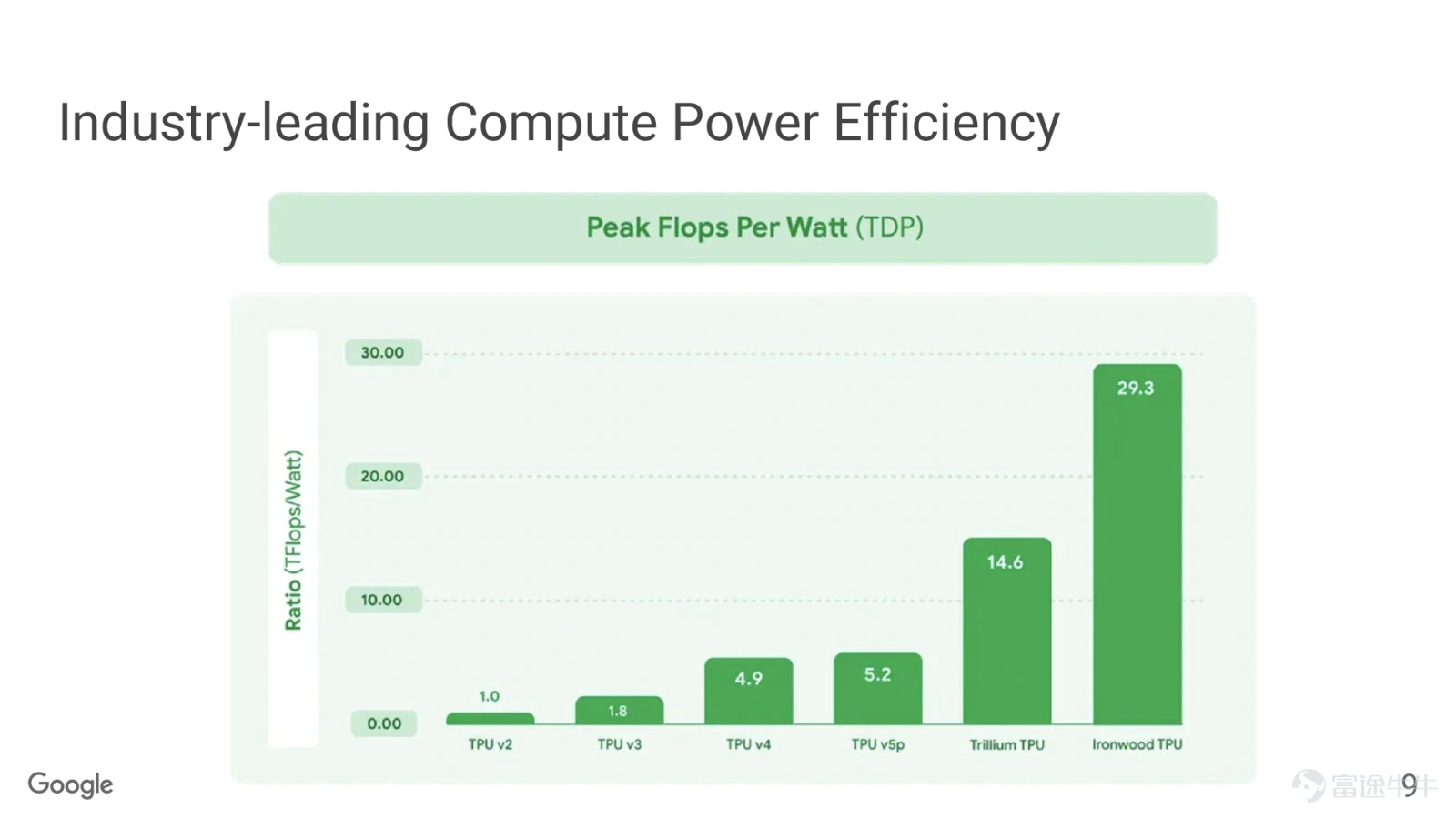
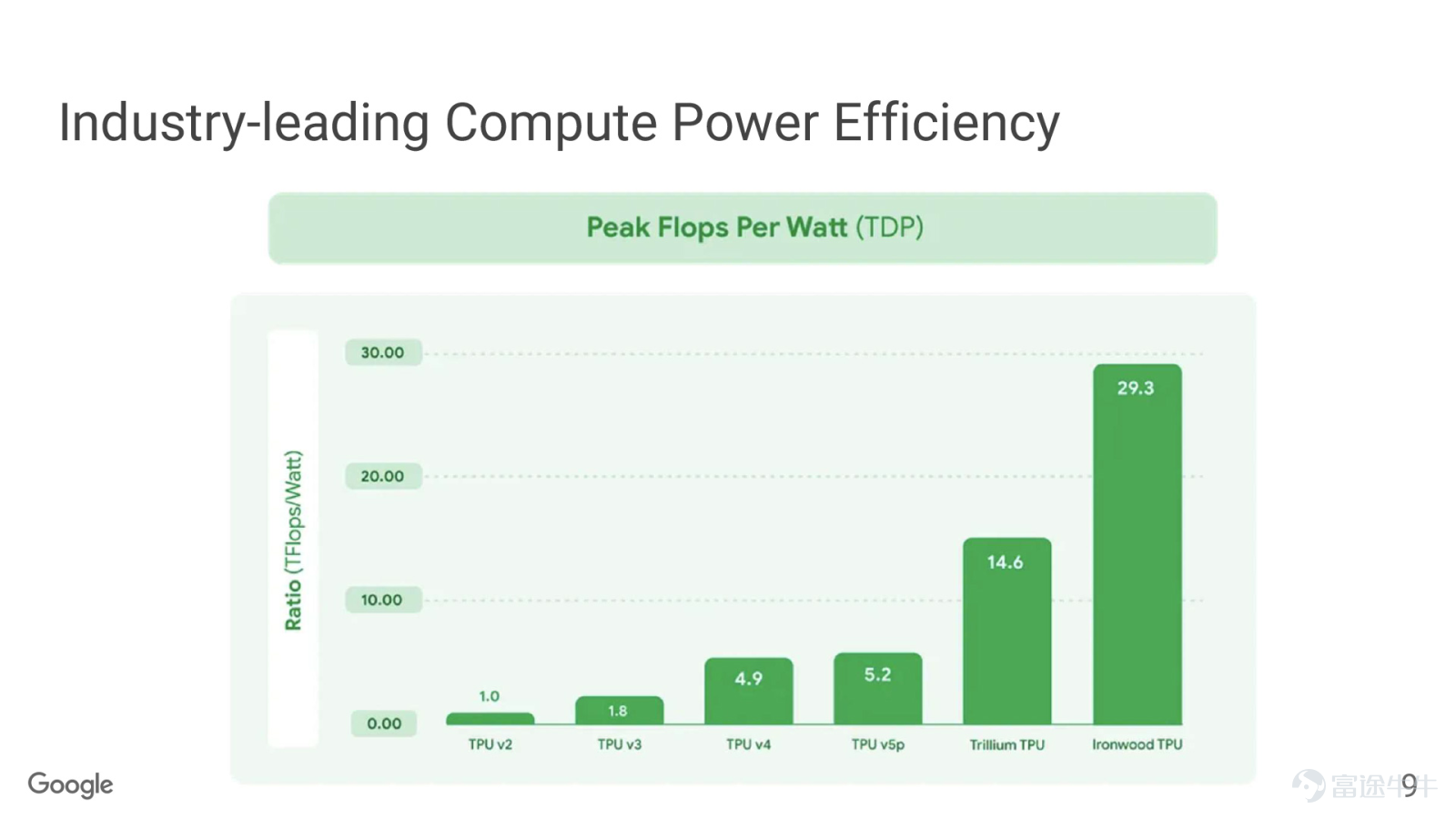
– Compared to TPU v5p, the peak performance has increased by 10 times.
– Compared to TPU v6e (Trillium), each chip has improved performance by 4 times in training and inference workloads.
– This is the most powerful and energy-efficient custom chip that Google has built to date.
It is worth noting that TPU serves as the core advantage of ASIC.It is not only about performance, but also about its outstanding "power efficiency ratio."Today, energy efficiency has become a core indicator for data centers and is widely regarded as their main development bottleneck.
The energy efficiency of TPUs typically reaches 2 to 3 times that of GPUs of the same generation. The latest v7 generation Ironstone has achieved a significant leap, with its energy efficiency reportedly reaching 2 times that of the v6 generation, and nearly 30 times that of the original v1.As energy issues increasingly become a core bottleneck for data centers today, this advantage has become highly disruptive.
On November 6, Google Cloud announced in its official blog that the company has officially released the seventh-generation TPU (Tensor Processing Unit) — 'Ironwood,' which will be officially launched in the coming weeks. The company stated thatthis chip is "custom-built for the most demanding workloads,"with performance in training and inference improved fourfold compared to the sixth-generation Trillium TPU. $Alphabet-C (GOOG.US)$ Google stated that the new Ironwood TPU can connect up to 9,216 chips in a single cluster, thereby eliminating "data bottlenecks in the most complex models," allowing customers "to run and scale some of the largest and most data-intensive models in the world today." In fact, NVIDIA's biggest competitor at present is the ASIC chip, with Google's TPU, which is currently developing at the fastest pace, recently securing a multi-billion-dollar contract from Anthropic. What are the advantages of Google’s TPU? At present, Google is engaged in a high-stakes AI infrastructure arms race with competitors such as Microsoft, Amazon, and Meta. Although most large language models and AI computations still rely on NVIDIA's graphics processing units (GPUs),Google's TPUs may have advantages in terms of cost, performance, and energy efficiency. The seventh-generation TPU, the "Ironwood" chip, has become Google's most powerful and energy-efficient custom chip.TPU v7 (Ironwood) is designed to capture the...
TPUs demonstrate a crushing advantage in cost-effectiveness for inference, with a cost-performance ratio that can reach 4 to 10 times that of GPUs. Even more astonishing is that the new generation v5e has achieved another leap in unit cost performance, with throughput per dollar reaching 2.5 times that of v4.
It is worth noting that although most large language models and AI workloads still rely on NVIDIA's GPUs,However, Google's TPU belongs to the category of custom chips and may have an advantage in terms of cost-effectiveness for completing specific tasks.In terms of performance, Ironwood has made significant progress compared to previous generations and is now closer to the latest chips from NVIDIA and AMD.
Some analysts have pointed out thatthe value of Google's TPU business may be significantly undervalued.Gil Luria of the research firm D.A. Davidson stated a few months ago that Google's TPU has narrowed the gap with NVIDIA's chips, becoming the latter's "best alternative." He believes thatif Google's TPU business were combined with its DeepMind AI research lab, its value could reach up to $900 billion.
Ben Reitzes, an analyst at Melius Research, expressed a similarly positive view on Google's TPU in a report at the end of last month, referring to it as "currently the most mature application-specific integrated circuit (ASIC)." ASICs are custom chips designed for handling specific AI tasks.
Reitzes noted that Google "is able to rapidly innovate Gemini using its TPUs." He highlighted that early decisions to develop this product are now beginning to reach an inflection point,contributing to Broadcom’s AI revenue and Google Cloud growth.
Which companies in the industry chain are worth paying attention to?
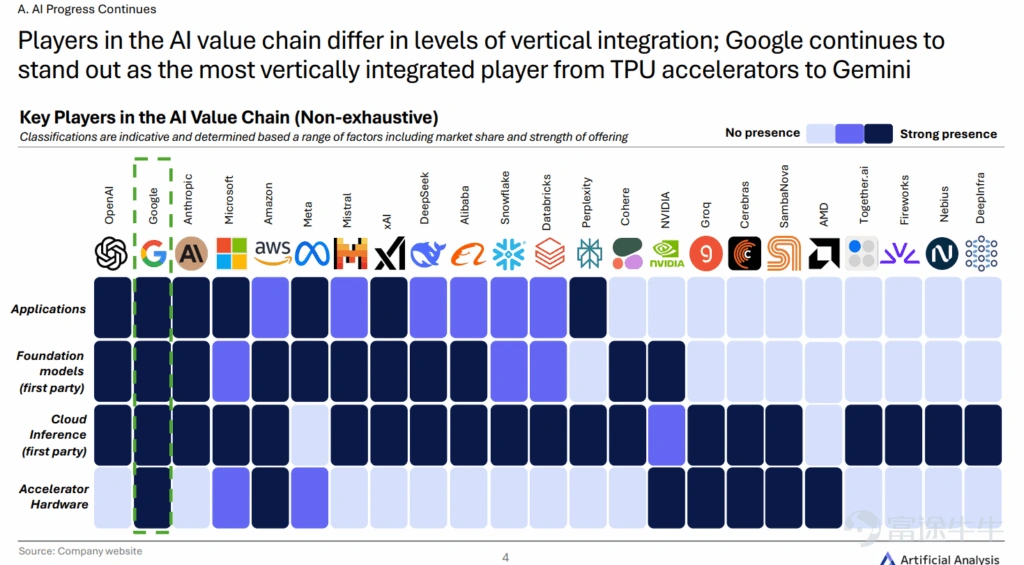
It has been observed that among all companies involved in the AI value chain, Google is the one quietly amassing wealth —Google is the only company that operates as a full-stack artificial intelligence provider: data → algorithms → hardware → cloud servers.
On November 6, Google Cloud announced in its official blog that the company has officially released the seventh-generation TPU (Tensor Processing Unit) — 'Ironwood,' which will be officially launched in the coming weeks. The company stated thatthis chip is "custom-built for the most demanding workloads,"with performance in training and inference improved fourfold compared to the sixth-generation Trillium TPU. $Alphabet-C (GOOG.US)$ Google stated that the new Ironwood TPU can connect up to 9,216 chips in a single cluster, thereby eliminating "data bottlenecks in the most complex models," allowing customers "to run and scale some of the largest and most data-intensive models in the world today." In fact, NVIDIA's biggest competitor at present is the ASIC chip, with Google's TPU, which is currently developing at the fastest pace, recently securing a multi-billion-dollar contract from Anthropic. What are the advantages of Google’s TPU? At present, Google is engaged in a high-stakes AI infrastructure arms race with competitors such as Microsoft, Amazon, and Meta. Although most large language models and AI computations still rely on NVIDIA's graphics processing units (GPUs),Google's TPUs may have advantages in terms of cost, performance, and energy efficiency. The seventh-generation TPU, the "Ironwood" chip, has become Google's most powerful and energy-efficient custom chip.TPU v7 (Ironwood) is designed to capture the...
Market analysis indicates that,Google's TPU is considered the biggest dark horse with the 'greatest expectation gap' in North America’s computing power market.Data shows that over 60% of funded generative AI startups utilize Google Cloud TPU services. Moreover, Google TPU boasts an impressive client portfolio, including prominent names such as Anthropic, Midjourney, and Hugging Face, while tech giant Apple has been a significant customer for TPU+GPU computing power since the TPUv3 era.
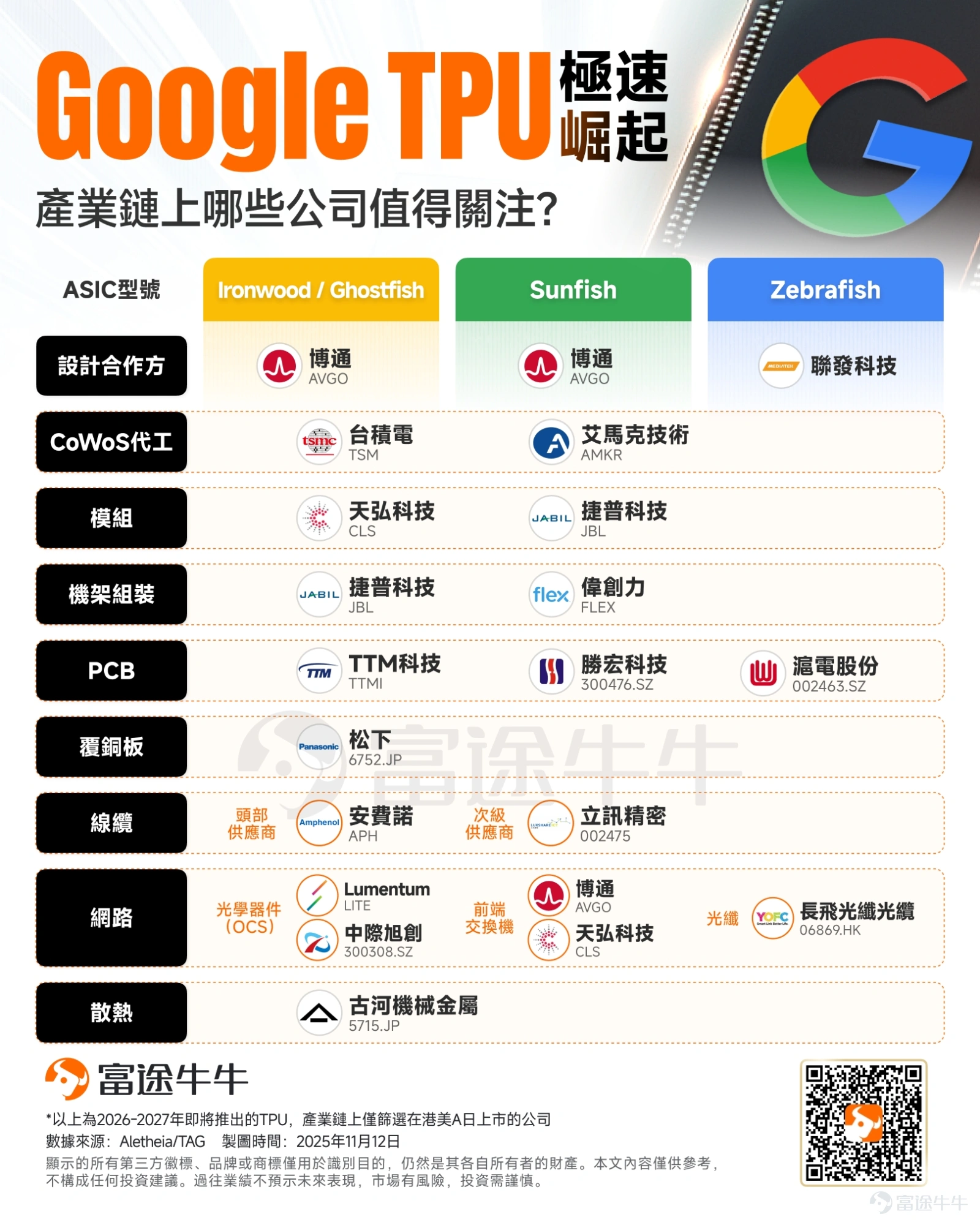
Overall, with Google’s TPU industry facing a historic opportunity, our analysis has also identified relevant investment targets for investor reference:
On November 6, Google Cloud announced in its official blog that the company has officially released the seventh-generation TPU (Tensor Processing Unit) — 'Ironwood,' which will be officially launched in the coming weeks. The company stated thatthis chip is "custom-built for the most demanding workloads,"with performance in training and inference improved fourfold compared to the sixth-generation Trillium TPU. $Alphabet-C (GOOG.US)$ Google stated that the new Ironwood TPU can connect up to 9,216 chips in a single cluster, thereby eliminating "data bottlenecks in the most complex models," allowing customers "to run and scale some of the largest and most data-intensive models in the world today." In fact, NVIDIA's biggest competitor at present is the ASIC chip, with Google's TPU, which is currently developing at the fastest pace, recently securing a multi-billion-dollar contract from Anthropic. What are the advantages of Google’s TPU? At present, Google is engaged in a high-stakes AI infrastructure arms race with competitors such as Microsoft, Amazon, and Meta. Although most large language models and AI computations still rely on NVIDIA's graphics processing units (GPUs),Google's TPUs may have advantages in terms of cost, performance, and energy efficiency. The seventh-generation TPU, the "Ironwood" chip, has become Google's most powerful and energy-efficient custom chip.TPU v7 (Ironwood) is designed to capture the...
Google’s TPU chips are primarily co-designed with $Broadcom (AVGO.US)$ ; manufacturing is completed by $Taiwan Semiconductor (TSM.US)$$Amkor Technology (AMKR.US)$ , utilizing CoWoS packaging technology; modules are mainly $Celestica (CLS.US)$ Secured an 80% market share, and $Jabil (JBL.US)$ ; rack assembly $Jabil (JBL.US)$ accounts for a 60% market share, $Flex Ltd (FLEX.US)$ accounts for 35%; the PCB supply chain is represented by $TTM Technologies (TTMI.US)$$Victory Giant Technology (300476.SZ)$ and $Wus Printed Circuit (002463.SZ)$ ; leading cable suppliers include $Amphenol (APH.US)$ , with secondary suppliers being $Luxshare Precision Industry (002475.SZ)$ ; optical modules encompass $Lumentum (LITE.US)$$Zhongji Innolight (300308.SZ)$In terms of fiber optics,$YOFC (06869.HK)$Its single-mode G.652.D products are used for OCS backbone optical cables, with a market share of 60%; the switches include$Broadcom (AVGO.US)$$Celestica (CLS.US)$The main purpose of heat dissipation is$Furukawa (5715.JP)$
Overall, Google's deep technological foundation is continuously being transformed into a competitive advantage. Thanks to years of unwavering investment, it not only remains firmly in the top tier in the large model domain but also converts its vast user base accumulated during the internet era into a powerful driving force for demand and iteration of large models. Meanwhile, its long-term strategic focus on TPU chips has seen rapid scaling over the past two years, ultimately forming a complete business loop encompassing technology, users, and chips. The growth flywheel has been set in motion, and the resulting opportunities across the industrial chain should not be overlooked.
Risk Disclaimer: The above content only represents the author's view. It does not represent any position or investment advice of Futu. Futu makes no representation or warranty.Read more
Thumbs Up
85
Lol
2
Heart
7
Respect
1
1.6M Views
Report
Comments (6)
Write a Comment...
6
95
123