
Volatility in Nvidia post-earnings: an opportunity?
On August 22, $NVIDIA (NVDA.US)$ at the Hot Chips conference, NVIDIA Spectrum-XGS Ethernet technology, aims to integrate multiple data centers into a "gigawatt-class AI superfactory" through cross-regional interconnectivity, overcoming the computational and energy limitations of a single data center.
Jensen Huang stated, "The AI industrial revolution has arrived, and massive AI factories are the core infrastructure of this transformation. Following the advancements in scale-up and scale-out technologies, we are now providing NVIDIA Spectrum-XGS Ethernet."The scale-across technology integrates data centers from different cities, countries, and even continents into a massive AI super factory with a capacity of billions of watts.
At this point, many investors may be curiousWhat is scale-across? Which companies are likely to benefit?The following will provide a detailed interpretation.
What is scale-across?
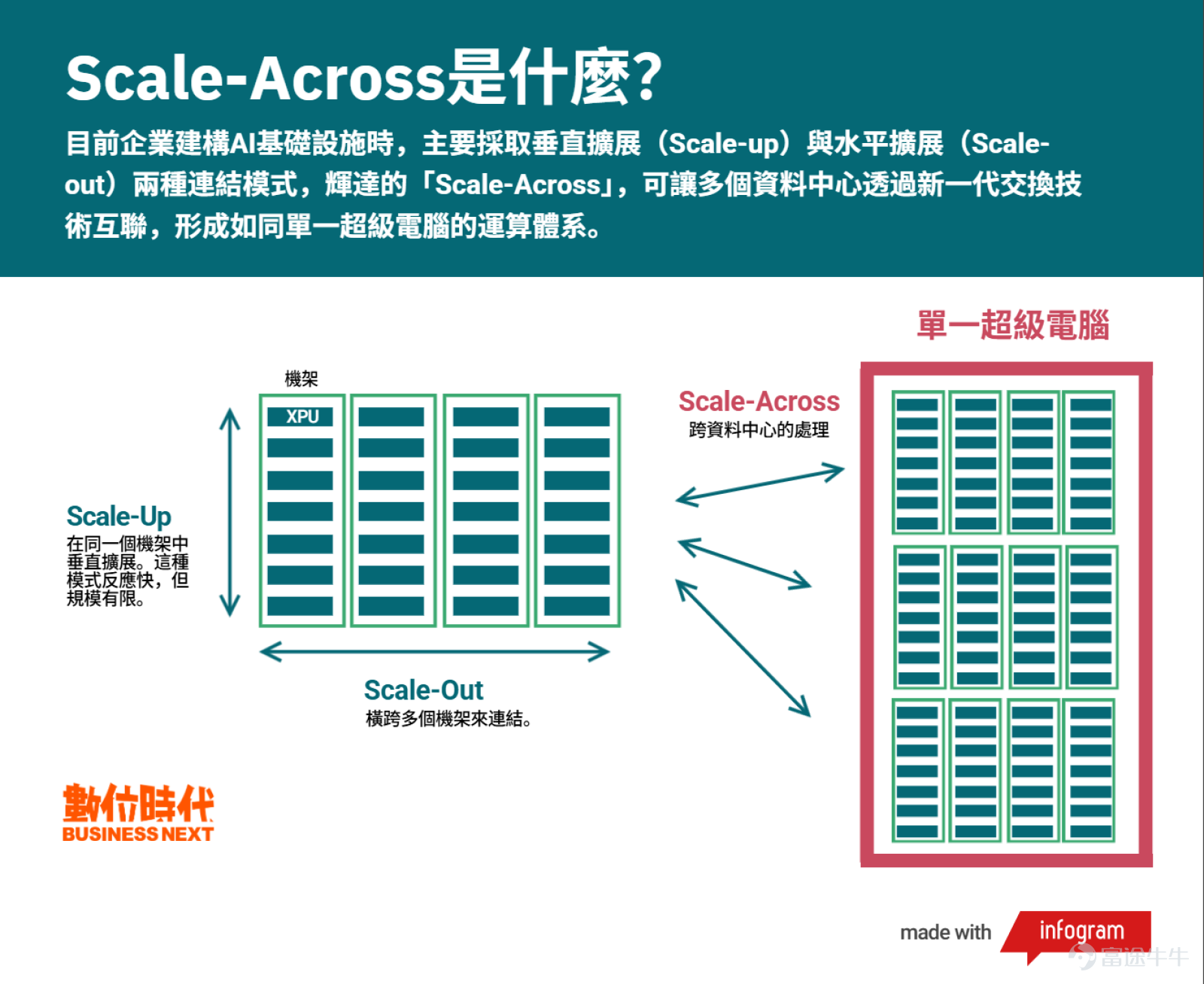
In the past, the expansion of AI clusters primarily followed two paths: vertical scaling (Scale-up), which involves deploying more GPUs within a single rack; and horizontal scaling (Scale-out), which aims to interconnect more racks within a single data center. However, constrained by physical conditions such as power, heat dissipation, and land, relying solely on Scale-up and Scale-out can no longer achieve unlimited expansion of cluster size.
Spectrum-XGS Ethernet has broken through these limitations by introducing 'cross-regional expansion (Scale-across)' infrastructure.Scale-across has become the 'third pillar' of AI computing following Scale-up and Scale-out,capable of extending the high performance and large-scale expansion capabilities of Spectrum-X Ethernet across multiple distributed data centers, thereby constructing a giant AI super factory with a total power capacity reaching one billion watts.

Source: Digital Age
NVIDIA introduced that Spectrum-XGS Ethernet incorporates a cross-domain expansion architecture, featuring adaptive network algorithms capable of dynamic adjustments based on the distance between data centers:
1. Adaptive Distance Congestion Control: Dynamically optimizes network transmission between data centers;
2. Precise Latency Management: Nearly doubles the performance of the NCCL communication library;
3. End-to-End Telemetry System: Ensures predictable performance for geographically dispersed clusters.
Which companies are expected to benefit?
The release of Spectrum-XGS marks a critical milestone in the evolution of AI computing networks toward scalability and widespread deployment. In the context of the ongoing explosion of artificial intelligence applications, high-speed interconnect technology and supporting thermal management supply chains are expected to usher in a new round of growth momentum.
Super AI computing centers are becoming an important direction for future development. With the continuous growth in demand for high-speed data exchange, technologies such as fiber optics, high-performance switches, and liquid cooling are anticipated to experience explosive demand in the coming years, forming the core pillars of next-generation computing infrastructure.
Niu Niu has outlined stocks benefiting from relevant industries in the Hong Kong and U.S. stock markets for investors' reference:

Specifically:
– Upgrading of optical communication technology
The Hong Kong and U.S. stock markets include $Coherent (COHR.US)$ 、 $Lumentum (LITE.US)$ 、 $Applied Optoelectronics (AAOI.US)$ 、 $Fabrinet (FN.US)$ 、 $Ciena (CIEN.US)$ 、 $Credo Technology (CRDO.US)$ 、 $Astera Labs (ALAB.US)$ 、 $Corning (GLW.US)$ 、 $Lumen Technologies (LUMN.US)$$YOFC (06869.HK)$Wait for the company.
Among these, The optical fiber industry is the most noteworthy. Hollow-core optical fibers are regarded as the subfield with the greatest long-term development flexibility, high technical barriers, and profit margins within the Scale-Across trend.Compared to traditional single-mode optical fibers, hollow-core optical fibers can significantly reduce latency by 30% and decrease signal attenuation by over 50%, demonstrating remarkable performance advantages.
CITIC Telecom stated that currently, companies like Microsoft and Google are accelerating the promotion of hollow-core optical fibers, with annual procurement volumes expected to increase from tens of thousands of core kilometers to millions of core kilometers in the future.Hollow-core optical fibers have extremely high barriers to entry. $YOFC (06869.HK)$It is a core leader in the domestic market. Benefiting from NVIDIA's Spectrum-XGS news, the company surged nearly 27% today, and has risen over 293% this year.

In addition, as a global inventor and technology leader in optical fibers, $Corning (GLW.US)$ is also worth noting, with an accumulated increase of nearly 40% this year,having significant advantages in the high-end optical communication product sector.Compared to Yangtze Optical Fibre and Cable, Corning has advantages in brand influence, fundamental materials science, and global market share, particularly dominating the high-end market in North America.
However, the technical indicators of Yangtze Optical Fibre in emerging fields such as hollow-core optical fibres have partially surpassed those of Corning, and it holds advantages in production costs and the layout of emerging markets.

Optical fibre company $Lumen Technologies (LUMN.US)$Last year, its stock price increased by over 190%, but this year's performance has not met expectations, recording a 13% decline within the year.

In late July last year, Lumen announced a partnership with Microsoft, with Microsoft stating that Lumen's Private Connectivity Fabric is a custom network that includes dedicated access to existing fibres within the Lumen network, the installation of new fibres on existing and new routes, and the use of Lumen's new digital services.
As data demand increases, this AI-supporting infrastructure will enhance the connectivity between Microsoft data centers by providing the network capacity, performance, stability, and speed that customers require.
Silicon Photonics and CPO Technology:Spectrum-XGS relies on high bandwidth, low power optical interconnects, with CPO (Co-Packaged Optics) technology integrating optical engines with switching chips, reducing laser usage by 75% and improving energy efficiency by 3.5 times.
Leading optical module company in the United States $Coherent (COHR.US)$ and $Lumentum (LITE.US)$ Recently, stock prices exhibited divergent performance, with a decline of 5% and a significant increase of 42%.Previously, JPMorgan released a research report indicating that the CPO (Co-Packaged Optics) industry chain is nearing the critical point of industrialization, and remains optimistic about the fundamental prospects for Coherent and Lumentum as leaders in optical components.JPMorgan emphasized that CPO technology is expected to enter the mass production phase in the second half of 2025 and to reach a scaling inflection point by 2027, with its growth rate significantly accelerated compared to any previous technological transformations in the optical communication field.

In addition, American optical module manufacturers $Applied Optoelectronics (AAOI.US)$ AI data center optical communication giants $Fabrinet (FN.US)$ optical network giants $Ciena (CIEN.US)$ American semiconductor and optical device companies $Credo Technology (CRDO.US)$ NVIDIA $Astera Labs (ALAB.US)$ is worth paying attention to.
– the switch industry
Spectrum-XGS Ethernet has nearly doubled NVIDIA's collective communication library performance, accelerating communication performance for multiple GPUs and multi-node setups, thereby achieving predictable performance for remote AI clusters.
Investors can focus on leading switch manufacturers in the data center supply chain. $Arista Networks (ANET.US)$ 、 $Cisco (CSCO.US)$ 、 $Celestica (CLS.US)$ In China, attention can be directed towards $ZTE (00763.HK)$ ; furthermore, $Broadcom (AVGO.US)$ 、 $Marvell Technology (MRVL.US)$ there are also relevant industry involvements.
– liquid cooling equipment
As demand for AI computing power grows, liquid cooling technology has become a critical solution for heat dissipation in data centers. $Vertiv Holdings (VRT.US)$ 、 $nVent Electric (NVT.US)$ Companies such as these will benefit from the demand for liquid cooling in data centers.
– Data center operators
The Spectrum-XGS technology not only addresses the bottleneck issues of computing power expansion in data centers but also optimizes network performance, reduces costs, and promotes the development of the industrial ecosystem,bringing significant economic benefits and enhancing competitiveness for data center operators.
Therefore, large-scale data center operators such as $Microsoft (MSFT.US)$ 、 $Amazon (AMZN.US)$ 、 $Alphabet-A (GOOGL.US)$ 、 $Meta Platforms (META.US)$ 、 $Oracle (ORCL.US)$ 、 $CoreWeave (CRWV.US)$ It is also worth noting.
Currently,Leading hyperscale cloud providers such as CoreWeave have begun deploying this new infrastructure,which can integrate multiple data centers into a unified supercomputer through NVIDIA Spectrum-XGS, providing customers with AI systems at the scale of one billion watts.
Overall, the launch of Spectrum-XGS technology not only benefits NVIDIA's own supply chain but also brings new growth momentum to the entire computing infrastructure sector.
🔥Futu's strategy meeting is making a significant impact!
From September 1 to September 14, Futu will host15 investment summits,Top expert institutions gather to discussinvestment opportunities in the era of Hong Kong and US stocks.At that timeOnline and offlinewill be broadcasted simultaneously, with real-time interactive Q&A, and even morea thousand giftsWaiting for you to receive the [gift]!Limited spots available, register now >>>

Risk Disclaimer: The above content only represents the author's view. It does not represent any position or investment advice of Futu. Futu makes no representation or warranty.Read more
Comments (11)
to post a comment
221
598
