
高通Q2業績超預期,你如何解讀?
On Wednesday, April 27th EST, the world's leading wireless technology innovator$Qualcomm (QCOM.US)$After the US stock market, QCOM announced its financial report for the second quarter of fiscal year 2022 ending March 27, 2022. Both the revenue for the second fiscal quarter and the outlook for the third fiscal quarter exceeded analysts' expectations. This was also the sixth consecutive quarter in which its revenue exceeded expectations, mainly due to growth in its four major chip markets.
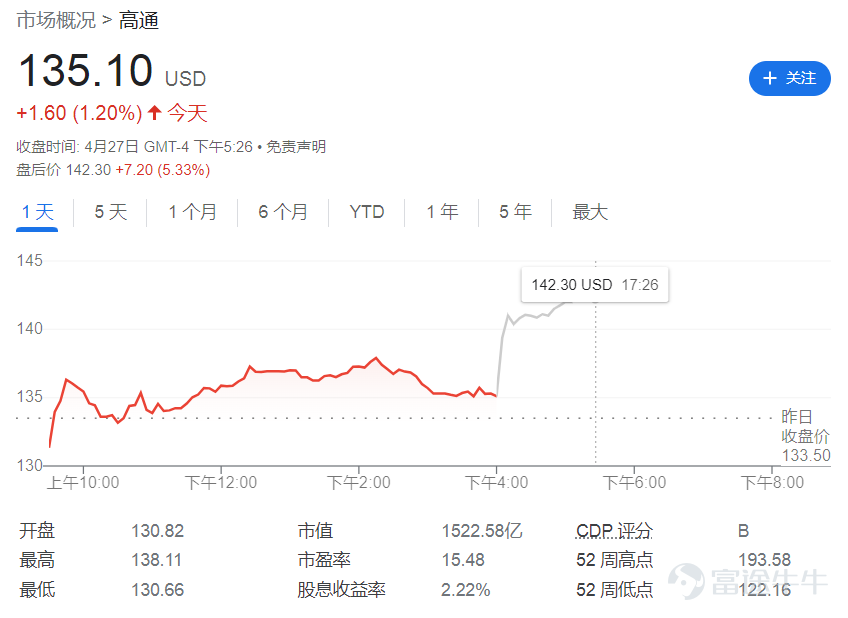
Qualcomm's US stock closed up 1.2% on Wednesday, boosted by favorable earnings reports, and surged 8.0% after the market. Since the beginning of the year, Qualcomm's cumulative decline has been about 27%.

Let's take a look at the core financial data in detail:
The adjusted EPS for the second fiscal quarter was $3.21, and analysts expected $2.93, up 69% year over year.
Adjusted revenue for the second fiscal quarter was $11.16 billion, and analysts expected $10.6 billion, up 41% year over year.
The adjusted EPS for the fiscal third quarter is expected to be $2.75 to $2.95, and analysts expect $2.60.
Sales for the fiscal third quarter are expected to be $10.9 billion, and analysts expect $9.98 billion.

Let's take a look at the specific business segments:
The chip business QCT reported sales of US$9.55 billion, and analysts expected US$8.86 billion, an increase of 52% over the previous year.
The revenue of the technology licensing division QTL reached $1.58 billion, and analysts expected $1.55 billion, down 2% year over year.

Most of Qualcomm's revenue comes from selling smartphone processors and modems, as well as technology to connect to cellular networks through licensing. Its strong results on Wednesday came amid broader market skepticism about 2022 chip companies, which benefited from strong demand and limited supply during the pandemic.
Led by CEO Cristiano Amon, Qualcomm emphasized to investors that it could become a chip supplier to many other broad markets and diversify from its mobile chip business.
Financial reports show growth in all four of Qualcomm's major chip markets.
Mobile phone chip sales, which is its largest market, grew at an annual rate of 56% to US$6.33 billion, indicating that in an inflationary environment, the slowdown in smartphone growth has not affected its core business.
The RF front-end division, which focuses on the chips needed for wireless connectivity, grew 28% to $1.16 billion.
Sales of automotive chips also increased by 41% to $339 million. Although its current sales in the automotive market are relatively small, Qualcomm believes that partnerships with automakers and suppliers will further drive growth (not including the revenue of Veoneer, which completed its acquisition this quarter).
The IoT division, which focuses on low-power, low-cost chips, grew 61% in sales to $1.72 billion.


Additionally, Qualcomm said it paid $764 million in cash dividends and bought back $951 million worth of shares during the quarter.
In October of last year, Qualcomm reached a final agreement with investment company SSW Partners to acquire Veoneer at a price of 37 US dollars per share (total consideration of about 4.5 billion US dollars). After the transaction is completed, SSW will sell Veoneer's autonomous driving software business Arriver to Qualcomm and then seek buyers for Veoneer's other businesses.
In April of this year, Qualcomm announced that it had completed the acquisition of Arriver™ (Angel) from SSW Partners, enhancing Qualcomm Technologies' ability to provide competitive, open and fully integrated advanced driver-assistance system ADAS solutions on a large scale to automakers and tier 1 suppliers.
Following the completion of the acquisition, Qualcomm Technologies will integrate Arriver's computer vision, driving strategies, and driver assistance assets into its leading Snapdragon Ride™ platform product portfolio, building on the foundation of its previous partnership with Arriver. The Snapdragon Ride platform is a complete product portfolio for high-performance central computing and vision system solutions, using the Snapdragon SoC and accelerator product line to meet the growing demand of the automotive ecosystem for scalable and upgradeable integrated software SoCs in the field of functional safety. In addition to being expandable to support a wide range of car types, the modular nature of the Snapdragon Ride platform provides car manufacturers with great flexibility to take full advantage of the software features they have developed.


Risk Disclaimer: The above content only represents the author's view. It does not represent any position or investment advice of Futu. Futu makes no representation or warranty.Read more
Comments
to post a comment
2
3
