The Fed raises interest rates for the first time in three years! How will the market react?

US Treasury yields are soaring, approaching 5%! Four forces are driving up the global pricing anchor; why are AI tech stocks bearing the brunt?
The biggest macro variable for US stocks recently is shifting from the AI industry itself to the bond market.
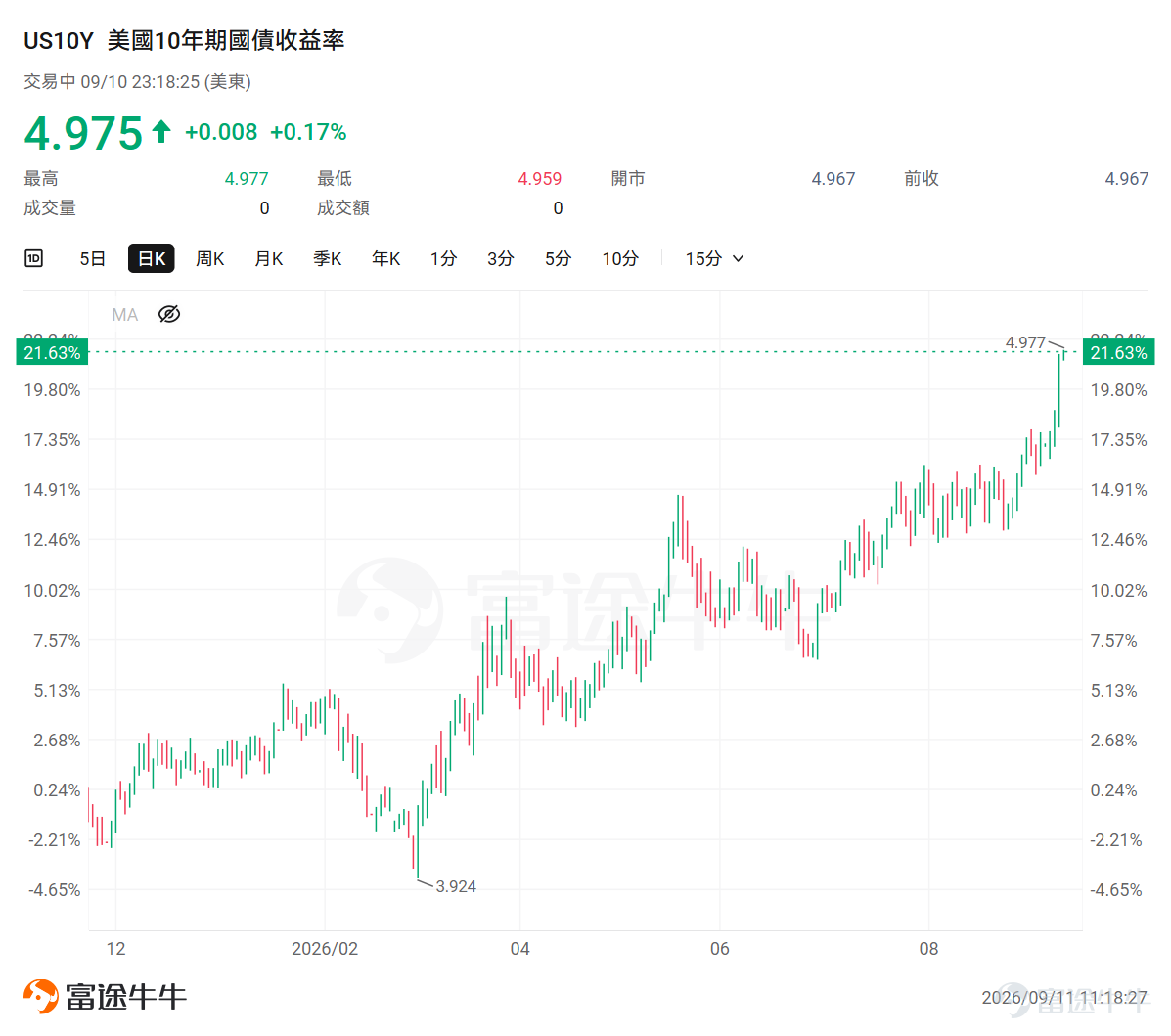
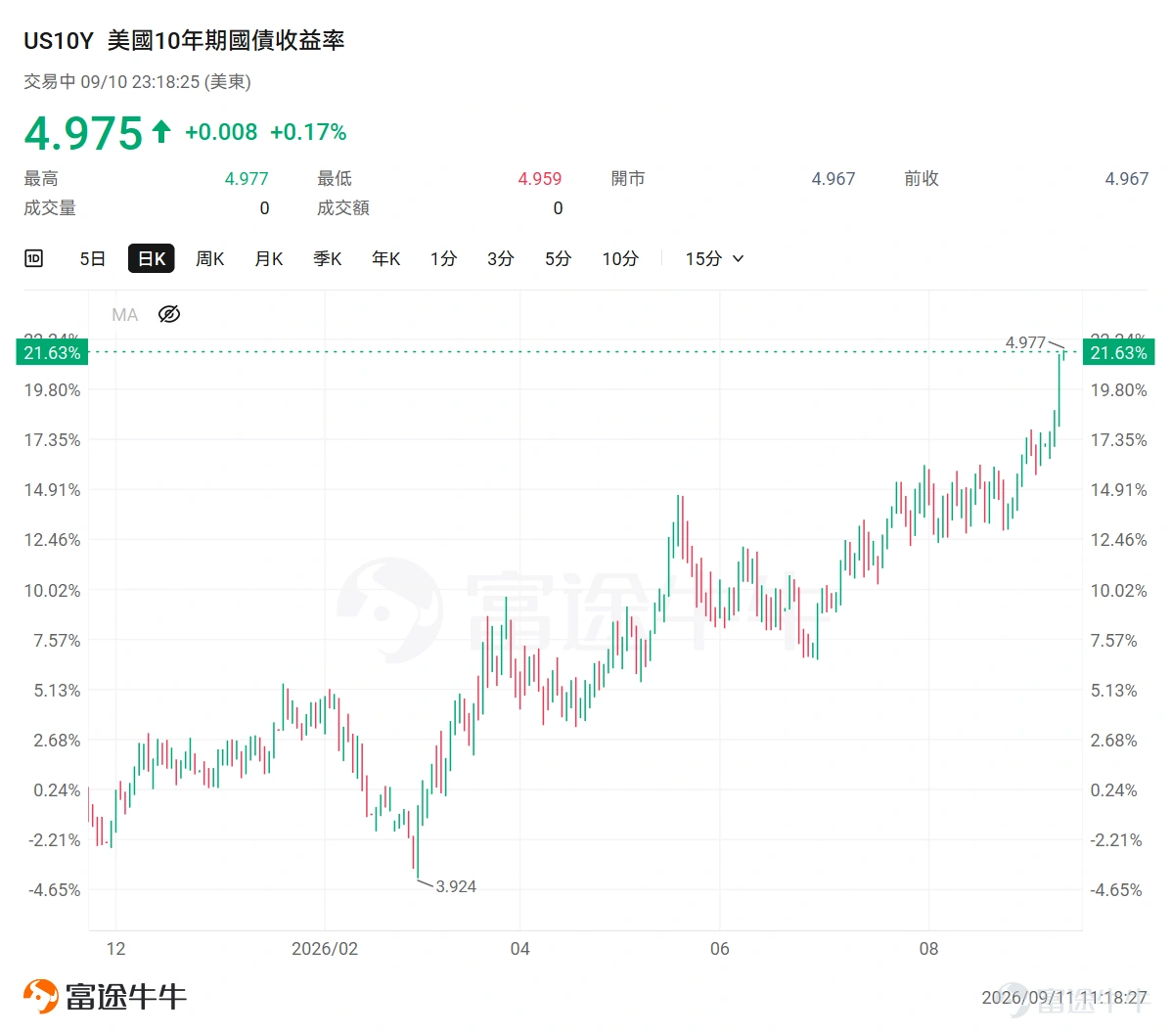
As a new round of selling intensifies in the global bond market, $U.S. 10-Year Treasury Notes Yield (US10Y.BD)$ it is once again approaching the key threshold of 5%, $U.S. 30-Year Treasury Bonds Yield (US30Y.BD)$ and has even risen to its highest level since 2007. Meanwhile, US stocks have faced continuous pressure, $S&P 500 Index (.SPX.US)$ 、 $Nasdaq Composite Index (.IXIC.US)$ 、 $Dow Jones Industrial Average (.DJI.US)$ closing lower across the board, with the tech sector bearing the brunt of the decline.
--
--
--
Why does a figure that seemingly belongs to the bond market have such a pronounced impact on tech stocks? The core reason lies in,The 10-year U.S. Treasury yield is not just a bond yield; it serves as the most critical "risk-free rate anchor" for global asset pricing.From corporate financing and real estate to equity valuation and global capital flows, nearly all are influenced by it.
This recent rapid rise in U.S. Treasury yields was not driven by a single factor, but rather by the combined effect of multiple forces.
Why have U.S. Treasury yields surged? The answer lies in the resonance of four key forces.
1. A sharp rise in oil prices has reignited inflation concerns.
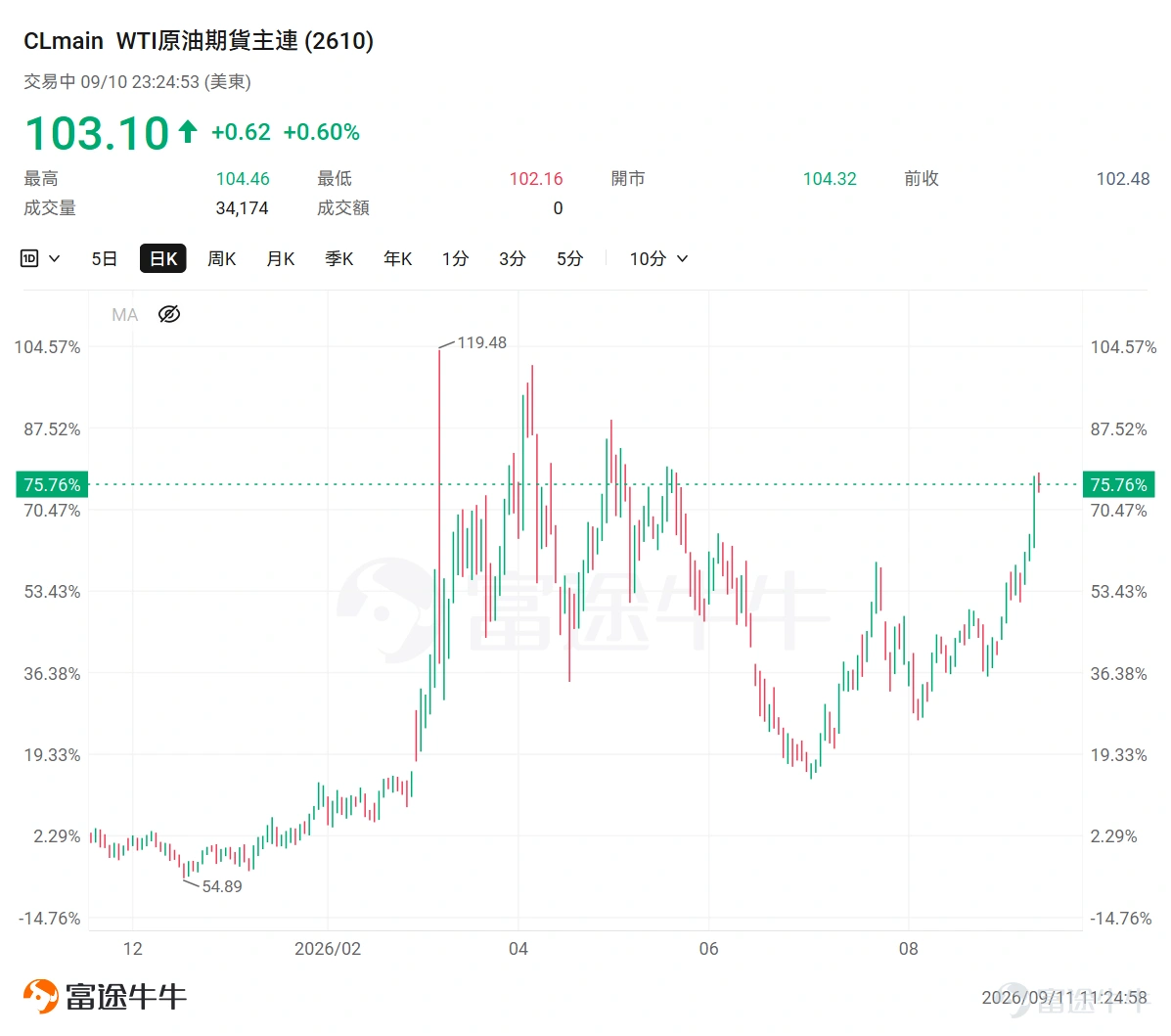
The most direct catalyst recently has been the sudden strength in international oil prices. On September 10, Brent crude closed at $107.63 and WTI at $102.48, with both surpassing the $100 mark. Reuters pointed out that this surge in oil prices was mainly driven by escalating tensions in the Middle East, increased tanker attacks, and disruptions to energy supply. Rising energy prices are the quickest way to rekindle market fears of inflation.
--
--
--
What the bond market fears most is precisely this type of "supply-shock inflation."This is because it leads the market to worry that inflation will not cool down quickly, making it harder for the Federal Reserve to pivot, and even creating a need for further rate hikes. As oil prices rise, the risk premium on long-term yields naturally increases.
2. The U.S. economy is stronger than expected, reigniting expectations of Fed rate hikes.
Beyond oil prices, recent U.S. economic data has also remained robust.Non-farm payrolls increased by 162,000 in August, significantly exceeding prior market expectations, while the unemployment rate held steady at 4.1%. Meanwhile, initial jobless claims in the US fell to 206,000 for the week ending September 5, indicating that the labor market has not deteriorated significantly.
Persistent economic resilience means the Federal Reserve is under no immediate pressure to cut rates. Instead, the market is likely to reprice in the possibility of "higher for longer" interest rates. The US August PPI rose 0.4% month-on-month, released on September 10, meeting expectations; however, underlying components remained firm, with energy prices rising 4.2% month-on-month, further reinforcing market concerns about sticky inflation and the Fed's continued hawkish stance.
3. The US fiscal deficit and Treasury supply pressures are raising the中枢 (central pivot) of long-term interest rates.
If oil prices and employment data serve as short-term catalysts, then fiscal issues are the deeper drivers behind the recent rise in long-end yields.
Reuters points out that a key background factor driving up US Treasury yields is the need for the US to have the market absorb more government borrowing. Investors, concerned about widening fiscal deficits and sustained increases in Treasury issuance, are demanding higher yields to compensate for risk. At the same time, there is growing skepticism among overseas investors regarding demand for US Treasuries.
Notably, the US government debt scale recently surpassed $40 trillion. Reuters mentioned in another report that,As the fiscal deficit widens and debt levels hit record highs, the market is increasingly concerned that this is not merely a short-term fluctuation, but rather signifies that the central pivot of long-term interest rates is being structurally raised.
4. The surge in AI capital expenditure is, in turn, pushing up the cost of capital.
This is the most easily overlooked yet most "endogenously impactful" narrative for the tech sector in the current market.
Over the past year, $Alphabet-C (GOOG.US)$ 、 $Amazon (AMZN.US)$ 、 $Meta Platforms (META.US)$ 、 $Microsoft (MSFT.US)$ 、 $Oracle (ORCL.US)$ US hyperscale cloud providers have cumulatively issued approximately $220 billion in bonds to support data center expansion and the AI arms race.
Reuters believes thatthe massive financing demand for AI is disrupting credit market pricing and intensifying competition for capital in the capital markets.In other words,While AI boosts sentiment in the tech sector, it is also driving up overall market demand for funding.
The US government is issuing debt, and tech giants are also issuing bonds; both the government and AI initiatives are vying for capital. As funding demands rise simultaneously, while oil prices and inflation push up interest rate expectations, long-term yields naturally find it harder to decline.
Why are AI tech stocks bearing the brunt of the impact?
First layer of impact: Rising valuation denominators make high-growth stocks the most sensitive.
Tech stocks, especially high-growth segments like AI, software, and semiconductors, are essentially 'long-duration assets'—a significant portion of their current valuation comes from the discounting of profits expected many years into the future.
Reuters points out thatrising yields reduce the present value investors assign to future profits, an effect that is particularly pronounced for high-growth tech stocks.In other words, even if a company's fundamentals remain unchanged, a rise in the risk-free rate will lead to a downward revision of its fair valuation. This is why, whenever the 10-year US Treasury yield spikes rapidly, the market tends to sell off high-valuation tech growth stocks with long-duration earnings narratives first, rather than defensive stocks.
Second Shock: A 5% Risk-Free Rate Is Competing with Tech Stocks for Capital
When the 10-year US Treasury yield was only 2% or 3%, investors were more willing to allocate capital to high-growth sectors because bond returns were too low. However, as the 10-year Treasury yield approaches 5% with virtually no credit risk, capital naturally prompts a reassessment: Why should I endure the volatility of tech stocks for a risk-return profile that may not offer a significant advantage over US Treasuries?
This is also the implication of the upward shift in the 'global pricing anchor.' Rising US Treasury yields are not just a bond market issue; they represent a broader compression of market risk appetite. The simultaneous decline of the three major US stock indices on September 10, along with the underperformance of the information technology sector, directly reflects this logic in the equity market.
Third Shock: This AI Cycle Is Not an Asset-Light Story, But a Capital-Intensive CapEx Story
Unlike the previous pure software bull market, this AI rally is underpinned by massive capital expenditures (CapEx): GPUs, HBM, servers, switches, optical modules, data centers, power, and cooling systems—all requiring substantial real cash outlays.
Luzhong explicitly pointed out that higher Treasury yields increase corporate borrowing costs, making capital-intensive projects such as data centers, energy infrastructure, and industrial expansion less economically viable. This is particularly critical for the tech industry, which is accelerating the construction of AI infrastructure.
Therefore, the market's concern is that while there is demand for AI, the cost of capital to fulfill this demand is rising. This will compress profit margins and intensify the market's scrutiny of valuations.
Rising US Treasury Yields Are Not Necessarily a 'Death Knell' for Tech Stocks; It Depends on Why Rates Are Rising
Here lies a key divergence: Is the rise in yields a 'good rate hike' or a 'bad rate hike'?
If the rise in yields is primarily driven by a robust economy and improving corporate earnings, tech stocks, despite valuation pressure, still have the earnings power to absorb some of the impact. However, if the yield increase stems more from oil price shocks, resurging inflation, widening fiscal deficits, and rising supply-side pressures, then for tech stocks, this represents a more typical case of "bad rate hikes"—because the denominator (discount rate) increases while the numerator (earnings) may not improve in tandem.
From the current market structure, this round of U.S. Treasury yield increases appears to be a combination of both factors: on one hand, the U.S. economy remains resilient; on the other, oil prices, fiscal concerns, and supply pressures are continuously pushing up the risk premium on long-term interest rates.
This also means thatTech stocks will find it difficult to shake off interest rate constraints in the short term, but divergence will emerge within the sector:Market leaders with strong cash flows and rapid earnings realization are relatively more resilient to pressure, whereas targets with high valuations and driven more by long-term narratives may experience greater volatility.
The true next watershed moment is tonight's U.S. August CPI data.
For the current market, the U.S. August CPI data released at 8:30 PM tonight will be a key variable influencing the short-term trends of U.S. Treasuries and tech stocks. The market currently expects August CPI to rise 0.4% month-over-month and 3.4% year-over-year; core CPI is expected to rise 0.2% month-over-month and 2.4% year-over-year.
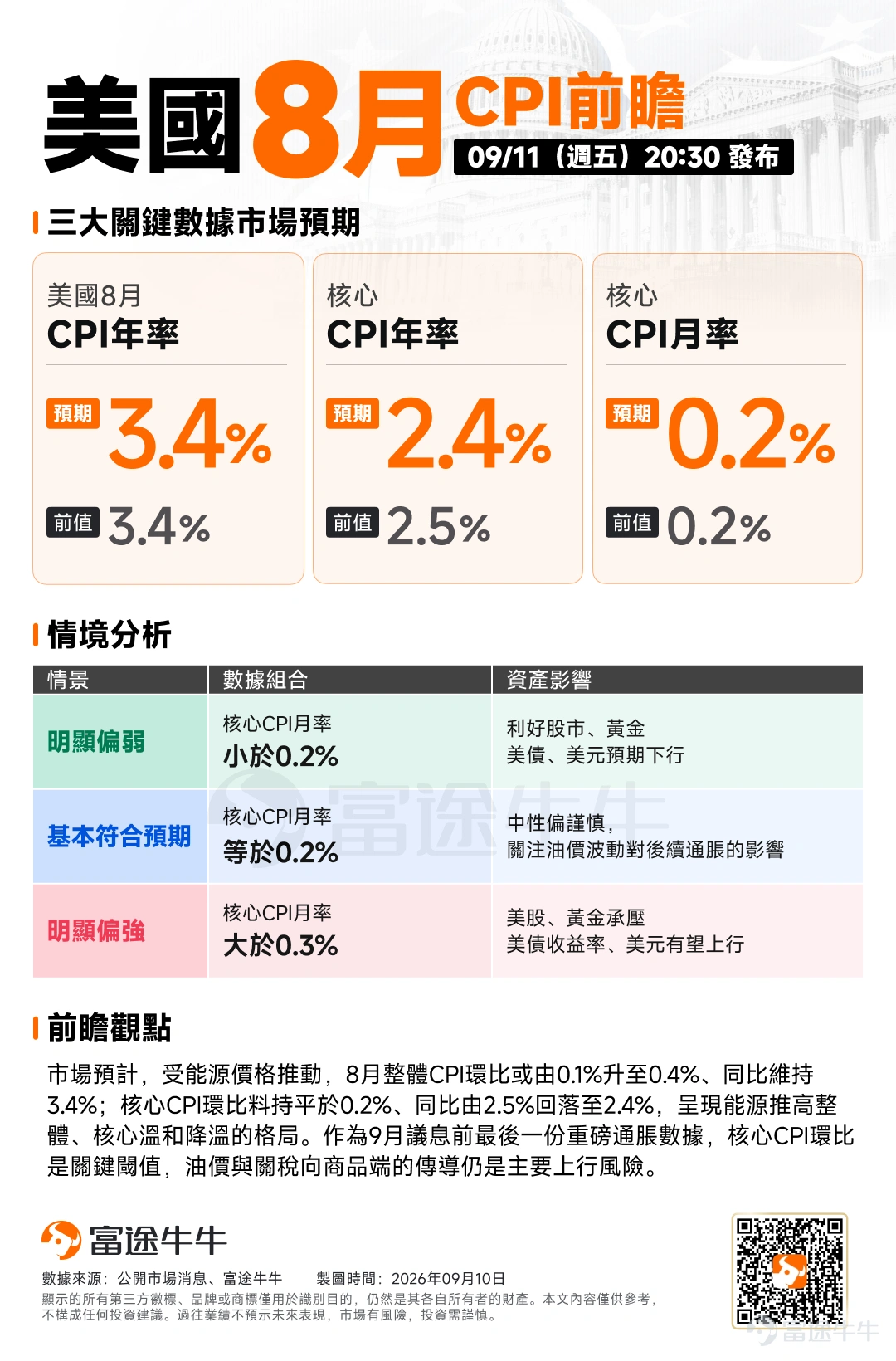
Why is this data important?Because the PPI has already shown warming upstream price pressures, oil prices have rebounded sharply, and the labor market remains robust.
If tonight's CPI comes in higher than expected, the market is likely to further reinforce pricing for a hawkish Fed, significantly increasing the probability that the 10-year U.S. Treasury yield will break through and stabilize above 5%; tech stocks, especially those in the AI supply chain, may continue to face pressure. Conversely, if core inflation performs mildly, it could provide a breathing space for both the bond market and tech stocks.
Conclusion: U.S. Treasuries are not a supporting actor, but the macro main line determining the valuation ceiling for tech stocks.
Ultimately, the surge in U.S. Treasury yields approaching 5% is not just a story within the bond market; it is redefining the valuation framework for global assets.
The driving forces can be summarized along four lines: inflation concerns driven by rising oil prices, expectations of further Fed tightening due to the resilience of the U.S. economy, higher long-term interest rates caused by fiscal deficits and increased Treasury supply, and capital competition triggered by the AI capex boom.
For U.S. stocks, especially AI tech stocks, the key question is: if the 10-year U.S. Treasury yield remains entrenched near the high level of 5%, how much valuation premium can tech stocks still enjoy? This is likely the core theme that the market will repeatedly trade on in the coming months.
Risk Disclaimer: The above content only represents the author's view. It does not represent any position or investment advice of Futu. Futu makes no representation or warranty.Read more


Comments (2)
to post a comment
28
60