The Fed raises interest rates for the first time in three years! How will the market react?

Options Sir's Macro View | How much macro risk is already priced into US stocks? The triple test of Non-Farm Payrolls, CPI, and FOMC is approaching
Risk appetite in US stocks is recovering, but it is still too early to conclude that macro pressures have been alleviated.
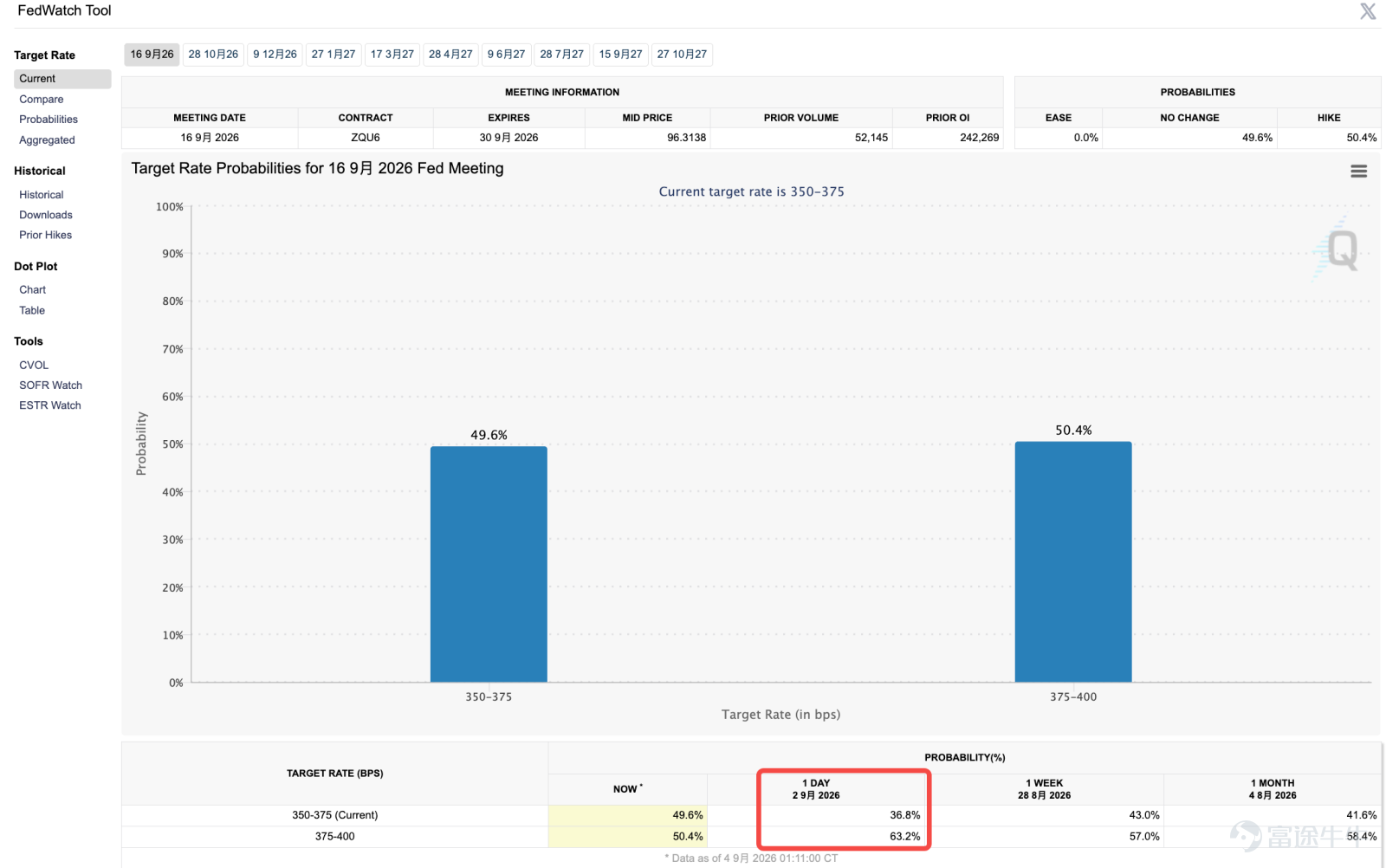
Fed Governor Waller recently stated that if inflation continues to improve in August, he leans towards keeping interest rates unchanged in September. Following the announcement, the market's pricing for a September rate hike quickly dropped from about 63% to around 50%,$U.S. 10-Year Treasury Notes Yield (US10Y.BD)$ and also retreated from the previous high of 4.818% to approximately 4.76%. On September 3, $S&P 500 Index (.SPX.US)$ rose by 1.06%, and the Nasdaq increased by 1.40%.
This indicates that the market is unwinding some of the overly hawkish pricing, but the pressure from high oil prices and high interest rates has not yet disappeared.
In the next two weeks, Non-Farm Payrolls, CPI, and the FOMC meeting will take center stage consecutively; the true macro test is just beginning.
How much is already priced into US stocks?
The market has currently priced in some easing of macro pressures.
Following Waller's comments, expectations for rate hikes cooled, U.S. Treasury yields retreated, and risk appetite in U.S. stocks quickly recovered. The market is now pricing in the idea that "the worst-case interest rate scenario may not materialize," rather than assuming that "risks from high oil prices and high interest rates have been completely eliminated."
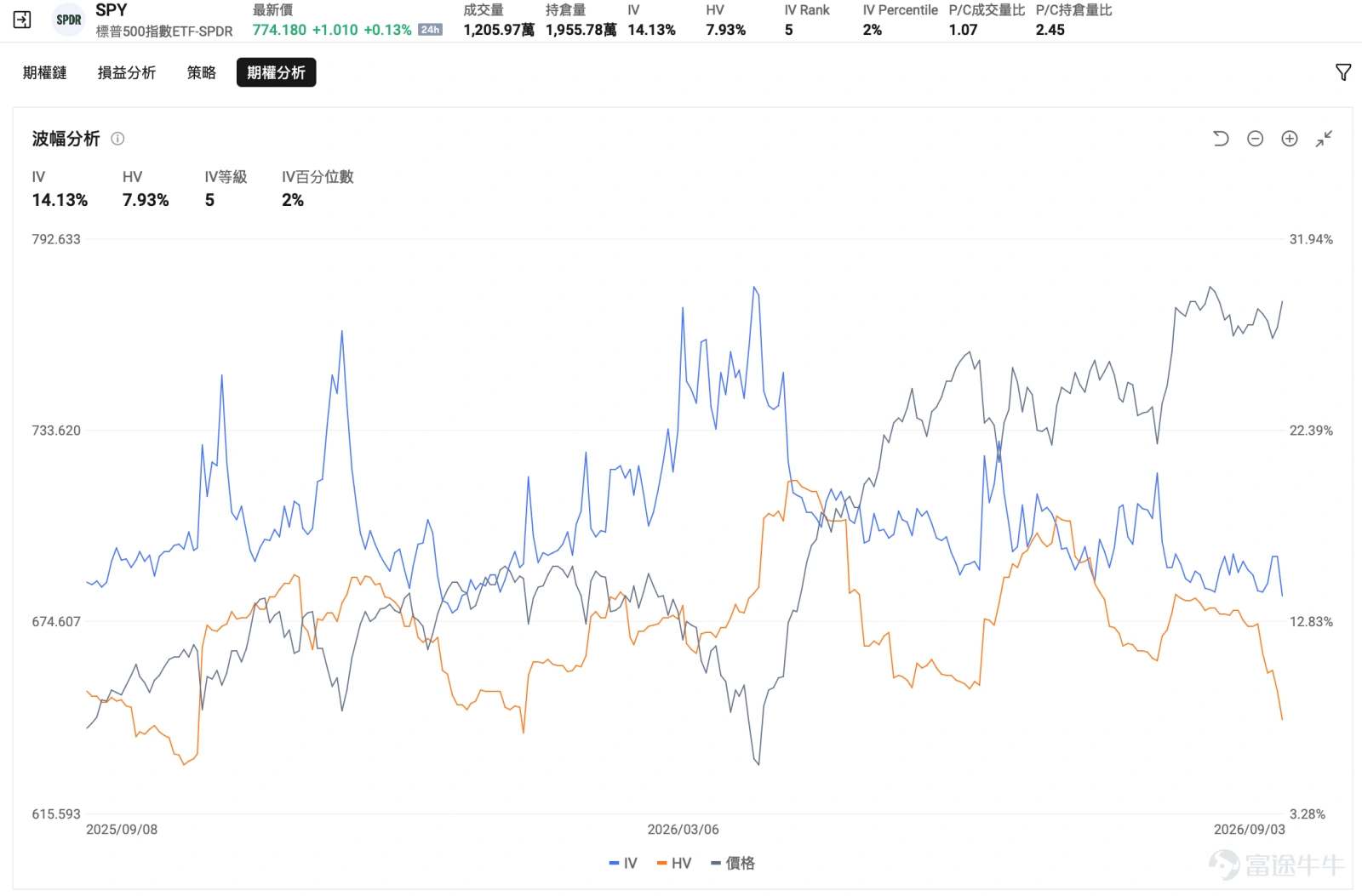
The options market also leaned toward calmness. As of September 3, $SPDR S&P 500 ETF (SPY.US)$ ATM IV is approximately 14.13%, with an IV Rank of just 5 and an IV Percentile of about 2%; $Invesco QQQ Trust (QQQ.US)$ ATM IV is approximately 20.01%, with an IV Rank of 17 and an IV Percentile of about 13%, both at relatively low levels.
Cboe data shows that on September 3, $CBOE Volatility S&P 500 Index (.VIX.US)$ it closed at 14.32, near its one-year low, reflecting that the market is not paying a high volatility premium for sustained macroeconomic panic.
However, the market has not fully let its guard down. The Put/Call volume ratio for SPY and QQQ over the past five days remains above 1, and open interest in SPY puts is significantly higher than that in calls. While open interest alone cannot determine the actual direction of capital flows, it at least indicates that there are still substantial downside-hedging positions.
Therefore, the more accurate current state is:Risk-on sentiment is returning, but the market has not yet entered a risk-free state.
The upcoming three macroeconomic tests will gradually verify whether this rally can sustain.
First hurdle: Tonight's non-farm payrolls report; the key is whether it will alter the Fed's policy path.
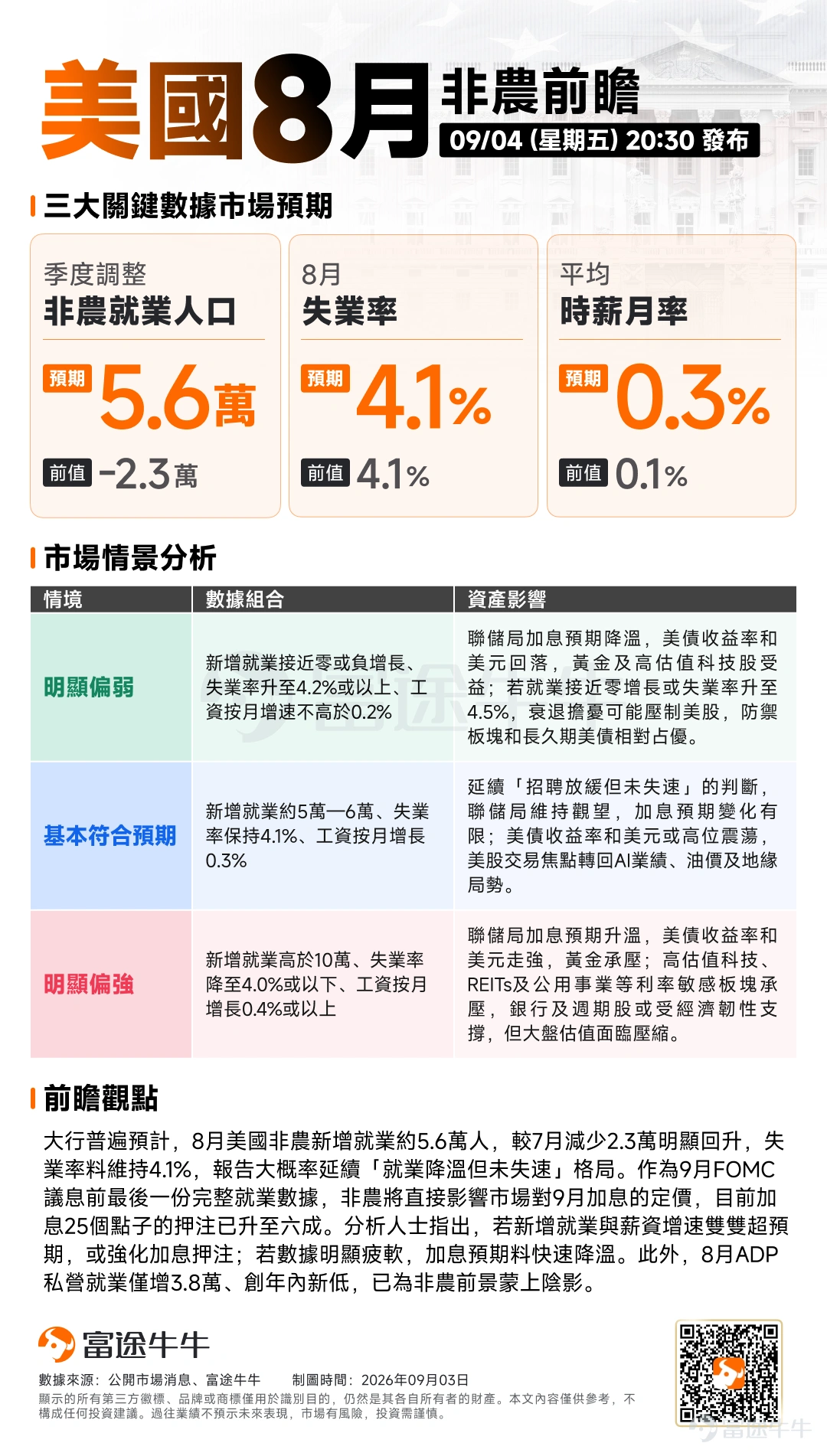
At 8:30 PM ET tonight, the US will release the August non-farm payrolls report.
Media surveys show that the market currently expects approximately 56,000 new non-farm jobs in August, compared to a decrease of 23,000 in July; the unemployment rate is expected to remain at 4.1%.
For US stocks, the ideal outcome is actually not "the worse the data, the better."
If job growth cools moderately without a significant stall, the market may further lower expectations for a September rate hike, US Treasury yields could continue to decline, and valuation pressure on tech stocks would ease.
If data such as new job additions and wages come in significantly stronger than expected,the market may raise the probability of a September rate hike again, pushing the 10-year US Treasury yield higher, and high-valuation tech stocks will face renewed pressure.。
Conversely, if employment data are weak enough to trigger recession fears, interest rates may fall, but the trading logic for US stocks could shift from "reduced rate hike pressure" to "slowing economic growth."
Therefore, the primary impact of the non-farm payrolls report is to recalibrate the market's expectations for the Fed's policy path in September.
Second hurdle: CPI could be even more critical.
Following the non-farm payrolls, the next key milestone isthe August CPI data released on September 11.。
This CPI release is particularly important because one of the biggest macro debates currently is whether high oil prices will reignite inflation.
In July, US CPI rose 3.4% year-on-year, a slight decline from June's 3.5%; core CPI increased 2.5% year-on-year, also lower than the previous 2.6%. However, energy prices still surged 14.7% year-on-year.
On the other hand, PCE inflation, which the Federal Reserve monitors more closely, remains elevated. In July, the PCE price index rose 3.7% year-on-year, while core PCE increased 3.3% year-on-year, still significantly above the 2% inflation target.
Waller also explicitly stated thatif upcoming inflation data confirms continued improvement in price pressures, he leans towards keeping interest rates unchanged in September;if inflation heats up again, a rate hike remains an option.
Therefore, compared to non-farm payrolls, the CPI may more directly determine market expectations for the September FOMC meeting.Employment determines whether the Fed has the patience to wait, while inflation determines whether the Fed has the conditions to wait.
The third hurdle: The FOMC meeting is the ultimate test.
On September 15-16, the Federal Reserve will hold its FOMC interest rate decision meeting, which will also release the latest economic projections.
At that time, investors should not focus solely on "whether to raise rates or not."
More importantly, there are three key things to watch:
First, how the Fed assesses the impact of recent energy prices on inflation;
Second, whether the cooling of the job market is sufficient to offset inflation risks;
Third, whether the new policy path still leaves room for further tightening within the year.
Even if there is no rate hike in September, it should not be interpreted as the end of the high-interest-rate trade.
Currently, long-end US Treasury yields are supported not only by Fed policy but also by factors such as fiscal deficits, capital demand, and the long-term neutral interest rate. Therefore, the market needs to judge not just whether there will be another 25 basis point rate hike next time, but ratherhow long interest rates may remain at elevated levels。
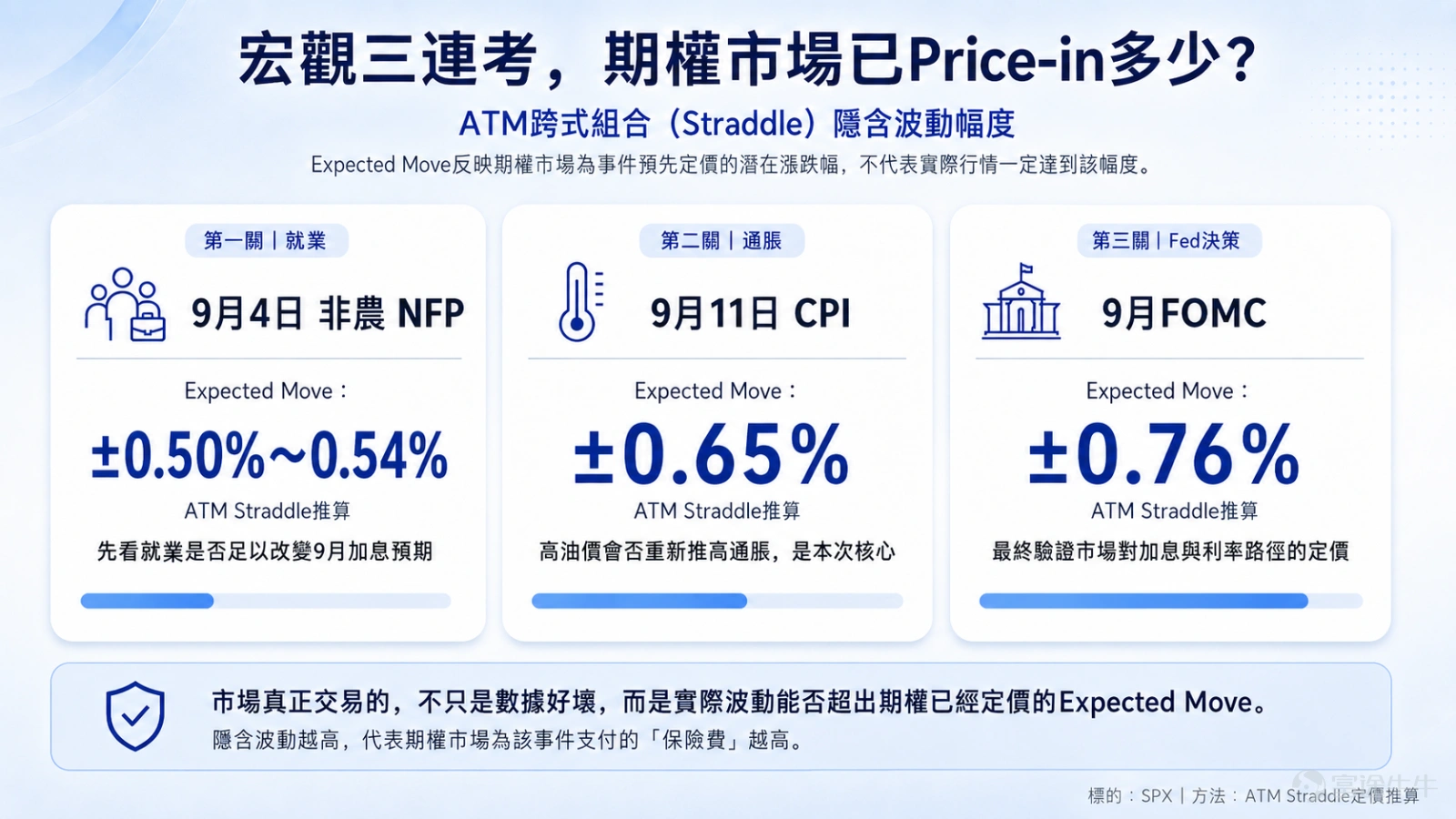
Based on options market pricing, expected volatility may change significantly depending on market events; this is for reference only.
Options Strategy: How to position under the 'triple test'
Currently, the IV of SPY and QQQ remains relatively low, while Non-Farm Payrolls, CPI, and the FOMC meeting are all scheduled within a two-week window. In this environment, options strategies can be approached from two dimensions:direction and volatility.
Betting on high volatility: Long Straddle / Long Strangle
If you have no clear view on the direction of US stocks but believe macro data could trigger significant volatility, consider Long Straddles or Long Strangles.
SPY's IV Rank is currently only 5, meaning the cost of buying volatility is relatively low compared to the past year, which is a favorable aspect of this strategy.
However, it is important to note thatLow IV does not necessarily mean Straddles are cheap.
Whether it is worth buying still depends on comparing the implied price movements in the options market with your own assessment of actual volatility. If the market reaction is muted after the data release, option buyers may suffer from both time decay and an IV crush.
The premium for a Long Strangle is typically lower than that of a Straddle, but it requires larger stock price movements to cover the cost. This strategy suits investors who anticipate significant market moves while wishing to reduce the initial premium outlay.
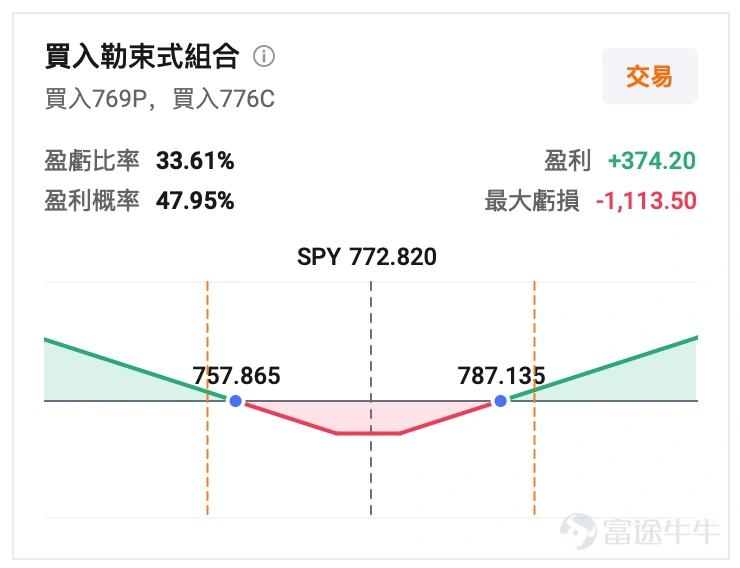
(The design images displayed on screen are for demonstration purposes only and do not constitute any investment advice or guarantee; market conditions fluctuate frequently, and the option prices shown in the diagrams do not reflect actual market data.)
With a directional view: Bull Call Spread / Bear Put Spread
If you have a clear view on macro outcomes, Vertical Spreads are generally easier to manage in terms of cost control compared to simply buying Calls or Puts.
For example, if you believe job growth is moderating mildly, CPI continues to improve, and rate hike expectations decline further, you might consider a Bull Call Spread to express a bullish view.
If you believe employment or inflation data is significantly hot, potentially driving US Treasury yields higher again, you can use a Bear Put Spread to express a bearish view.
The advantage of these two strategies is that the maximum loss is predetermined, and the premium cost is reduced by selling options with further-out strike prices; the trade-off is that profit potential is also capped.
In environments where IV can change rapidly ahead of macro events, Vertical Spreads are generally less affected by an IV crush compared to single-leg options.
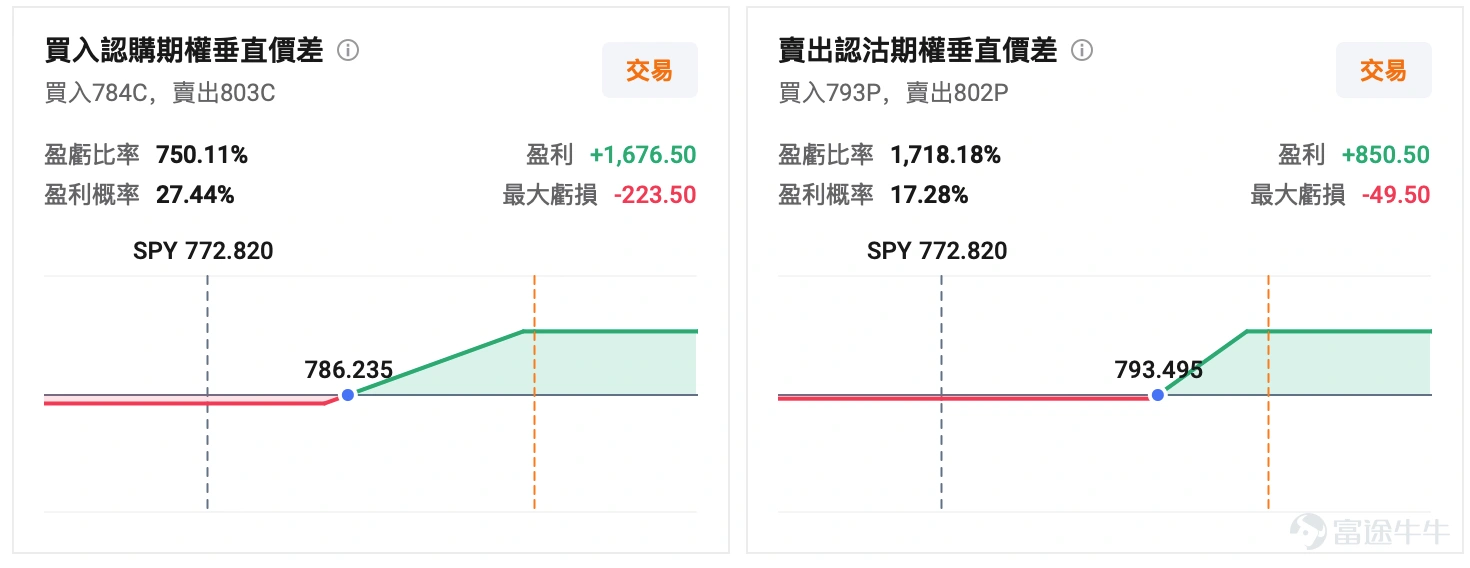
(The design images displayed on screen are for demonstration purposes only and do not constitute any investment advice or guarantee; market conditions fluctuate frequently, and the option prices shown in the diagrams do not reflect actual market data.)
Believing the real risk lies ahead: Calendar Spread
If you judge that tonight's Non-Farm Payrolls will have limited market impact, while the key events determining Fed policy are the upcoming CPI and FOMC meeting, you may want to focus further on Calendar Spreads.
The basic idea is to sell options with nearer expirations while simultaneously buying options with the same strike price but farther-out expirations.
If near-term implied volatility (IV) drops rapidly after the Non-Farm Payrolls release, while far-term IV—covering CPI and FOMC events—remains supported, a Calendar Spread may benefit from the divergence in time value and volatility changes between the near and far legs.
However, this strategy relies heavily on the IV term structure. Before implementing it, you should compare the ATM IV for the expiration dates corresponding to Non-Farm Payrolls, CPI, and FOMC meetings, rather than simply establishing a position because overall IV is low.
Amidst three major consecutive data releases, prioritize risk assessment before determining direction.
US stocks have already priced in some easing of macroeconomic pressures: the probability of a rate hike has dropped from over 60% to around 50-50, US Treasury yields have retreated from highs, and risk assets have rebounded.
But this does not mean that high oil prices and high interest rates have been fully digested by the market. Tonight's Non-Farm Payrolls will test the labor market, next week's CPI will test inflation, and finally, the FOMC will provide the policy answer.
For options investors, the next two weeks require particular attention to:Direction, IV, expiration dates, and event timing. Getting the directional call right does not guarantee profits on options; if the purchased volatility is too expensive, time decay is too rapid, or the expiration date does not cover the truly significant events, the strategy's outcome may still differ from expectations.
Therefore, during periods with a high density of macroeconomic events, controlling premium costs, maximum loss, and position sizing is more important than simply betting on a single data release result.
Finally, Options Sir brings a small perk for fellow investors. You are welcome to claim it. Options Beginner's Gift Pack
*This event is limited to invited users in HK. Click to learn more. Detailed event terms >>
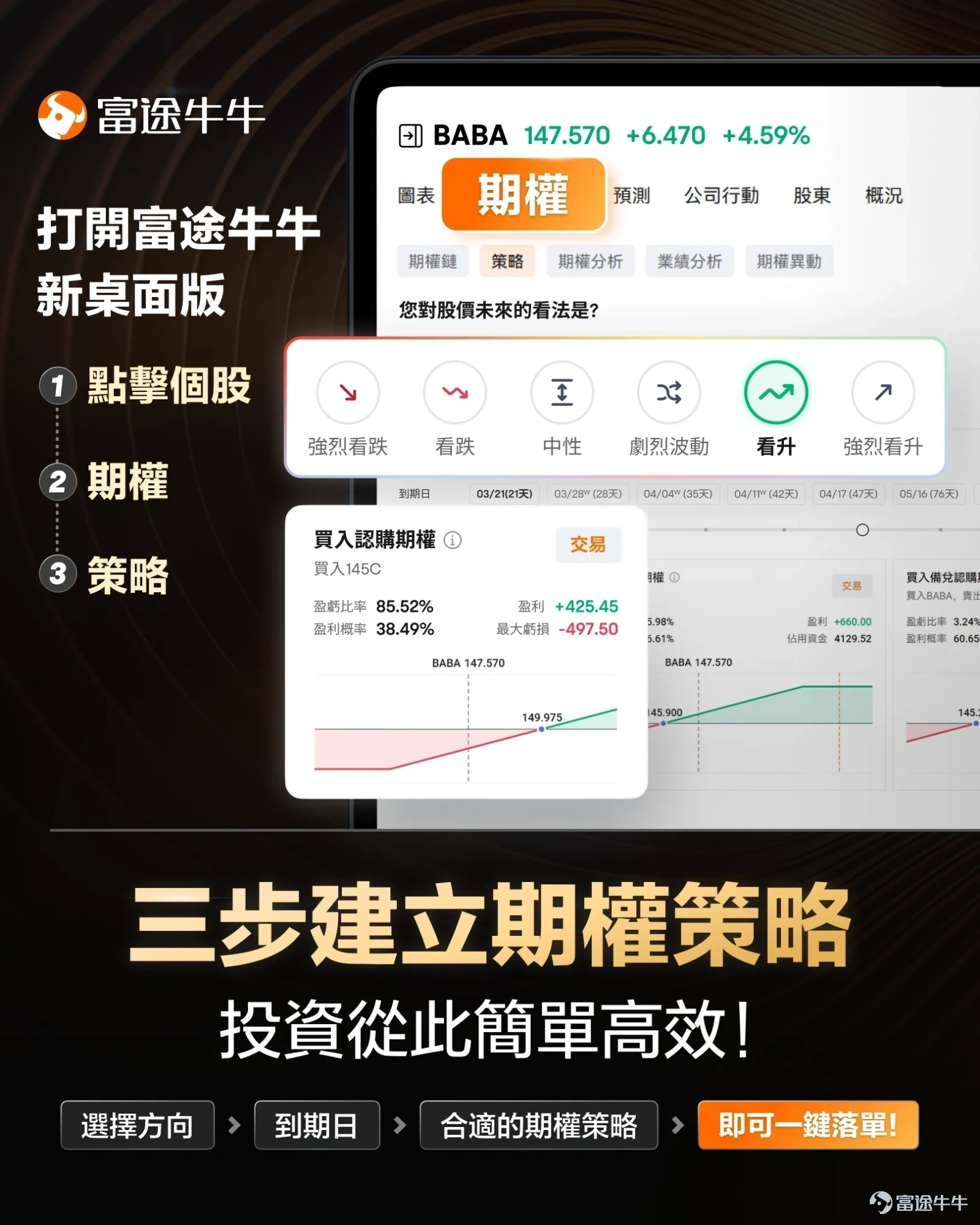
Market conditions are complex and volatile, Options strategies with numerous options available, unsure how to choose? Futubull helps you set up in three steps Options strategies , making investing simple and efficient from now on.
Risk Disclaimer: The above content only represents the author's view. It does not represent any position or investment advice of Futu. Futu makes no representation or warranty.Read more


Comments (2)
to post a comment
41
27