The Fed raises interest rates for the first time in three years! How will the market react?

Hot Topics in 5 Minutes | The "Mini Non-Farm" Comes to the Rescue! What Is the Relationship Between ADP and Tomorrow's Non-Farm Payrolls?
For global financial markets, this week's most anticipated headline event—the U.S. August Non-Farm Payrolls report—is set to debut at 8:30 PM Beijing Time on Friday. Last night, an "appetizer" was served early, triggering significant market volatility:The August ADP employment data (also known as the "Small Non-Farm") unexpectedly missed expectations, adding only 38,000 jobs. This figure fell short of the forecasted 48,000 and was lower than the previous month's 44,000, hitting a new low for the year.。
Following the release of this data,Market concerns about a Federal Reserve rate hike in September eased, leading to slight gains in the three major U.S. stock indices.Precious metals such as gold and silver also saw a rebound.
For many retail investors, professional terms like "Small Non-Farm" and "Big Non-Farm" can be confusing: What exactly are they? Why can a single data point cause such wild swings in the stock market? How should we interpret and respond to tomorrow's Big Non-Farm report? In today's article, we will use plain language to thoroughly clarify these questions for you.
Small Non-Farm to the Rescue: What Happened Last Night?
Let's first review the market background from last night. Prior to the ADP data release, market sentiment was actually quite pessimistic. Due to frequent hawkish signals from Federal Reserve officials recently, coupled with continuously rising U.S. Treasury yields, investor expectations for a September rate hike had once intensified.
The release of the ADP data came just in time, like a timely rain.In August, ADP reported only 38,000 new jobs, missing the expected 48,000 and falling short of forecasts for two consecutive months. This clearly signals a cooling labor market.Following the data release:
First isThe U.S. tech sector rebounded. Although there was divergence within the AI supply chain, tech giants led by NVIDIA saw their stock prices rise, helping to stabilize the Nasdaq index;Meanwhile, U.S. Treasury yields plunged, with the yield on the 10-year U.S. Treasury note quickly dropping from around 5.29% to approximately 5.25%. This alleviated pressure on interest-rate-sensitive tech stocks. Additionally, gold and silver staged a strong rebound, with spot gold breaking through $4,400 per ounce and silver prices rising significantly.
The market logic is simple:The weaker the employment data, the less urgent the Federal Reserve's need to raise interest rates, leading to a looser interest rate environment, which benefits growth stocks and precious metals.This is why the disappointing 'small non-farm' (ADP) report turned out to be 'good news' for the market.
However, we must remind everyone:The ADP report is merely an 'appetizer'; the real 'main course' to watch is tomorrow's official non-farm payrolls data.Although ADP data provides a reference, it should never be the sole basis for trading the Non-Farm Payrolls report.
Why are there "Small Non-Farm" and "Big Non-Farm" reports? What are the differences between the two?
Many investors are confused: why is the same employment data split into "Small Non-Farm" and "Big Non-Farm" versions? In fact, these are common market terms for data from two different statistical scopes.
"Small Non-Farm": ADP Employment Data
This data is released by Automatic Data Processing (ADP), a private human resources services company. It is typically published at 20:15 Beijing Time on the first Wednesday of each month (two days before the Non-Farm Payrolls release). Its statistical scope covers private sector employment across approximately 400,000 companies under ADP, which is relatively limited in scale. ADP's advantages lie in its early release time and timeliness, but its statistical scope is narrower, and it occasionally deviates from official data.
"Big Non-Farm": U.S. Department of Labor Non-Farm Payrolls Report
This report is released by the U.S. Bureau of Labor Statistics (BLS), an official agency, and is published on the evening of the first Friday of each month (Beijing Time).Its statistical scope comprehensively covers all non-agricultural sectors in the United States, including both the private and government sectors, making it the most authoritative indicator for measuring the U.S. job market.In comparison, this data is more comprehensive and authoritative, serving as one of the core reference indicators for the Federal Reserve's monetary policy decisions. Market reactions to its release are far more volatile than those to the ADP data.
Why does the market focus more on the "Big Non-Farm" report?For example:ADP is like an "appetizer," giving you a rough idea of the overall flavor; but the Non-Farm Payrolls (NFP) report is the main course, determining the final verdict on the entire meal.。
First, their authority differs: NFP is released by official government agencies, making the data more rigorous and its impact more profound. Second, there are differences in statistical scope: NFP includes government sector employment, while ADP only covers the private sector. These differing methodologies can sometimes even lead to directional divergences. Third, the market impact varies significantly: the release of NFP often triggers substantial volatility in assets such as the US dollar, US Treasuries, gold, and US equities, with fluctuations typically several to dozens of times larger than those caused by ADP.
Therefore, ADP serves more as a "weather vane," while NFP acts as the actual "decision-maker."。
The predictive value of "Small Non-Farm" (ADP) for "Big Non-Farm" (NFP): Is it reliable?
Since ADP is released two days before NFP, many investors naturally wonder: Can ADP be used to predict NFP? The answer is:It has some reference value, but should absolutely not be relied upon blindly.。
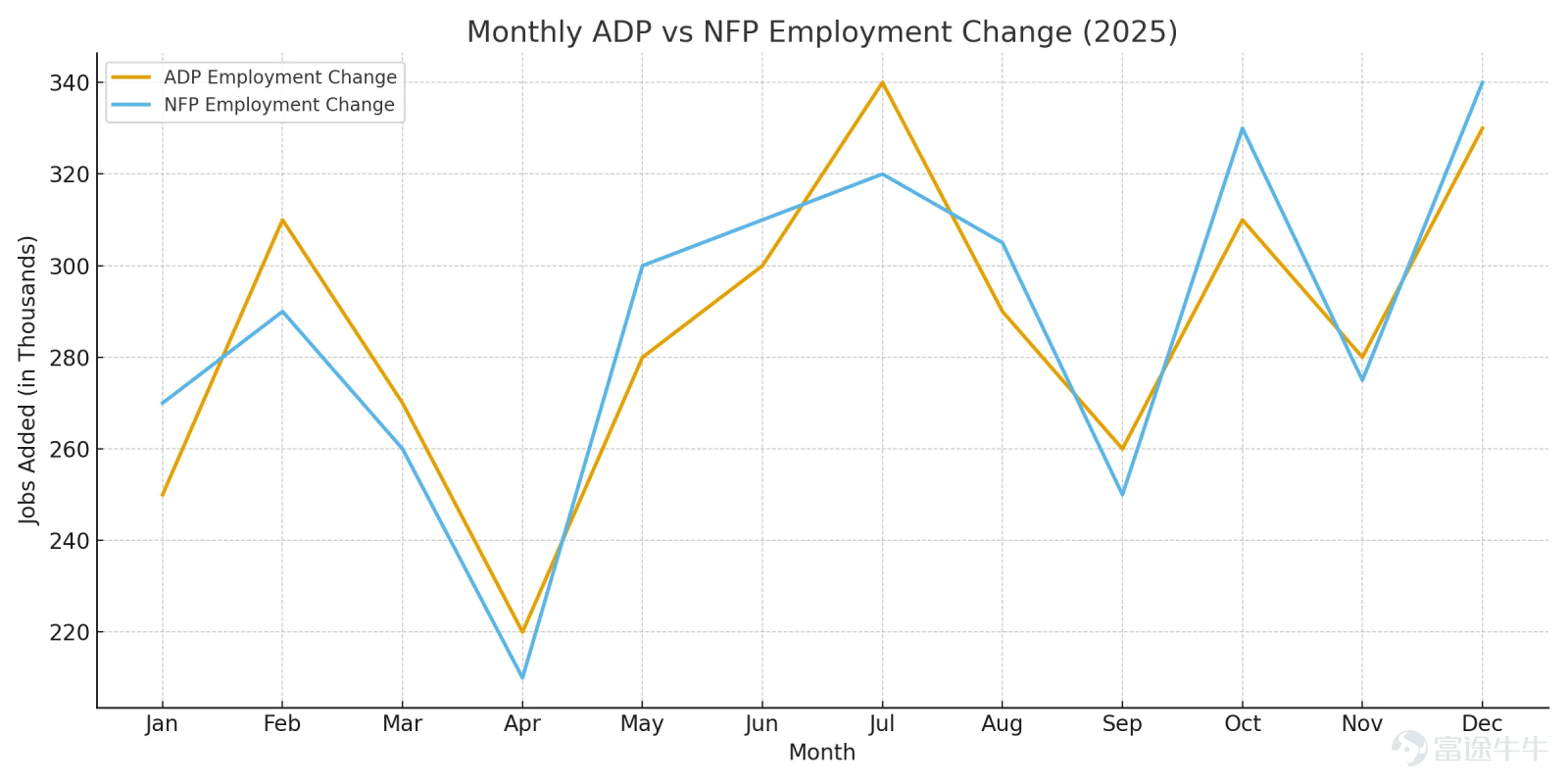
Historical data shows that ADP and NFP indeed move in the same direction in most months. For instance, when ADP data weakens, the market often expects NFP to be weak as well, and vice versa. This is why, after ADP surprisingly missed expectations last night, the market immediately began pricing in the logic of "NFP missing expectations."

However, divergences are also common. The most typical example occurred this June.In early June this year, the market witnessed a "significant divergence" between ADP and NFP.
Specifically,June 3 (Wednesday), data released by ADP Research showed that private sector employment in May increased by122,000 jobs,slightly exceeding the market expectation of 120,000, with little market volatility; however,on June 5 (Friday),the Non-Farm Payrolls data was released,with non-farm employment rising by 172,000,nearly double the market expectation of 88,000. The market plummeted that day, with tech stocks, gold, and other assets suffering significant declines.

This case illustrates:ADP's "moderate" figures do not guarantee that the Non-Farm Payrolls will also be "moderate."Differences in statistical methodologies, sample biases, and seasonal adjustments can all lead to discrepancies. The ADP report is merely a "signpost," not a "map."
Why does this situation occur?
First, there are differences in the samples: ADP primarily covers mid-sized enterprises, while the Non-Farm Payrolls (NFP) report includes more small and large businesses; hiring rhythms may vary across companies of different sizes. Second, the statistical methods differ: ADP uses its own model for adjustments, whereas the Department of Labor employs a more complex dual-verification approach using both household and establishment surveys. Additionally, seasonal factors cannot be ignored: the two statistical systems have inconsistent capabilities in capturing employment fluctuations during certain months (such as graduation season or holidays).
Conclusion: The ADP report can give you a "psychological expectation," but never use it to make an all-in bet on the NFP data.。
Preview of tomorrow's Non-Farm Payrolls: How to interpret it? How to respond?

Based on current market expectations, if NFP job growth is below 50,000, it will be seen as a significant deterioration in the labor market. The probability of a Fed rate hike in September will drop sharply, potentially triggering a market rebound. Gold is expected to surge, while tech and growth stocks will benefit significantly. If the data falls between 50,000 and 70,000, the market may remain volatile with intensified battles between bulls and bears; investors should closely monitor subsequent statements from Fed officials. If NFP exceeds 70,000, it indicates resilience in the labor market, potentially reigniting expectations for Fed rate hikes, while defensive assets such as utilities and consumer staples may perform better.
Scenario 1: Data misses expectations (bullish for growth stocks and gold)
In terms of trading strategy, consider focusing on rebound opportunities in interest-rate-sensitive sectors such as AI, semiconductors, and innovative pharmaceuticals. For instance, after last night's ADP data release, tech stocks like NVIDIA and Google already showed positive performance. However, note that divergence within the AI supply chain has intensified recently, with sub-sectors like optical communication and memory storage showing weak performance. Avoid blindly chasing highs; it is advisable to prioritize leading companies with solid earnings support.
Scenario 2: Data beats expectations (bearish for growth stocks, bullish for defensives)
Consider reducing position sizes or rotating into defensive sectors such as utilities, healthcare, and consumer staples. Meanwhile, if NFP data beats expectations, gold may face renewed pressure.
Scenario 3: Data meets expectations or direction is unclear
Market volatility may remain low; continue trading along the existing main themes.
However, it is important to note thatnon-farm payrolls are just a single month's economic indicator. The outcome of a single release does not determine long-term trends. Historically, the market's overreaction to non-farm data is often corrected in the following trading sessions;secondly, focus on the broader logic. Beyond non-farm payrolls, keep an eye on the Fed's interest rate meeting in two weeks. This Friday's non-farm data is likely the most critical reference point before the Fed's September decision.
Risk Disclaimer: The above content only represents the author's view. It does not represent any position or investment advice of Futu. Futu makes no representation or warranty.Read more


Comments
to post a comment
20
19