The Fed raises interest rates for the first time in three years! How will the market react?

Wall Street Brief (September 2): U.S. stocks declined for the third consecutive session, with a noticeable rise in safe-haven demand; escalating tensions between the U.S. and Iran fueled oil prices, while U.S. Treasury yields spiked, and both gold and Bitcoin fell.
Summary: On Tuesday, US stocks declined for the third straight session. The S&P 500 fell 0.71%, the Nasdaq dropped 1.03%, the Dow Jones slipped 0.79%, and the Russell 2000 declined 1.23%. The VIX rose 9.52% to 16.34, indicating a significant increase in market hedging demand. The US expanded military strikes against Iran, pushing crude oil above $90 per barrel. Concerns over inflation and interest rate hikes once again weighed on equity valuations. Energy stocks bucked the trend and rose, while technology, consumer discretionary, and industrial sectors generally weakened. In major asset classes, the 10-year US Treasury yield rose 0.80% to 4.796%; gold fell 2.69% to $4,328.89; crude oil surged 5.06% to $90.68; Bitcoin dropped 1.68% to $77,274.01; and the US Dollar Index gained 0.25% to 99.66.

I. Major Events
1. US expands military strikes against Iran
On Tuesday, the US military targeted Iranian air defense, radar, and naval military assets. Iran subsequently launched missiles and drones toward Jordan. Trump warned that if Iran continues its retaliation, the US will launch more intense strikes, stating there is no rush to force Iran back to the negotiating table. Supply risks in the Strait of Hormuz have further escalated, pushing crude oil above $90. Rising energy costs have reignited inflation and interest rate hike expectations, putting simultaneous pressure on bonds and equities.
2. Federal Reserve Governor states that if inflation does not cool sufficiently, decisive interest rate hikes are warranted
Federal Reserve Governor Michael Barr stated that inflation remains excessively high. If data fails to confirm that prices are falling toward the 2% target at a sufficient pace, the Fed should decisively raise interest rates; if inflation continues to cool, it can afford to wait and observe for a while longer. This stance reinforces the hawkish signals previously released by Governor Waller at Jackson Hole. Labor demand remains stable, manufacturing is in expansion territory, and there are no clear signs of an economic stall, giving the Fed more room to continue tackling inflation. Consequently, expectations for a rate hike in September have intensified.
3. Dell releases Q2 earnings, significantly raises full-year guidance
Dell's revenue in the second fiscal quarter reached $47 billion, a 58% year-over-year increase, and it raised its full-year revenue guidance from $167 billion to $192 billion. AI server orders hit $60.9 billion, with the ending backlog rising to $95 billion, while the full-year AI server revenue forecast was increased to $74 billion. Strong orders indicate that cloud service providers and enterprises are still accelerating the build-out of AI infrastructure, thereby providing new fundamental support for demand in chips, servers, and storage.
II. Major Trends
All four major indices fell on Tuesday, with the Russell 2000 and Nasdaq experiencing deeper declines, while the Dow Jones and S&P 500 showed relative resilience. With both oil prices and interest rates rising simultaneously, selling pressure is no longer confined to high-valuation tech stocks; small-cap and cyclical weights also weakened in tandem, marking the market's third consecutive day of decline.
Over a two-week horizon, SPY fell 0.74%, QQQ dropped 1.38%, DIA declined 0.97%, and IWM slipped 3.22%, with small-cap stocks clearly lagging. Over a three-month period, DIA rose 3.19%, IWM gained 0.55%, SPY advanced 0.43%, and QQQ fell 4.73%, indicating that the mid-term trend is still led by the Dow Jones, while tech growth remains the weakest performer.
Over the past two weeks, MAGS rose 2.23%, while SPY fell 0.74% and the equal-weight S&P 500 ETF (RSP) dropped 1.00%, suggesting short-term support has reconcentrated in leading tech stocks. Over three months, RSP rose 4.01%, significantly outperforming SPY's 0.43% gain; the value-focused SPYV climbed 3.92%, while the growth-oriented SPYG fell 2.38%, indicating that the mid-term advantage still lies with broader constituents and value stocks.
III. Market Sentiment
The VIX rose to 16.34, up 9.52%, while the CNN Fear & Greed Index dropped from 48 to 45. Following consecutive market declines, safe-haven demand has increased noticeably, but neither indicator has entered extreme territory, suggesting the market is closer to an orderly cooldown rather than panic selling.
The index option Put/Call ratio stands at 1.00, the equity option Put/Call ratio at 0.85, and the total Put/Call ratio at 0.90. Hedging demand on the index side has nearly reached balance, while individual stock options still lean slightly toward bullish trades. The options market has turned notably cautious, but defensive positioning has not yet become crowded.
4. Market Scan
1. Index ETFs
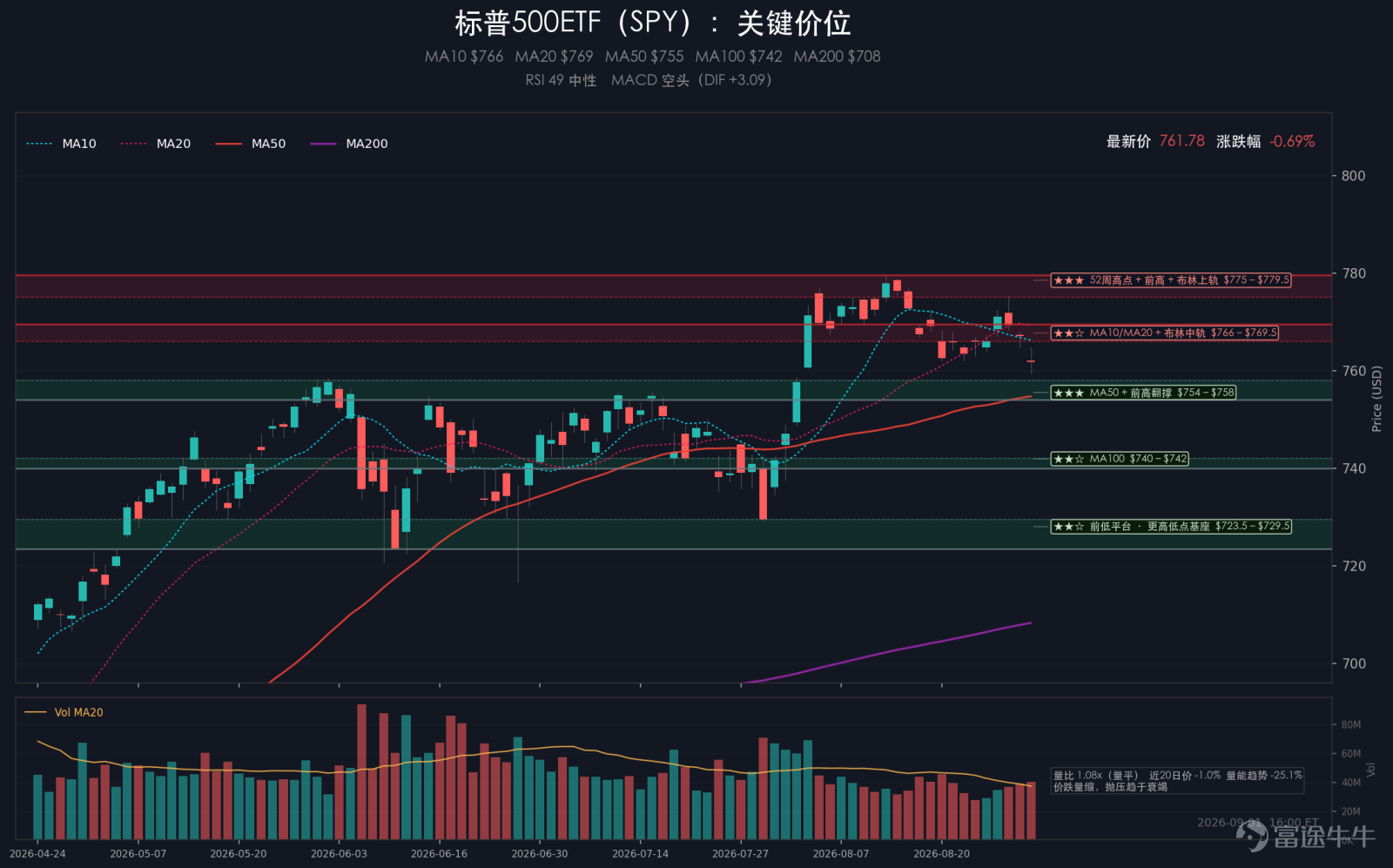
The S&P 500 (SPY) fell 0.69%, the Nasdaq 100 (QQQ) dropped 1.27%, the Dow Jones (DIA) declined 0.72%, and the Russell 2000 (IWM) slipped 1.14%. Tech and small-cap stocks faced greater pressure, while the Dow and S&P showed relative resilience; however, none of the four ETFs held their previous day's closing levels, indicating that the decline is no longer limited to a few heavyweight stocks.
2. Sector Performance
$Energy Select Sector SPDR Fund (XLE.US)$ It rose 1.27%, making it the only sector among the 11 major sectors to show significant strength. $Consumer Discretionary Select Sector SPDR Fund (XLY.US)$ down 1.72%, $The Technology Select Sector SPDR® Fund (XLK.US)$ down 1.53%, $Industrial Select Sector SPDR Fund (XLI.US)$ down 1.37%, $Materials Select Sector SPDR ETF (XLB.US)$ down 1.18%. The sharp rise in crude oil prices directly supported energy stocks, while rising interest rates simultaneously weighed on both growth and cyclical sectors.
From a sub-sector perspective, there are clearly more areas showing weakness, $First Trust Exch Traded Fund 2 Nasdaq Cybersecurity Etf (CIBR.US)$ down 3.94%, $Global X Copper Miners ETF (COPX.US)$ and $VanEck Gold Miners Equity ETF (GDX.US)$ both down 3.90%, $iShares Expanded Tech-Software Sector ETF (IGV.US)$ down 3.46%, $Global X Uranium ETF (URA.US)$ down 3.45%, $Roundhill Memory ETF (DRAM.US)$ down 3.23%, $VanEck Semiconductor ETF (SMH.US)$ down 2.05%. AI optical communication stocks generally pulled back, the memory chip segment also lacked unified support, and AI hardware failed to form a cohesive market trend.
3. The Magnificent Seven Tech Stocks
Most of the seven major tech stocks declined, with only Apple and Meta bucking the trend. Apple rose 2.61%, and Meta gained 1.08%; Tesla fell 3.22%, Amazon dropped 1.87%, NVIDIA declined 1.51%, Microsoft slipped 1.24%, and Google edged down 1.01%. On the day the CEO transition officially took effect, Apple rose against the market trend, and Meta provided some support, but the other five companies all declined, with Tesla, Amazon, and NVIDIA dragging the sector down more significantly.
4. Chinese ADRs
$KraneShares CSI China Internet ETF (KWEB.US)$ Down 0.46%, with the overall decline smaller than that of the Nasdaq. $Futu Holdings Ltd (FUTU.US)$ Down 2.34%, $Bilibili (BILI.US)$ Down 2.29%, $NetEase (NTES.US)$ down 1.40%, $JD.com (JD.US)$ Down 1.20%, $Alibaba (BABA.US)$ Alibaba fell 1.03%; $Tencent Music (TME.US)$ Up 0.24%. The sector lacked a common catalyst; cooling risk appetite mainly suppressed high-beta stocks, resulting in a relatively restrained overall pullback.
5. Cryptocurrencies
Bitcoin fell 1.68% to $77,274.01. Crypto assets remained under pressure following the rise in the US dollar and US Treasury yields. Losses in related concept stocks widened further, $Circle (CRCL.US)$ Down 6.35%, $Riot Platforms (RIOT.US)$ Down 6.34%, $Strategy (MSTR.US)$ Down 6.06%, $Coinbase (COIN.US)$ Down 6.01%, $MARA Holdings (MARA.US)$ Down 5.01%, $Robinhood (HOOD.US)$ Down 1.24%.
$S&P 500 Index (.SPX.US)$ $SPDR S&P 500 ETF (SPY.US)$ $Invesco Exchange Traded Fd Tr S&P 500 Equal Weight Etf (RSP.US)$ $NASDAQ 100 Index (.NDX.US)$ $Invesco QQQ Trust (QQQ.US)$ $Dow Jones Industrial Average (.DJI.US)$ $State Street® SPDR® Dow Jones Industrial Average® ETF Trust (DIA.US)$ $Russell 2000 Index (.RUT.US)$ $iShares Russell 2000 ETF (IWM.US)$ $Roundhill Magnificent Seven ETF (MAGS.US)$ $USD (USDindex.FX)$ $U.S. 10-Year Treasury Notes Yield (US10Y.BD)$ $iShares 20+ Year Treasury Bond ETF (TLT.US)$ $XAU/USD (XAUUSD.CFD)$ $SPDR Gold ETF (GLD.US)$ $CBOE Volatility S&P 500 Index (.VIX.US)$ $CME-Bitcoin RR Futures (SEP6) (BTCmain.US)$ $iShares Ethereum Trust ETF (ETHA.US)$ $NVIDIA (NVDA.US)$ $Tesla (TSLA.US)$ $Meta Platforms (META.US)$ $Amazon (AMZN.US)$ $Alphabet-C (GOOG.US)$ $Microsoft (MSFT.US)$ $Apple (AAPL.US)$
Risk Disclaimer: The above content only represents the author's view. It does not represent any position or investment advice of Futu. Futu makes no representation or warranty.Read more


Comments
to post a comment
6