[Welcome Newcomers] Investment Beginner's Hub: Your trading journey starts here with ease

[Must-Read for New Investors] Do US stock movements hinge on the Non-Farm Payrolls report? Decoding the jargon in plain language, with one strategy to balance offense and defense and protect your portfolio!
On the first Friday of every month, do you always see financial news overwhelmingly focusing on two words:"Non-Farm"?
Then we saw US stocks swing wildly, surging one moment and plunging the next, with even gold and US Treasuries experiencing crazy volatility.
What exactly is "Non-Farm"? Why does it have such a huge impact? As investing beginners, how should we interpret this report to help grow our assets? Today's article breaks it all down for you!
1. What is Non-Farm? (A Simple Analogy)
"Non-Farm Payrolls" (NFP), simply put,is the total number of people in the US, excluding farmers, who found new jobs last month.
You can imagine the "US economy" as a super-large corporation:
If this company hires a large number of people every month ➡️ It indicates strong business performance and ample cash flow for the boss (a robust economy).
If this company is barely hiring, or even laying off staff, ➡️ It signals tough business conditions and cost-cutting measures (indicative of an economic recession).
As the US is the world's largest economy, the headcount of this "major corporation" directly reflects the temperature of the global economy. That’s why every savvy Wall Street heavyweight keeps a close eye on this report each month!
II. Why is this Friday's "Non-Farm Payrolls" report particularly important?
Because this "August report card" will determine the Fed's ultimate policy move at its September interest rate meeting!
At last Friday's global central bank symposium, new Fed Chair Kevin Warsh struck a notably hawkish tone. He reiterated the 2% inflation target and warned that if inflation does not cool quickly enough, the Fed still has "work to do." These remarks immediately dampened market sentiment and fueled expectations of further rate hikes.
Following this, Fed Governor Waller will share his views on the inflation outlook this Thursday night. Unlike Warsh, who deliberately keeps his language vague and avoids clear "forward guidance," Waller’s statements often provide more substantive clues, acting like a "leak" before the Fed's major exam. The market will use this to recalibrate expectations for whether the Fed will hike rates, cut rates, or hold steady in September.
andThis Friday's Non-Farm Payrolls data will be the key test of whether these "statements and rhetoric" can translate into actual action.
Looking back at July's NFP report, the data unexpectedly weakened, with non-farm payrolls actually decreasing by 23,000 (triggering market concerns about the economy cooling too rapidly). The latest Reuters survey expects August non-farm payrolls to increase by 58,000, with the unemployment rate holding steady at 4.1%. This suggests the market anticipates a mild rebound and recovery in the labor market.
💡 Note for beginners: Does "mild rebound and recovery" mean stocks will rise? How should beginners interpret this?
In short: it may not lead to a massive surge, but it is definitely a "shot in the arm"! The drop of 23,000 in July's non-farm payrolls briefly sparked market panic, raising fears that the US economy was stalling into recession. However, the expected increase of 58,000 jobs in August indicates that the labor market is stabilizing and gradually improving.
For investors, the healthiest state is neither an economy that is "overheating" (which would force the Fed to continue raising interest rates) nor one that is "freezing cold" (signaling a recession), but rather a "moderate recovery" like we are seeing now. As long as it proves that the economy is not in recession and corporate earnings have solid support, the stock market will naturally have the momentum to stop falling and rebound!
3. Market Outlook: "Three Major Scenarios" for the Non-Farm Payrolls Release
For our holdings in stocks, bonds, or cash, what we hope for most is not "the stronger the economy, the better," but rather "moderate cooling without recession" (commonly known as the Goldilocks economy).
Below are three possible scenarios for this Friday, directly corresponding to your investment strategy:
🌟 Scenario 1: Moderate Cooling (Most optimistic, most bullish for US stocks) 📈)
Data Performance: New job additions around the expected 58,000, with wage growth slowing down.
Beginner's Take: This is the "golden balance point" most favorable to risk assets! It proves that the US economy has not fallen into recession, while also indicating that the job market is not so overheated as to require the Fed to remain "hawkish."
Investment Impact: Expectations for a September rate hike will cool down, giving US stocks a chance for a strong rebound, while bond prices should steadily recover.
⚡ Scenario 2: Employment Too Strong (Short-term Pressure, but Solid Fundamentals ☀️)
Data Performance: Non-farm payrolls significantly exceed expectations (e.g., higher than 100,000), and wage growth remains hot.
Beginner's Take: The US economy is simply too robust! Hawkish Fed officials will feel more confident: "Look, the economy is doing so well, we need to continue raising rates/keep rates high in September!" Although this may raise market concerns about higher rates lasting longer, putting short-term pressure on US stocks, it also confirms that US corporate earnings are secure, which is not a bad thing in the long run.
Investment Impact: Yields on 2-year U.S. Treasury bonds and the U.S. dollar are expected to rise further. U.S. equities and bond prices may face downward pressure in the short term, while cash (USD) will strengthen.
❄️ Scenario 3: Poor employment data (recession fears resurface ❄)
Data Performance: Job growth is near zero or even records negative growth again.
Beginner's Interpretation: The market will worry that July's weakness was not an isolated incident, shifting focus from "will there be a rate hike?" to "is the U.S. heading for a recession?" Market volatility is likely to increase in the short term.
Investment Impact:The market will fall into panic. Risk assets (stocks) may face sell-offs, while capital floods into safe-haven assets (such as long-term U.S. Treasuries and gold).
4. Balanced Offense and Defense! How Should Beginners "Strategize" This Week?
Facing September, when clarity is expected to emerge, blindly betting on one-sided moves is inadvisable. The smarter approach is to allocate your capital...A balanced portfolio strategy for both offense and defense:
🛡️ Defensive Side: Stable assets to enhance portfolio resilience
If you wish to avoid excessive short-term market volatility, consider increasing the allocation to defensive assets with relatively stable performance:
Cash Management Account (e.g., Futubull's Cash Bao): Earns daily interest on non-trading days, can be used directly for IPO subscriptions, or for immediate stock trading when market opportunities arise, offering high flexibility.
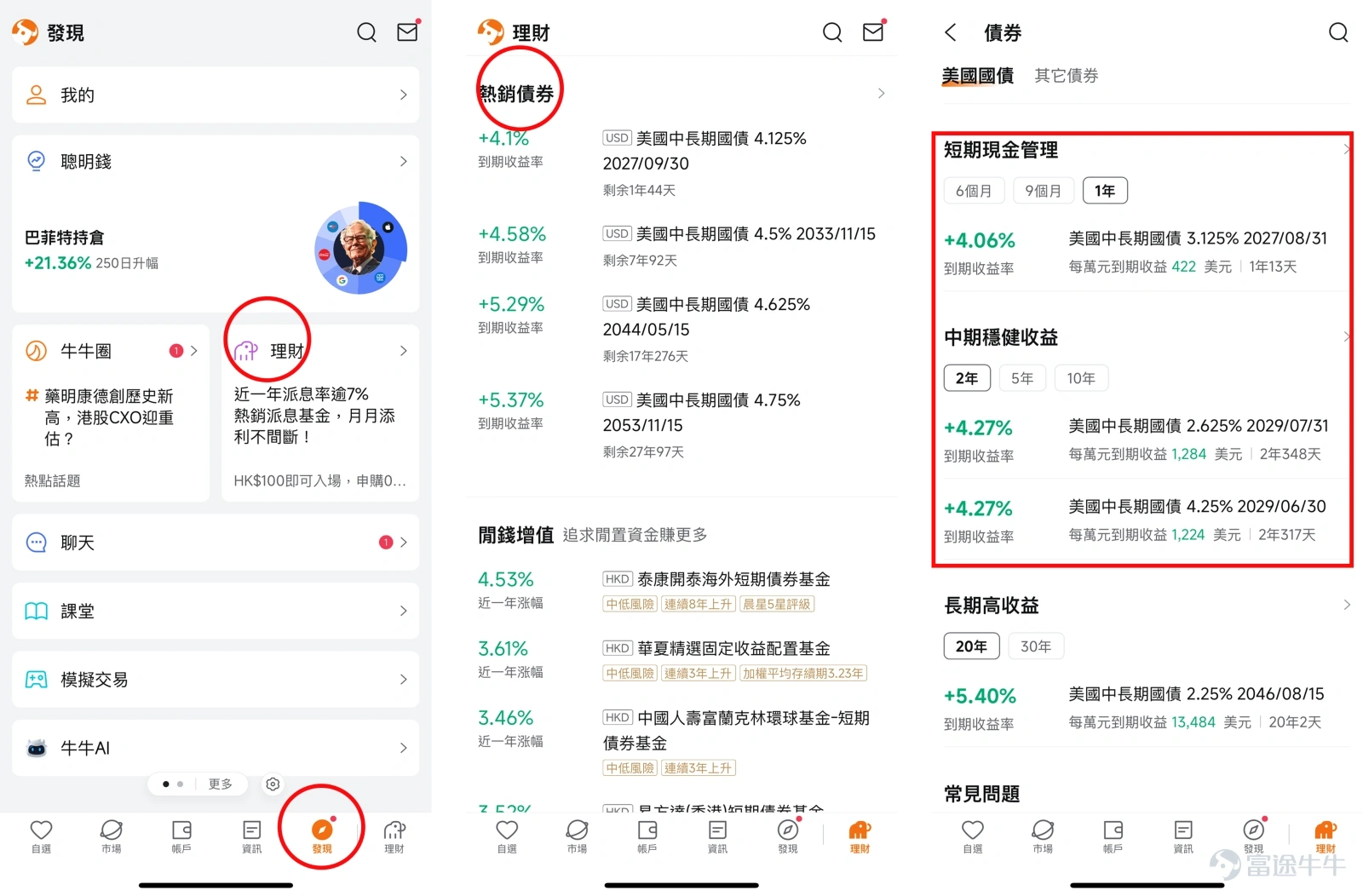
U.S. Treasury Bonds maturing within 2-3 years: Compared to long-term U.S. Treasuries with 10- or 30-year maturities, bonds maturing within 2-3 years are less sensitive to changes in market interest rates (prices are very stable, with almost no price fluctuation risk). Additionally, they have a shorter lock-up period and higher liquidity. The government pays fixed coupon interest semi-annually, and 100% of the principal is returned at maturity. With a low entry threshold starting at US$1,000, they are ideal as a "safe haven" for short-term hedging funds.

⚔️ Offensive Side: Dollar-cost averaging into broad U.S. market indices / Technology-themed ETFs (proactive positioning, awaiting rebound)
If you can tolerate a certain level of volatility, are bullish on the long-term value of economic development, and wish to capture flexible returns by following market trends, you can split this offensive portion of your assets into two parts:One part tracking the broader market, and the other following high-sentiment, high-growth thematic sectors.. Meanwhile,"Monthly Investment Plan + ETFs"are excellent tools for diversifying risk within this allocation strategy.
Monthly investments in broad-market index ETFs(such as $Vanguard S&P 500 ETF (VOO.US)$、 $Invesco QQQ Trust (QQQ.US)$): ignore short-term volatility, use dollar-cost averaging through regular fixed-amount investments to ride the long-term growth of the U.S. economy. Leverage the Monthly Investment Plan ($0 commission on fractional share monthly investments for HK and US stocks) to cultivate a habit of consistent investing. If the broader market declines due to factors like Waller's comments or non-farm payroll data, the monthly investment mechanism will automatically help you buy more shares at lower prices; patiently wait for the market to recover, and you will be among the first to reap the benefits of long-term compound interest.

Data screening criteria: Based on the closing prices of HK and US stocks on July 23, 2026, we selected non-leveraged HK and US ETFs with the largest asset sizes within the "Index ETF" section of the Futubull app, specifically those tracking the S&P 500 and Nasdaq 100 indices respectively. The monthly investment date is the 1st of each month. Cumulative Return = (Latest Closing Price × Total Shares Accumulated) − (Monthly Investment Amount × Number of Investment Periods), rounded to the nearest whole number. The calculation excludes buying/selling fees. Exchange rate: HK$7.8 = US$1. Data source: Futubull. Data as of: July 23, 2026. Past performance does not indicate future results. The market involves risks; please invest with caution.
Focus on popular thematic ETFs (e.g., AI, healthcare, gold ETFs, etc.): If you are bullish on the elastic returns of themes like technology, healthcare, or gold, can tolerate significant short-term volatility, but are unsure how to pick individual stocks, you can allocate a portion of your capital to accumulate thematic ETFs in batches. This allows you to capture upside potential while leveraging the diversification benefits of ETFs to minimize the risks associated with holding single stocks.

We have previously published detailed articles on how to invest in U.S. broad-market indices and related thematic ETFs. Interested readers can click the titles below to jump directly to the content:
💡 Summary:
Although Waller's hawkish stance briefly cooled the market, the true policy trump cards will be revealed this week by "Waller" and the "Non-Farm Payrolls" data.
Facing the critical juncture in September, the best strategy for novices is not to "stay on the sidelines with empty positions," but to adopt a "balanced offensive and defensive approach": secure steady interest income on one hand, and make regular monthly investments at low levels on the other. This ensures you can advance or retreat safely, regardless of fluctuations in Non-Farm Payrolls or other macroeconomic data!
Risk Disclaimer: The above content only represents the author's view. It does not represent any position or investment advice of Futu. Futu makes no representation or warranty.Read more

Comment (1)
to post a comment
29
13