[Welcome Newcomers] Investment Beginner's Hub: Your trading journey starts here with ease
The Federal Reserve (Fed) will release the FOMC Minutes tomorrow night. Many new investors may wonder: What does this have to do with my portfolio? People often only notice that their account assets always experience a wave of volatility around the release of the rate decision minutes! This undoubtedly leaves many novices exclaiming that they "can't handle the pressure."
Facing the impending volatile market, do novices really have no choice but to "anxiously wait" or "bet on luck"?
Today, we will deeply dissect the underlying "monetary transmission mechanism"and provide you with a practical "capital defense guide"!
🔍 1-Minute Explainer: Why does your account shake as soon as the Fed Minutes are released?
To understand stock market volatility, we first need to clarify the "food chain relationship" between the Federal Reserve (Fed) and the stock market:
The Fed controls the monetary "faucet": The Fed's policies determine US dollar interest rates. When inflation is high, the Fed tends to maintain high interest rates (or even hike them) and conduct "balance sheet reduction" (reducing liquidity in the market).
The FOMC Minutes are the "truth tape": The minutes to be released tomorrow night record the true policy stance of decision-making officials behind the scenes. Investors will scrutinize these minutes with a magnifying glass, attempting to guess whether interest rates will be cut or remain high in the future. Different speculations based on these signals will further transmit to the stock market, triggering market volatility.
We have previously explained in detail the "transmission chain of interest rate changes—from the Fed to your stocks." Interested readers can click the link below to read more:
📈 Compounded by "soaring US Treasury yields": Why is the current investment environment becoming increasingly complex?
In addition to tomorrow night's Fed minutes, another factor putting significant pressure on the stock market recently is the continued rise in US Treasury yields.
Currently, the yield on the US 30-year Treasury bond $U.S. 30-Year Treasury Bonds Yield (US30Y.BD)$ has risen to 5.31% a high level (marking the highest closing level since June 2007), while the yield on the 10-year US Treasury bond $U.S. 10-Year Treasury Notes Yield (US10Y.BD)$ has also risen to 4.725% 。
📊 Why are U.S. Treasury yields continuing to rise?
This reflects multiple market concerns:
1. High inflation and geopolitical tensions: forcing the market to expect short-term interest rates to remain elevated for an extended period.
2. The AI investment boom has triggered a surge in corporate bond issuance: Tech giants are issuing bonds to secure funding, leading to shrinking buyer demand for traditional long-term Treasuries.
3. Massive fiscal deficits: The U.S. federal government's annual fiscal deficit of nearly $2 trillion is continuously driving up the national debt, putting downward pressure on U.S. Treasury values.
💡 With U.S. Treasury yields at high levels, what is the impact on the stock market?
U.S. Treasury yields are regarded as the "anchor" for global asset pricing. When they surge to high levels, they impact the stock market through the following channels:
1. "Risk-free" returns are too attractive, leading to capital outflows from the stock market:
Since buying US Treasury bonds offers a guaranteed interest yield of over 5.3%, many conservative funds (such as pension funds and large institutions) choose to sell stocks and switch to Treasuries. As capital is drained from the stock market, it naturally lacks upward momentum.
2. Soaring financing costs: Impact on the real economy and tech stocks
Long-end US Treasury yields (such as the 10-year and 30-year) serve as the "pricing anchor" for global borrowing costs.
– A surge in US Treasury yields quickly transmits to the real economy, pushing up US 30-year mortgage rates and the cost of various commercial loans.
– For ordinary people, mortgages become more expensive and consumption shrinks; for businesses (especially $Invesco QQQ Trust (QQQ.US)$ tech giants that rely heavily on financing for AI R&D),a significant rise in borrowing costs will erode future profits, thereby affecting stock valuations and share prices. 。
3. Yield curve "steepening"
Recently, short-end interest rates (such as the 2-year) have remained relatively stable, but long-end rates (such as the 30-year) continue to soar, leading to The yield spread between 2-year and 30-year US Treasuries has widened further 。
This is akin to lending money to a friend. You aren't too worried about a 2-year loan (short end); but for a 30-year loan (long end), you demand higher compensation due to concerns about future hyperinflation (currency devaluation) and excessive borrowing (massive US fiscal deficits).higher interest rates than short-term instrumentsas compensation.
This indicates deepening market concerns that "long-term inflation will be hard to bring down and fiscal deficits are spiraling out of control." Rising long-term uncertainty is making the overall macro investment environment increasingly complex.
Under the triple pressure of "geopolitical tensions, high US Treasury yields, and uncertain Fed policy," investors who blindly follow trends and trade frequently risk getting hit from both sides in a volatile market.
This is whereWe need to learn how to add a safety cushion to our investments, achieving both offensive and defensive capabilities in volatile markets!
🛡️ Strategy 1: If you seek stable returns, consider focusing on US Treasuries with maturities of "2 years or less"
US Treasuries are essentially "IOUs" where you lend money to the US government. Backed by the full faith and credit of the US government, they have never defaulted in history and are regarded as the safest risk-free assets globally.
– The only risk lies inIf you need to sell early due to an urgent cash requirement before maturity, you may incur losses from the bid-ask spread due to market price fluctuations at that time.
💡 Why choose US Treasury bonds with maturities within 2 years?
Because compared to long-end US Treasuries with 10-year or 30-year maturities,Treasury bonds with maturities within 2 years are less sensitive to changes in market interest rates(prices are very stable, with almost no volatility risk). Meanwhile, they have a short capital lock-up period and higher liquidity. After purchase, the government pays fixed interest (coupons) every six months, and returns 100% of the principal at maturity, making them highly suitable as a "safe haven" for short-term hedging funds.
How to find US Treasury bonds with maturities within 2 years on Futu?
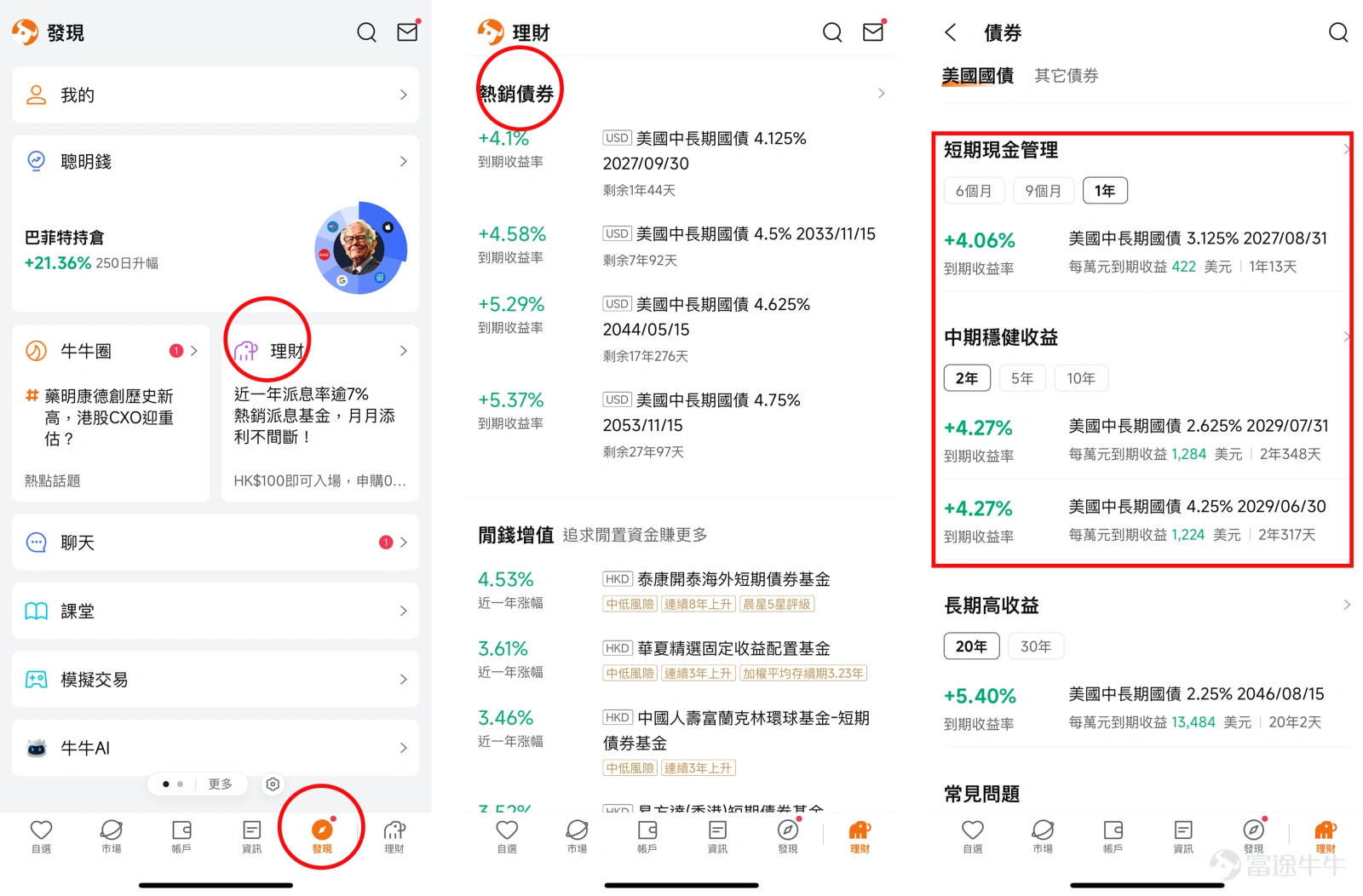
Click [Discover] — [Wealth Management] — [Hot-Selling Bonds] to enter the "Bonds - US Treasuries" page, where you can filter for US Treasuries by maturity date.

📈 Option 2: If you can accept some volatility but want to avoid losses from "buying high and selling low" in the short term: Dollar-Cost Averaging (DCA) into US Index ETFs is a great choice!
Through DCA, we can navigate through volatility and accumulate steady funds into substantial long-term wealth.
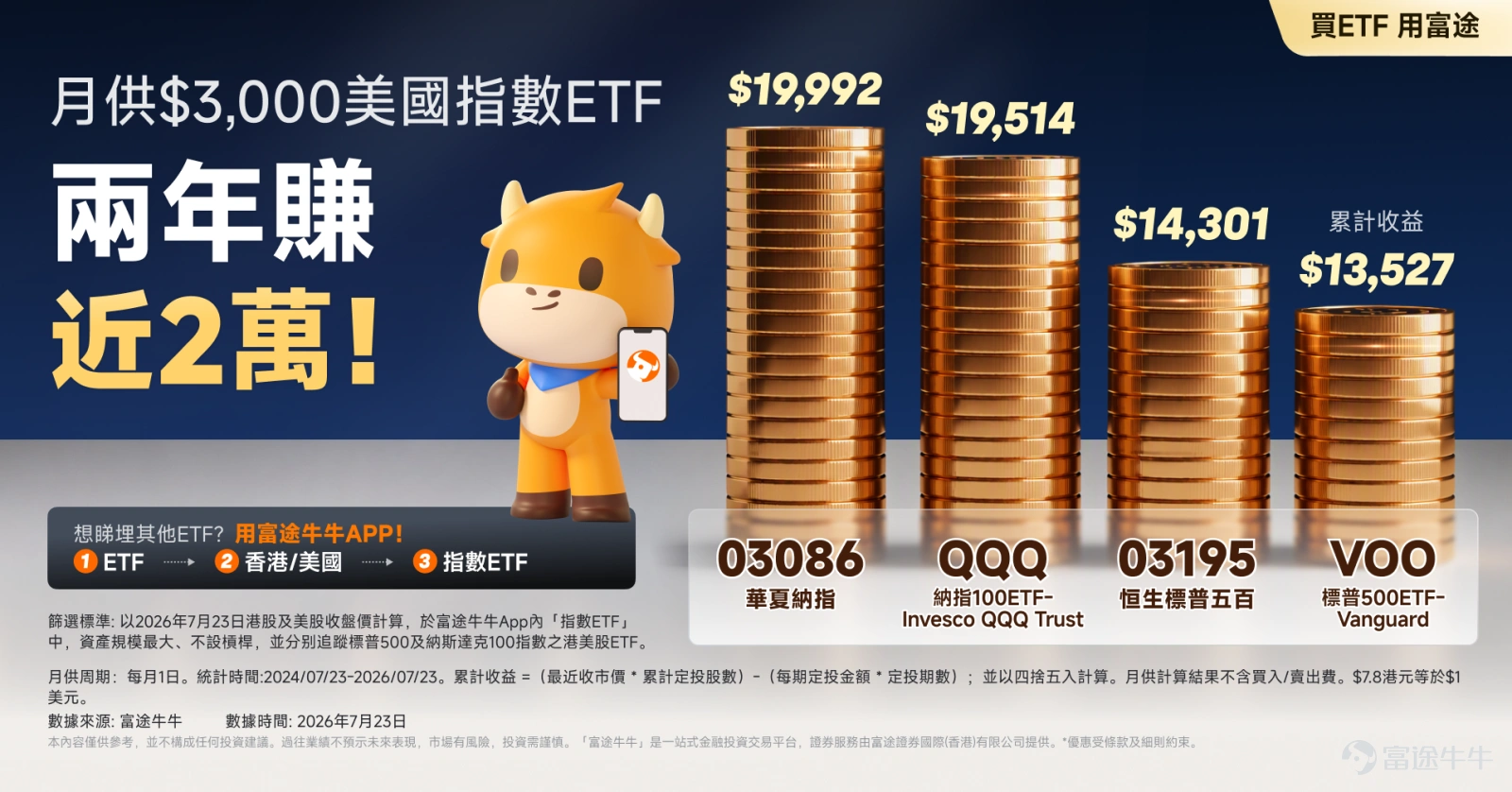
📊 Let the data speak: How much can you earn in two years by DCA-ing $3,000 monthly into US Index ETFs?
Assume you started two years ago,investing HK$3,000 every month Below are several popular ETFs that track the two core US stock indices (Nasdaq 100 and S&P 500) via monthly investment plans: $ChinaAMC NASDAQ 100 ETF (03086.HK)$$Invesco QQQ Trust (QQQ.US)$$Hang Seng S&P 500 Index ETF (03195.HK)$$Vanguard S&P 500 ETF (VOO.US)$ As of July 23, 2026 (just before this round of stabilization in the US stock market), their cumulative returns have been quite impressive:

Data selection criteria: Based on Hong Kong and U.S. market closing prices as of July 23, 2026, sourced from the 'Index ETFs' section of the Futubull app. Selected ETFs are the largest by assets under management, non-leveraged, and track the S&P 500 and Nasdaq-100 indices respectively. Monthly contributions occur on the 1st of each month. Cumulative return = (Latest closing price × Total shares purchased) − (Monthly contribution amount × Number of contributions), rounded to the nearest whole number. Transaction fees for purchases/sales are excluded. HK$7.8 equals US$1. Data source: Futubull. Data date: July 23, 2026. Past performance does not guarantee future results. Investing involves risk; please proceed with caution.
We have also provided a detailed explanation of monthly ETF investment strategies in our ETF-related columns.Interested readers can click to view:
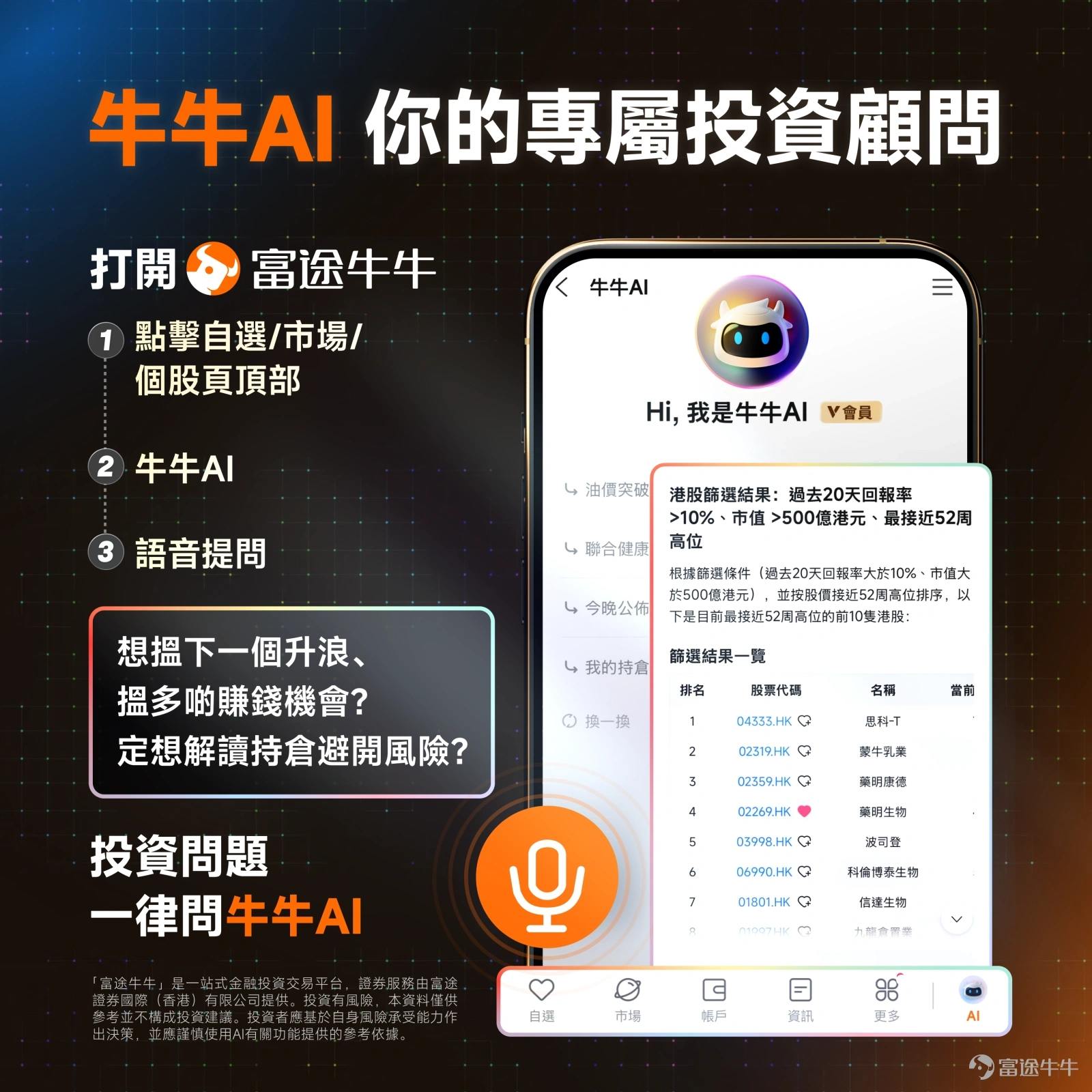
🤖 Option 3: If you are still uncertain about your portfolio, you can choose to ask AI with one click.
Futu's built-in intelligent AI assistant is always at your service. You can enter:
💬 "How should I optimize my portfolio given the current market?"
💬 "How can I make my investments more robust in volatile market conditions?" etc.
questions to instantly receive professional-grade intelligent answers.
You can evenSelect "Expert Mode"It not only provides information, stock selection, stock analysis, and portfolio analysis, but also allows you to write code, create indicators, and execute strategies, enabling a one-stop, zero-code journey from investment "inspiration" to "verification"!

💡 Conclusion
Market volatility is the norm. With the Fed minutes releasing tomorrow night, rather than going with the flow, it is better to proactively strengthen your capital defense starting today. Whether you chooseto lock in high yields with short-term US Treasuries, or opt forzero-commission monthly investments in US stock index ETFs to patiently wait for the power of compounding over time, the best investment strategy is the one that suits your risk appetite.
[Compliance Disclaimer] Note: The above content is for educational purposes and sharing historical data only, and does not constitute any investment advice, commitment, or guarantee. US Treasury bonds are backed by the credit of the US government; however, selling them before maturity may still result in principal loss due to market price fluctuations. Monthly investment plans involve dollar-cost averaging, which helps diversify timing risk but does not guarantee profits or protect against losses. Investors should carefully read the relevant sales documents for bonds and plans and assess their personal risk tolerance before making any investment decisions. Investment involves risks; please proceed with caution.
Risk Disclaimer: The above content only represents the author's view. It does not represent any position or investment advice of Futu. Futu makes no representation or warranty.Read more
Comments
to post a comment
21
15