BTC returns to $85,000! Is the crypto market heating up again?

ETF Battle Guide | BTC and crypto-related stocks are rallying in rotation. How should you choose an ETF to participate?
Recently, $Bitcoin (BTC.CC)$ A significant rebound has emerged, bringing it back into the market spotlight. As crypto prices recover, capital is beginning to flow from Bitcoin into other major digital assets like ETH and SOL. Shares of certain exchanges, mining companies, and data center-related firms have also risen in tandem.
Whenever the crypto market heats up, investors often face several questions: If you want to chase BTC, should you buy a spot ETF or a leveraged ETF? If you are bullish on ETH's long-term development, should you choose products that offer staking yields? If you prefer not to hold cryptocurrencies directly, does buying Coinbase or mining company ETFs equate to buying the coins themselves?
For investors who primarily trade Hong Kong and US stocks and are unfamiliar with crypto wallets, ETFs have become a relatively straightforward way to participate.
But issues arise along with it:Although they all have "Crypto" in their names, different ETFs may actually generate profits from completely different sources.
Some ETFs directly hold BTC or ETH, while others hold shares of exchanges, mining firms, and blockchain companies. Some products incorporate staking, while others use options or leverage to amplify returns. Their risk profiles, sources of return, and suitable holding periods all differ.
Therefore, when selecting a crypto ETF, the first step is not to pick a ticker symbol, but to ask yourself:Do you want to track coin prices, earn staking yields, or bet on the entire crypto industry chain?
Want to directly track BTC and ETH? Start by looking at spot ETFs.
This is the simplest and most straightforward category to understand.
Spot Bitcoin and Ethereum ETFs primarily hold the corresponding crypto assets directly, with the goal of closely tracking the price performance of BTC and ETH. When BTC rises, spot ETFs generally benefit in tandem; when crypto prices fall, the ETFs directly absorb the corresponding declines. In other words, the investment logic for these products is relatively clear: it is essentially a bet on the underlying crypto assets themselves.
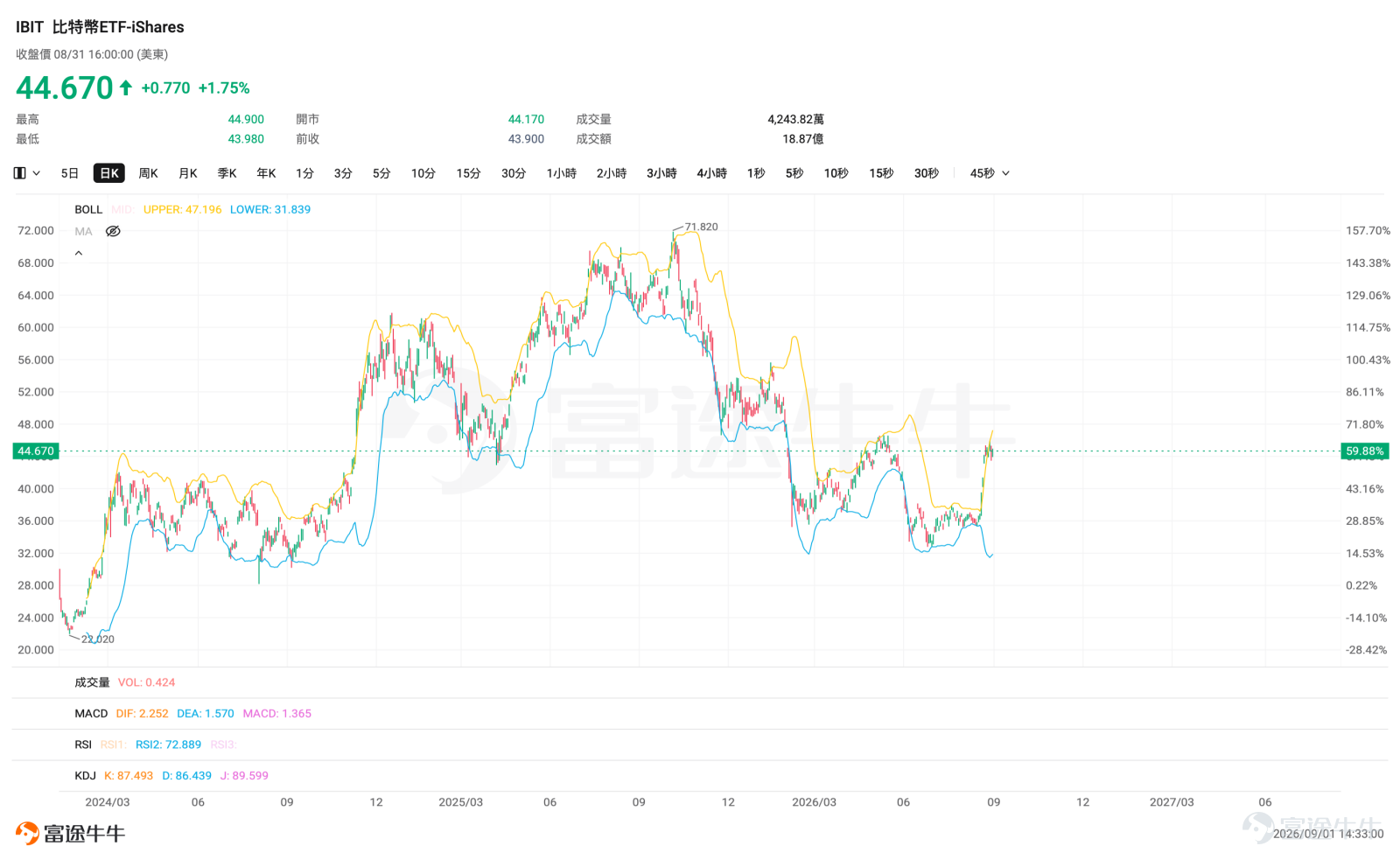
Representative US-listed products include $iShares Bitcoin Trust (IBIT.US)$, which mainly provide exposure to Bitcoin prices; for Ethereum, keep an eye on products such as $iShares Ethereum Trust ETF (ETHA.US)$. The Hong Kong market also offers spot ETFs, such as $ChinaAMC Bitcoin ETF (03042.HK)$and $ChinaAMC Ether ETF (03046.HK)$, which can be traded directly through securities accounts.
If your investment thesis is simply:"I am bullish on BTC/ETH rising."
Spot ETFs are typically the most direct choice, as you do not need to take on additional risks related to mining company profitability, corporate valuations, electricity costs, or management decisions. This is especially true for investors new to crypto assets, as spot ETFs are easier to understand and make it simpler to calculate your actual exposure.
When comparing BTC ETFs, look at assets under management (AUM), trading volume, bid-ask spreads, and management fees. Products with larger AUM and higher trading activity are generally easier to enter and exit. Management fees impact returns over the long term, so this cost becomes increasingly significant the longer you hold.
Also bullish on ETH and SOL; keep an eye on Staking ETFs.
Another recent development in crypto ETFs is the inclusion of staking.
Simply put, some ETH and SOL ETFs not only hold the underlying crypto assets but also allocate a portion to staking to generate additional yield. Staking involves locking tokens or delegating them to the network's validation mechanism to earn rewards, conceptually similar to earning network incentives while holding the asset.
There are already more direct products available in the US stock market, such as $iShares Staked Ethereum Trust ETF (ETHB.US)$, which provide exposure to both ETH prices and staking rewards; for those looking to participate in SOL, keep an eye on $Bitwise Solana Staking ETF (BSOL.US)$。
If you already plan to hold ETH or SOL for the medium term, these products offer an additional potential source of yield. When coin prices do not rise significantly, staking yields may provide some support to overall returns; if prices rise, investors have the opportunity to benefit from both price appreciation and staking rewards.
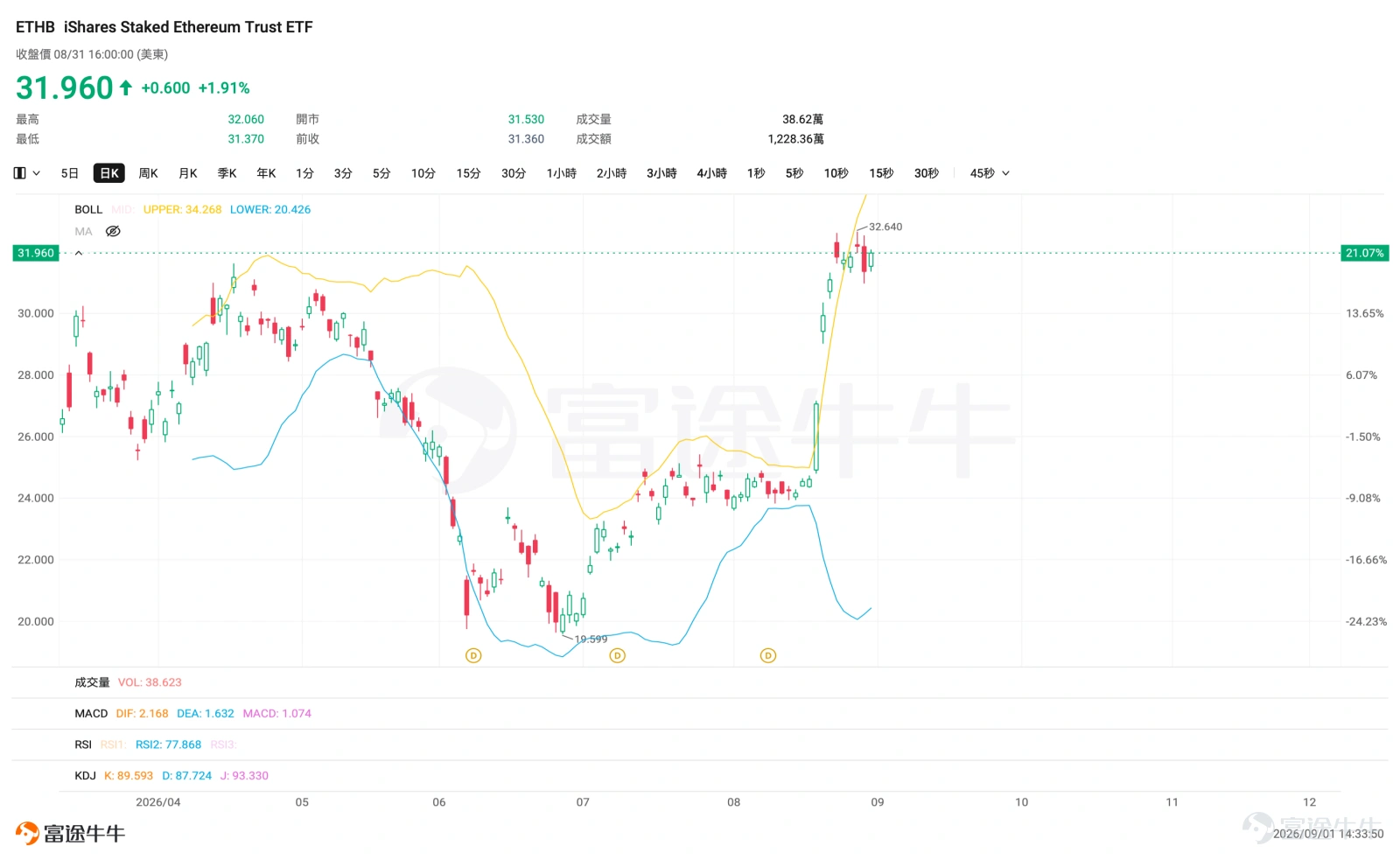
However, note thatstaking rewards are not fixed interest;yields fluctuate, and there are additional risks involving nodes and liquidity. Some assets may require a waiting period to unstake, and during sharp market declines, this liquidity constraint could impact investors' ability to react quickly.
Additionally, staking yields collected by ETFs may not be passed on to investors in full, as management fees, operational costs, and other arrangements may apply. Therefore, do not just look at the advertised reward rate; also understand the actual distribution method and total fees.
Therefore, it is not merely a "free upgrade" to standard spot ETFs, but rather a slightly more complex option. Investors should first determine whether they are willing to bear the additional structural and liquidity risks.
Want exposure to BTC, ETH, and SOL? Consider multi-asset crypto ETFs.
If you don't want to guess whether BTC, ETH, or SOL will outperform in the next cycle, the market also offers basket-style crypto asset ETFs.
The concept is similar to a "Crypto Index Fund," where a single product holds multiple mainstream crypto assets simultaneously. For example, $Bitwise 10 Crypto Index ETF (BITW.US)$ it provides exposure to a basket of large-cap crypto assets, with holdings including BTC, ETH, XRP, SOL, and others.
For investors who do not wish to bet all their capital on a single cryptocurrency, multi-asset ETFs offer a degree of diversification and eliminate the hassle of manually adjusting allocation ratios across different coins.
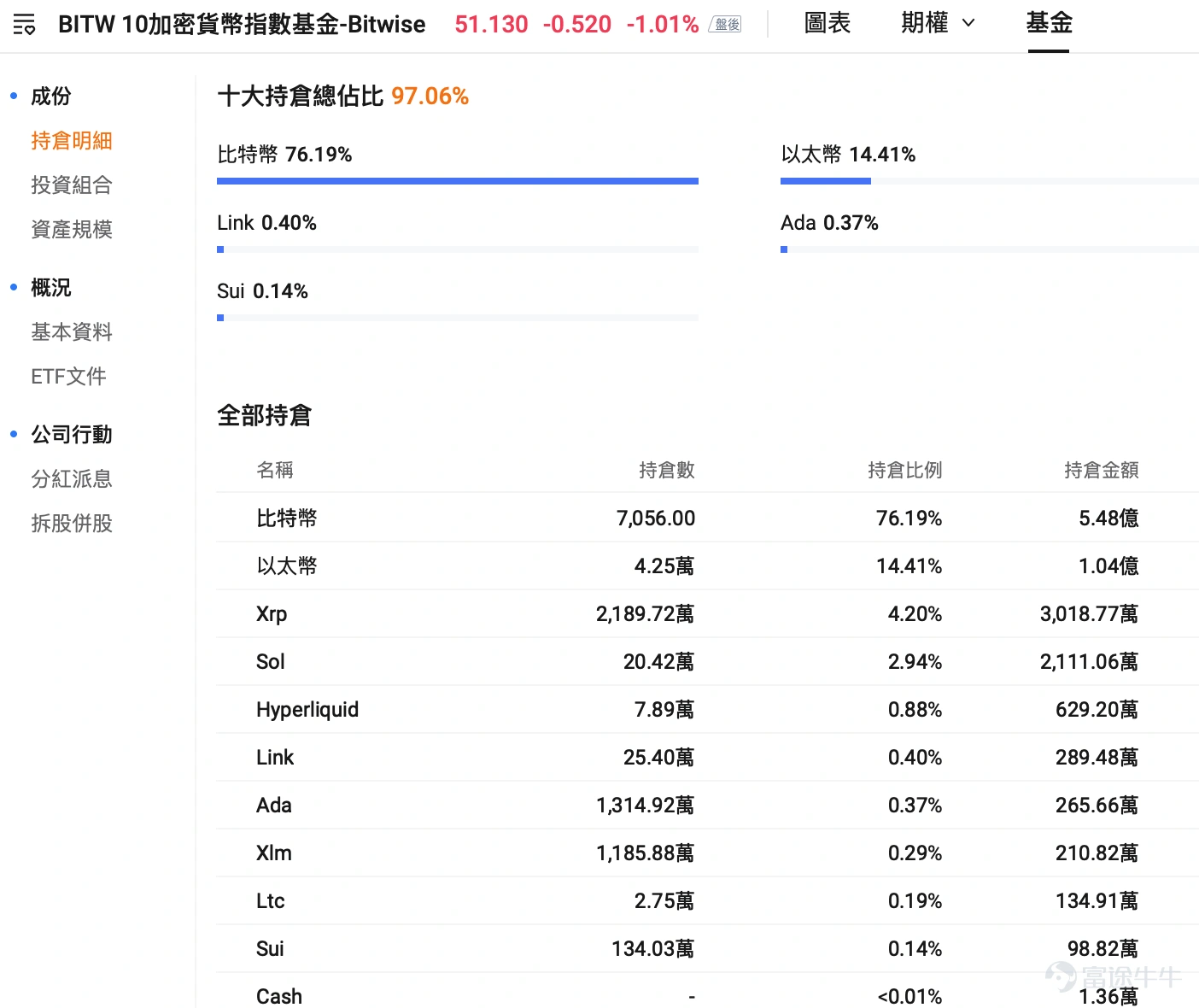
However, be aware of a common misconception:"Basket" does not mean equal weighting.
Many products still rely heavily on BTC and ETH as their core holdings, with potentially low weights for other altcoins. While some products hold multiple tokens, the majority of assets are often concentrated in the largest market-cap cryptocurrencies. Additionally, some products periodically rebalance, causing holding proportions to shift with market movements.
Therefore, before buying, carefully review the holding allocations, restructuring rules, and rebalancing mechanisms. Do not assume that investing in a "Crypto Index" means you are equally betting on the entire crypto market.
Furthermore, the volatility of multi-currency ETFs is not necessarily lower than that of spot BTC or ETH ETFs. If a product includes a higher proportion of altcoins, its overall price fluctuation may actually be greater. It is more suitable for investors who seek exposure to multiple mainstream crypto assets in one go and are willing to accept the overall volatility of the crypto market.
Don't want to buy coins directly? You can also invest in cryptocurrency-themed stock ETFs.
Another common type is crypto-themed stock ETFs, which may hold:$Coinbase (COIN.US)$ trading platforms, Bitcoin mining companies, blockchain infrastructure firms, data centers, and related technology companies.
For example, $VANECK VECTORS DIGITAL TRANSFORMATION ETF (DAPP.US)$Holdings include Coinbase, $Circle (CRCL.US)$and various other companies across the crypto industry chain such as miners; if you wish to concentrate your bets on mining firms, power supply, and AI computing infrastructure, you may consider $CoinShares Bitcoin Mining and Digital Power ETF (WGMI.US)$。
Although these products are related to crypto, they are not the same as spot BTC ETFs.
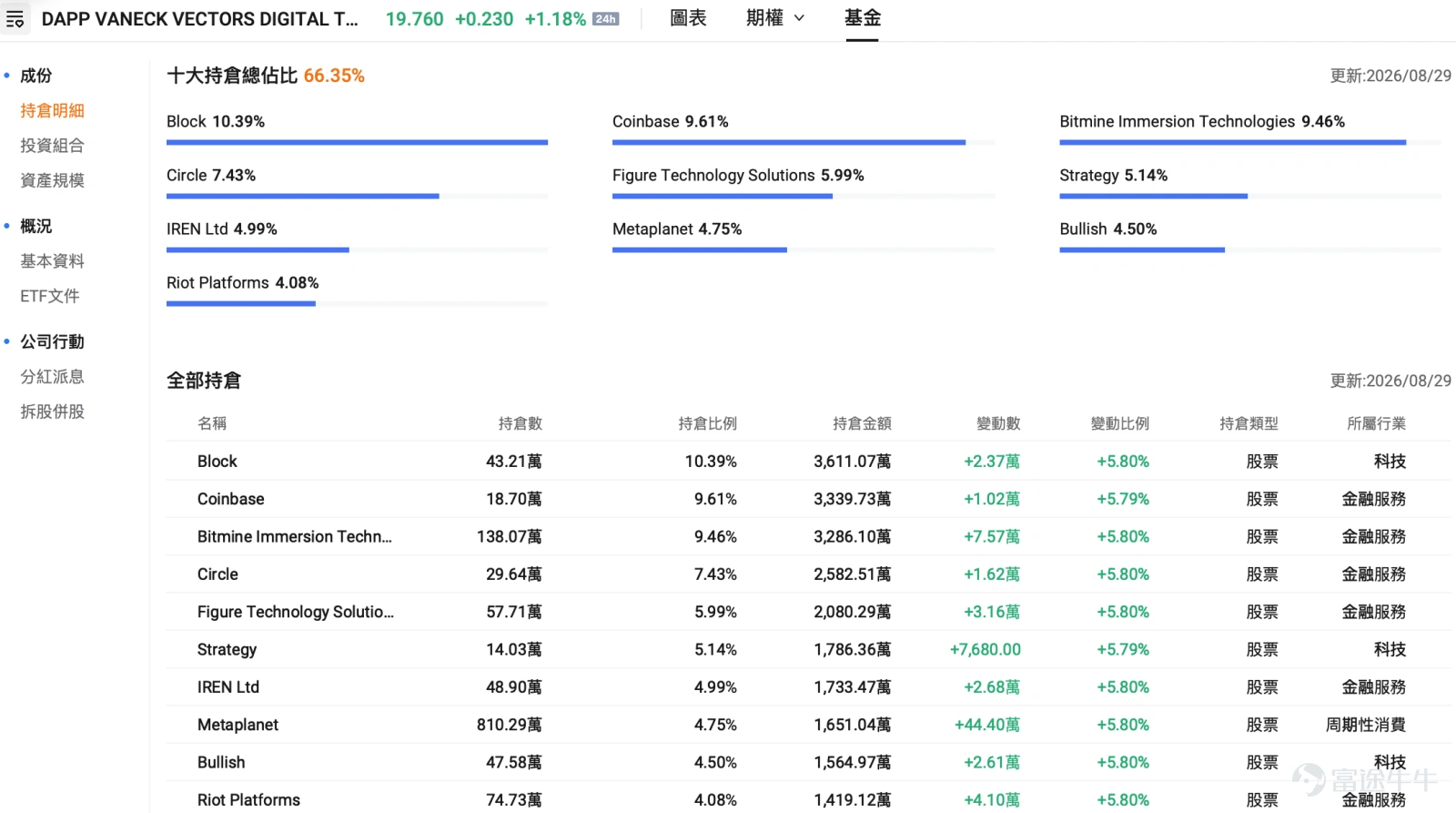
The reason is simple:BTC ETFs primarily track coin prices; crypto stock ETFs also depend on corporate earnings, valuations, and overall risk appetite in the US stock market.
For instance, trading platforms are more influenced by trading volume, fee income, regulatory policies, and user activity. As for data center companies, they may benefit simultaneously from AI and cloud computing demand, so their performance does not necessarily correlate perfectly with crypto prices.
Therefore, a rise in BTC does not guarantee a synchronous rise in mining ETFs; conversely, even if BTC trades sideways, related stocks may still see their own momentum if mining companies pivot to AI data centers and improve earnings expectations. Stock ETFs are also affected by interest rates, corporate earnings, and broader US market valuations, so investors should not rely solely on crypto price trends for judgment.
If your viewpoint is:"I am bullish on the entire crypto industry, not just the price of Bitcoin."
In that case, crypto-related stocks or ecosystem-focused ETFs align more closely with this investment logic. The advantage of these products is that they allow participation in the industry's development through the stock market, but the trade-off is that investors must analyze both corporate fundamentals and crypto market cycles, making them more complex to understand than spot ETFs.
Looking to amplify market exposure? There are also leveraged and income-oriented ETFs.
Given the high volatility of the crypto market, there are naturally many advanced ETF options available.
For example, $2x Bitcoin ETF (BITX.US)$, aiming to provide Bitcoinwith approximately 2x daily performanceleveraged exposure; if you prefer an income strategy, there are $NEOS Bitcoin High Income ETF (BTCI.US)$, which seek monthly income by combining Bitcoin-related ETPs with call option strategies.
When the market experiences a sharp short-term rally, the gains from leveraged products can be very attractive; while in sideways markets, covered call products may provide cash flow through option premiums.
However, neither of these two types should be considered a substitute for standard spot ETFs.
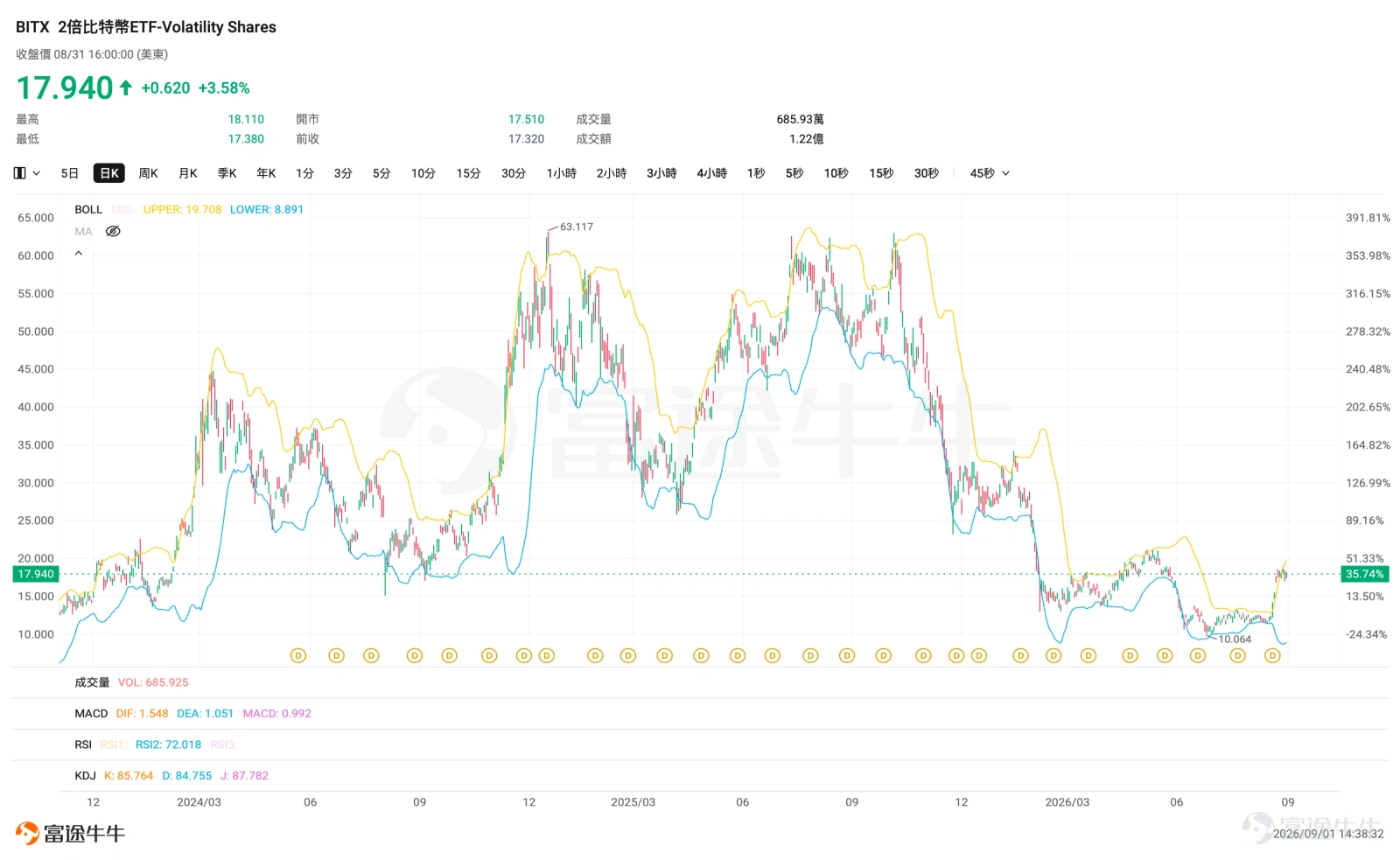
2x leveraged ETFs are short-term trading tools. Due to daily resets, the longer you hold, the more likely actual returns will deviate from "2x BTC's long-term return." In volatile markets, even if BTC eventually returns to its original price, leveraged ETFs may suffer losses due to daily volatility and the compounding effect.
Furthermore, the high distribution rate of Covered Call products does not equate to high total returns, as upside potential may be capped by selling call options. When the underlying asset rises significantly, the product may only capture part of the gain; when the market falls, option premiums may not be sufficient to offset the decline in asset value.
For beginners, it is best to understand the structure of these products before considering using them. It is crucial to distinguish that "distribution rate," "total return," and "principal fluctuation" are not the same thing. Do not mistake a product with high dividend payouts for a low-income risk tool solely based on its yield.
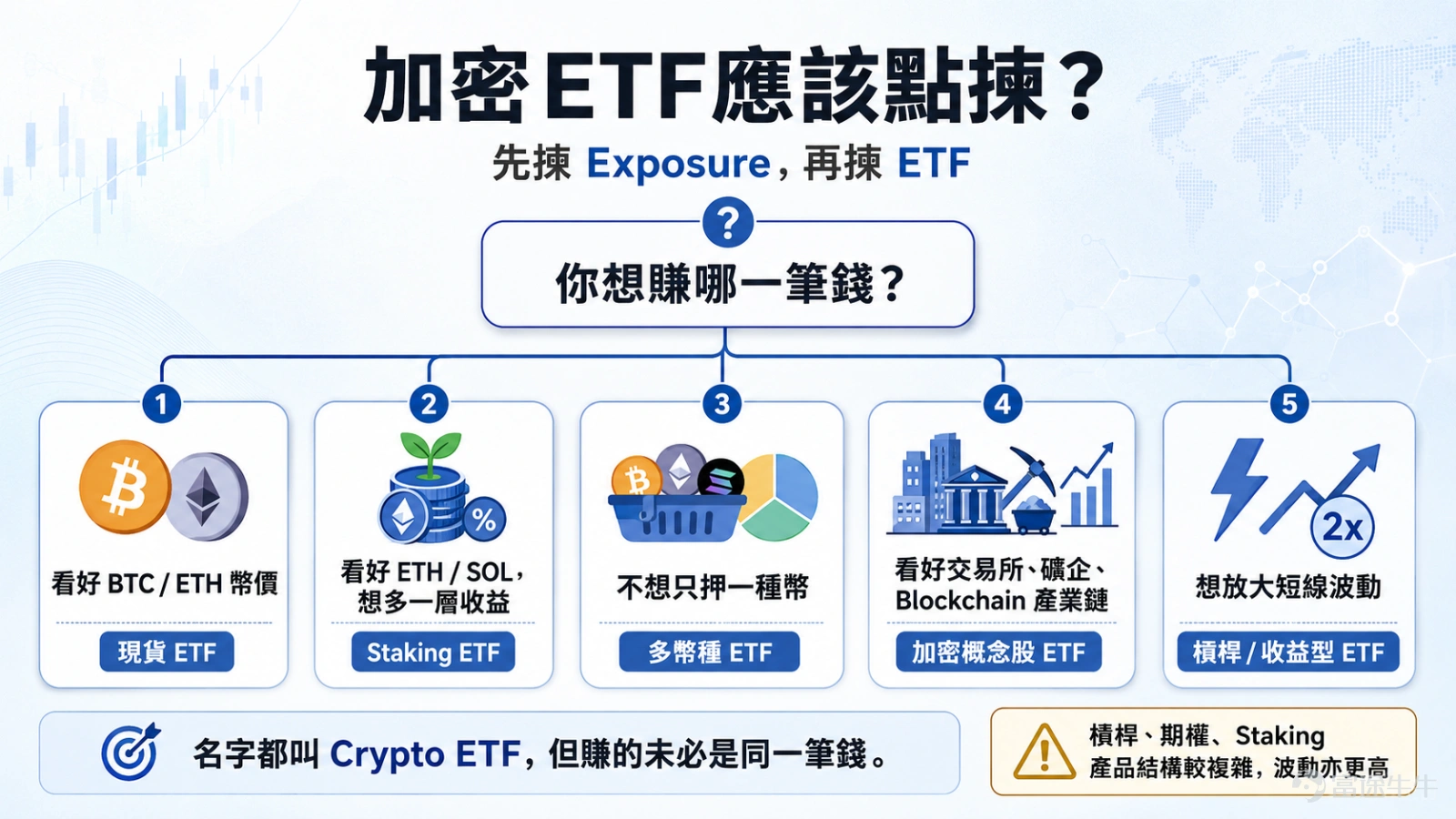
So how should you choose? First, clarify which type of profit you aim to make.
In reality, no single crypto ETF is suitable for all market conditions.
If you are simply bullish onthe prices of BTC and ETH,prioritize researching spot ETFs. These products closely track coin prices and are suitable for investors seeking straightforward exposure to the underlying assets.
If you are bullish in the medium term,on ETH and SOL, and also want an additional layer of staking rewards,you can compare staking products, but be prepared to accept additional risks such as fluctuating yields, liquidity constraints, and product structure complexities.
If you prefer not to pick individual coins, you can researchmulti-asset ETFs,but remember to first review their holdings allocation, rebalancing rules, and altcoin weightings.
If your bullish outlook is onexchanges, mining companies, blockchain infrastructure, and the entire crypto industry chain,then consider crypto-themed equity ETFs. In this case, beyond token prices, you also need to analyze corporate earnings, valuations, debt levels, and industry competition.
If you simply want to amplify short-term volatility, further researchLeveraged ETFHowever, these products are not suitable for investors adopting a "buy and hold" strategy, expecting passive appreciation over time.
For individual investors primarily focused on Hong Kong and US stocks, one advantage of ETFs is the ability to gain exposure to crypto asset markets through their existing securities accounts. However, ETFs merely change the access point; they do not eliminate the inherent high volatility of crypto assets.
When BTC rebounds sharply, related ETFs may rise rapidly; conversely, if market sentiment reverses, declines can be equally swift. Investors still need to manage their position sizes carefully to avoid over-concentration driven by short-term rallies.
Risk Disclosure: Crypto asset prices are highly volatile, and related ETFs may also be affected by liquidity, product structure, leverage, derivatives, and market sentiment. Before investing, fully understand the underlying assets and associated risks, and make decisions based on your own risk tolerance.
Risk Disclaimer: The above content only represents the author's view. It does not represent any position or investment advice of Futu. Futu makes no representation or warranty.Read more

Comment (1)
to post a comment
31
24