Circle surges 50% in August! Is the crypto-stock rally here to stay?

Demand and Market Indicators, Treasury Repo Discussions, and Quantum-Safe Preparedness—Observations on Bitcoin Market Structure
Key Takeaways
This episode of $Bitcoin (BTC.CC)$ Market focus centers on demand and trading structure, macro liquidity, and the security of financial infrastructure. $Bitcoin (BTC.CC)$ The negative value of Apparent Demand (30-day cumulative) has narrowed significantly [1,2], futures open interest has rebounded [3], and prices have regained the 50-week Exponential Moving Average (EMA) [4]. These three indicators reflect supply-demand absorption, leverage participation, and medium-to-long-term technical positioning, respectively, offering different perspectives on changes in market structure. On the policy front, the U.S. Treasury is evaluating the possibility of using the Treasury General Account (TGA) to support an expansion of Treasury repurchase agreements [6,8,9], with specific arrangements currently under assessment. The U.S. Treasury has also established a Quantum-Readiness Task Force [10,11], incorporating digital assets and emerging technology risks into the preparation framework for post-quantum cryptography migration in the financial industry.
I. Demand and Market Indicators: Supply-Demand Gap Narrows, Futures Participation Rebounds
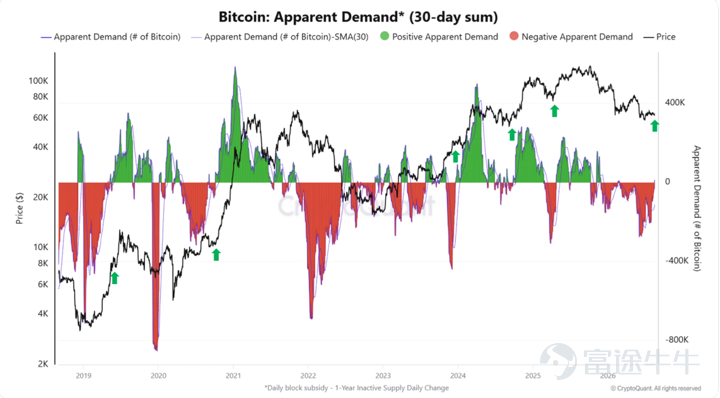
$Bitcoin (BTC.CC)$ Apparent Demand (30-day cumulative) has gradually recovered from its lows in late July 2026. CryptoQuant data indicates that this metric dropped to approximately -206,000 BTC on July 23, before narrowing to around -5,000 BTC, approaching its first return to positive territory since February 26. [1, 2]
According to CryptoQuant's methodology, Apparent Demand is calculated as "Daily Block Subsidy minus Daily Change in 1-Year Inactive Supply." This metric estimates the market's absorption of Bitcoin's new issuance and long-term inactive supply re-entering circulation. The recent narrowing of negative values indicates that the gap between new/re-circulating supply and market absorption has narrowed, with readings returning to near the zero axis.[1]
Research data also provides statistics on historically independent instances where Apparent Demand turned positive. Results show that within 60 days following such events, Bitcoin recorded positive returns approximately 78% of the time, with a median return of about 18.1%.[2] These figures serve as historical context for observing current demand changes, though their practical reference value depends on the duration and magnitude of the indicator remaining positive.
Regarding futures, the CryptoQuant chart "Bitcoin: Open Interest - All Exchanges, All Symbol" shows[3] that Bitcoin's open interest across all exchanges and contract types has rebounded to approximately $25.1 billion. An increase in open interest signifies a rise in unsettled derivative positions in the market, reflecting a recovery in trading and leverage activity. The directional bias (long/short) of these new positions can be further analyzed by combining funding rates, basis spreads between spot and futures, liquidation volumes, and the distribution of long and short holdings.
On the technical indicators front, Cointelegraph cited TradingView data stating that Bitcoin's weekly candle closed above the 50-week Exponential Moving Average (EMA) for the first time since November 2025, with the moving average situated around $77,752 at the time of reporting. The 50-week EMA is a commonly used reference for medium-to-long-term market trends. The weekly close above this level indicates that prices have returned above the technical zone that previously acted as resistance; subsequent weekly performance and market support near the moving average will likely influence the sustainability of this signal.
![Key Takeaways This episode of $Bitcoin (BTC.CC)$ Market focus centers on demand and trading structure, macro liquidity, and the security of financial infrastructure. $Bitcoin (BTC.CC)$ The negative value of Apparent Demand (30-day cumulative) has narrowed significantly [1,2], futures open interest has rebounded [3], and prices have regained the 50-week Exponential Moving Average (EMA) [4]. These three indicators reflect supply-demand absorption, leverage participation, and medium-to-long-term technical positioning, respectively, offering different perspectives on changes in market structure. On the policy front, the U.S. Treasury is evaluating the possibility of using the Treasury General Account (TGA) to support an expansion of Treasury repurchase agreements [6,8,9], with specific arrangements currently under assessment. The U.S. Treasury has also established a Quantum-Readiness Task Force [10,11], incorporating digital assets and emerging technology risks into the preparation framework for post-quantum cryptography migration in the financial industry. I. Demand and Market Indicators: Supply-Demand Gap Narrows, Futures Participation Rebounds $Bitcoin (BTC.CC)$ Apparent Demand (30-day cumulative) has gradually recovered from its lows in late July 2026. CryptoQuant data shows that...](https://nnqimage.futunn.com/sns_client_feed/12917760/20260831/web-1788145337215-LzFwxq5V90.png/big?area=2&is_public=true&imageMogr2/ignore-error/1/format/webp)
Chart: Bitcoin Apparent Demand (30-day Cumulative Value) and Bitcoin Price Trend
Note: Apparent Demand is calculated as "Daily Block Subsidy minus Daily Change in 1-Year Inactive Supply"; green and red represent positive and negative Apparent Demand, respectively.
Source: CryptoQuant, as of August 19, 2026.
II. Treasury General Account and Treasury Repurchase Agreements: Potential Funding Arrangements Still Under Assessment
The Treasury General Account (TGA) is the primary cash account held by the U.S. Department of the Treasury at the Federal Reserve, used for receiving government revenue and making government expenditures. According to Federal Reserve and FRED WTREGEN data, the TGA's weekly average balance stood at $953.612 billion as of August 19, 2026.[7]
In the "Quarterly Refunding Statement" released on August 5 by Brian Smith, Deputy Assistant Secretary for Federal Finance, the U.S. Treasury used a cash balance assumption of $950 billion for the end of September and projected that the TGA could reach approximately $1.05 trillion by the end of October, with a fluctuation range of about $50 billion.[5] A higher TGA balance provides the Treasury with greater operational flexibility for cash and debt management.
Regarding Treasury repurchase agreements, the U.S. Treasury confirmed on August 19 that, effective September 9, 2026, it will raise the single-operation limit for liquidity-supporting repo operations on 10- to 20-year and 20- to 30-year nominal Treasuries from $2 billion to at least $4 billion. This arrangement will remain in effect for the remainder of the current quarterly refinancing period, until November 4. The Treasury stated that the expansion aims to provide greater liquidity support for long-end nominal Treasuries.[6]
Media outlets later cited two senior U.S. Treasury officials stating that the Treasury is evaluating the inclusion of the Treasury General Account (TGA) as a potential funding source for expanding Treasury repo operations[8,9]. Treasury Secretary Scott Bessent subsequently indicated that the expanded liquidity-supporting repo operations would take effect on September 9, and the current Treasury auction schedule would proceed as planned. The scale, timing, and specific mechanisms for TGA usage are currently under evaluation.
If a portion of TGA funds is ultimately used to repurchase off-the-run securities, the Treasury's additional absorption of these instruments could improve market depth and trading liquidity at the long end of the curve. If pressure on long-end yields eases accordingly, assets sensitive to financial conditions, such as equities and Bitcoin, may benefit from a relatively stable market environment. The actual transmission effect will depend on the scale of repos, the method of TGA replenishment, and subsequent Treasury issuance plans.
![Key Takeaways This episode of $Bitcoin (BTC.CC)$ Market focus centers on demand and trading structure, macro liquidity, and the security of financial infrastructure. $Bitcoin (BTC.CC)$ The negative value of Apparent Demand (30-day cumulative) has narrowed significantly [1,2], futures open interest has rebounded [3], and prices have regained the 50-week Exponential Moving Average (EMA) [4]. These three indicators reflect supply-demand absorption, leverage participation, and medium-to-long-term technical positioning, respectively, offering different perspectives on changes in market structure. On the policy front, the U.S. Treasury is evaluating the possibility of using the Treasury General Account (TGA) to support an expansion of Treasury repurchase agreements [6,8,9], with specific arrangements currently under assessment. The U.S. Treasury has also established a Quantum-Readiness Task Force [10,11], incorporating digital assets and emerging technology risks into the preparation framework for post-quantum cryptography migration in the financial industry. I. Demand and Market Indicators: Supply-Demand Gap Narrows, Futures Participation Rebounds $Bitcoin (BTC.CC)$ Apparent Demand (30-day cumulative) has gradually recovered from its lows in late July 2026. CryptoQuant data shows that...](https://nnqimage.futunn.com/sns_client_feed/12917760/20260831/web-1788145344766-8DWb5lYxPF.png/big?area=2&is_public=true&imageMogr2/ignore-error/1/format/webp)
Chart: Weekly Average Balance of the U.S. Treasury General Account (TGA)
Note: The chart uses the FRED series WTREGEN, denominated in millions of U.S. dollars, with weekly frequency and not seasonally adjusted.
Source: Board of Governors of the Federal Reserve System, FRED, as of August 19, 2026.
3. Quantum-Safety Preparedness: U.S. Treasury Establishes Public-Private Collaboration Framework
On August 24, 2026, the U.S. Treasury announced the launch of the Quantum-Readiness Task Force. Adopting a public-private partnership mechanism, the task force aims to facilitate an orderly and operationally resilient transition of the U.S. financial sector to quantum-resistant technologies, aligning with the G7 Cyber Experts Group's roadmap for post-quantum cryptography migration.[10]
According to the Treasury announcement, the task force will operate along three workstreams: 'Industry Coordination and Post-Quantum Cryptography Migration,' 'Third-Party and Vendor Readiness,' and 'Digital Asset and Emerging Technology Risks.' Participants include government agencies, financial institutions, financial market infrastructures, technology vendors, and other private sector entities. Related efforts include identifying critical dependencies, enhancing cryptographic agility and interoperability, strengthening the protection of critical financial infrastructure, and addressing implementation issues related to third-party dependencies and digital assets.[10,11]
The long-term development of quantum computing may impact some of the public-key cryptography and digital signature mechanisms currently used in the financial system. As digital assets involve technical aspects such as private key management, transaction signing, custody, and settlement, they have been included in the 'Digital Asset and Emerging Technology Risks' workstream. This arrangement incorporates digital asset security issues into the financial industry's post-quantum cryptography migration preparedness, providing a foundation for cross-agency coordination in identifying critical dependencies, establishing technical standards, and advancing system migration.
Conclusion:
Based on the above observations, recent market and policy changes mainly include:
· $Bitcoin (BTC.CC)$ The negative value of Apparent Demand (30-day cumulative) has narrowed significantly. Historical statistics serve as a background reference for changes in demand structure, and the persistence of the current signal depends on subsequent Apparent Demand readings;
· "Bitcoin: Open Interest - All Exchanges, All Symbol" shows a rebound in open interest size, with the weekly chart also reclaiming the 50-week Exponential Moving Average (EMA). These two indicators reflect leverage participation and technical positioning, respectively;
· The U.S. Treasury has expanded liquidity support repo operations for nominal Treasuries in the 10–20 year and 20–30 year tenors. The Treasury General Account (TGA) is currently being evaluated as a potential funding source;
· The Quantum-Ready Task Force has listed "Digital Assets and Emerging Technology Risks" as one of its three workstreams, and coordinated preparations for post-quantum cryptography migration within the financial industry are beginning to advance.
Demand data, derivatives positions, and technical indicators provide different perspectives for observing Bitcoin's market structure. The U.S. Treasury's Treasury repo arrangements and quantum readiness efforts involve macroeconomic financial conditions and long-term technical security preparations, respectively; their subsequent impacts will unfold gradually depending on specific operational plans, technical standards, and industry participation.
China AMC Cryptocurrency ETF Series – Compliant, Convenient, and Diversified Allocation Tools
Investors do not need to manage private keys or open accounts on virtual asset trading platforms directly; they can participate in regulated virtual asset ETF investments through Hong Kong stock trading accounts. However, these funds still involve risks related to virtual asset trading platforms, custody, extreme price volatility, tracking error, premium/discount trading, and multi-counter trading. Investors should carefully review the fund offering documents and the Product Key Facts Statement before investing.
China AMC Bitcoin ETF (3042.HK / 83042.HK / 9042.HK), China AMC Ethereum ETF (3046.HK / 83046.HK / 9046.HK)
🎖️ The largest ETF of its kind in Asia [1]
🎖️ The most liquid ETF of its kind in Hong Kong, and the only product of its type in Hong Kong with three trading counters in HKD, USD, and RMB [1]
China AMC Solana ETF (3460.HK / 83460.HK / 9460.HK)
🎖️ Asia’s first and only Solana ETF [1]
🎖Simultaneously offers three trading counters: HKD, USD, and RMB
Important Information Regarding China AMC Bitcoin ETF
Investment involves risks, including the loss of principal. Past performance is not indicative of future results. Before investing in the China AMC Bitcoin ETF (the "Fund"), investors should refer to the Fund's prospectus, including a careful review of the risk factors. You should not rely solely on this information to make investment decisions. Please note:
• The Fund's investment objective is to provide investment results that closely track the performance of Bitcoin (as measured by the performance of the CME CF Bitcoin Reference Rate (Asia Pacific Close) (the "Index")), before fees and expenses.
• The Fund is passively managed. A decline in the Index may lead to a corresponding decline in the Fund's value. The Fund involves risks associated with new products, new indices, tracking error, and trading at a discount or premium.
• As this fund invests solely and directly in Bitcoin, it is exposed to concentration risk and Bitcoin-related risks, such as Bitcoin and Bitcoin industry risks, speculative risk, unforeseen risks, extreme price volatility risk, ownership concentration risk, regulatory risk, fraud, market manipulation and security breach risks, cybersecurity risk, risk of potential manipulation of the Bitcoin network, fork risk, illicit use risk, and time-zone trading risk.
• The Fund involves risks related to Virtual Asset Trading Platforms ("VATPs"), custody risks, and risks associated with discrepancies between the executable price of Bitcoin on SFC-licensed VATPs and the Index price for cash subscriptions and redemptions.
• Listed and unlisted classes follow different pricing and trading arrangements. Due to differences in fees and costs, the net asset value per unit may vary across classes. The trading cut-off times differ between listed and unlisted classes, as well as among various classes.
• Units of the listed class are traded on the secondary market at prevailing market prices, whereas units of the unlisted class are sold through intermediaries based on the end-of-day net asset value at the close of the trading day. Investors in the unlisted class can redeem their units at net asset value, while investors in the listed class on the secondary market can only sell at prevailing market prices and may have to exit the Fund at a significant discount. Investors in the unlisted class may be at an advantage or disadvantage compared to investors in the listed class.
• The Fund involves multi-counter risks.
Please note that the above list of risks is not exhaustive. For details, please refer to the Fund's prospectus.
Important Information Regarding China AMC Ethereum ETF
Investments involve risks, including the loss of principal. Past performance is not indicative of future results. Before investing in China AMC Ethereum ETF (the “Fund”), investors should refer to the offering documents, including a detailed review of risk factors. You should not rely solely on this information to make investment decisions. Please note:
• The Fund’s investment objective is to provide investment results that closely correspond to the performance of Ethereum (as measured by the CME CF Ethereum-Dollar Index (Asia Pacific Closing Price) (“Index”)), before fees and expenses.
• The Fund is passively managed. A decline in the Index may lead to a corresponding decline in the Fund's value. The Fund involves risks associated with new products, new indices, tracking error, and trading at a discount or premium.
• As this fund invests solely and directly in Ether, it is subject to concentration risk and risks associated with Ether, such as Ether and Ether industry-related risks, speculative risk, unforeseen risks, extreme price volatility risk, ownership concentration risk, regulatory risk, risks of fraud, market manipulation, and security vulnerabilities, cybersecurity risk, fork risk, illicit use risk, risks related to Ether staking, and settlement timing risk.
• The Fund is exposed to risks associated with Virtual Asset Trading Platforms (“VATPs”), custody risk, and risks arising from discrepancies between the executable price of Ethereum on SFC-licensed VATPs and the index price used for cash creations and redemptions.
• Listed and unlisted classes follow different pricing and trading arrangements. Due to differences in fees and costs, the net asset value per unit may vary across classes. The trading cut-off times differ between listed and unlisted classes, as well as among various classes.
• Units of the listed class are traded on the secondary market at prevailing market prices, whereas units of the unlisted class are sold through intermediaries based on the end-of-day net asset value at the close of the trading day. Investors in the unlisted class can redeem their units at net asset value, while investors in the listed class on the secondary market can only sell at prevailing market prices and may have to exit the Fund at a significant discount. Investors in the unlisted class may be at an advantage or disadvantage compared to investors in the listed class.
• The Fund involves multi-counter risks.
Please note that the above list of risks is not exhaustive. For details, please refer to the Fund's prospectus.
Important Notes Regarding China AMC Solana ETF
Investments involve risks, including the loss of principal. Past performance is not indicative of future results. Before investing in China AMC Solana ETF (the “Fund”), investors should refer to the offering documents, including a detailed review of risk factors. You should not rely solely on this information to make investment decisions. Please note:
• The Fund’s investment objective is to provide investment results that closely correspond to the performance of SOL (as measured by the CME CF Solana-Dollar Index (Asia Pacific Closing Price) (“Index”)), before fees and expenses.
• This fund is passively managed. A decline in the index may result in a corresponding decline in the value of the fund. The fund is subject to new product risk, new index risk, tracking error risk, and the risk of trading at a discount or premium.
• As this fund invests solely and directly in SOL, it is subject to concentration risk and risks associated with Solana and SOL, such as SOL and Solana industry-related risks, speculative risk, unforeseen risks, limited operating history of Solana, hybrid Proof-of-History (PoH) and Proof-of-Stake (PoS) mechanism risk, inflation risk, extreme price volatility risk, ownership concentration risk, regulatory risk, risks of fraud, market manipulation, and security vulnerabilities, cybersecurity risk, network disruption risk, fork risk, illicit use risk, and settlement timing risk.
• The fund is subject to risks associated with Virtual Asset Trading Platforms (“VATPs”), custody risk, and the risk arising from discrepancies between the executable price of SOL on SFC-licensed VATPs and the index price used for cash subscriptions and redemptions.
• Listed and unlisted share classes follow different pricing and trading arrangements. Due to differences in fees and expenses, the net asset value per unit may vary across share classes. The cut-off times for trading differ between listed and unlisted share classes, and may vary among share classes.
• Units of the listed class are traded on the secondary market at prevailing market prices, whereas units of the unlisted class are sold through intermediaries based on the end-of-day net asset value at the close of the trading day. Investors in the unlisted class can redeem their units at net asset value, while investors in the listed class on the secondary market can only sell at prevailing market prices and may have to exit the Fund at a significant discount. Investors in the unlisted class may be at an advantage or disadvantage compared to investors in the listed class.
• The Fund involves multi-counter risks.
Please note that the above list of risks is not exhaustive. For details, please refer to the Fund's prospectus.
Source:
[1]. CryptoQuant, The Bitcoin apparent demand is revive, August 19, 2026, https://cryptoquant.com/insights/quicktake/6a83fe56e39b9362d99d2add-The-Bitcoin-apparent-demand-is-revive
[2]. AMBCrypto, Bitcoin demand deficit shrinks from 206K to 5K BTC – Is a rally next?, August 19, 2026, https://ambcrypto.com/bitcoin-demand-deficit-shrinks-from-206k-to-5k-btc-is-a-rally-next/
[3]. CryptoQuant, Bitcoin: Open Interest - All Exchanges, All Symbols, August 24, 2026, https://cryptoquant.com/asset/btc/chart/derivatives/open-interest?exchange=all_exchange&symbol=all_symbol&window=DAY&sma=0&ema=0&priceScale=log&metricScale=linear&chartStyle=line
[4]. Cointelegraph, First bear-market trend line reclaim since 2025: Five things to know in Bitcoin this week, August 24, 2026, https://cointelegraph.com/markets/first-bear-market-trend-line-reclaim-since-2025-five-things-to-know-in-bitcoin-this-week
[5]. U.S. Department of the Treasury, Quarterly Refunding Statement of Deputy Assistant Secretary for Federal Finance Brian Smith, August 5, 2026, https://home.treasury.gov/news/press-releases/sb0590
[6]. U.S. Department of the Treasury, Treasury Announces Increased Sizes of Nominal Long-End Liquidity Support Buybacks Beginning September 9, August 19, 2026, https://home.treasury.gov/news/press-releases/sb0607
[7]. Federal Reserve Bank of St. Louis, Liabilities and Capital: U.S. Treasury, General Account: Week Average (WTREGEN), as of August 19, 2026, https://fred.stlouisfed.org/series/WTREGEN
[8]. Wallstreetcn, US Treasuries continue their rally! Report: Bessent may utilize nearly $1 trillion from the Treasury General Account to fund bond buybacks, August 24, 2026, https://wallstreetcn.com/articles/3780164
[9]. Bloomberg News, Bessent Stops Short of New Bond Measures Amid Report on Cash Use, August 24, 2026, https://news.bloomberglaw.com/securities-law/bessent-stops-short-of-new-bond-measures-amid-report-on-cash-use
[10]. U.S. Department of the Treasury, Treasury Announces the Quantum-Readiness Task Force, August 24, 2026, https://home.treasury.gov/news/press-releases/sb0615
[11]. PANews, US Treasury Establishes Quantum-Readiness Task Force, Focusing on Digital Asset and Emerging Technology Risks, August 25, 2026, https://www.panewslab.com/zh/articles/01a0389d-25c5-73ac-afbc-0474a32fef95
[1] "Peer ETFs" refer to spot Bitcoin ETFs and spot Ether ETFs listed in Hong Kong. "Best Liquidity" refers to the highest average daily turnover over the 10 trading days preceding the comparison date. Claims such as "Largest in Asia," "The only one in Hong Kong with trading counters in HKD, USD, and RMB," and "Asia's first and only Solana ETF" are benchmarked against similar virtual asset ETFs listed on the Hong Kong Stock Exchange. Data sourced from China AMC (HK) and Bloomberg, as of August 27, 2026.
Market data, case studies, and industry observations mentioned herein are for illustrative purposes only, sourced from publicly available media reports and industry research, and do not constitute investment advice.
Investment involves risks, including the potential loss of principal. Any forecasts, outlooks, or opinions contained herein are for your reference only and do not guarantee realization. The information in this document reflects market conditions and our views as of the publication date and is subject to change without notice. Fund unit prices may rise or fall, and past performance of the fund does not indicate future returns. As this fund invests directly in virtual assets ("VA"), it is exposed to concentration risk, inherent risks associated with each virtual asset and its ecosystem, and risks related to virtual asset trading platforms. You should read the fund's prospectus and product key facts statement for details. Investors should not make investment decisions based solely on this promotional material.
This document is for your reference only and does not constitute an offer to buy or sell any securities or funds, nor does it constitute investment advice. It has not been prepared in response to any such offer. The issuer of this material is China AMC (HK). This material has not been reviewed by the Securities and Futures Commission of Hong Kong.
For full details and risks regarding the mentioned funds, please refer to our official website and fund sales documents.
$Bitcoin (BTC.CC)$ $Solana (SOL.CC)$ $Ethereum (ETH.CC)$ $S&P 500 Index (.SPX.US)$ $SSE Composite Index (000001.SH)$$CSI 300 Index (000300.SH)$$NVIDIA (NVDA.US)$$Amazon (AMZN.US)$$Alphabet-C (GOOG.US)$$Meta Platforms (META.US)$$Tesla (TSLA.US)$$HSTECH (LIST91332.HK)$$Hang Seng Index (800000.HK)$$SSE 50 Index (000016.SH)$$CSI 1000 Index (000852.SH)$ $SSE Science and Technology Innovation Board 50 Index (000688.SH)$$XIAOMI-W (01810.HK)$$JD.com (JD.US)$$TENCENT (00700.HK)$$Shenzhen Component Index (399001.SZ)$$Alibaba (BABA.US)$
Risk Disclaimer: The above content only represents the author's view. It does not represent any position or investment advice of Futu. Futu makes no representation or warranty.Read more


Comment (1)
to post a comment
4
1