The Fed raises interest rates for the first time in three years! How will the market react?

Gaozhan Weekly Rate Analysis | Waller's Debut Leans Hawkish, September Rate Hike Probability at 59.9%! Signs of Bull Flattening in the US Treasury Yield Curve?
Issue No. 202624
In the previous column, we dissected the hawk-dove rift and communication framework shock revealed by the July minutes, judging that"holding rates steady in September"would be the base-case scenario.
Last week, Fed Governor Waller delivered a keynote speech at the Jackson Hole Symposium, adopting a hawkish stance. He stated that US inflation remains too high and that curbing inflation is the current top priority.
Meanwhile, $U.S. 1-Year Treasury Bills Yield (US12M.BD)$ rose 11 bps to 4.131%, $U.S. 10-Year Treasury Notes Yield (US10Y.BD)$ fell 1.8 bps to 4.716%, $U.S. 30-Year Treasury Bonds Yield (US30Y.BD)$ fell 12.4 bps to 5.207%, with the curve showing signs of bull flattening.
A triple resonance of Waller's hawkish stance, repricing of term premium, and resilient economic data.
▌ FedWatch Data Snapshot
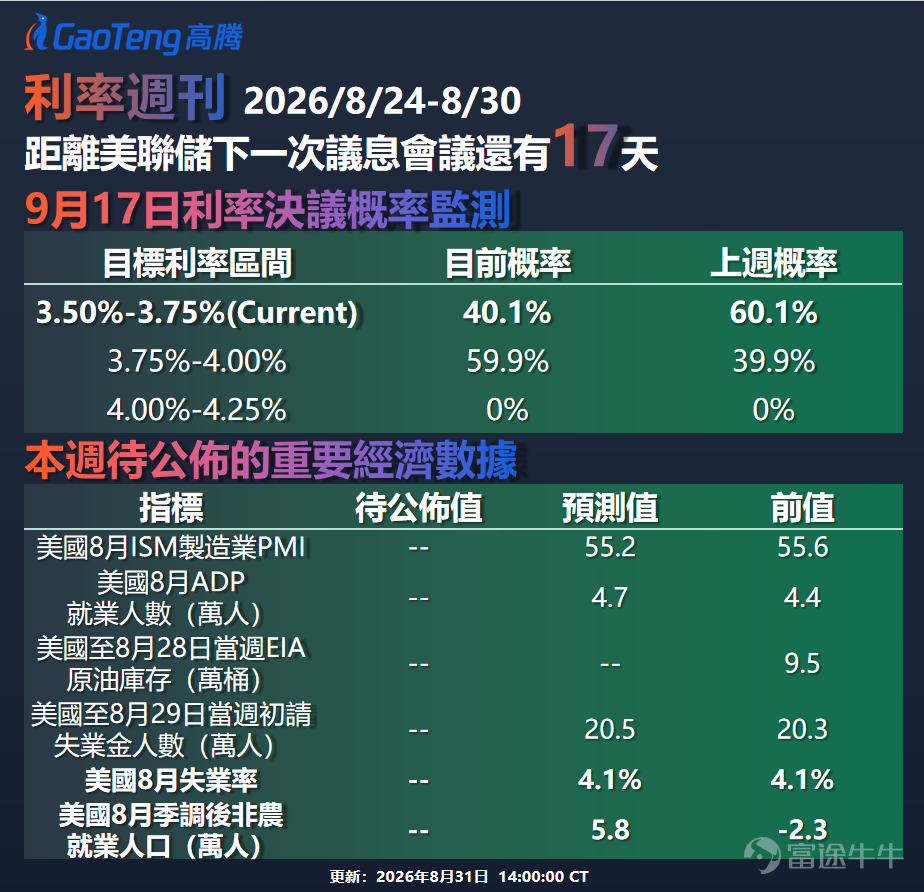
According to CME FedWatch (data as of August 24), with 17 days remaining until the next FOMC meeting, the market currently assigns a 40.1% probability to holding rates steady at 3.50%–3.75%, and a 59.9% probability to a rate hike to 3.75%–4.00%.
The core driver behind the data shifts was Waller's hawkish speech at Jackson Hole, which exerted marginal upward pressure on short-end yields.
▌ Waller's Debut Tilts Hawkish, Significantly Heating Up Rate Hike Expectations
Waller explicitly stated that inflation data has not shown a significant improvement in trend, and there is still work to be done if the 2% target is not reached quickly.
The market priced this in by surging the probability of a September rate hike from 38.9% to 59.9%, with former official Blinder commenting that his speech laid the groundwork for a September hike.
Apollo Global Management expects Waller to deliver a hawkish economic outlook to anchor long-term yields.
▌ Pricing Implications of Hawkish Stance
Inflation Stance: Walsh ReiteratesPrice Stabilityis the top priority, with multiple inflation indicators above the 2% target and core inflation showing no substantial improvement. The market is pricing this in as an expansion of term premiums, rather than merely expectations for immediate rate hikes.
Economic Assessment: Walsh stated that the economy appears to have strengthened, with the labor market aligning with full employment. Economic resilience supports the hawkish stance, and the market believes the economy may achieve a soft landing.
Communication Framework: Walsh advocates for reducing forward guidance, allowing the Fed"to be quieter". Barclays believes this move could exacerbate market volatility but is beneficial for policy flexibility in the long run.
▌ Fed Developments
Walsh's speech at Jackson Hole was his most hawkish statement since taking office as Chair, clearly prioritizing inflation and leaving room for further rate hikes in the coming months.
However, please note that Walsh did not provide a clear timeline, so this should not be interpreted as forward guidance.
▌ Internal Divergence
Hawks:Kansas City Fed President Schmid stated that interest rates have not yet restrained the economy and indicated he may support a rate hike in July; several meeting participants expressed support for raising rates in the minutes. The market is pricing in hawkish rhetoric as an increase in term premium.
Dovish:Chicago Fed President Goolsbee remarked that inflation over the past three months"does not look bad"; J.P. Morgan Asset Management believes rates should not be raised in September. There is a divergence between dovish pricing and market-implied probabilities.
Centrist:Boston Fed President Collins stated that inflation remains too high, with future focus on evidence of continued decline. The centrist stance is cautious, leading to ambiguous pricing implications.
▌ Yield Curve Structure
Last week, the 1-year yield was 4.131% (+11bps on the week), the 10-year yield was 4.716% (-1.8bps on the week), and the 30-year yield was 5.207% (-12.4bps on the week). The 2s10s spread stood at +58.5bps (previous: +57.7bps).
The short end reflects rising expectations of rate hikes, while the long end declined due to falling term premiums, resulting in a bull flattening of the curve.
Bull flattening often occurs in the late stages of a rate-hiking cycle, implying expectations of an economic slowdown. The widening of key spreads reflects the market's declining long-term inflation expectations.
▌ Historical Perspective: Comparing the 2018 Jackson Hole Symposium with the Current Situation
In 2018, Powell defended gradual rate hikes at Jackson Hole. The market initially priced in a hawkish stance but later pivoted due to trade friction.
Currently, Waller is leaning hawkish, but with a stronger economic backdrop, market pricing is more sensitive. Volatility typically rises after the Chair's symposium speech, and term premiums expand.
▌ Scenario Analysis
Scenario 1: A 25bp rate hike in September, with short-end yields continuing to rise, the yield curve bear-steepening, and gold under pressure.
Scenario 2: Short-end yields surge sharply, bear-steepening of the curve deepens, and gold plunges. Probabilities will be reassessed if inflation data exceeds expectations.
Scenario 3: Short-end yields decline, the yield curve bull-flattens, and gold rebounds. Probabilities rise if employment data deteriorates.
Due to Waller's remarks, the market is currently pricing in Scenario 1, which aligns with FedWatch probabilities; the deviation stems from Waller not specifying a clear timeline.
▌ Other Major Central Bank Developments
People's Bank of China:Conducted RMB 500 billion in MLF operations at an interest rate of 1.40%, while maintaining the reverse repo rate at 1.40%. Policy easing supports liquidity, narrowing the interest rate differential between domestic and offshore markets.
European Central Bank:Governing Council member Radev stated that waiting for second-round effects might be too late; Executive Board member Schnabel indicated that interest rates need to be raised further. Euro pricing is under pressure.
Bank of Japan:Deputy Governor Uchida Ryozo stated that rate hikes should continue to avoid a sharp spike in inflation caused by delays. Expectations for a narrowing US-Japan interest rate differential have strengthened.
▌ Market Reaction
$Gold Futures (DEC6) (GCmain.US)$ Fell 3.38% for the week to $4,504.1 per ounce, $Brent Last Day Financial Futures (DEC6) (BZmain.US)$ Weekly decline of 3.84% to $86.25 per barrel.
Gold fell as the U.S. dollar strengthened and real interest rates rose, reflecting cooling inflation expectations.
The pricing chain is as follows: Waller turns hawkish → rate hike expectations rise → USD strengthens → Gold weakens.
▌ Note at the End
Waller's hawkish tone at Jackson Hole marks a shift in the communication framework, lifting the probability of a September rate hike to 59.9%. Investors should closely monitor the September FOMC meeting and August PCE data—if inflation exceeds expectations, the probability of a rate hike could rise significantly; if employment deteriorates, this trend may reverse.
This article is for informational purposes and market observation only and does not constitute investment advice. Markets carry risks; please invest with caution.
$GaoTeng WeInvest Money Market Fund (HK0000478930.MF)$ $GaoTeng WeValue USD Money Market Fund (HK0000584752.MF)$ $GaoTeng WeFund-GaoTeng Asian Income Fund (HK0000447943.MF)$ $USD (USDindex.FX)$ $Hang Seng Index (800000.HK)$ $Hang Seng TECH Index (800700.HK)$ $Nasdaq Composite Index (.IXIC.US)$ $Dow Jones Industrial Average (.DJI.US)$ $S&P 500 Index (.SPX.US)$
Risk Disclaimer: The above content only represents the author's view. It does not represent any position or investment advice of Futu. Futu makes no representation or warranty.Read more


Comments
to post a comment
5
1