The Fed raises interest rates for the first time in three years! How will the market react?

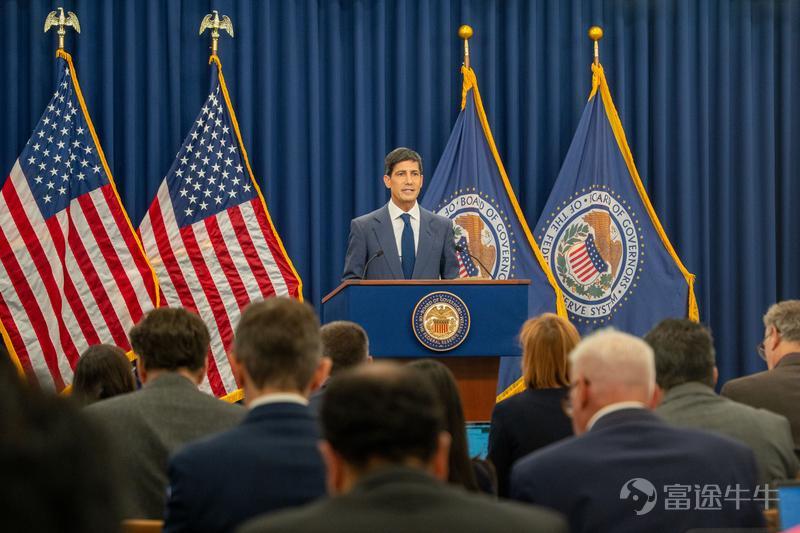
Warsh makes his debut at the Jackson Hole conference tonight at 22:00; the market is awaiting answers.

Image source: Xinhua News Agency
Around 22:00 tonight,new Federal Reserve Chair Warsh will deliver his first public address at the Jackson Hole Central Bank Symposium.With the annual symposium taking place less than three weeks before the September FOMC meeting, the timing is highly sensitive. Consequently, every word and phrasing in Warsh's speech tonight is likely to be amplified and scrutinized by the market. This article will subsequently review the key focal points of the conference and analyze the current price structure and critical levels of US equities from a technical perspective.
1. The "Cards" Warsh Currently Holds
Inflation:The US has missed the 2% target for 65 consecutive months, with the cost of living approaching twice the target level.
Fiscal Deficit:Officially surpassing $40 trillion, fiscal dominance pressure persists
Federal Funds Rate:At the July meeting, three dissenting votes called for an immediate rate hike, the highest number since 2016, signaling emerging internal divisions
US Treasury Yields:The yield on the 30-year US Treasury bond broke through 5.3% in mid-August, hitting a nearly 20-year high
Employment Data:July's seasonally adjusted non-farm payrolls saw a net decrease of 23,000 jobs, indicating initial signs of softening
So when Warsh takes the podium tonight, heholds macroeconomic cards that are far from favorable,His dilemma lies not in whether his remarks are hawkish or dovish, but rather in:Speaking too much carries risks, but saying too little will continue to undermine credibility.
2. What the Market Really Wants to Hear
Before his remarks at this meeting, Waller hinted that his speech would essentially be a blank slate. As a result, the market's current dissatisfaction with Waller stems not from a lack of forward guidance, butfrom the absence of a clear reaction function—the market wants to know under what conditions the Fed will intervene.
Furthermore, Treasury Secretary Bessent previously announced that the cap on long-term Treasury buybacks would be doubled to $4 billion, which directly conflictswith Waller’s advocacy for “returning power to the market and allowing free pricing.”Therefore,The market expects Waller to draw a clear line tonight regarding the boundary between the Fed’s and the Treasury’s responsibilities; failing to clarify this could continue to damage the narrative of the Fed’s independence.
3. Recent Performance of the Broad US Stock Market
From a technical perspective, the broad US stock market is currently in a short-term consolidation phase with a bullish bias, while maintaining an upward structure in the medium term.

Taking $SPDR S&P 500 ETF (SPY.US)$ and $Invesco QQQ Trust (QQQ.US)$ Take SPY as an example. The stock price has risen above the 60-day EMA ($751.32),confirming that it is in a technical bull market range,with the 5-day EMA at $767.70, the 10-day EMA at $767.39, and the 20-day EMA at $764.77, forming a bullish alignment,indicating upward momentum in the short to medium term. However, the short-term trend has not fully recovered, so caution is still advised.
The first support level is at $768.10—a double support zone formed by the 20-day MA and the middle Bollinger Band;followed by,the 23.6% Fibonacci retracement level at $764.55 and the 38.2% retracement level at $755.38; further down, key support lies at the 60-day EMA of $751.32,which serves as the technical dividing line between bull and bear markets, making its support crucial.
On the resistance side,The initial resistance is at the recent 60-day high of $779.37, as well as the upper Bollinger Band at $781.54.

QQQ's stock price has risen above the 20-day MA at $716.52 and the 50-day MA at $712.15,Short-term price action is likely to remain range-bound, but the medium-term trend structure remains intact.
Regarding key support levels, there isa dual support zone at $716.52 formed by the 20-day Moving Average (MA20) and the middle Bollinger Band; further below lies the 60-day Exponential Moving Average (EMA60) at $706.57.On the resistance side,The nearest resistance level is the 23.6% Fibonacci retracement at $727.37; subsequent resistance includes the upper Bollinger Band at $737.10 and the recent high of $734.58.
Summary
At tonight's Jackson Hole symposium, the focus is less on "what Powell will say" and more on "whether the market can accept him saying nothing"—the former will determine the short-term direction of related assets, while the latter will define the future "mode of communication" between the market and the Federal Reserve.
Risk Disclaimer: The above content only represents the author's view. It does not represent any position or investment advice of Futu. Futu makes no representation or warranty.Read more


Comments (18)
to post a comment
25
49