PDD Holdings' adjusted profit exceeded expectations; is the market finally rewarding its ecosystem i

PDD Holdings' profits tower over peers; Colin Huang is hailed as the "God of Business"
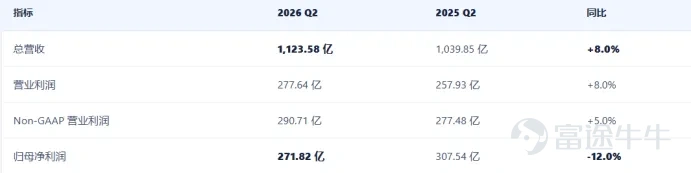
According to authoritative media outlets such as Xinhua Finance and CNR, PDD Holdings officially released its financial report for the second quarter of 2026 on August 24. The company's platform revenue for the second quarter reached RMB 112.4 billion, with net profit attributable to shareholders amounting to RMB 27.2 billion. Looking at the entire domestic e-commerce sector, the industry has bid farewell to the era of high-speed incremental growth, with competition for existing market share becoming the dominant market theme.

Source: Xueqiu
These profit figures are certainly impressive, but behind the glossy financial report, the platform cannot avoid the practical challenges of merchant ecosystem governance and compliance transformation. Amidst the current reality of parallel high profitability and risk control development, PDD Holdings is exploring a path toward high-quality development. Many of the company's current choices still reflect the shadows of the business framework established early on by founder Colin Huang.
Profit-generating assets and robust fundamentals
Amid a broader slowdown in the e-commerce sector, with many peers experiencing shrinking profits, PDD Holdings still delivered strong profitability. Revenue hit new highs while maintaining substantial profit margins. This is not merely a short-term quarterly anomaly but the result of its business model and asset structure working in tandem.
First, its profitability outperforms peers, with a solid transaction base supporting profit realization.Comparing the three major domestic e-commerce platforms, PDD Holdings achieved a net profit of RMB 27.2 billion in a single quarter, compared to approximately RMB 10.5 billion for Alibaba and just RMB 5.1 billion for JD.com. Meanwhile, PDD Holdings leverages its years of accumulated social e-commerce model and extensive industrial clusters to build a strong transaction foundation for merchants. The ability to maintain such high profit margins in a currently conservative consumer market further validates the enduring market viability of this social e-commerce model.

Source: PDD Holdings Q2 Financial Report

Source: Alibaba Q2 Financial Report
Second, substantial cash reserves and zero interest-bearing debt reduce operational risks.As of the end of June this year, PDD Holdings' total cash, cash equivalents, and short-term investments reached RMB 456.4 billion, with no interest expenses. This financial position provides strong risk resilience. Adequate cash flow serves as a buffer against cyclical changes in domestic consumption or uncertainties in overseas markets driven by geopolitical factors.
Finally, capital reserves create strategic room for maneuver, providing a safety net for long-term business investments.The over RMB 400 billion in available funds is not only a safety cushion against risks but also an arsenal for corporate expansion. Whether it involves deepening Temu's presence in overseas markets, digitalizing supply chains, or investing in R&D at the technology level, continuous capital outlay is required. Ample cash flow provides the practical conditions for implementing PDD Holdings' medium-to-long-term strategies, freeing the company from constraints related to short-term survival concerns.
Merchant ecosystem awaits a breakthrough
With the platform's GMV and profits continuing to rise, balancing consumer rights, platform revenue, and merchants' viability has become a structural challenge that PDD Holdings must now confront.
First, under the guidance of low-price algorithms, some small and medium-sized merchants are trapped in a dilemma of high volume but negligible profits.Field research by multiple financial media outlets reveals that the platform's long-term orientation toward low-price competition, compounded by consumer protection mechanisms such as "refund-only" policies, has sharply increased operating pressures for many small and medium-sized merchants. While customer acquisition costs continue to rise and selling prices are relentlessly suppressed, many stores report impressive sales volumes yet razor-thin actual profits after accounting for all expenses. Small and medium-sized merchants form the foundation of PDD Holdings' low-price advantage; if their profitability continues to erode, the vitality of the supply chain will gradually be depleted.
Second, the platform has launched targeted remediation efforts to address internal ecosystem conflicts.During periods of rapid expansion, prioritizing scale over balance is a common pitfall for many internet platforms. In response to issues frequently raised by merchants, the platform has implemented a series of targeted remediation measures and revised unrealistic regulations to alleviate operational pressures on merchants.
Third, while the multi-billion yuan support plan has been rolled out, the effectiveness of ecosystem restoration will depend on actual execution.Beyond regulatory changes, PDD Holdings has introduced a multi-billion yuan merchant assistance program, including measures such as waiving service fees and refunding a portion of advertising costs to indirectly support merchants. This marks a shift from a previous focus solely on scale to a current approach that balances the interests of all stakeholders, reflecting PDD Holdings' transition from extensive growth to refined development. However, policy documents represent only one aspect of the work; ultimate success will depend on the intensity of subsequent implementation.

Colin Huang's wisdom lays the foundation
Although Colin Huang has stepped back from the front lines and no longer directly participates in the management of PDD Holdings, many of the company's major strategies continue to reflect the ideological foundation established during his tenure, which remains a crucial spiritual pillar for the enterprise's development.
First, he seized the window of opportunity presented by the times, completing an entrepreneurial journey that has become legendary.Born in Hangzhou in 1980, Colin Huang joined Google in 2004 and founded PDD Holdings in 2015. In just three years, he led the company to its listing on Nasdaq. By 2024, with a net worth of $48.6 billion, Huang topped the list of China's richest individuals. This entrepreneurial success was not merely a gift from the era's tailwinds but also stemmed from his precise capture of opportunities in lower-tier markets and industrial supply chains.
Second, he adhered to the core value of "integrity," embedding cost efficiency into the company's DNA.The most important legacy Colin Huang left to PDD Holdings is this value system and the relentless pursuit of cost-effectiveness. Rather than prioritizing flashy brand marketing, PDD allocated more resources to upgrading and transforming its supply chains and industrial clusters. The philosophy of "integrity" has consistently played a pivotal role in the company's development.
Third, he chose to step back at the height of his career, balancing commercial returns with social value.At the peak of his career, Colin Huang chose to retreat behind the scenes, establishing a philanthropic fund with a significant portion of his shares to support research in food science and life sciences. Simultaneously, he promoted the digital transformation of domestic manufacturers, helping factories establish online sales channels. This long-termism, practiced from behind the scenes, has allowed the enterprise to pursue commercial profits while shouldering the social responsibility of industrial upgrading.
The future financial prospects are limitless.
Currently, PDD Holdings boasts strong profitability. Looking ahead, the iteration of its domestic business combined with overseas market expansion will continue to unlock growth potential. With the advancement of new private-label brands and the successful globalization of Temu, a commercial ecosystem spanning both domestic and international markets is taking shape.
First, the domestic main platform serves as a cash cow, leading to a shift in the revenue structure.The domestic market remains PDD Holdings' foundation. The multi-billion yuan support plan continues to solidify the supply chain base. Transaction service fees have surpassed advertising revenue, becoming one of the company's most important income sources. This shift in revenue structure indicates a change in PDD's profit model, with more profits derived from actual merchandise circulation. After generating stable cash flows continuously in the domestic market, these funds are reinvested into other innovative projects.
Second, the overseas fulfillment system continues to improve, bringing Temu closer to its profitability inflection point.Temu has entered a phase of rapid development, establishing its own warehousing network globally and continuously refining its semi-managed model. These efforts have laid the foundation for reducing overall fulfillment costs. Previously, the focus of overseas operations was on expanding market scale; however, with improved operational management capabilities, Temu's potential for profitability is gradually increasing.
Third, by integrating domestic production with global sales into a closed loop, there is ample room for long-term growth imagination.PDD Holdings has established a complete business cycle by connecting mature domestic industrial supply chains with massive overseas consumer traffic. The synergy between supply chain advantages and globalized traffic, bolstered by over RMB 400 billion in cash reserves, positions this e-commerce giant to continue competing for market share in the global e-commerce sector.

Source: GF Securities Development Research Center
Conclusion
PDD Holdings' Q2 financial report is a testament to strong profitability and continued progress in compliance construction. It demonstrates that this business model has robust monetization capabilities and validates its rationale, proving its value extends beyond mere账面 (book) data. Meanwhile, beyond revenue and profit, the company must also consider the balance of the merchant ecosystem and the perfection of regulatory systems, which are critical components of corporate development.
Under Colin Huang's long-termist philosophy, PDD Holdings not only exhibits strong profitability but also supports the healthy development of the industry. In addition to an efficiency-first business model, it reflects a development concept that balances commercial interests with social responsibility. On one hand, it enhances its competitiveness to secure greater profit margins; on the other, it strives to improve the business ecosystem, marking the transition of internet giants from wild growth to regulated development.
Future trends will be driven by supply chain upgrades and the implementation of globalization strategies. On a stable foundation, PDD Holdings is poised for higher-quality growth. As domestic supply chains continue to improve, Temu is rapidly maturing in overseas markets, placing PDD Holdings, with its strong cash flow, in a new stage of development. However, competition remains intense both domestically and internationally. Effectively balancing profits, merchants, and globalization will determine the future growth ceiling of this e-commerce giant.
Risk Disclaimer: The above content only represents the author's view. It does not represent any position or investment advice of Futu. Futu makes no representation or warranty.Read more

Comments
to post a comment
1