PDD Holdings' adjusted profit exceeded expectations; is the market finally rewarding its ecosystem i
PDD Holdings Q2 2026: A financial report showing "revenue growth without profit growth" hides four layers of truth
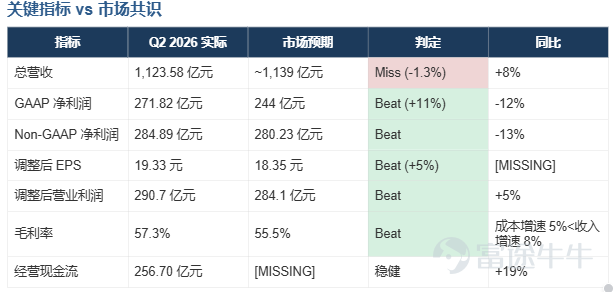
$PDD Holdings (PDD.US)$ PDD Holdings released its Q2 2026 financial results before the market open on August 24. Total revenue for the quarter reached RMB 112.358 billion (approx. USD 15.7 billion), an 8% year-over-year increase, slightly below the market expectation of RMB 113.9 billion. Net income attributable to ordinary shareholders was RMB 27.182 billion, a 12% year-over-year decline, but significantly higher than the market expectation of RMB 24.4 billion. Non-GAAP net income was RMB 28.489 billion, down 13% year-over-year, slightly exceeding expectations. Adjusted earnings per share (per ADS) were RMB 19.33, surpassing the market expectation of RMB 18.35.

This marks the first quarterly decline in net profit since the company's IPO. However, a closer look reveals that this "ugly" income statement does not indicate a collapse of core operations, but rather reflects proactive investments and one-time clean-ups.
Four factors contributed to the profit decline. First: Proactive investments. Marketing expenses rose 9%, R&D increased 27% (up 40% on a Non-GAAP basis, hitting a new single-quarter record high), and administrative expenses jumped 53%. What did these costs yield? Operating profit actually grew 8% to RMB 27.8 billion.The core e-commerce business itself has not deteriorated.。Second, and most critically: One-time compliance clean-up. Other items recorded a net loss of approximately RMB 7.4 billion, including a RMB 1.52 billion fine for domestic "ghost kitchen" violations, a EUR 200 million fine under the EU Digital Services Act (DSA), and corresponding provisions. This represents a concentrated realization of regulatory costs, rather than operational bleeding.Third: An increase in the effective tax rate.The effective tax rate rose from 13.6% in the same period last year to 18.3%, creating a rigid deduction against profits.Fourth:Interest income of RMB 13.5 billion partially offset the aforementioned impacts.
The segment landscape follows a "one stable, one risky, one speculative" pattern. The domestic main platform remains the most stable.: GMV +5%, outperforming the industry; DuoDuo Grocery shows strong momentum, but ad revenue grew only +3.5% as management opted to sacrifice margins to support the merchant ecosystem.Temu is the biggest risk area this quarter,, with the EU eliminating the duty-free exemption for small parcels starting in July (adding €3 per item). This led to a significant decline in European GMV, slowing transaction service growth from +20% to +13.3%."New Pinmu" represents a high-stakes bet:: a three-year, CNY 100 billion branded self-operated plan. Management admitted for the first time that the launch was "slower than expected," with current revenue contribution nearly zero.
Valuation and Institutional Sentiment: Goldman Sachs, Morgan Stanley, and Jefferies all lowered their target prices but maintained Buy/Overweight ratings, with a consensus target price $116.93. Currently trading at 9.4x TTM P/E, or approximately 4x excluding cash, with CNY 552.8 billion in cash on hand, zero debt, and an ROE of 25%. The stock appears extremely cheap on paper, but lacks growth catalysts, faces regulatory overhang, and offers no shareholder returns.
Based on financial report performance,, this is a "cheap stock requiring event-driven validation". Existing holders should continue to hold, as one-time costs have been cleared and the balance sheet remains solid. Those not currently holding should avoid chasing highs and instead build positions in tranches upon the emergence of either of two signals: first, transaction service growth stabilizes and returns to above 9% in the Q3 earnings report; second, the frequency of fines decreases after Temu submits its rectification plan to the EU on August 28. If domestic GMV growth falls below the industry average, or if substantial fines are imposed in the US market, the investment thesis will need to be reassessed.
Disclaimer:The above content is based on public data and quantitative analysis and is for reference only; it does not constitute investment advice. The market involves risks, so invest with caution. Any investment decision should be made independently based on personal risk tolerance, financial status, and investment objectives, consulting licensed professional institutions when necessary. Past performance does not indicate future returns.
Content Disclosure: Personal opinion
Risk Disclaimer: The above content only represents the author's view. It does not represent any position or investment advice of Futu. Futu makes no representation or warranty.Read more
Comments
to post a comment
2