Optical communication stocks lead the rebound; will the AI optical cycle continue?

Make AI systems 'photonics-centric'! SK Hynix releases CPO roadmap; who will seize the prime spot in the supply chain?
Is SK Hynix bringing photonics into packaging?
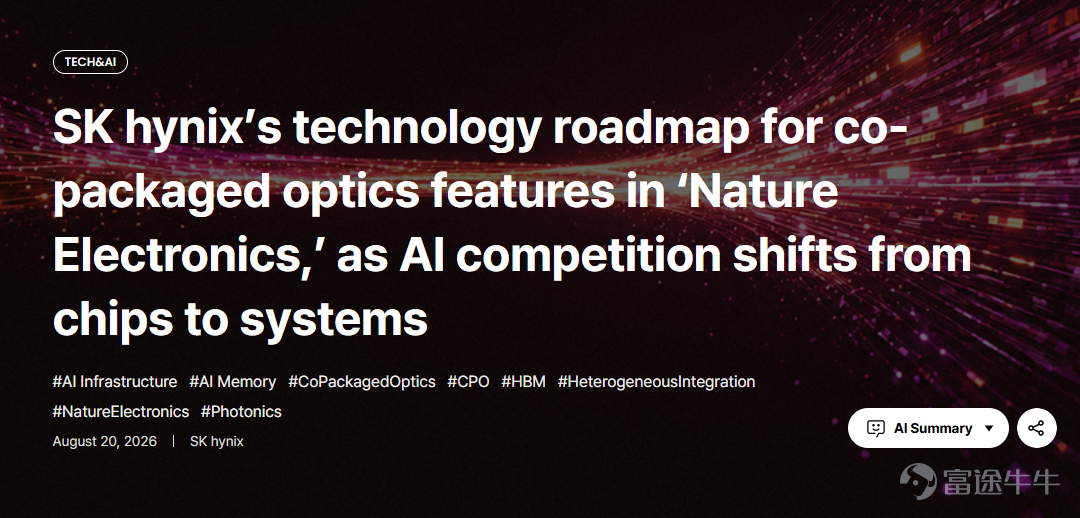
On August 20, $SK hynix (SKHY.US)$ Jointly published a paper with researchers from institutions such as the University of Virginia in the top scientific journal Nature Electronics, systematically outlining the development roadmap for Co-Packaged Optics (CPO) technology in high-performance computing and AI. This is $SK Hynix (000660.KR)$ the first time its technical blueprint for AI interconnect architecture has been disclosed in a journal of this caliber.

Unlike typical product launches, this paper discusses not just a specific optical engine, but integrates memory, processors, optical interconnects, and advanced packaging into a unified system architecture:In the short term, CPO aims to break through bandwidth bottlenecks between racks and pods; in the long term, it seeks to extend optical interconnects further to memory interfaces, allowing multiple AI accelerators to share a large memory pool.
This also signifies that SK Hynix's technological positioning is evolving from an HBM supplier to a participant in next-generation AI system architectures.
From chips to systems, is CPO the key?
AI model training has long moved beyond single chips or individual servers, operating instead across large-scale networks composed of racks and pods. In this architecture, overall system performance depends not only on the connection efficiency between processors and memory but also heavily on data transmission speeds between racks.Data shows that computing power grows approximately threefold every two years, while interconnect bandwidth increases by only about 1.4x during the same period.

This divergence is precisely the source of the "bandwidth wall."Traditional copper-based electrical interconnects still hold a cost advantage over short distances. However, as transmission speeds increase and distances lengthen, signal loss and power consumption rise sharply, necessitating increasingly complex compensation circuits and resulting in higher latency.
Notably, the most compelling aspect of this paper is not the existing CPO solutions, but its proposed "optics-centric" architecture. In current solutions, optical interconnects primarily address data transmission issues between processors and between racks.In contrast, the "optics-centric" architecture proposed in the paper directly connects the processor resource pool (XPU pool) with the memory resource pool via a photonic interposer.

The practical significance of this architecture lies in enabling multiple AI accelerators to share a large-capacity memory pool, rather than each accelerator being equipped with its own dedicated memory. This not only improves memory utilization efficiency but also provides AI infrastructure with more flexible scalability as model sizes continue to grow.
Why is SK Hynix pursuing CPO?
For SK Hynix, the strategic significance of this roadmap may outweigh its technical implications. HBM has resolved the memory bandwidth bottleneck within AI accelerator packages and has been SK Hynix's core competitive advantage in recent years. However, as AI competition shifts from individual GPUs to entire clusters, customers need more than just faster memory; they require more efficient system-level data movement solutions.
If memory pooling becomes the norm in the future, memory manufacturers will need to participate in: memory device and controller design; optical interconnect interfaces; coherence protocols; photonic interposers and advanced packaging; as well as thermal management, yield rates, and system reliability.
SK Hynix's role will gradually shift from merely "supplying HBM to GPU manufacturers" to "participating in defining how AI accelerators connect to and utilize memory."
This aligns with the company's recent strategic布局 in HBM, HBF, and CPO: extending beyond providing standalone storage products to encompassing AI data movement and system architecture.
Who stands to benefit the most from the CPO industry chain?
From an industry chain perspective, CPO involves multiple segments such as optical engines, external light sources, FAU fiber arrays, optical circuit switch boxes, connectors, advanced packaging, testing, and equipment. However, the certainty of benefits varies across different companies. Previously,"NVIDIA CPO Switches Enter Full-Scale Mass Production! AI Network Revolution Ignites: Who Will Benefit First in This Industry Chain?" we had previously outlined the relevant industry chain, as detailed below:

--
--
--
Tier 1: Companies with sway over architecture and platforms
The most critical players are AI chipmakers, switch chip manufacturers, and advanced packaging firms capable of defining the CPO system architecture, including:$NVIDIA (NVDA.US)$ : Driving the deployment of silicon photonics switches and AI networking platforms;$Broadcom (AVGO.US)$ : Possessing capabilities in switch chips, DSPs, silicon photonics, and CPO integration;$Marvell Technology (MRVL.US)$ : Establishing a presence in high-speed interconnects, DSPs, and silicon photonics platforms;$Taiwan Semiconductor (TSM.US)$ : Providing silicon photonics manufacturing, photonic interposers, and advanced packaging capabilities.
These companies determine the CPO architecture adopted, the timeline for mass production, and the market space available to the supply chain.
Tier 2: Lasers and optical components
CPO requires stable, high-power, and low-power consumption external light sources. The value of lasers and optical components is expected to rise, with representative companies including $Lumentum (LITE.US)$ 、 $Coherent (COHR.US)$ 、 $Broadcom (AVGO.US)$ and $Furukawa Electric (5801.JP)$ , among others. Notably, Lumentum and Coherent have established relatively comprehensive layouts in areas such as lasers, laser modules, and micro-optical devices.
Layer 3: FAU, Optical Fibers, and Connectors
Between the optical engine and external fibers, a large number of high-precision coupling devices are required, including Fiber Array Units (FAUs), microlenses, MPO/MMC connectors, and optical path switching boxes. Related companies include $Corning (GLW.US)$ 、 $Suzhou TFC Optical Communication (300394.SZ)$ 、 $Accelink Technologies (002281.SZ)$ 、 $YOFC (06869.HK)$ 、 $T&S Communications (300570.SZ)$ etc.
The core barrier in this segment is not merely production capacity, but rather micron-level coupling precision, insertion loss, reliability, and mass production yield. As the number of CPO ports and fiber density increase, the per-unit value of high-precision FAUs and connectors is expected to grow in tandem.
Layer 4: Packaging, Testing, and Equipment
CPO requires integrating electronic chips, silicon photonics chips, lasers, optical fibers, and heat dissipation structures into a single system, imposing higher demands on packaging precision, yield control, and testing capabilities.
In this direction, investors may focus on $Fabrinet (FN.US)$ 、 $ASE Technology (ASX.US)$ 、 $Universal Scientific Industrial(Shanghai)Co., (601231.SH)$ , as well as companies like Robotico that are laying out silicon photonics packaging equipment. If CPO evolves further from 2.5D to 3D heterogeneous integration, the importance of advanced packaging will continue to rise.
Conclusion
HBM addresses the memory bandwidth issue "around" the GPU, CPO solves the data transmission problem "between" GPUs, while optical memory architecture attempts to resolve how computing power and memory can break through single-package limitations to achieve system-level sharing.
Therefore, the key signal conveyed by SK Hynix's paper is:Competition in AI hardware is shifting from three separate tracks—computing power, memory, and optical communication—to a system-level competition integrating "compute, storage, and optics."
For SK Hynix, this marks a step from being the HBM leader to becoming a participant in AI infrastructure architecture. For the CPO supply chain, it implies that its long-term market potential may no longer be limited to switches and optical modules, but will further extend to processors, memory pools, photonic interposers, and advanced packaging.
The ultimate goal of CPO may not be merely integrating optical engines into chips, but rather enabling the entire AI system to become "optics-centric."
Risk Disclaimer: The above content only represents the author's view. It does not represent any position or investment advice of Futu. Futu makes no representation or warranty.Read more


Comments (9)
to post a comment
73
317