
English
Back
Open Account
NVIDIA's earnings report drops next Thursday! Will it satisfy the market this time?
牛牛課堂
joined discussion · Aug 17 17:12 ·

NVIDIA CPO switches enter full-scale mass production! The AI network revolution is exploding; who will benefit first from this supply chain?

AI data center networks are reaching a critical turning point.
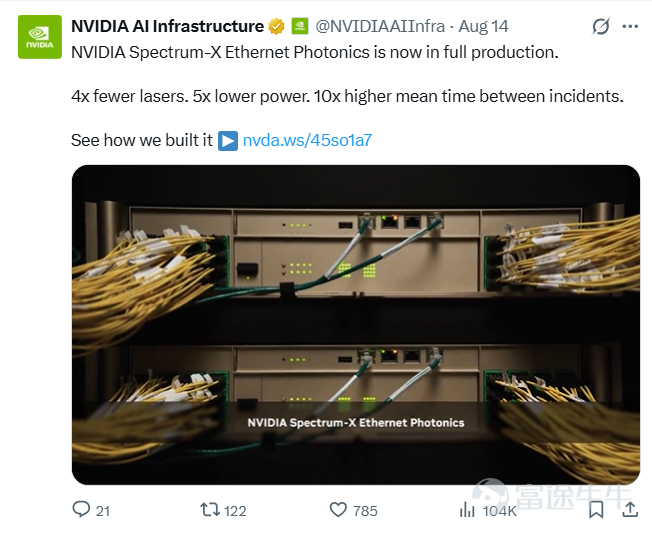
NVIDIA announced that its Spectrum-X Ethernet Photonics switches, based on Co-Packaged Optics (CPO) technology, have officially entered mass production. Compared to traditional pluggable optical module solutions, the new architecture delivers 5x better optical power efficiency, 5x longer runtime for AI applications, and a 10x improvement in reliability, signaling that CPO is moving from technical validation to规模化 application.
AI data center networks are reaching a critical turning point. NVIDIA announced that its Spectrum-X Ethernet Photonics switches, based on Co-Packaged Optics (CPO) technology, have officially entered the mass production phase. Compared to traditional pluggable optical module solutions, the new architecture delivers 5x optical power efficiency, 5x longer runtime for AI applications, and a 10x improvement in reliability, signaling that CPO is transitioning from technical validation to large-scale application. This mass production involves a supply chain spanning multiple top-tier suppliers: $Taiwan Semiconductor (TSM.US)$ responsible for silicon photonics chip manufacturing, $ASE Technology (ASX.US)$ its subsidiary Silicon Precision Industries handles chip-level packaging and testing, $Lumentum (LITE.US)$ and $Suzhou TFC Optical Communication (300394.SZ)$ supplies laser components, while Foxconn is responsible for the R&D and assembly of the overall switch system. NVIDIA conducts final testing on the finished switches before shipment. This supply chain landscape indicates that photonic integration technology is penetrating the core of AI hardware, and companies across the relevant supply chain are poised to benefit from expanding demand. So, why has CPO become a must-have for AI networks? Which companies are worth watching? This article will explain it all to our fellow investors. Why has CPO become a must-have for AI networks? Traditional data center switches rely on independent optical modules plugged into the front panel to convert electrical signals into optical signals...
This mass production involves a supply chain spanning multiple top-tier suppliers: $Taiwan Semiconductor (TSM.US)$ responsible for silicon photonics chip manufacturing, $ASE Technology (ASX.US)$ with its subsidiary Siliconware Precision Industries handling chip-level packaging and testing, $Lumentum (LITE.US)$ and $Suzhou TFC Optical Communication (300394.SZ)$ supplying laser components, while Foxconn is responsible for the R&D and assembly of the overall switch system. NVIDIA conducts final testing on the finished switches before shipment. This supply chain landscape indicates that photonic integration technology is penetrating the core of AI hardware, and companies in the related supply chain are poised to benefit from expanding demand.
So, why has CPO become a must-have for AI networks? Which companies are worth watching? This article will explain it all to our fellow investors.
Why has CPO become a must-have for AI networks?
Traditional data center switches rely on independent optical modules plugged into the front panel to complete the conversion between electrical and optical signals.
This architecture is already highly mature, but as AI clusters scale from thousands to tens of thousands or even millions of GPUs, bottlenecks are beginning to emerge prominently: excessively long electrical transmission paths, high DSP power consumption, increased thermal pressure, and a large number of independent optical modules and lasers introducing more potential points of failure.
Spectrum-X Ethernet Photonics places the optical engine directly near the switching ASIC, allowing electrical signals to be converted into optical signals over extremely short distances, thereby reducing signal attenuation, network latency, and energy loss.Meanwhile, external laser sources can centrally supply light to multiple optical engines, reducing the number of lasers by approximately 75%. Fewer components not only lower power consumption but also reduce potential points of failure.
NVIDIA currently offers two types of Spectrum-X CPO switches:
The SN6810 uses a single switching ASIC, providing 128 ports at 800Gb/s, with a total bandwidth of 102.4Tb/s;
The SN6800 uses four switching ASICs, providing 512 ports at 800Gb/s or 2,048 ports at 200Gb/s, with a total bandwidth of 409.6Tb/s.
Additionally, the SN6800 integrates an optical fiber shuffle mechanism within the chassis, enabling GPU clusters to scale horizontally without adding extra switching layers, thus reducing network hops and latency. NVIDIA Technical Blog
Beyond hardware, Spectrum-X enhances cluster stability through adaptive routing, congestion control, multi-plane networks, and end-to-end telemetry. NVIDIA states that the Spectrum-X platform can improve AI network performance by approximately 1.6x; Spectrum-XGS further extends the network across different buildings or even data centers hundreds of kilometers apart. Spectrum-X Official Page
In other words, NVIDIA is packaging GPUs, switching chips, optical systems, and network software into a complete AI factory network architecture.
Which segment has the greatest elasticity?
Bank of America's supply chain research indicates that short-term shipments of NVIDIA CPO switches may remain low. As scale-up penetration increases, significant volume growth is expected to occur in 2028-2029. BofA's technology team forecasts NVIDIA CPO switch shipments to be 14,000, 52,000, and 190,000 units in 2026, 2027, and 2028, respectively.
Among key components, the Optical Engine (OE) is core to converting electrical signals into optical signals; the FAU acts like a highway, connecting optical fibers to the optical engine to complete data transmission. Beyond CPO switches, External Laser Sources (ELS) provide the laser light enabling signal transmission along optical fibers, while MPO/MMC connectors link fibers within the shuffle box to external ports.Based on the BOM for CPO switches, Optical Engines, ELS, and FAUs are estimated to account for 40%-55%, 10%-15%, and 5%-10% of total material costs, respectively.
Source: Bank of America
Among these,Regarding FAUs, Bank of America estimates their potential market size within NVIDIA CPO switches could reach approximately $8 billion by 2030.The true barriers to entry for FAUs lie in two areas: first, micron-level precision alignment capabilities, and second, automated alignment and testing capabilities. This is why Bank of America believes that despite numerous new entrants in the FAU industry, only a few companies are likely to emerge as winners.
From a supply chain perspective, which companies deserve more attention?
Bank of America's report divides the CPO supply chain into seven tiers, covering optical engines, precision optics, lasers, fiber optic connectivity, packaging and testing, and equipment.
AI data center networks are reaching a critical turning point. NVIDIA announced that its Spectrum-X Ethernet Photonics switches, based on Co-Packaged Optics (CPO) technology, have officially entered the mass production phase. Compared to traditional pluggable optical module solutions, the new architecture delivers 5x optical power efficiency, 5x longer runtime for AI applications, and a 10x improvement in reliability, signaling that CPO is transitioning from technical validation to large-scale application. This mass production involves a supply chain spanning multiple top-tier suppliers: $Taiwan Semiconductor (TSM.US)$ responsible for silicon photonics chip manufacturing, $ASE Technology (ASX.US)$ its subsidiary Silicon Precision Industries handles chip-level packaging and testing, $Lumentum (LITE.US)$ and $Suzhou TFC Optical Communication (300394.SZ)$ supplies laser components, while Foxconn is responsible for the R&D and assembly of the overall switch system. NVIDIA conducts final testing on the finished switches before shipment. This supply chain landscape indicates that photonic integration technology is penetrating the core of AI hardware, and companies across the relevant supply chain are poised to benefit from expanding demand. So, why has CPO become a must-have for AI networks? Which companies are worth watching? This article will explain it all to our fellow investors. Why has CPO become a must-have for AI networks? Traditional data center switches rely on independent optical modules plugged into the front panel to convert electrical signals into optical signals...
Technical barriers, value contribution, and competitive landscapes vary significantly across different segments. Among them, optical engines have the highest value contribution, FAUs offer the most prominent potential earnings elasticity, while assembly/testing and automation equipment determine whether CPO can truly achieve mass production at scale.
Optical Engine:Responsible for converting electrical signals to optical signals, accounting for approximately 40% to 55% of the CPO switch BOM, making it the highest-value segment. Key participants include $NVIDIA (NVDA.US)$$Broadcom (AVGO.US)$$Marvell Technology (MRVL.US)$ and $Taiwan Semiconductor (TSM.US)$
FAU:Responsible for precisely connecting optical engines to optical fibers, including V-grooves, fiber arrays, and microlenses. Major suppliers include Tianfu Communication, Coherent, Corning, and Focuslight Technologies, with Largan Precision as a potential supplier. FAUs account for approximately 5% to 10% of the total unit BOM. The core barriers are micron-level alignment and automated mass production, making this the high-elasticity segment most favored by Bank of America.
External Laser Source (ELS):Provides centralized light supply outside the package, reducing the number of lasers, power consumption, and failure points, accounting for approximately 10% to 15% of the total unit BOM. Laser chip suppliers include $Lumentum (LITE.US)$$Coherent (COHR.US)$$Broadcom (AVGO.US)$$Furukawa Electric (5801.JP)$$Suzhou Dongshan Precision Manufacturing (002384.SZ)$ and $Yuanjie Semiconductor Technology (688498.SH)$ ; module suppliers include $Suzhou TFC Optical Communication (300394.SZ)$$ZJ INNOLIGHT (03308.HK)$ and $Eoptolink Technology Inc., (300502.SZ)$ etc.
Shuffle Box:Responsible for organizing and distributing the large volume of optical fibers within the switch. Major suppliers include $Corning (GLW.US)$$Suzhou TFC Optical Communication (300394.SZ)$
MPO/MMC Connectors:Responsible for connecting internal optical fibers to the switch's external ports. As port density increases, connectors must simultaneously meet requirements for low loss, high density, and reliability over multiple mating cycles. Major suppliers include $T&S Communications (300570.SZ)$
Assembly and Testing:Responsible for chip packaging, optical component testing, and switch system integration. Key participants include $Fabrinet (FN.US)$$ASE Technology (ASX.US)$ Siliconware Precision Industries under its umbrella and $Universal Scientific Industrial(Shanghai)Co., (601231.SH)$
Equipment:Provides automated alignment, precision placement, and testing equipment for FAUs and optical components. Major suppliers include Chroma ATE and $Robotechnik Intelligent Technology (300757.SZ)$ FiconTEC under its umbrella. Automation capabilities will directly impact CPO production efficiency and yield rates.
Overall, optical engines have the highest value content; FAU supply is concentrated with high per-unit value, offering greater potential earnings elasticity. Taiwan Semiconductor, Siliconware Precision Industries, Tfc Communication, and Foxconn are part of the mass production collaboration chain confirmed by NVIDIA.
CPO is shifting from a technical theme to an order-driven theme.
The full-scale mass production of Spectrum-X signifies a major shift in the investment logic for CPO.
Previously, the market focused on 'whether the technology is feasible,' but now the focus is shifting to 'who has entered the mass production supply chain, whether yields can be stabilized, when customers will deploy at scale, and what the per-unit value content is.'
In the short term, mass production will primarily benefit silicon photonics manufacturers, packaging and testing firms, FAU suppliers, laser module providers, and system assemblers already integrated into NVIDIA's production ecosystem. In the medium to long term, as shipment volumes enter a steep growth phase in 2028–2029, the earnings elasticity of FAU, external laser sources, and precision optical components may become more pronounced.
However, the key metrics to monitor going forward remain customer certification, order share, yield rates, capacity expansion speed, and the extent of cost reduction for CPO relative to traditional pluggable solutions.
The true inflection point has already emerged, but the divergence within the industry supply chain is just beginning.
Risk Disclaimer: The above content only represents the author's view. It does not represent any position or investment advice of Futu. Futu makes no representation or warranty.Read more
Emm
4
Thumbs Up
67
Heart
6
Lol
2
703K Views
Report
Comments (9)
Write a Comment...
9
79
378