The Fed raises interest rates for the first time in three years! How will the market react?

Save this trading guide in advance! The Jackson Hole Annual Symposium is coming next week. Can Walsh's debut keep long-term interest rates in check?
Global markets are about to witness one of the most important macroeconomic events of the second half of the year.
The 2026 Jackson Hole Global Central Bankers Symposium will be held from August 27 to 29, with the theme "Financial Innovation: Implications for Payments and Policy."However, the market's true focus remains on Fed Chair Walsh's first speech at Jackson Hole since taking office.
Unlike in the past, the market may not just be trading on a simple "hawkish" or "dovish" label this time,but rather on a more critical question: Can Walsh re-establish a clear and credible policy framework and prevent long-term interest rates from spiraling further out of control?
Why should Jackson Hole be approached with caution? It has historically triggered significant market volatility on multiple occasions.
Jackson Hole was originally an academic conference for discussing long-term economic issues, but as Fed Chairs have frequently used it to signal important policy shifts, it has gradually become a key window for global asset pricing.
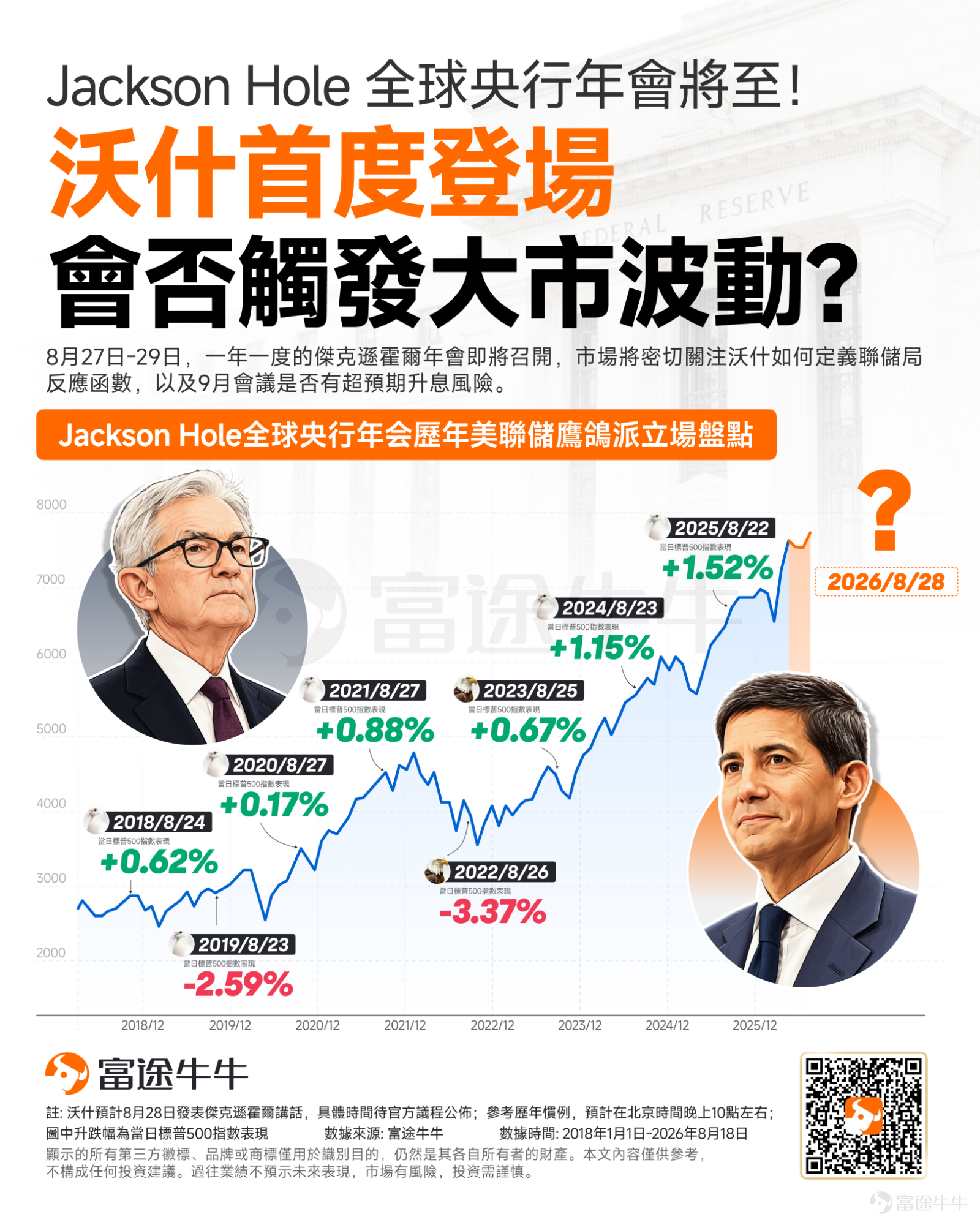
As shown in the chart below, during the eight Jackson Hole symposiums from 2018 to 2025, the S&P 500 Index rose on the day of the Chair's speech six times and fell only twice, resulting in a 75% probability of gains.But what truly warrants caution is its明显 asymmetric tail risk:Gains in up years mostly ranged between 0.2% and 1.5%, while the two declines reached 2.59% and 3.37%, respectively.

--
--
--
The most typical example was 2022. Powell stated bluntly in his speech that curbing inflation could bring "pain" to households and businesses, emphasizing that the Federal Reserve would continue to adopt restrictive policies. On that day, $Dow Jones Industrial Average (.DJI.US)$ plunged 3%, $S&P 500 Index (.SPX.US)$ dropped 3.4%, $Nasdaq Composite Index (.IXIC.US)$ with a decline reaching 3.9%, making it one of the most violent Jackson Hole market moves in recent years.
Uncertainty is even higher this year:This marks not only Warsh's first appearance at Jackson Hole, but also the market's first opportunity through this critical window to reassess the new Fed's policy reaction function.
Against the backdrop of elevated long-term US Treasury yields and a shift in the Fed's communication style, the market's greatest fear may not be Waller simply being "hawkish," but rather that his remarks fail to provide a sufficiently clear policy framework, thereby further amplifying volatility in both bond and equity markets.
Waller's challenge: The Fed hasn't raised rates, yet the market has effectively tightened conditions for it.
At the July FOMC meeting, the Federal Reserve held the policy rate steady at 3.50% to 3.75%, but three members voted in favor of a 25-basis-point hike, reflecting that inflation concerns within the Fed have not dissipated.Meanwhile, the bond market has proactively tightened financial conditions.
As of August 18, $U.S. 10-Year Treasury Notes Yield (US10Y.BD)$once rose to 4.739%, $U.S. 30-Year Treasury Bonds Yield (US30Y.BD)$touching 5.327%, the highest level since 2007.Driving up long-term bond yields are not only oil prices and inflation risks, but also the US fiscal deficit, increased supply of Treasury securities, large-scale financing by AI giants, and investors' demand for a higher term premium.

--
--
--
In other words, although the Fed has not continued to raise rates, the bond market has increased long-term financing costs for corporations, households, and the government by selling off long-term bonds.
This is also the core contradiction that Waller must face at Jackson Hole.Since Waller took office, the Fed has significantly reduced forward guidance, shortened FOMC statements, and downplayed hints about the future interest rate path. The intention behind this approach is to reduce the market's reliance on the Fed "spoon-feeding answers," allowing asset prices to resume their price discovery function.
But the costs are beginning to show.As the policy reaction function becomes harder to predict, investors will demand higher risk premiums, potentially driving up term premiums. A recent Reuters survey indicates that some market participants worry that reduced policy communication could directly push up bond yields and financing costs for the real economy.
Therefore, what Waller really needs to explain is whether reducing communication is actually restoring market price discovery, or inadvertently raising the cost of capital for the entire economy.
DruckenMiller significantly expanded positions in Q2: Not betting on a broad recession
To understand Waller's policy thinking, DruckenMiller's latest disclosed holdings may offer another perspective.
Before returning to the Fed, Waller worked for over a decade at Duquesne Family Office under DruckenMiller. The two have long collaborated on researching macroeconomics, market pricing, and asset allocation, with Waller being particularly influenced by DruckenMiller's investment framework of "trusting data and market signals."
Of course, DruckenMiller's holdings do not represent Fed policy, nor should they be interpreted as "front-running policy." However, there is indeed a clear lineage in their shared emphasis on productivity, liquidity, and financial market signals.
Duquesne's latest 13F filing shows that the market value of its US equity holdings disclosed for Q2 rose to $5.211 billion from approximately $3.377 billion in Q1, an increase of about 54%. However, this position buildup was not a simple bet on the Nasdaq, but rather followed three clear themes:

--
--
--
First theme: Bullish on AI, but no longer chasing highs across the board
Drucken Miller increased his holdings $Taiwan Semiconductor (TSM.US)$ and $STMicroelectronics (STM.US)$ , initiated new position in $Alphabet-A (GOOGL.US)$ , and raised his position; $Amazon (AMZN.US)$ while simultaneously liquidating positions in companies such as $Broadcom (AVGO.US)$ 、 $Micron Technology (MU.US)$ 、 $Coherent (COHR.US)$ and $Lumentum (LITE.US)$ . This indicates that he has not exited the AI sector, but rather shifted from a broad bet on the entire supply chain to focusing on wafer fabrication, platform companies, and targets with higher earnings certainty.AI trading is entering a stock-picking phase.
Point 2: Betting on market breadth expansion
Duquesne holds approximately $191 million in $SPDR S&P 500 ETF (SPY.US)$ and call options, and significantly increased its $iShares Russell 2000 ETF (IWM.US)$ call options; while also positioning in homebuilding, aviation, construction materials, and industrial stocks. Its core thesis may be:As long as the US avoids a deep recession, capital is expected to rotate from a few tech giants into small-cap stocks and cyclical sectors.
Rule #3: Allocate to Latin America, resources, and new computing power infrastructure.
Druckenmiller continues to hold positions, $iShares MSCI Brazil ETF (EWZ.US)$ 、 $YPF SA (YPF.US)$ and $Southern Copper (SCCO.US)$ maintaining exposure to benefits from a weaker U.S. dollar and rising commodity prices. Additionally, Duquesne has invested in $Bitdeer Technologies Group (BTDR.US)$ 、 $Hut 8 (HUT.US)$ and $Riot Platforms (RIOT.US)$ companies driving positive AI computing power and NeoCloud transformation, as well as digital finance assets like Hyperliquid Strategies, balancing both AI infrastructure and financial innovation themes.
Interestingly, this year's Jackson Hole Symposium focuses precisely on financial innovation and payment policies. Whether stablecoins, digital assets, and new payment systems will be incorporated into the Fed's policy framework could become another trading narrative for the conference.
Therefore, the signal conveyed by this 13F filing is not a "broad bet on recession," nor a simple bet on rate cuts, but rather closer to:Policy rates do not need to drop immediately; as long as the Federal Reserve does not tighten significantly further, AI capital expenditure, productivity improvements, and economic expansion may continue.
Duquesne's portfolio appears to be betting on three things:A U.S. economic slowdown without recession, continued AI investment supporting growth, and market breadth expanding from tech giants to more sectors and regions.This is an allocation strategy that does not rely on a single interest rate direction, while simultaneously capturing tech growth, economic expansion, and a weaker U.S. dollar.
What is the market really listening for at Jackson Hole?
For investors, whether Waller uses "hawkish" or "dovish" language is not the most critical factor. Instead, focus on the following four clues:
First, will he reaffirm the 2% inflation target?If Waller emphasizes that inflation remains elevated and explicitly keeps the door open for further rate hikes, short-term rates and the US dollar could find support.
Second, will he address the sharp rise in long-end yields?If he acknowledges that rising term premiums and financing costs have become new economic risks, the market may interpret this as the Fed beginning to worry about long-term interest rates spiraling out of control.
Third, how will he assess AI and productivity?If Waller highlights that AI investment and productivity gains are boosting the US economy's potential growth rate, the market may ease concerns about a hard landing, but may also conclude that there is no urgent need for the Fed to cut rates.
Fourth, can he clearly articulate the new policy reaction function?The market does not necessarily need a clear interest rate path, but it does need to know under what conditions the Fed will hike, pause, or pivot to easing. If Waller continues to reduce communication without providing an understandable decision-making framework, the term premium could rise further.
Summary
Given current economic data, internal FOMC voting patterns, and changes in Druckenmiller's positions, the more reasonable base case scenario is thatWarsh will adopt a "balanced but not dovish" stance at Jackson Hole:On one hand, he will continue to emphasize that the 2% inflation target remains unchanged and keep open the possibility of another rate hike this year; on the other hand, with employment, housing, and consumption gradually cooling, there is no need to pre-commit to a rate hike in September.
What truly determines market direction is whether he can convince investors that the new Fed still possesses a clear, credible policy framework capable of controlling inflation.
If the answer is yes,Long-end yields may gradually peak, providing risk assets with some breathing room;If the speech further increases policy uncertainty,the bond market may continue to "price in Fed hikes" even if the Fed does not actually raise rates.
This represents the biggest tail risk of this year's Jackson Hole symposium.
 [In-Store Seminar] Before the Jackson Hole outcomes land, gain clarity on the true forces driving the market
Nasdaq Chief Economist Phil Mackintosh × Managing Director of Futu Securitieswill engage in an in-depth dialogue centered on "Divergence and Restructuring of Global Markets," helping you clarify the operational logic and key investment themes of US stocks!Click the image below to register >>
📅 Seminar Time: August 20, 2026, 16:00-17:00
📍 Seminar Venue: Futu Physical Store*Causeway Bay

Risk Disclaimer: The above content only represents the author's view. It does not represent any position or investment advice of Futu. Futu makes no representation or warranty.Read more


Comments (2)
to post a comment
41
61