August ETF Trading Challenge! Share your trading stories and win great prizes 🎁
ETF Investment Guide | Tech Stocks Swing Wildly: Is Buying a "Basket" More Stable?
Over the past month or so, if you’ve been keeping an eye on US tech stocks, you may have already experienced what it’s like to ride a "roller coaster."
In July, the market grew concerned about returns on AI capital expenditures and overvalued tech stocks, leading to a rapid correction in the semiconductor sector. The Philadelphia Semiconductor Index fell more than 20% from its June highs at one point. However, entering August, AI-related trades clearly recovered, with storage and chips regaining strength. Stocks like Micron and SanDisk have once again become the market's focus.
Market enthusiasm for AI has not faded, but capital is rotating quickly among different areas such as chips, storage, and cloud computing.
For fellow investors just starting out, a very practical question arises:I’m bullish on AI, but should I buy NVIDIA, Micron, or SanDisk? What if I get the industry right but pick the wrong stock?
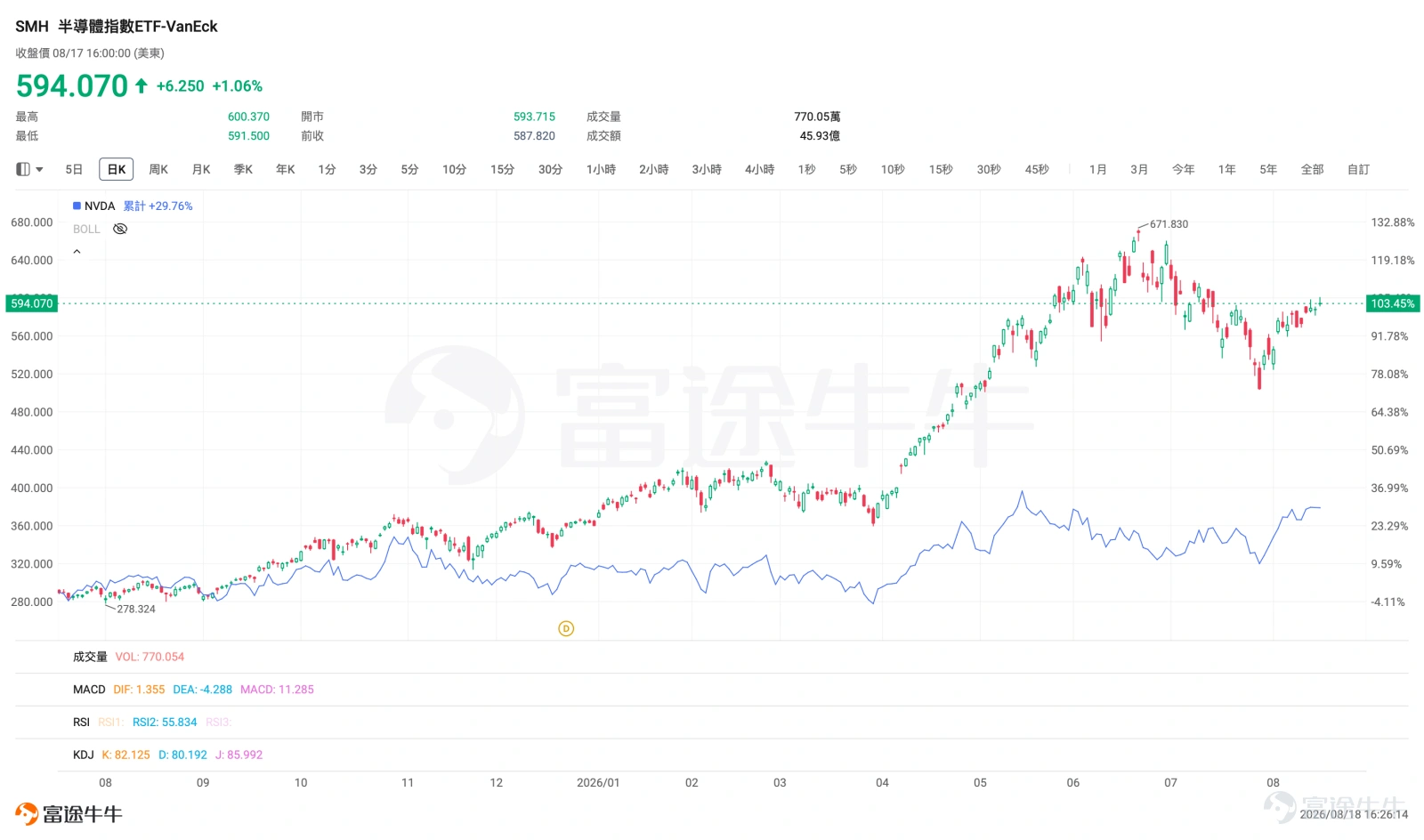
Semiconductor ETF (SMH) vs. NVIDIA (NVDA) Performance
Actually, besides picking individual stocks yourself, there is another simpler way to participate—ETFs.
This is also the key issue we want to clarify in the first installment of the "ETF Investment Guide":What exactly is an ETF? How does buying a "basket of stocks" differ from concentrating on a single stock?
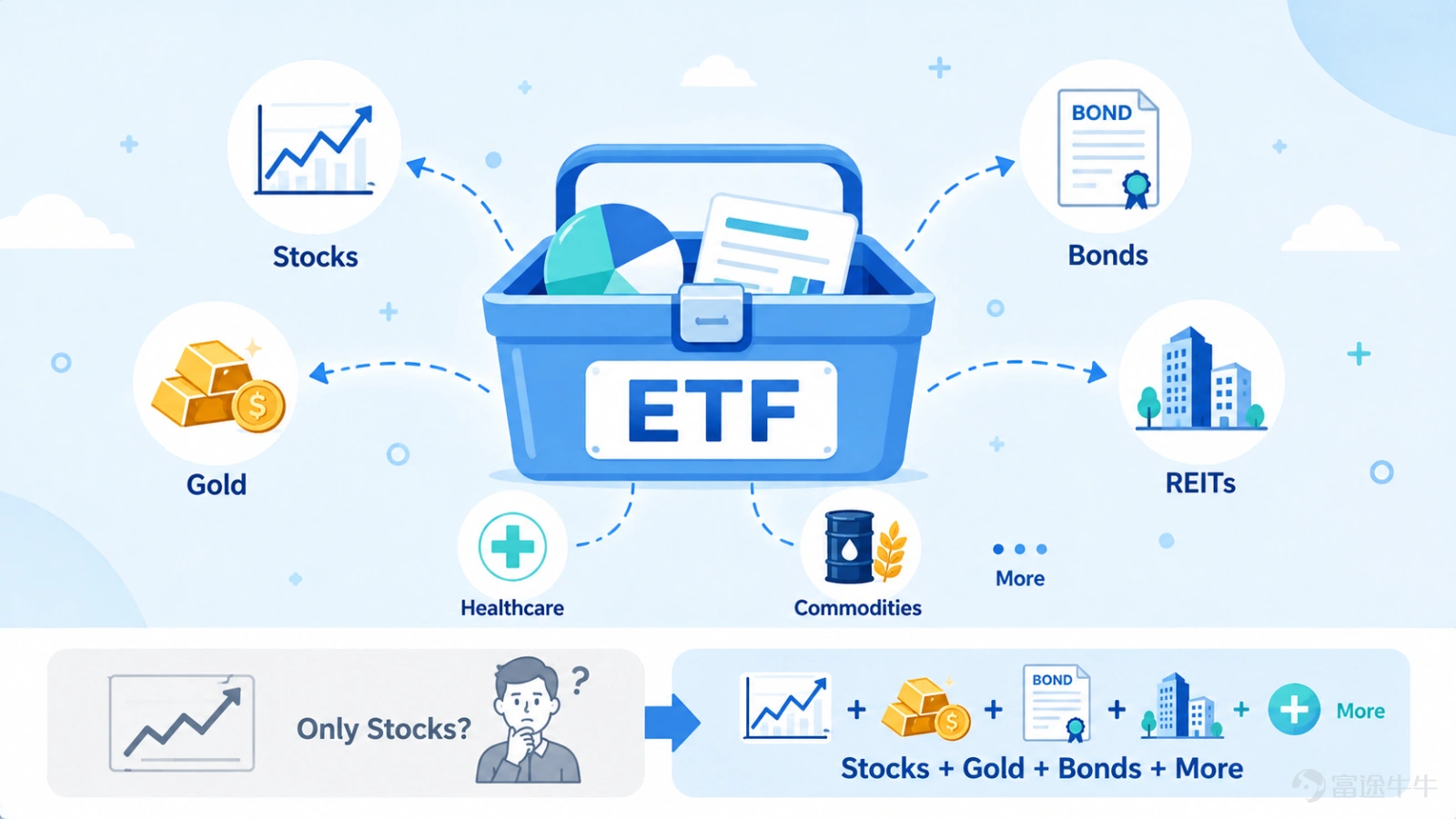
What is an ETF? First, think of it as a "basket of assets."
No need to memorize complex definitions for now.
You can simply understand an ETF as:
Putting many stocks or other assets into a "basket," and then trading the entire basket on an exchange.
ETF stands for Exchange Traded Fund, which meansExchange Traded Fund. Many ETFs track a specific index by holding a basket of related securities, allowing investors to gain exposure to a particular market, industry, or theme through a single transaction.
For example, if you are bullish on semiconductors.
One approach is to research each stock individually:NVDA, AMD, AVGO, TSM, ASML...
But questions quickly arise:
Which company has the greatest potential?
How much should I buy of each stock?
What if you get the industry right but pick the wrong company?
Another approach is to conduct research,Semiconductor ETF。
such as the VanEck Semiconductor ETF (SMH), which is well-known in the market. $VanEck Semiconductor ETF (SMH.US)$ and $iShares Semiconductor ETF (SOXX.US)$ It provides exposure to the industry through a basket of semiconductor-related companies.
In other words, instead of betting on the story of a single company, you are investing ina portfolio representing an entire industry.。
This is the most intuitive value proposition of ETFs:You don't necessarily have to guess the "next top-performing stock"; you can first invest in the markets or industries you are bullish on.
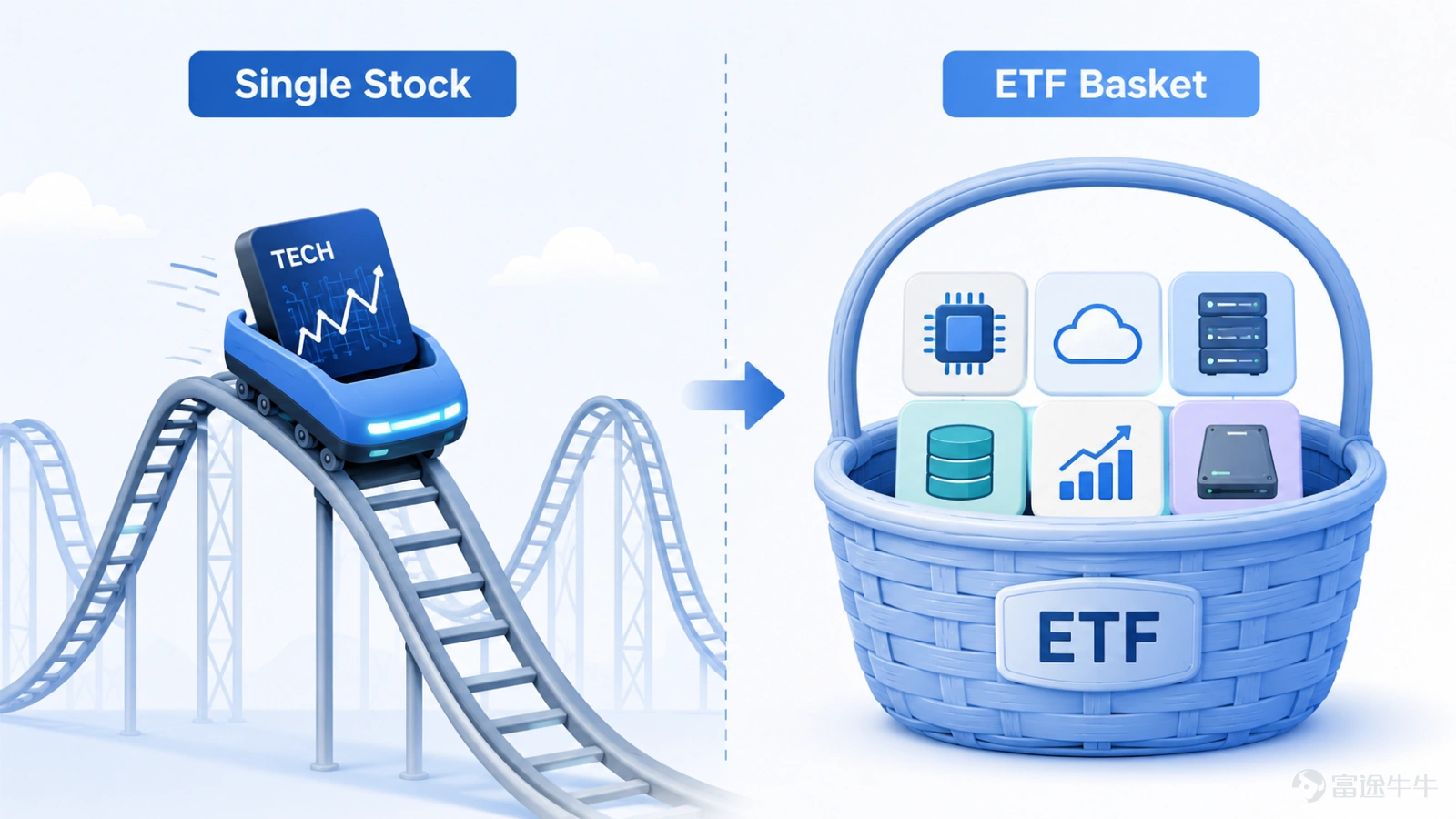
Why is a "basket" approach important for beginners?
BecauseGetting the sector right doesn't guarantee you'll pick the right stock.
Let's take AI as an example.
Suppose you are very bullish on the AI industry's growth over the next few years, so you concentrate your capital in Company A.
Then, when the next earnings report is released, Company A suddenly faces:
– Revenue missing market expectations;
– Delays in new product launches;
– Reduced procurement from major clients;
– Management lowering future guidance.
Even if the entire AI industry continues to grow,Company A's stock price could still plummet.
This is an unavoidable issue when investing in individual stocks—the company-specific risk.
ETFs hold shares of multiple companies, which can mitigate the impact of any single company to some extent.
Let's look at a highly simplified example.
Suppose you have $100 in capital.
If:
You invest the entire $100 in Company A.
If Company A drops by 20%, your $100 would become approximately $80, excluding other factors.
But suppose:
You invest the $100 equally across 10 companies, putting $10 into each.
If Company A drops by 20% while the stock prices of the other nine companies remain unchanged, the direct loss to the overall portfolio from Company A would be approximately $2.
Of course, real-world ETFs do not simply hold equal positions in 10 companies; the constituents and weightings of different ETFs can vary significantly.
This example is merely intended to illustrate a core concept:Diversifying capital across more companies can reduce the risk associated with "betting on a single company."
Scrutinize ETF data for more precise positioning
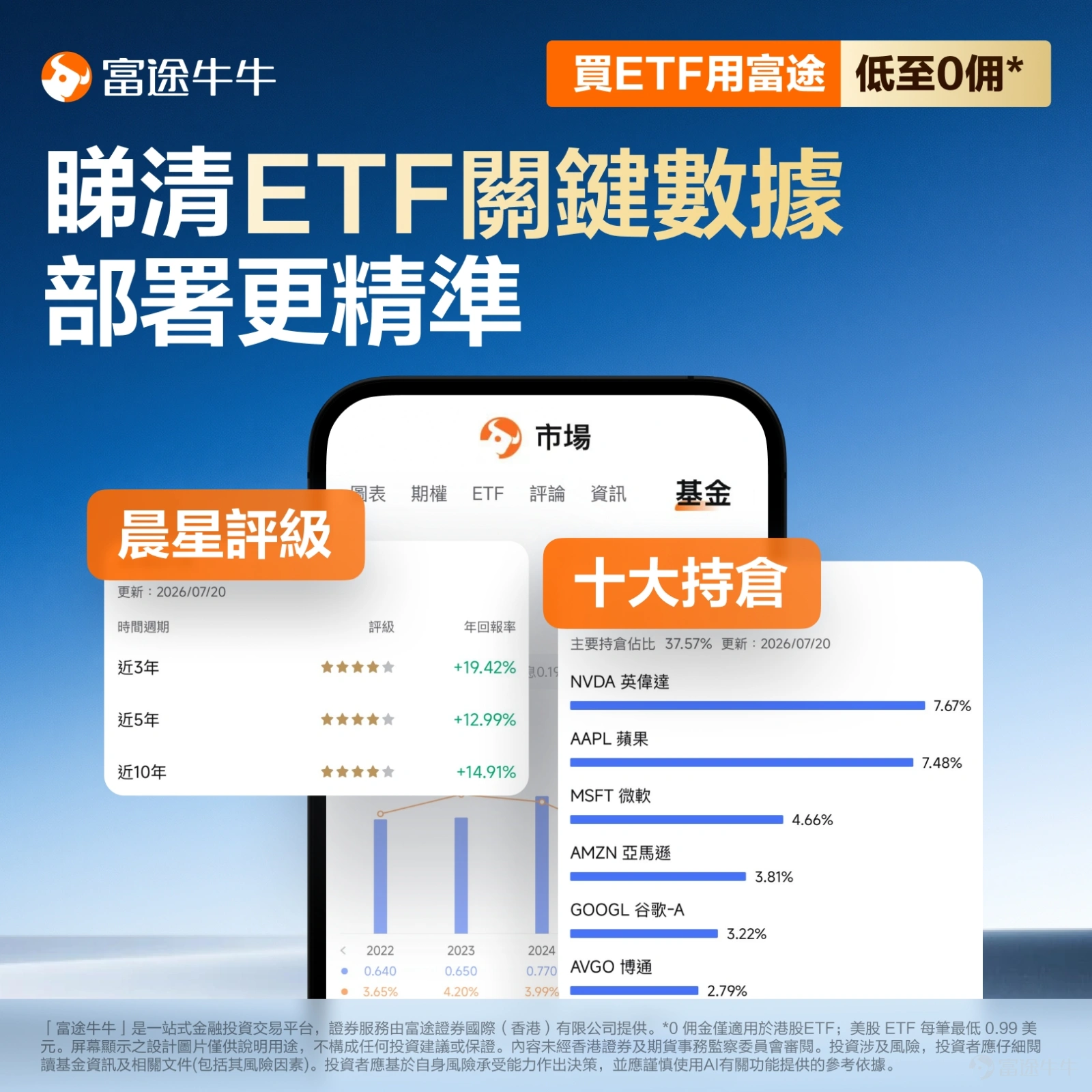
However, take note: ETFs do not guarantee "no losses."
This is the most common misconception when first learning about ETFs.
ETFs can diversify some idiosyncratic stock risks, but they cannot eliminate market risk.
Let's continue with the semiconductor sector as an example.
If only one company's earnings miss expectations while other chip companies perform normally, a basket of holdings indeed has the potential to mitigate the impact of a single stock on the overall portfolio.
But if the market suddenly starts to worry:Is AI investment growth slowing down? Are valuations across the entire chip industry too high, or are global tech stocks entering a broader correction?
In such scenarios, semiconductor companies may decline in unison, and semiconductor ETFs will likely fall as well.
July this year serves as a clear example. At that time, global chip stocks underwent a collective pullback, with the Philadelphia Semiconductor Index dropping more than 20% from its June highs. This reflected that the market was not just trading on issues specific to one company, but rather on valuation, capital expenditure, and position risks across the entire AI and semiconductor sectors.
So, what does a "basket" approach truly help address?
It prevents a single wrong stock pick from having an outsized impact on your entire portfolio.
It does not guarantee principal protection, nor does it necessarily imply low volatility.
ETFs are not limited to just "tech ETFs."
Once you understand the concept of a "basket," ETFs are actually not that complex.
BecauseWhat’s inside the basket essentially determines what you are investing in.
Want to invest in the entire market? Look at broad-market / broad-based ETFs.
If you don't want to guess which sector will be the strongest next, you can start by getting familiar withbroad market or broad-based ETFs。
For example, in the US stock market, representative options $SPDR S&P 500 ETF (SPY.US)$ and $Vanguard S&P 500 ETF (VOO.US)$primarily track the S&P 500 Index, allowing investors to hold a basket of large-cap US listed companies through a single ETF.
Looking at the Hong Kong market, the more familiar option $TRACKER FUND OF HONG KONG (02800.HK)$ aims to track the performance of the Hang Seng Index by holding the corresponding constituent stocks.
Simply put:Instead of guessing which company is the strongest, buy "the entire broad market" first.
Of course, broad market ETFs will also rise and fall with the overall stock market; they are not low-risk or capital-guaranteed products.
Bullish on a specific sector: Sector ETFs
If your view is more specific, such as being bullish on semiconductors, technology, healthcare, or energy, you can further researchSector ETFs。
Take the Select Sector SPDR series under State Street as an example, $The Technology Select Sector SPDR® Fund (XLK.US)$、 $Energy Select Sector SPDR Fund (XLE.US)$ 、 $Financial Select Sector SPDR Fund (XLF.US)$ which provide investment exposure to different sectors of the S&P 500 respectively.
If you believe that demand for AI computing power will remain strong in the coming years, but are unsure which company in the chip supply chain will ultimately come out on top, then looking into semiconductor ETFs is another approach.
However, holdings in sector ETFs are typically more concentrated than those in broad-market ETFs,so volatility can still be significant when the entire sector undergoes a correction.
Bullish on a hot narrative: Thematic ETFs
There are still manythematic ETFs。
They typically do not follow traditional sector classifications such as technology, finance, or energy, but instead select companies围绕围绕 an investment theme.
For example: AI, robotics, cybersecurity, cloud computing, the space economy, etc.
Taking AI as an example, there are already many products on the market:
$Global X Artificial Intelligence & Technology ETF (AIQ.US)$ : Focuses on companies involved in AI technology and related hardware;
$Global X Robotics & Artificial Intelligence Thematic ETF (BOTZ.US)$ : Places greater emphasis on robotics, automation, and AI applications.
This raises a crucial point: even if they all have "AI" in their names, the underlying stocks can be completely different.
Some ETFs lean towards chips and hardware, others towards software, while some hold significant positions in robotics, automation, or other tech companies.
Therefore:Before buying an ETF, you cannot rely solely on its name.
This is also a key focus that will be further broken down in the upcoming "ETF Investment Guide."
Don't just buy individual stocks: ETFs can also invest in other assets
ETFs are not limited to equities.
For example, if you want gold exposure, you can look into $SPDR Gold ETF (GLD.US)$; if you want to research long-term US Treasury bonds, there are also products like $iShares 20+ Year Treasury Bond ETF (TLT.US)$ . GLD primarily tracks the performance of gold prices, while TLT mainly invests in US Treasury bonds with remaining maturities of over 20 years.
The Hong Kong market also has listed $SPDR Gold Trust (02840.HK)$ , allowing investors to gain gold-related exposure through trading on the HKEX.
Therefore, the use of ETFs goes far beyond just "buying tech stocks." They are more like a comprehensive investment toolbox.
When looking at ETFs for the first time, start by focusing on these three areas
If you open the ETF section now and feel overwhelmed by the numerous tickers, unsure where to start, remember that you don't need to analyze all metrics like expense ratios and tracking errors on day one.
Just focus on three key points.
First, check: What exactly does this ETF invest in?
The most straightforward approach is to look atconstituent stocks。
For example, when you see an AI ETF, don't just buy it because the name says "AI."
Take a closer look:
– Who are the top holdings?
– What is NVIDIA's weighting?
– Are there more chip companies or software companies?
– Are there many companies you are completely unfamiliar with?
You will gradually discover:
The ETF name is just the entry point; what truly determines its risk and return profile is what it holds.
Next, look at: Which index does it track?
Most ETFs are backed by an index.
You can simply think of an index as the ETF's set of "stock selection and weighting rules."
Which companies are included, their respective weights, and how often the portfolio is rebalanced all impact the ETF's final performance.
For example, both SPY and VOO primarily track the S&P 500 Index. While SMH and SOXX both invest in semiconductors, their underlying indices and construction methodologies differ, leading to divergent actual performance.
As for exactly how indices, constituents, and weights affect ETF price movements, we will cover that in detail in our next issue.
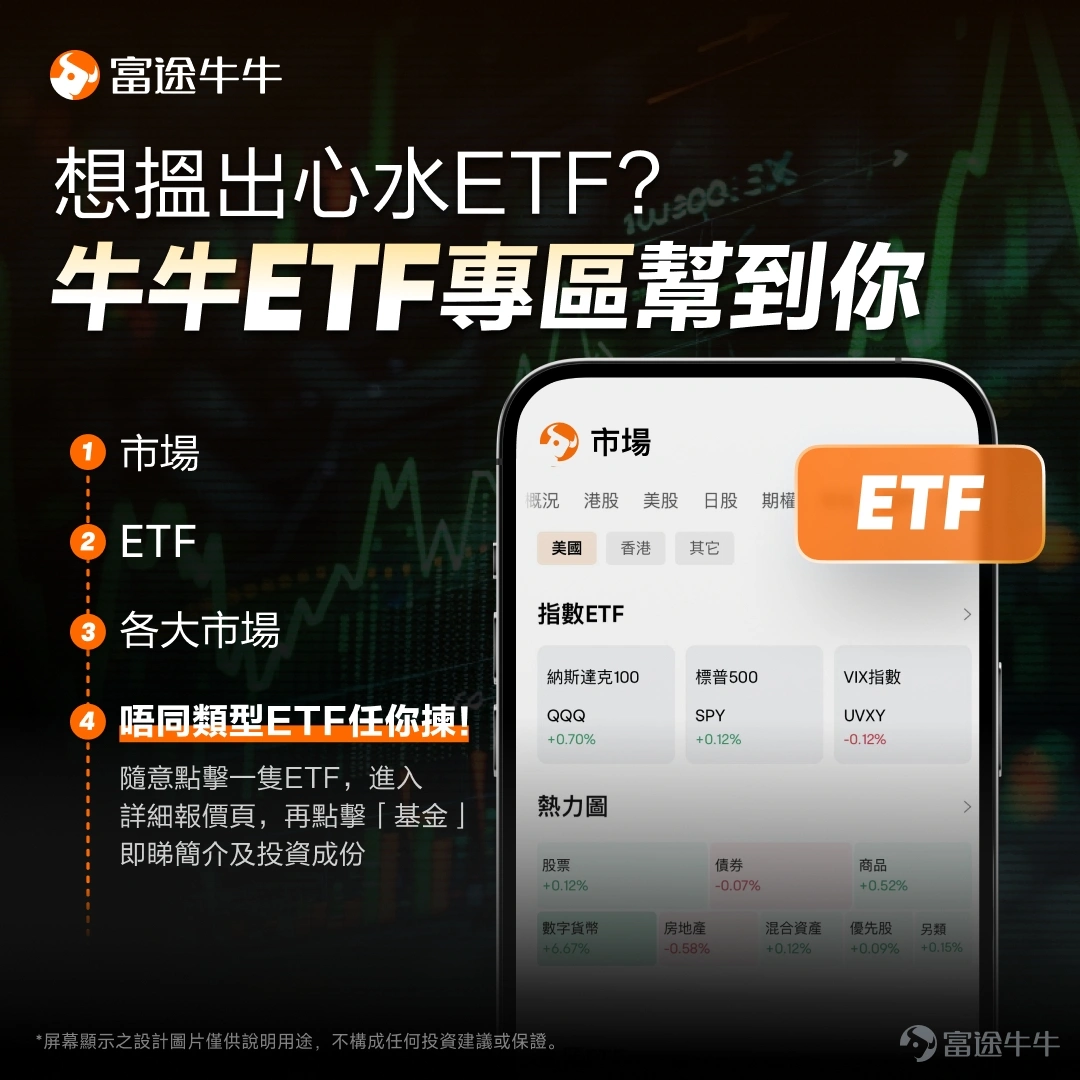
Finally: Start by searching based on your areas of interest.
If you already know what sectors you've been focusing on recently:
AI, semiconductors, technology, gold, healthcare...
You can start by visiting the ETF section to find relevant products based on specific markets, industries, or themes, and then review:
Related ETF → Index Performance → Constituents
For example:
Bullish on the broader US market → SPY, VOO, etc.; bullish on semiconductors → SMH, SOXX, etc.; bullish on the AI theme → AIQ, BOTZ, etc.; interested in researching the Hong Kong market → 2800, etc.
These product examples are merely intended to help everyone understand how different ETFs are categorized,and do not constitute product recommendations. Actual selection requires comparing holdings, concentration, liquidity, fees, and your own risk tolerance.
When your research approach shifts from:
"Which stock is rising the most today?"
Gradually becoming:
"What direction am I actually bullish on? Is there a basket of assets that can express this view?"
you have actually taken an important step toward understanding ETFs.
If you are just starting out in investing, keep this one sentence in mind:
If you are bullish on a specific company, you can research individual stocks; if you are bullish on a market or industry, you can also look for corresponding ETFs.
ETFs hold a basket of securities, which can helpdiversify the risks associated with holding individual stocks, but ETF prices also fluctuate with the market, and investors may lose part or even all of their principal.
In particular, sector and thematic ETFs often have more concentrated holdings than broad-market ETFs, and their volatility may not be low. Before investing, you should understandwhat they actually hold, where the concentrations lie, and whether you can bear the associated risks.
In the next installment of "ETF Investment Guide",we will start by examiningthe index, constituent stocks, and weightingsto see why ETFs both labeled "AI" can ultimately exhibit completely different price trends.
Looking for your favorite ETFs? The Bull ETF Zone is here to help
🎁 The August ETF Challenge is in full swing!Whether you're a novice investor just starting out or a seasoned pro with battle-tested experience, join the ETF Trading Challenge now! Share your ETF trading stories and stand a chance to win points, vouchers, Bullboxer merchandise, and other exciting prizes!Click to join now >>
Risk Disclaimer: The above content only represents the author's view. It does not represent any position or investment advice of Futu. Futu makes no representation or warranty.Read more


Comments (12)
to post a comment
46
46