The Fed raises interest rates for the first time in three years! How will the market react?
US July CPI "lands perfectly": US stocks breathe a sigh of relief, but uncertainties remain
On the evening of August 12, the U.S. Bureau of Labor Statistics released the July CPI data.

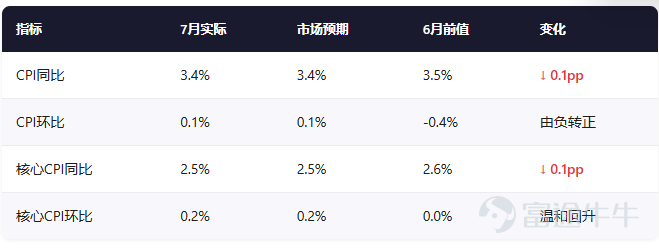
July CPI rose 3.4% year-over-year (previous: 3.5%) and 0.1% month-over-month; core CPI rose 2.5% year-over-year (the lowest since March 2021) and 0.2% month-over-month, all in line with market expectations. Housing costs contributed about two-thirds of the monthly increase, while a 1.5% month-over-month decline in energy was the main drag. The data showed no upside surprises, directly pushing the probability of a Fed rate hike in September down to 33%-40%, while the probability of holding rates steady rose to over 60%. For the market, the significance of this report lies in its "lack of surprises"—it both confirmed the trend of moderate disinflation and bought risk assets a window to catch their breath.
Market Reaction
Following the release of CPI data, the market's most immediate reaction was one of relief. Prior to this, expectations for a Federal Reserve rate hike in September were evenly split and deadlocked; this unsurprising data caused rate hike expectations to recede rapidly.
The three major US stock indices showed mixed performance but remained generally strong: the Nasdaq Composite rose 0.54% to close at 26,588.49, hitting a near one-month high; the S&P 500 gained 0.26% to 7,748.50, approaching record highs; the Dow Jones Industrial Average slipped slightly by 0.04% to 53,770.27, marking its third consecutive daily decline, reflecting a divergence between traditional value stocks and growth-oriented tech stocks.
AI computing power, memory chips, and optical communications surged collectively, while traditional tech giants and Chinese concept stocks faced broad pressure. Capital is engaging in a new round of structural repricing centered on AI infrastructure hardware.

Computing Power CloudNEBIUS: Q2 cloud revenue soared 514% year-over-year, sending the stock up 34%; CoreWeave reported revenue of $2.58 billion (+112% YoY) with a backlog of approximately $104 billion, rising 19%; Super Micro Computer provided next-quarter guidance significantly above expectations, projecting FY2027 revenue of $65–72 billion, up 19%.
Memory chipsSK Hynix rose 9%, Seagate Technology climbed 7%, and Micron Technology gained 5%, as the HBM cycle continues to recover.
Optical CommunicationsLumentum's results beat estimates across the board, jumping 13.6% and driving Coherent up 8% and Corning up 5%. The Philadelphia Semiconductor Index closed up 2.49%, with 25 of its 30 components advancing. In contrast, the Golden Dragon China Index fell 2.37% and Microsoft dropped 2%, highlighting a clear divergence.
Future Trend: Short-term strength, but variables remain reversible
Bullish supports:Expectations for rate hikes continue to fade; if August CPI remains moderate, discussions about rate cuts may even begin. The AI earnings season provides structural support, and the infrastructure investment cycle is still accelerating. The VIX has dropped to an intra-year low of around 14, indicating extremely optimistic market sentiment. If CTA trend funds shift from shorting bonds to going long, it could trigger a positive feedback loop of 'falling yields -> covering shorts -> further yield declines,' which would be bullish for risk assets.
Three Major Risks:First, the Strait of Hormuz remains closed, pushing Brent crude near $90, with a gain of over 16% in the past month. If oil prices break through $100, it could force the Federal Reserve to adopt more aggressive measures. Second, inflation remains well above the 2% target; core services (excluding housing) have rebounded, and housing stickiness has not been fundamentally resolved. Third, there are two key data releases before the September FOMC meeting: August CPI and August non-farm payrolls. Any surprises could reshape policy expectations.
Overall, the market is likely to remain moderately strong in the short term (1-2 weeks), with AI hardware continuing as the structural main theme. However, the data window before the September 16 FOMC meeting is decisive. If data continues to show moderation, a hold decision is virtually certain, which could push the market higher. Conversely, if oil prices breach key levels, the current bullish logic could be overturned. Investors should prepare for both scenarios.
Content Disclosure: Personal opinion
Risk Disclaimer: The above content only represents the author's view. It does not represent any position or investment advice of Futu. Futu makes no representation or warranty.Read more


Comments
to post a comment
2