The Fed raises interest rates for the first time in three years! How will the market react?

July's nonfarm payrolls data came in shockingly weak 🥶—will it jolt the markets?
I. Core Highlights of the Nonfarm Payrolls Report
On August 7, the U.S. Bureau of Labor Statistics released the July nonfarm payrolls report. The data overall showed a rare 'mixed cold-hot' divergence: employment change unexpectedly turned negative, falling far below even the market’s most pessimistic expectations.

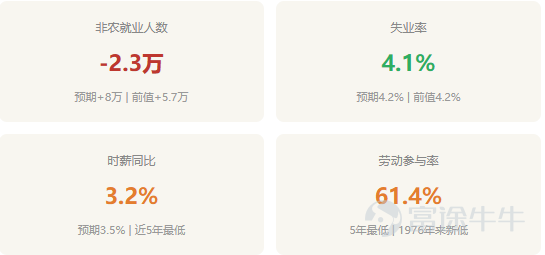
July nonfarm payroll employmentwith a decline of 23,000 jobs, significantly below the market expectation of +80,000 and marking the first monthly decline this year. Combined revisions for May and Junedownwardly revised by 103,000 jobs(May revised from 129,000 to 63,000; June revised from 57,000 to 20,000), indicating labor market weakness began earlier than headline figures suggested. Although the unemployment rate declined to 4.1%, this was due to 264,000 people exiting the labor force. The labor force participation rate dropped to 61.4%, the lowest since 1976, reflecting deterioration rather than improvement in employment conditions. Year-over-year wage growth of 3.2% is the lowest in nearly five years and no longer outpaces inflation. By sector, local government education payrolls fell by 50,000, retail by 19,000, and finance by 14,000, while only healthcare added 22,000 jobs.
II. U.S. Equity Market Reaction
All three major indices closed higher, posting their largest weekly gains since mid-April: Nasdaq +1.30%, S&P 500 +0.62% (reaching a record closing high), Dow Jones Industrial Average +0.28%.
The optical communications sector led gains, while memory and semiconductor stocks broadly rose.

The US Dollar Index declined, gold and silver prices rose, and US Treasury yields moved lower.

III. Shifts in Federal Reserve Rate Hike Expectations
According to CME data, the probability of a 25-basis-point rate hike in September plunged from 55% to 44%, while the likelihood of holding rates steady rose to 56%. The expected hike by December decreased from 32 basis points to 28 basis points, and the first meeting with a 100% probability of a rate hike was pushed back from October to December.
IV. Diverging Institutional Forecasts
Goldman Sachs(Dovish view): Inflation data has become more critical than employment figures; no further rate hikes may occur this year. Oil prices could fall below $70 by year-end, and AI-driven productivity gains are expected to ease long-term inflationary pressures. Recommendation: "Stay invested."Bank of America(Leaning hawkish): Maintains the forecast of a cumulative 75 basis point rate hike starting from September; July CPI is a more critical signal.Loretta J. Mester, Federal Reserve Bank of Cleveland(Hawkish): Current interest rates are not yet meaningfully restrictive; multiple rate hikes are needed to bring inflation down.Oxford Economics(Neutral): The recent employment decline was primarily driven by seasonal government-related distortions, not a sign of recession.
V. Outlook and Forecasts
In the near term, this week’s July CPI data is the key focal point. If inflation continues to ease, equities will likely benefit further; if inflation comes in higher than expected, markets may face short-term correction pressure.
Looking ahead to the medium term, the September FOMC meeting is critical. If the Fed holds rates steady in September, U.S. equities could see short-term gains on confirmation of a dovish stance, though inflation trends will need monitoring. If the Fed hikes by 25 basis points in September, tech valuations may face downward pressure, though economic resilience could limit the extent of declines.
For the medium to long term, three key themes emerge: First, whether inflation is genuinely cooling—was June’s moderation a one-off or the start of a sustained downtrend? This will dictate the Fed’s next move. Persistent disinflation would reduce rate hike expectations and provide stronger support for risk assets. Second, whether AI-driven productivity gains can alleviate inflationary pressures. In the short run, AI infrastructure investment consumes substantial capital and energy, potentially adding to inflation. However, once infrastructure matures, AI-enabled productivity improvements could allow firms to generate more output without significantly raising costs, offering structural economic support. Third, economic resilience and corporate earnings—the Atlanta Fed’s GDPNow model has revised its Q3 GDP forecast upward from 5.0% to 5.8%. Despite headwinds including high rates, Middle East tensions, and rising energy prices, nominal U.S. economic growth continues to show notable resilience. Corporate earnings remain the fundamental anchor for markets over the medium to long term.
VI. Summary
A weaker-than-expected jobs report has fueled expectations for rate cuts, giving U.S. equities a short-term window for recovery. However, the medium- to long-term outlook is unlikely to be a one-way rally; future performance hinges on inflation data, geopolitical developments, and the Fed’s policy decision in September. Institutional views remain sharply split between hawkish and dovish camps, leaving market direction unclear.
Content Disclosure: Personal opinion
Risk Disclaimer: The above content only represents the author's view. It does not represent any position or investment advice of Futu. Futu makes no representation or warranty.Read more

Comments
to post a comment
4