The Fed raises interest rates for the first time in three years! How will the market react?

July nonfarm payrolls posted negative growth, significantly easing near-term rate hike risks; inflation remains the key focus
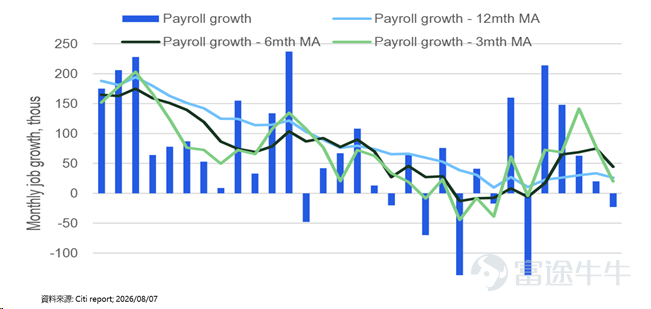
Last Friday (August 7), the U.S. released its July nonfarm payrolls report, showing a decline of 23,000 jobs—far below expectations—and downward revisions of 103,000 combined for May and June. The three-month average job gain has been only about 20,000. Hourly earnings rose just 0.1% month-over-month, and the year-over-year rate fell from 3.4% to 3.15%, indicating continued deceleration in wage growth momentum. Although the unemployment rate dipped to 4.1%, this was primarily due to a decline in labor force participation.
Analysis: Weaker employment eases near-term rate hike pressure, but inflation remains the true focal point
Structurally, this weak jobs report does not reflect a broad-based deterioration:
– Weakness was concentrated mainly in local government education services (−50,000, partly influenced by seasonal factors) and leisure & hospitality (−40,000, possibly suppressed by high oil prices dampening travel demand).
– Private-sector employment actually increased by 30,000, with construction (+22,000), professional and business services (+18,000), and healthcare (+22,000) still posting gains.
– The drop in the unemployment rate stemmed largely from reduced labor supply, consistent with a 'labor supply shock' rather than a sharp collapse in demand.
Among these indicators, the hourly earnings data sent the clearest dovish signal. Further slowing in wage growth suggests that even amid constrained labor supply, there is currently no significant pass-through into cost-push inflationary pressure. This further reduces the urgency for the Fed to hike rates in the near term. Additionally:
– Only one more jobs report will be released before September; barring a substantial upward revision, it will be difficult to justify a Fed rate hike amid an average monthly job gain of just 20,000.
– The Fed’s October meeting falls just one week before the U.S. midterm elections, making a rate hike politically more challenging. Consequently, market pricing for a rate hike before October—which had been relatively high—has significantly diminished, and the most likely timing for the next hike has shifted toward December.
However, inflation remains the true key. The Federal Reserve is currently more focused on prices than employment, and the July Consumer Price Index (CPI), due for release this week (August 12), will be the core variable determining the policy path.

Monthly change in nonfarm payrolls (in thousands)
Investment strategy view: Use a short-duration strategy as a common framework to effectively contain interest rate risk.
In an environment of heightened uncertainty around the interest rate path, we continue to use a short-duration strategy as the common framework to effectively contain interest rate risk:
– Core: Maintain money market funds and short-duration, high-quality investment-grade bond strategies to lock in relatively certain yields while reducing exposure to interest rate volatility.
– Credit allocation: Continue with a selective credit approach—allocating over 70% to high-quality investment-grade (IG) and short-duration assets as the defensive component; the remainder, under controlled risk parameters, may be allocated to credits with sound fundamentals and room for spread tightening as the opportunistic component (particularly high-quality Asian credits) to enhance portfolio risk-adjusted returns.
– Avoid: Excessively extending duration (to mitigate interest rate risk) or concentrating exposure in highly valued growth assets (e.g., AI-related names, which have recently experienced heightened volatility).
$Taikang Kaitai Hong Kong Dollar Money Market Fund (HK0000772993.MF)$$Taikang Kaitai Overseas Short Tenor Bond Fund (HK0000369196.MF)$$Taikang Kaitai Overseas Short Tenor Bond Fund (HK0000369188.MF)$$Taikang Kaitai Monthly Stable Income Fund (HK0000965977.MF)$$Taikang Kaitai Monthly Stable Income Fund (HK0000965993.MF)$$Taikang Kaitai US Dollar Money Market Fund (HK0000857273.MF)$
Disclaimer
Unless otherwise stated, all information contained herein is as of the date of publication.
The foregoing content is provided for reference purposes only and is intended for general informational use by clients of Taikang Asset Management (Hong Kong) Company Limited ("Taikang Hong Kong"). It does not take into account the specific investment objectives, financial situation, or particular needs of any individual recipient and should not be construed as investment advice, an offer, or a solicitation to buy or sell any investment product.
Any research or analysis used in preparing this document was obtained by Taikang Hong Kong for its own purposes from sources believed to be reliable as of the date hereof; however, no representation or warranty, express or implied, is made regarding the accuracy or completeness of third-party data.
Any projections or other forward-looking statements regarding future events or performance are not necessarily indicative and may differ materially from actual events or outcomes. Any opinions, estimates, or forecasts are subject to change at any time without prior notice. Taikang Hong Kong shall not be liable for any losses arising from the use of this document.
The views, recommendations, suggestions, and opinions expressed in this document do not necessarily reflect the position of Taikang Hong Kong and may be changed at any time without notice. Taikang Hong Kong is under no obligation to provide updates to any such information or opinions.
This document may not be reproduced, distributed, or transmitted to any person without the prior written consent of Taikang Hong Kong. This document and the information contained herein must not be distributed or published in any jurisdiction where such distribution or publication is prohibited. If you are not the intended recipient of this document, please discontinue reading immediately and destroy it forthwith.
Investing involves risk. Past performance is not an indicator of future results.
This document is issued by Taikang Hong Kong and has not been reviewed by the Securities and Futures Commission. You should consult your investment adviser before making any investment decision.
Risk Disclaimer: The above content only represents the author's view. It does not represent any position or investment advice of Futu. Futu makes no representation or warranty.Read more


Comments
to post a comment
9